Clocks · Wall clock
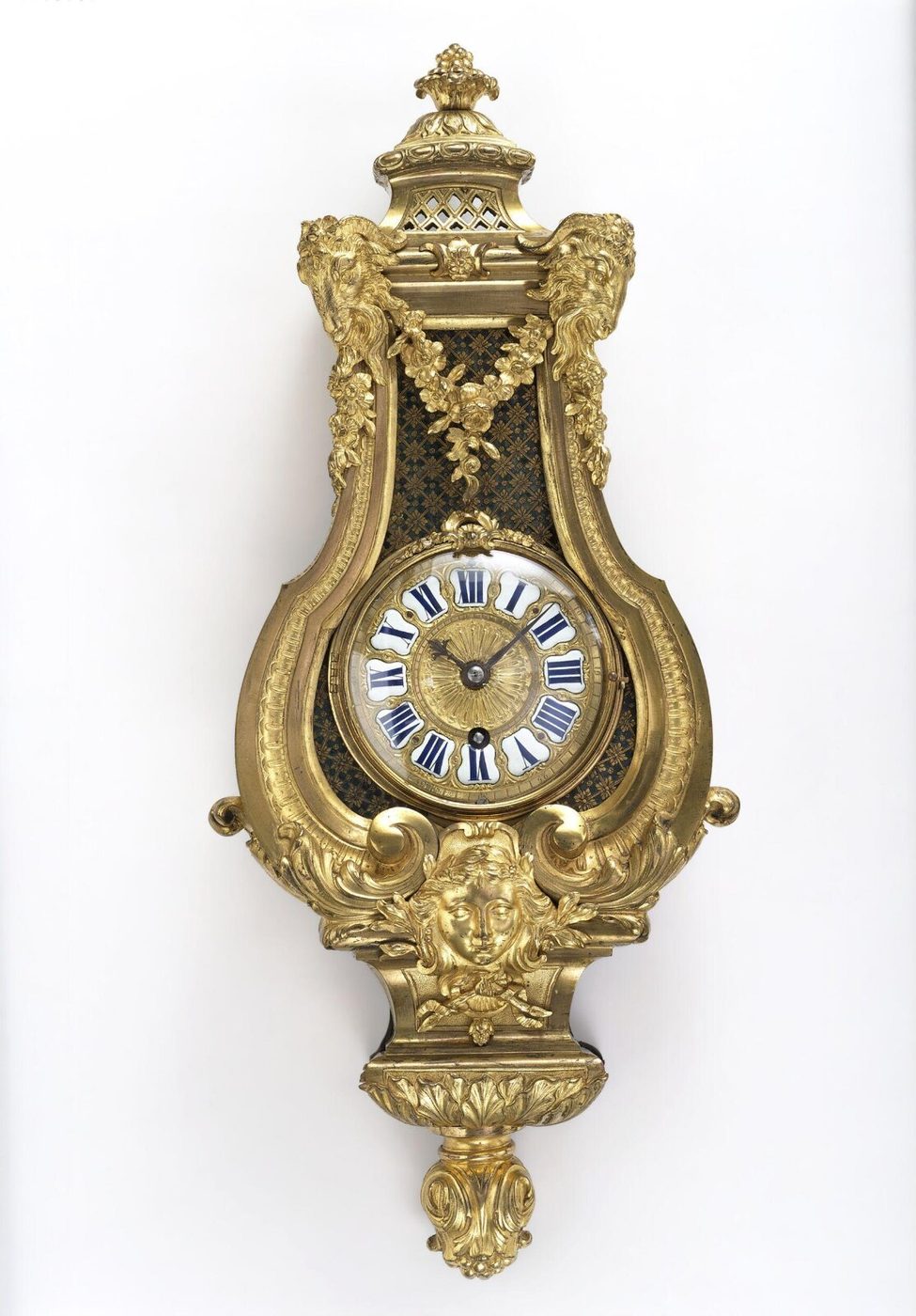
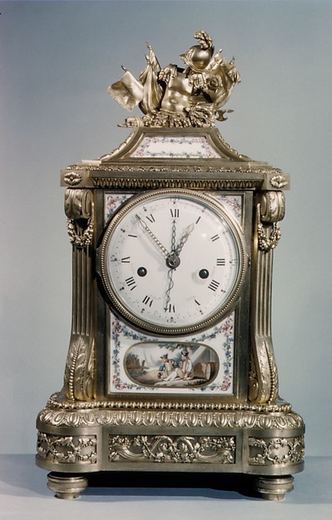
'Pendule d'alcove' wall clock, gilt-bronze and boulle marquetry, Paris, 1760-1860
- Maker / attribution
- Louis Mynuel (clockmaker)
- Date
- 1760–1860
- Historical period
- Precision & Scientific Horology (1750 – 1850)
- Country of origin
- France
- Place
- Paris
- Object type
- Wall clock
- Materials / technique
- Gilt-brass and boulle marquetry gilt- brass and blue-stained horn, enamelled dial
- Dimensions
- Height: 67.8 cm; Width: 28.5 cm; Depth: 14 cm; Diameter: 14 cm (brass dial)
- Holding institution
- Victoria and Albert Museum, London
- Accession / object no.
- 130-1865
Record summary
Held and catalogued by Victoria and Albert Museum, London (object number 130-1865), this is a wall clock by Louis Mynuel, made in Paris, France, dated 1760–1860. The Atlas places it in the Precision & Scientific Horology period (1750 – 1850) of its Clocks collection. Materials and techniques recorded by the source: Gilt-brass and boulle marquetry gilt- brass and blue-stained horn, enamelled dial. Recorded dimensions: Height: 67.8 cm; Width: 28.5 cm; Depth: 14 cm; Diameter: 14 cm (brass dial). The record is illustrated with 4 photographs.
Assembled from the source record's structured fields. Dates and attributions are given as the source states them; where a field is missing the Atlas leaves it blank rather than estimating.
Catalogue description
V&A — Summary
A wall clock for display in a bed alcove with a repeater mechanism for striking the nearest hour on demand using strings pulled from below through two holes pierced on each side. They activated a chime so the owner could hear the time when the room was dark. The clock is in the form of a lyre, a musical instrument associated with Apollo and symbolic of the reign of Louis XIV of France, the 'Sun King'. The movement was made by Louis Mynuel appointed Royal Clockmaker to Louis XIV in 1705; the case is attributed to André-Charles Boulle but it is probable that the movement and case are a later marriage. A clock was a collaborative production, probably assembled in Boulle's workshop. The clockmaker produced the movements; a sculptor designed the model for the case, a bronze caster produced the mounts, which were finisheded by a specialist chaser and gilder. An enameler would paint and fire the enamel numbers on the dial, each of which was inserted individually.
V&A — Physical description
Case: A gilt-brass lyre-shaped case with acanthus floral finial; the upper section mounted with two rams' heads supporting festoons of flowers; the lower section adorned with a female mask; the space around the dial is filled with marquetry of gilt-brass and blue-stained horn. The lyre rests on a straight bracket with foliate decoration and acanthus drop. Dial: The brass dial has an engraved outer minute ring, the minute marks replaced by small arabic numerals every 5. The hours marked by inset plaques of white enamel with roman numerals in blue; there are applied cast decorations around the plaques and in the centre of the dial. A ring of quarter-hour marks is engraved within the hour plaques. Simple winding hole pierces the upper part of VI. There is a regulator hole between XII plaque and 60 mark. Steel hands. Movement: rectangular movement plates with bottom corners of backplate cut away, partly interrupting the signature 'Mynuel AParis'. Central going barrel, with going train in left half of movement; anchor-type escapement; with escape wheel of 38T and pallets embracing 5 teeth. Pendulum missing. Now with Brocot-type regulator (invented 1840) the top wheel stamped 'BROCOT PROPTE' Ting-tang full hour and quarter-repeating train in right-hand half of movement. Bell hammers missing. Key missing (These notes compiled by Dr Ward of the Science Museum) Striking Train: This is the old French design of repeat strike in beautiful condition. The system is on three bells probably E A C notes. On pulling the strike chord The last hour strikes on E During the 1st Quarter there is no strike During the 2nd Quarter 1 on A During the 3rd Quarter 1 on A; 1 on C During the 4th Quarter 1 on A; I on C; I on A The four positions of the Quarter Strike setting rack enabled Mynuel to give Quarter Strikes as follows During the 1st Quarter 1 on A During the 2nd Quarter 1 on A, I on C During the 3rd Quarter 1 on A; 1 on C; 1 on A During the 4th Quarter 1 on A; 1 on C; 1 on A; I on C In this particular movement, Mynuel did not put in the strike actuating lever for the final '1 on C' in the 4th Quarter and so the strike for the Quarters was planned according to the first option. (The notes on the Striking Train were made by A.J.Munro 28 July 1966
V&A — Object history
Clock received in 1865 from Mr Whitehead; Duke Clemence inheritance (see Max Tillman)
V&A — Production note
Louis Mynuel became marchand-horloger privilégié du roi suivant la cour (privileged merchant clockmaker attendant upon the court and counsels of his majesty) on 19th May 1705 on the resignation of Florimond Riollet. Born in Dieppe, son of Jacques, merchant goldsmith. One of the most important clock makers of his time for both the excellence of his movements and his prestigious clientele. He made the movement of the Apollo chariot clock, which belonged to the princes de Condé. His work was also acquired by the courts of Parma and Sweden. Mynuel made clocks for cases supplied by Andre Charles Boulle. Such a reputation created a market for copies and fakes. Parts of the case are from different periods; the rams' head masks date from the 1760s; the other sections are probably 19th century reproductions although the central mask and finial are of good quality. In an early 18th century clock, the movement would have been contained within a polished back. This clock was made in the period 1830-1860 with the intent to deceive. The central dial does not fit the case. The surface chasing is too precise and busy for early 18th century work.
V&A gallery label
WALL CLOCK ( Cartel ) Gilt-bronze and boulle marquetry PARIS, about 1710-20 130-1865 This is a pendule d'alcove , a clock for placing above the bed. It has a repeater mechanism to avoid disturbing the sleeper. The nearest hour is struck when strings are pulled. They formerly hung down from the holes on either side of the case. This is an early example of a case made almost entirely of gilt-bronze. The lyre form, with the female mask and the diaper-work marquetry panel of blue-stained horn and brass are characteristic of the Régence style. The clock maker (horloger) Louis Mynuel was granted a royal appointment in 1705. He is known to have made movements for clock cases by Boulle and this example may be one of them.
Inscriptions & marks
Mynuel AParis
Historical context
Precision & Scientific Horology (1750 – 1850)
Harrison solves longitude; Mudge invents the lever; Breguet's Paris workshop defines the modern watch.
The age of the deadbeat escapement, compensated pendulums and observatory regulators. Domestic clocks spread through the middle classes: English longcase and bracket clocks, French gilt-bronze mantel clocks, Viennese Biedermeier wall clocks, Black Forest painted-shield clocks, and the first American shelf clocks.
Read the period in the timelineMore clocks from this periodEarlier: Early Modern Horology
Atlas type guide
Regulators, wall and Vienna clocks
A regulator is a precision pendulum clock used as a time standard in observatories, workshops and railway offices. Typical features are a deadbeat or Graham escapement, a temperature-compensated pendulum (mercury jar, gridiron or later invar), maintaining power and a regulator dial that separates hours, minutes and seconds. George Graham's deadbeat escapement (c. 1715) and his mercury pendulum, together with Harrison's gridiron, set the pattern for two centuries.
Wall clocks span a much wider range: the elegant Viennese Laterndluhr and Dachluhr of the Biedermeier period, the Dutch stoelklok and staartklok, English 'dial' clocks used in schools, offices and railway stations, and mass-produced spring and weight wall clocks from Germany (Gustav Becker, Junghans, Kienzle) and America.
What to look for
- Deadbeat escapement and compensated pendulum (gridiron rods, mercury jar or wood rod).
- A regulator dial with a large central minute hand and separate hour and seconds dials.
- Vienna regulators: glazed cases, slender pendulum, small weights, enamel two-piece dials.
- German factory trademarks stamped on the backplate (e.g. Gustav Becker anchor and crown, Junghans star).
Dating clues
- Graham-type deadbeat regulators: from c. 1720.
- Viennese Laterndluhr: c. 1800–1850.
- German factory 'Vienna-style' regulators: c. 1870–1930; Gustav Becker serial numbers allow close dating.
General guidance written by the Atlas editors about this kind of object. It is not a statement about this particular piece; for that, rely on the source record above and on physical examination.
Related records
Clocks · 1723–1811
Table clock by Louis Montjoye, France, 1723–1811
Badisches Landesmuseum Karlsruhe
Clocks · 1738–1814
Table clock by Jean Simon Bourdier, France, 1738–1814
Badisches Landesmuseum Karlsruhe
Clocks · 1750-1800
Bracket clock in metal case with scroll handles and flamed-shaped top signed by Pierre Seignoret, Clockmaket to the the Comte d'Artois
Victoria and Albert Museum, London
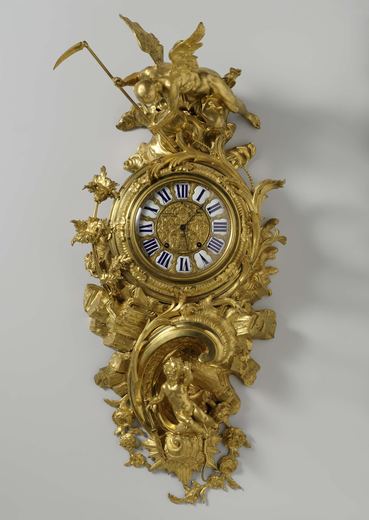
Clocks · 1756
Mantel clock, France, 1756
Rijksmuseum
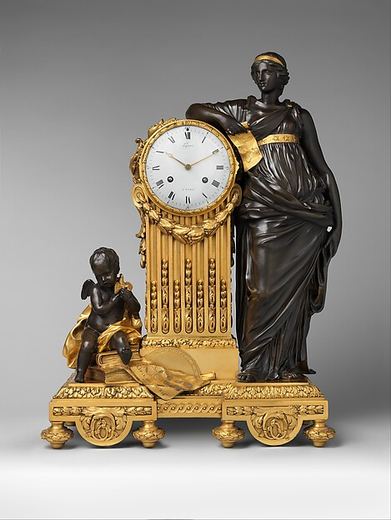
Clocks · ca. 1764–70
Mantel clock by Jean-André Lepaute, France, ca. 1764–70
The Metropolitan Museum of Art, New York
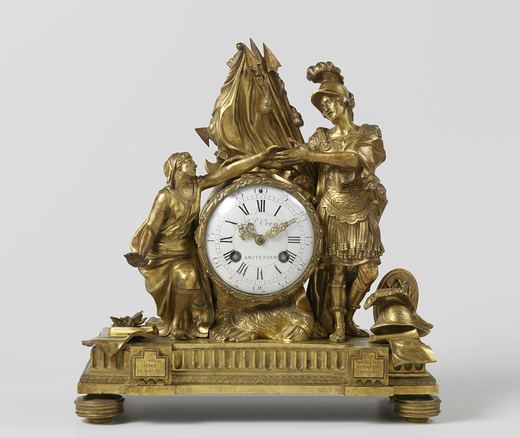
Clocks · 1760
Mantel clock, France, 1760
Rijksmuseum
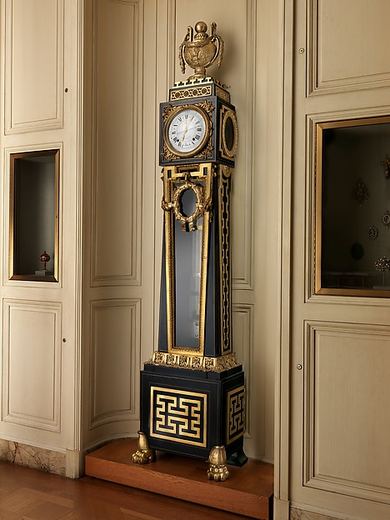
Clocks · ca. 1768–70
Longcase astronomical regulator by Ferdinand Berthoud, France, ca. 1768–70
The Metropolitan Museum of Art, New York
Clocks · ca. 1775
Clock by Porcelain plaques by Sèvres Manufactory, France, ca. 1775
The Metropolitan Museum of Art, New York