
Clocks · Astronomical regulator
Astronomical regulator by John Shelton
- Maker / attribution
- John Shelton (maker)
- Date
- c. 1769
- Historical period
- Precision & Scientific Horology (1750 – 1850)
- Country of origin
- Unrecorded in source
- Object type
- Astronomical regulator
- Dimensions
- Overall: 1815 x 435 x 245 mm
- Holding institution
- Royal Museums Greenwich
- Accession / object no.
- ZBA1765
- Credit line
- National Maritime Museum, Greenwich, London
- Catalogue title (original)
- Astronomical regulator (English)
View the source record ↗ (opens another website in a new tab)Suggest a correction
Record summary
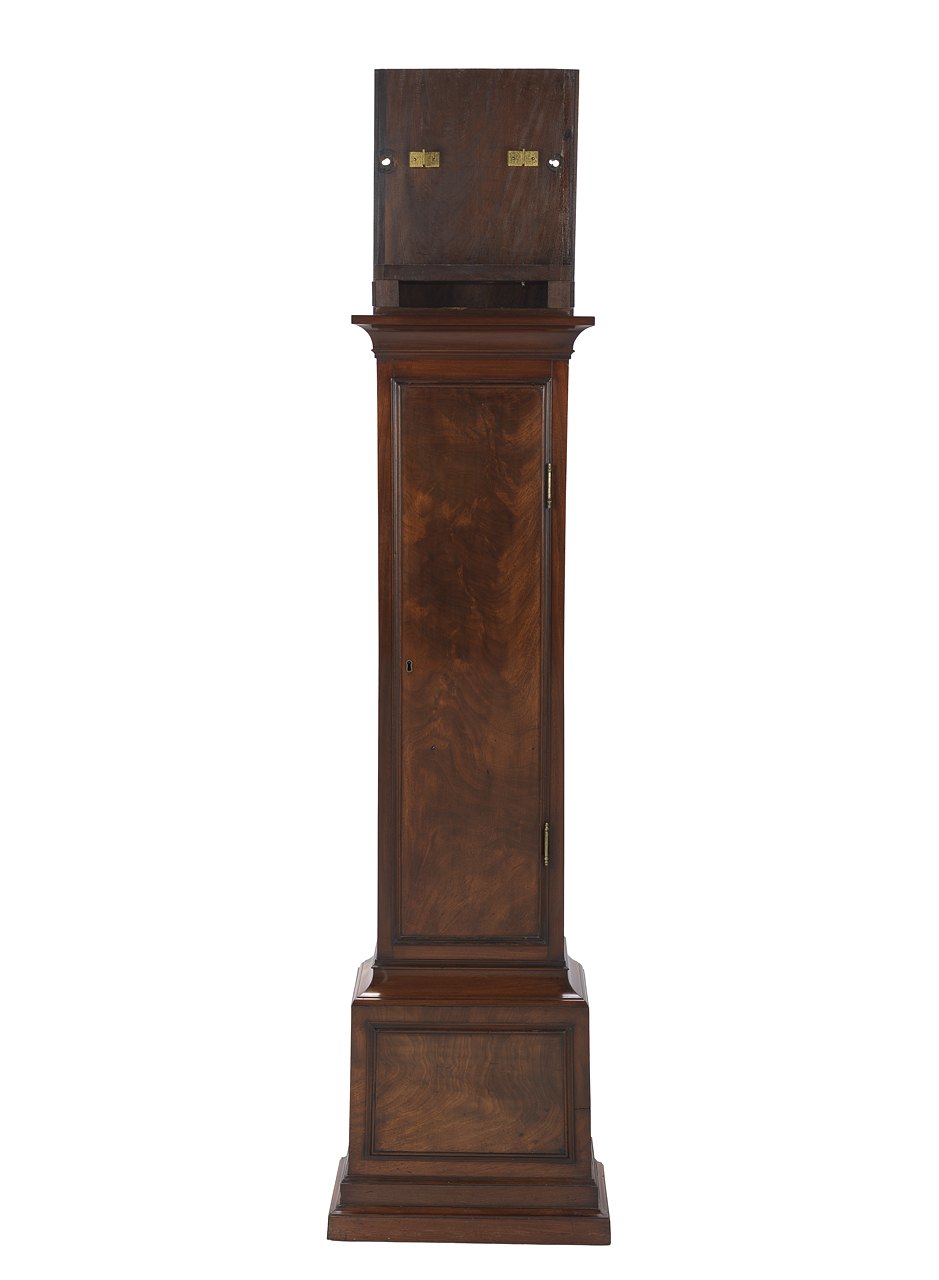
Held and catalogued by Royal Museums Greenwich (object number ZBA1765), this is an astronomical regulator by John Shelton, dated c. 1769. The Atlas places it in the Precision & Scientific Horology period (1750 – 1850) of its Clocks collection. Recorded dimensions: Overall: 1815 x 435 x 245 mm. The record is illustrated with 6 photographs.
Assembled from the source record's structured fields. Dates and attributions are given as the source states them; where a field is missing the Atlas leaves it blank rather than estimating.
Catalogue description
Catalogue description — Royal Museums Greenwich
A one-month duration mahogany longcase regulator by John Shelton, London, circa 1769. The movement is of typical Graham/Shelton form with chamfered corners to the tall plates which are united by six latched knopped pillars. The five wheel train is driven by a brass cased cylindrical lead weight suspended on a brass pulley with double line to the going barrel (17 turns). The train wheels all have four curved crossings except for the fine brass escape wheel which has six straight crossings and is triple screwed to a short brass collet. The movement is fitted with vertically pivoted stop work, bolt and shutter maintaining power and Graham type long shank steel pallets fitted with ruby nibs. The backplate is fitted with two screwed end plates, the uppermost plate is inscribed 'The pendulum spring & escapement by John R. Arnold . Anno 1816'. The top of the crutch is fitted with two hand screws for beat adjustment with a pin engaging into a slot within the grid-iron pendulum which runs against a silvered beat scale reading 0-2.5 degrees. The ten and one quarter inch signed silvered regulator dial has an outer minute circle with arabic five-minute marks enclosed by an outer scribe line and inner track, the similarly laid out subsidiary seconds dial has bold observatory marks. The hours are engraved upon a revolving silvered ring mounted to the hour wheel by a push fit frictional collet, visible through an upturned lunette. Both hands are constructed from blued steel; the seconds hand is counterpoised and the finely sculpted minute hand is counterpoised by a semi solid minute wheel and cannon pinion (under the dial). The well figured mahogany veneer is laid onto a mahogany carcass. The case has a flat hood with moulded cornice over rounded corners, moulded sided panels and glazed door. The trunk has a concave throat moulding with moulded rectangular door and stands upon a panelled base with double plinth.
Historical context
Precision & Scientific Horology (1750 – 1850)
Harrison solves longitude; Mudge invents the lever; Breguet's Paris workshop defines the modern watch.
The age of the deadbeat escapement, compensated pendulums and observatory regulators. Domestic clocks spread through the middle classes: English longcase and bracket clocks, French gilt-bronze mantel clocks, Viennese Biedermeier wall clocks, Black Forest painted-shield clocks, and the first American shelf clocks.
Read the period in the timelineMore clocks from this periodEarlier: Early Modern Horology
Atlas type guide
Regulators, wall and Vienna clocks
A regulator is a precision pendulum clock used as a time standard in observatories, workshops and railway offices. Typical features are a deadbeat or Graham escapement, a temperature-compensated pendulum (mercury jar, gridiron or later invar), maintaining power and a regulator dial that separates hours, minutes and seconds. George Graham's deadbeat escapement (c. 1715) and his mercury pendulum, together with Harrison's gridiron, set the pattern for two centuries.
Wall clocks span a much wider range: the elegant Viennese Laterndluhr and Dachluhr of the Biedermeier period, the Dutch stoelklok and staartklok, English 'dial' clocks used in schools, offices and railway stations, and mass-produced spring and weight wall clocks from Germany (Gustav Becker, Junghans, Kienzle) and America.
What to look for
- Deadbeat escapement and compensated pendulum (gridiron rods, mercury jar or wood rod).
- A regulator dial with a large central minute hand and separate hour and seconds dials.
- Vienna regulators: glazed cases, slender pendulum, small weights, enamel two-piece dials.
- German factory trademarks stamped on the backplate (e.g. Gustav Becker anchor and crown, Junghans star).
Dating clues
- Graham-type deadbeat regulators: from c. 1720.
- Viennese Laterndluhr: c. 1800–1850.
- German factory 'Vienna-style' regulators: c. 1870–1930; Gustav Becker serial numbers allow close dating.
General guidance written by the Atlas editors about this kind of object. It is not a statement about this particular piece; for that, rely on the source record above and on physical examination.
Read next:Deadbeat escapementAnchor (recoil) escapementGrasshopper escapement
Related records
Clocks · 1768–1769
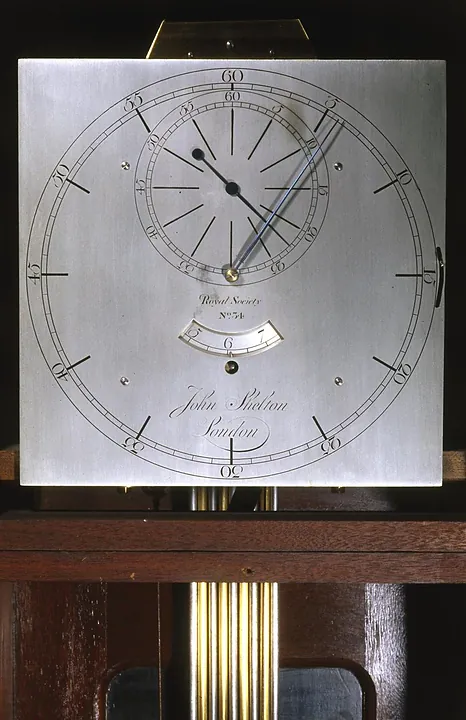
Regulator clock by John Shelton, England, 1768–1769
Science Museum Group, London
Clocks · c. 1770
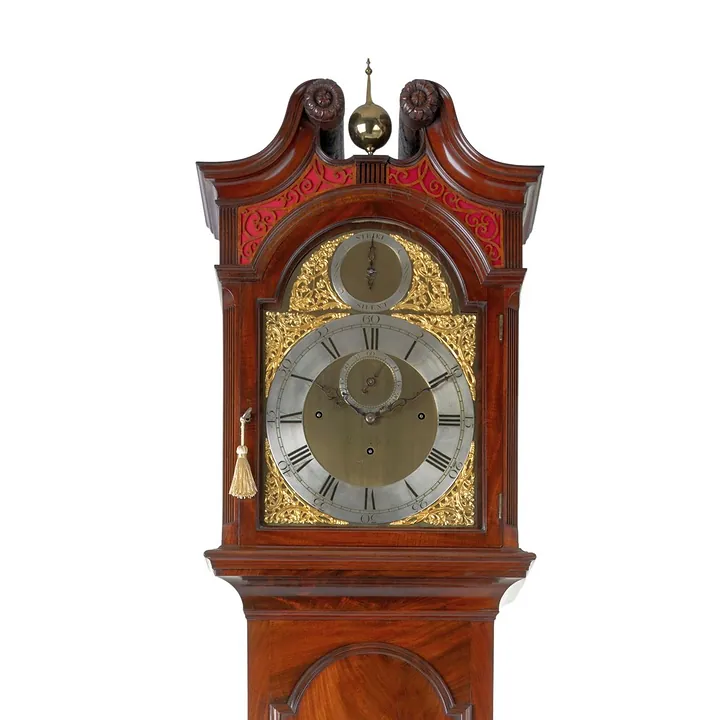
Mahogany quarter-striking longcase clock with grid-iron pendulum by John Shelton, London
The Antique Clock Company (dealer), Dorset
Clocks · c. 1780
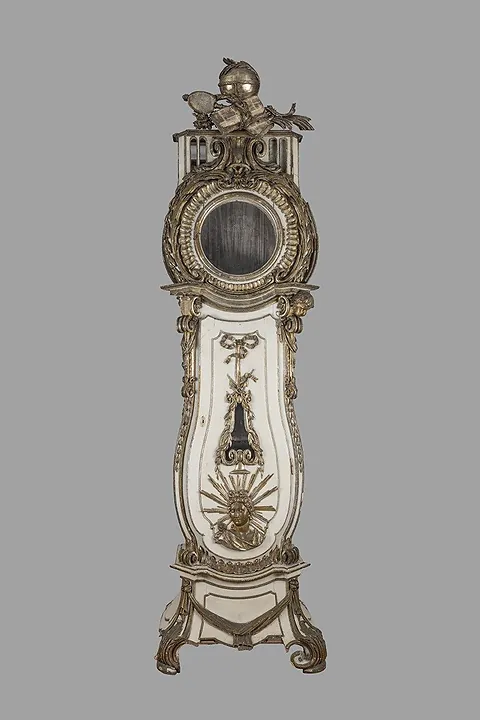
Longcase clock by Louis George, Eberswalde, c. 1780
Museum Eberswalde
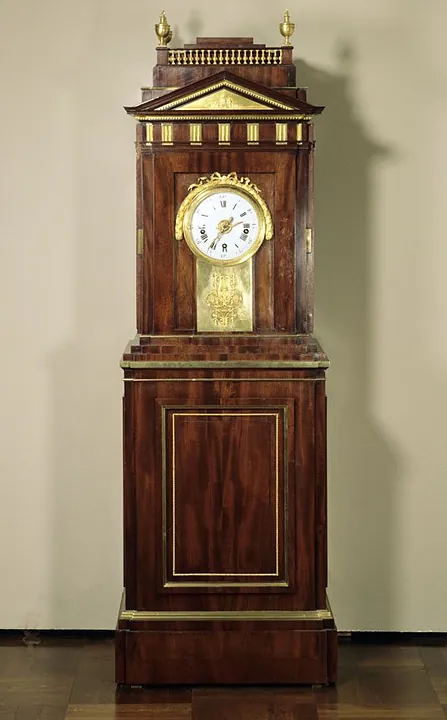
Clocks · 1780s (inferred: the museum dates the style to the 1780s and the music includes Gluck's Iphigénie en Tauride of 1779)
Musical longcase clock, Roentgen workshop, Neuwied, 1780s
Badisches Landesmuseum Karlsruhe
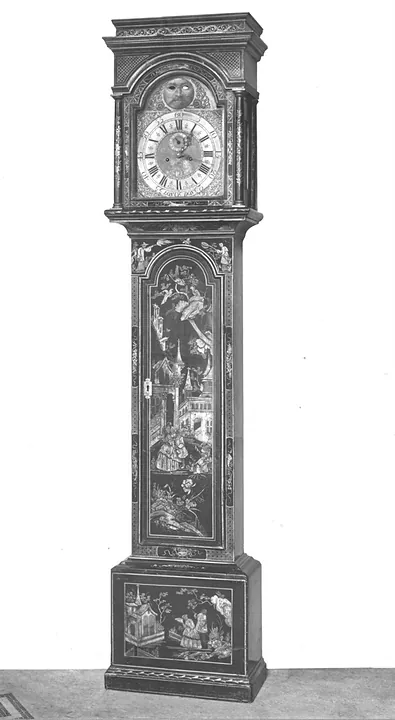
Clocks · 1740–1760
Longcase clock, English, 1740–1760, japanned wood, John Ellicott
Victoria and Albert Museum, London
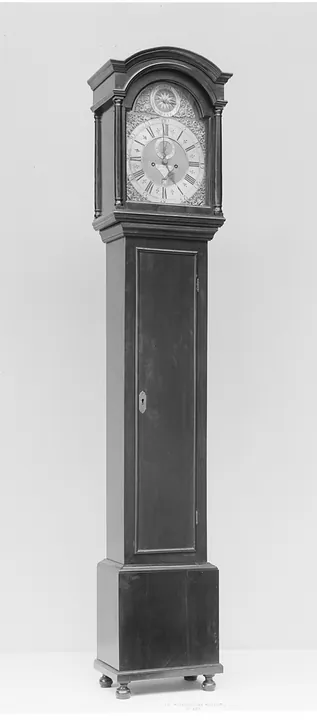
Clocks · 1740–60
Tall clock by Samuel Bagnall, United States, 1740–60
The Metropolitan Museum of Art, New York
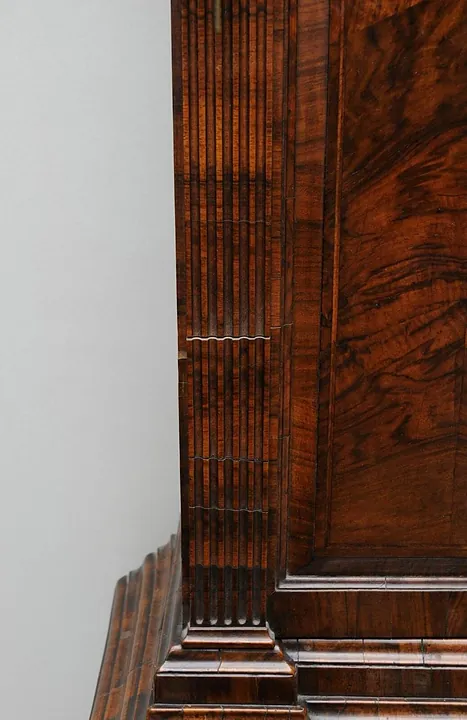
Clocks · c.1750
Long-case clock, English, ca. 1750, by Richard Peyton of Gloucester
Victoria and Albert Museum, London
Clocks · 1750–1800
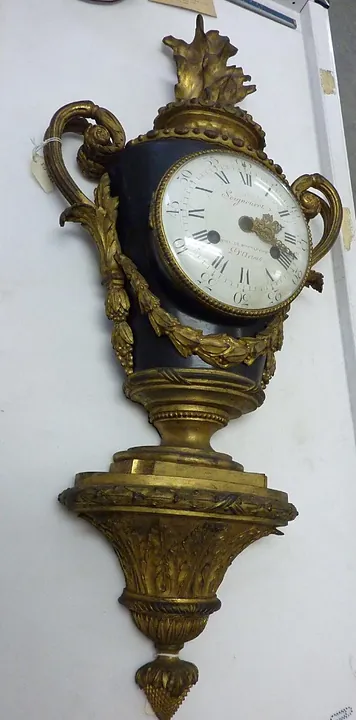
Bracket clock in metal case with scroll handles and flamed-shaped top signed by Pierre Seignoret, Clockmaket to the the Comte d'Artois
Victoria and Albert Museum, London