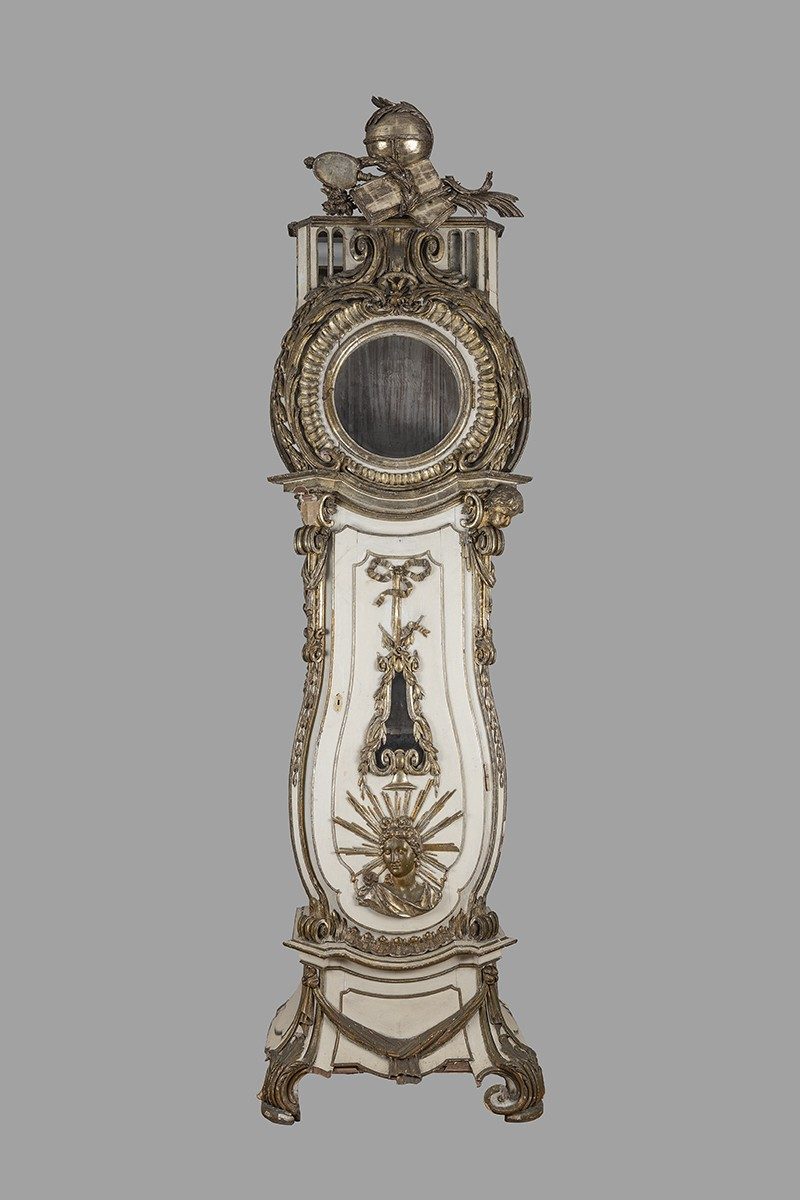
Clocks · Longcase clock
Longcase clock by Louis (Uhrmacher) (Herstellung) George, Eberswalde, 1700–1799
- Maker / attribution
- Louis (Uhrmacher) (Herstellung) George (creator)
- Date
- 1700–1799
- Historical period
- Early Modern Horology (1600 – 1750)
- Country of origin
- Unrecorded in source
- Place
- Eberswalde
- Object type
- Longcase clock
- Holding institution
- Museum Eberswalde
- Accession / object no.
- item_IJN4GZKZRRR5N3Q3TAS3ACRRIVVV4FXW
- Catalogue title (original)
- Louis George, Bodenstanduhr, ehemals mit Flötenwerk, um 1780, Inv. Nr. V 214 E (German)
Record summary
Held and catalogued by Museum Eberswalde (object number item_IJN4GZKZRRR5N3Q3TAS3ACRRIVVV4FXW), this is a longcase clock by Louis (Uhrmacher) (Herstellung) George, made in Eberswalde, dated 1700–1799. The Atlas places it in the Early Modern Horology period (1600 – 1750) of its Clocks collection. The record is illustrated with 1 photograph.
Assembled from the source record's structured fields. Dates and attributions are given as the source states them; where a field is missing the Atlas leaves it blank rather than estimating.
Catalogue description
Catalogue description from Museum Eberswalde (German)
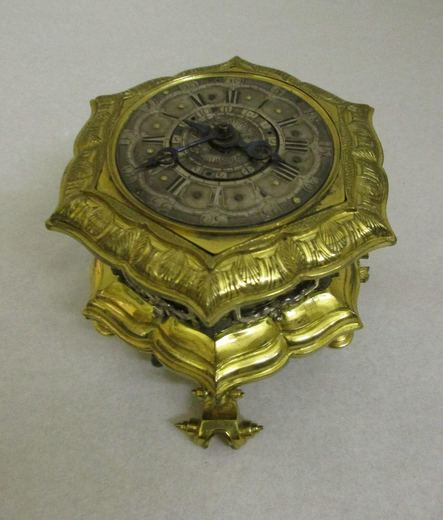
Die monumentale Uhr stammt aus dem Schloss Lichterfelde (heute Ortsteil der Gemeinde Schorfheide im Landkreis Barnim), vermutlich aus dem Weißen Saal. Das Gehäuse hat einen dreiteiligen Aufbau aus Sockel, Pendelkasten und Uhrenkopf mit bekrönendem Aufsatz. Der niedrige Sockel steht auf Volutenfüßen, ein Tuchgehänge ziert die Vorderseite. Darüber setzt der bauchige, nach oben gerade endende Pendelkasten mit geschnitzten und vergoldeten figürlichen und dekorativen Elementen auf, unten verziert mit Akanthusblättern, auf der vorderen Tür: unter dem Pendelfenster Reliefdarstellung einer Apollbüste nach antikem Vorbild vor einem Strahlenkranz, darüber das verglaste Pendelfenster in Form einer stilisierten Lyra, begleitet von an einer Schleife aufgehängten Blattgirlanden. Unter den übereck gestellten Gesimskonsolen ursprünglich zwei Puttenköpfchen, von denen nur das rechte erhalten ist, sowie Voluten und weitere Blattgirlanden. Die Dekoration der Seiten besteht aus Trophäengehängen mit Holzblasinstrumenten. Zur Aufnahme des sehr großen runden Uhrenkopfes ist die obere Gesimsplatte des Pendelkastens konkav eingezogen. Die Rahmung des vorn verglasten Kopfes bilden Lorbeerkränze, seitlich befinden sich mit Seidenbespannungen versehene Schalllöcher mit Strahlenkranzdekoration, die ursprünglich wohl als Klappen (vgl. Flötenuhr von Louis George, Coburg, Schloss Callenberg), jetzt als Türen ausgebildet sind. Typisch für die frühere Funktion als Musikuhr ist der kastenförmige und über den Uhrenkopf hinausragende Aufbau auf der Rückseite (zur Aufnahme des Flötenwerks), dessen horizontal gerader Abschluss vorn von einem bekrönenden Arrangement aus Büchern, Globus, Spiegel und Instrumenten gebildet wird. (Silke Kiesant)
Shown in the original language of the source catalogue. An editor-reviewed English translation has not yet been published; we do not publish machine translations as authoritative text.
Historical context
Early Modern Horology (1600 – 1750)
Huygens' pendulum and balance spring transform accuracy; English makers develop the anchor and deadbeat escapements.
Huygens's pendulum (1656–57) improved clock accuracy from about a quarter of an hour to under a minute a day. The anchor escapement (c. 1670) and the long seconds pendulum created the longcase clock; London makers such as Fromanteel, Knibb, Tompion and Quare led European clockmaking, and French makers created the Boulle pendule.
Read the period in the timelineMore clocks from this periodEarlier: Renaissance Horology
Atlas type guide
Longcase (tall-case or grandfather) clocks
The longcase clock was born from two seventeenth-century innovations: Christiaan Huygens's pendulum (1656–57) and the anchor escapement (c. 1670). A long seconds pendulum, nearly a metre long, swings with a small arc, and enclosing it together with the driving weights in a tall wooden case protected the mechanism and created a new piece of furniture. London makers such as Ahasuerus Fromanteel, Thomas Tompion and Joseph Knibb set the pattern.
By the eighteenth century longcase clocks were made throughout Britain, the Netherlands, Scandinavia (the Swedish Mora clock), France (the Comtoise from the Franche-Comté), Germany and colonial America. Eight-day movements with two weights became standard in better clocks; thirty-hour clocks with one weight and a rope or chain were cheaper alternatives.
What to look for
- Winding holes in the dial: two (eight-day, going and striking) or none (thirty-hour, pulled up by a chain).
- Brass dials with applied chapter rings (earlier) versus painted iron 'white' dials (after c. 1770 in Britain).
- Moon-phase arches, date apertures, seconds dials and maker's name on the dial.
- Case woods and style: ebonised, walnut marquetry, lacquer, oak or mahogany; regional styles from London, Lancashire, Scotland or America.
- Whether the movement and dial match the case — 'marriages' are common.
Dating clues
- Square brass dials suggest c. 1670–1720; arched brass dials c. 1715–1790.
- Painted (white) dials were made by Birmingham dial-makers from about 1772.
- Comtoise clocks with repoussé pendulums are mostly nineteenth century.
General guidance written by the Atlas editors about this kind of object. It is not a statement about this particular piece; for that, rely on the source record above and on physical examination.
Related records
Clocks · 1550–1650
Turret clock, Netherlands, 1550–1650
Museum Klok & Peel
Clocks · case 1554, movement ca. 1680
Table clock by Caspar Behaim (Chasparus Bohemus), Austria, case 1554, movement ca. 1680
The Metropolitan Museum of Art, New York
Clocks · 1590–1610
Clock, France, 1590–1610
MAK – Museum of Applied Arts
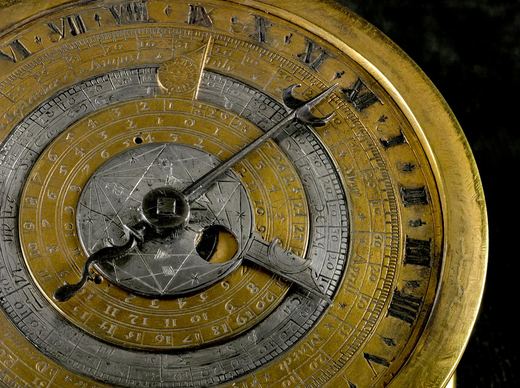
Clocks · 1598-1603
Circular table-clock with calendrical and lunar indications made by Nicholas Vallin in London between 1598 and 1603.
Science Museum Group, London
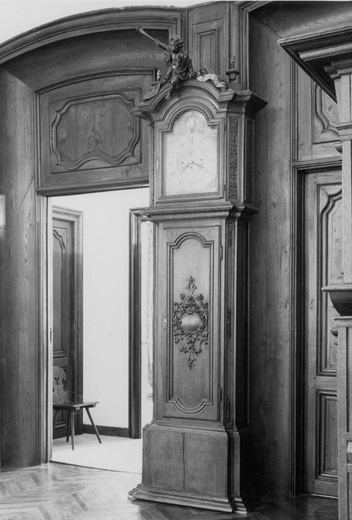
Clocks · 1600–1699
Clock by Joannes Volcker, Belgium, 1600–1699 (Royal Institute for Cultural Heritage AP_10156031)
Royal Institute for Cultural Heritage
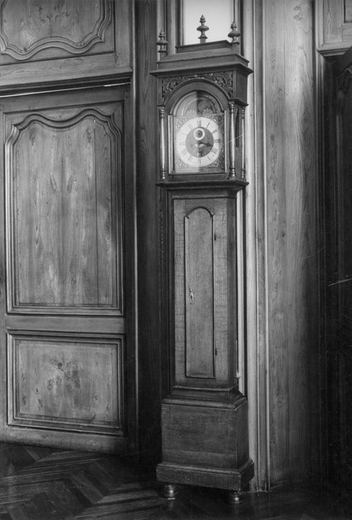
Clocks · 1600–1699
Clock by Joannes Volcker, Belgium, 1600–1699 (Royal Institute for Cultural Heritage AP_10156032)
Royal Institute for Cultural Heritage
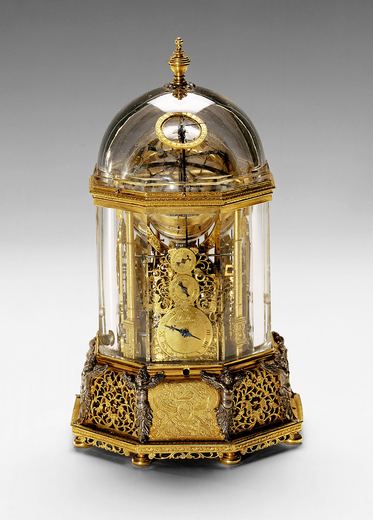
Clocks · 1600–1699
Clock by Jobst Bürgi (ascribed to), Czech Republic, 1600–1699
Fine Arts Museum Vienna
Clocks · 1600-1700
Clock, Germany, 1600-1700
Victoria and Albert Museum, London