Clocks · Clock
Clock, Germany, 1600-1700
- Maker / attribution
- Unrecorded in source
- Date
- 1600-1700
- Historical period
- Early Modern Horology (1600 – 1750)
- Country of origin
- Germany
- Place
- Germany
- Object type
- Clock
- Materials / technique
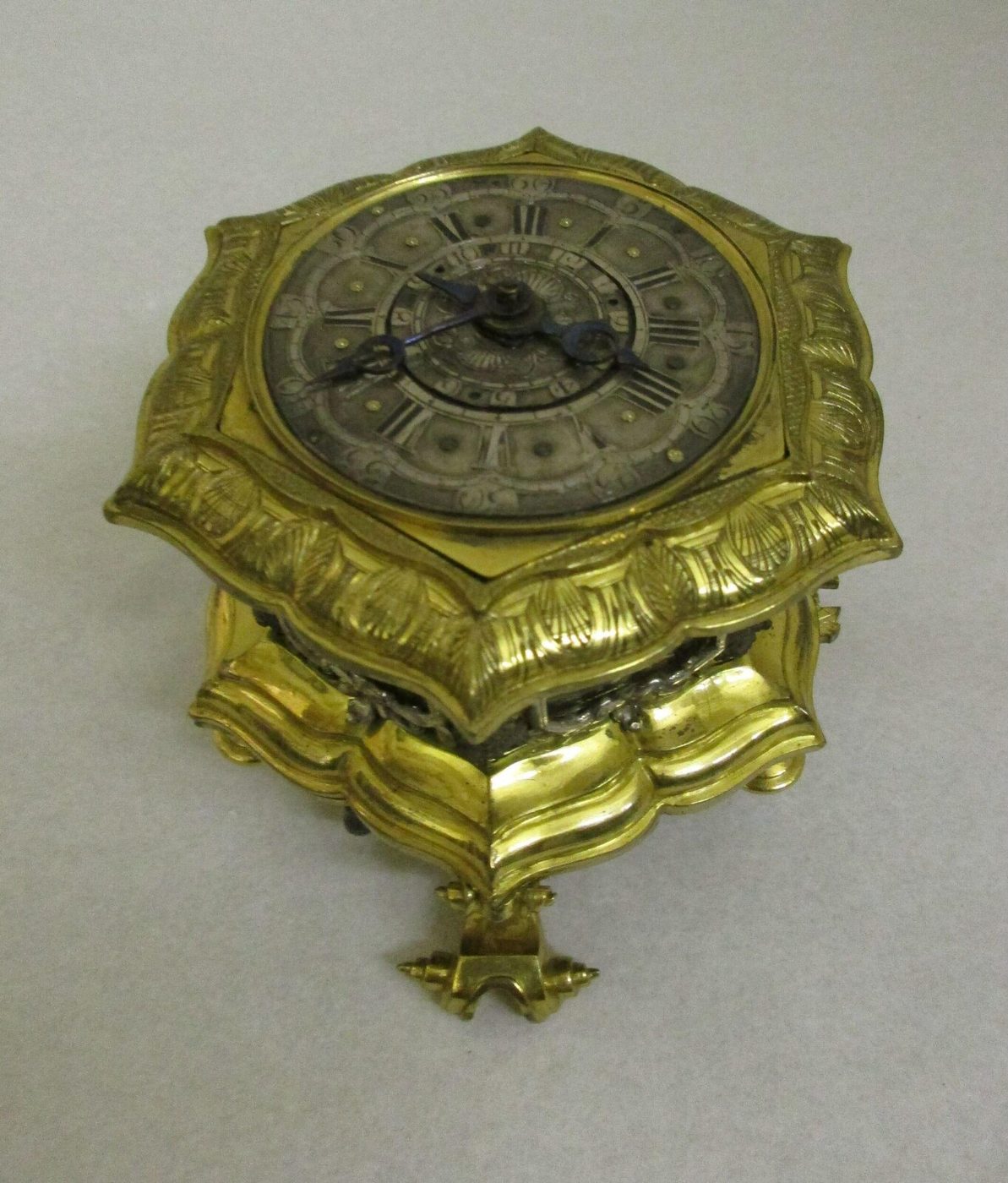
- Gilt metal hexagonal case with silver dial and applied silver cartouches with ornamental masks
- Dimensions
- Diameter: 4 1/4 in
- Holding institution
- Victoria and Albert Museum, London
- Accession / object no.
- 2377-1855
- Credit line
- Purchased from the Bernal Collection
Record summary
Held and catalogued by Victoria and Albert Museum, London (object number 2377-1855), this is a clock, made in Germany, dated 1600-1700. The Atlas places it in the Early Modern Horology period (1600 – 1750) of its Clocks collection. Materials and techniques recorded by the source: Gilt metal hexagonal case with silver dial and applied silver cartouches with ornamental masks. Recorded dimensions: Diameter: 4 1/4 in. The record is illustrated with 4 photographs.
Assembled from the source record's structured fields. Dates and attributions are given as the source states them; where a field is missing the Atlas leaves it blank rather than estimating.
Catalogue description
V&A — Summary
An hexagonal table clock with a gilt metal case and silver catrouche ornaments on the side decorated with masks with a silver dial resting on scroll feet.
V&A — Physical description
Clock, hexagonal gilt metal case with, on the sides, applied silver cartouches with masks on scroll feet with silver dial.
V&A — Object history
From the collection of Ralph Bernal (1783-1854). This was an enormous collection of metalwork, glass, ceramics and miniatures. Bernal was trained as a lawyer and served as MP from 1818-1852. Bernal was buying in the 1830s and 1840s when prices were low. The sale after his death by Christie, Manson and Woods took 32 days during which 4294 lots fetched nearly £71,000. The Museum bought 730 lots. Provenance Ralph Bernal (1783-1854) was a renowned collector and objects from his collection are now in museums across the world, including the V&A. He was born into a Sephardic Jewish family of Spanish descent, but was baptised into the Christian religion at the age of 22. Bernal studied at Christ's College, Cambridge, and subsequently became a prominent Whig politician. He built a reputation for himself as a man of taste and culture through the collection he amassed and later in life he became the president of the British Archaeological Society. Yet the main source of income which enabled him to do this was the profits from enslaved labour. In 1811, Bernal inherited three sugar plantations in Jamaica, where over 500 people were eventually enslaved. Almost immediately, he began collecting works of art and antiquities. After the emancipation of those enslaved in the British Caribbean in the 1830s, made possible in part by acts of their own resistance, Bernal was awarded compensation of more than £11,450 (equivalent to over £1.5 million today). This was for the loss of 564 people enslaved on Bernal's estates who were classed by the British government as his 'property'. They included people like Antora, and her son Edward, who in August 1834 was around five years old (The National Archives, T 71/49). Receiving the money appears to have led to an escalation of Bernal's collecting. When Bernal died in 1855, he was celebrated for 'the perfection of his taste, as well as the extent of his knowledge' (Christie and Manson, 1855). His collection was dispersed in a major auction during which the Museum of Ornamental Art at Marlborough House, which later became the South Kensington Museum (now the V&A), was the biggest single buyer.
V&A gallery label
CLOCK. Gilt metal; a table clock, hexagonal, with silver cartouche ornaments and masks round the sides; silver dial, resting on scroll feet 17th cent y . German. Diam. 4 1/ 4; H.3 1/ 4 in.. Bought (Bernal coll.)11l..
Inscriptions & marks
DE JEAN QUARU LONDON
Historical context
Early Modern Horology (1600 – 1750)
Huygens' pendulum and balance spring transform accuracy; English makers develop the anchor and deadbeat escapements.
Huygens's pendulum (1656–57) improved clock accuracy from about a quarter of an hour to under a minute a day. The anchor escapement (c. 1670) and the long seconds pendulum created the longcase clock; London makers such as Fromanteel, Knibb, Tompion and Quare led European clockmaking, and French makers created the Boulle pendule.
Read the period in the timelineMore clocks from this periodEarlier: Renaissance Horology
Atlas type guide
Domestic clocks
A clock combines four systems: a source of power (falling weight, coiled spring, or later electricity), a gear train that divides time, an escapement and oscillator that regulate it (foliot, pendulum or balance), and an indicating system of dial and hands or a bell. Its history runs from the large iron weight-driven clocks of the late thirteenth century to Renaissance spring-driven table clocks, the pendulum revolution of 1656, the factory clocks of the nineteenth century and electric and quartz clocks of the twentieth.
Domestic clocks also reflect regional furniture and decorative traditions — English longcase and bracket clocks, French pendules, Viennese regulators, Black Forest and American shelf clocks — and therefore record changing tastes as much as technical progress.
What to look for
- How the clock is powered: weights, spring barrel, fusee, electric coil.
- The oscillator: foliot, short pendulum, long seconds pendulum or balance.
- Whether it strikes: hour only (count wheel) or hours and quarters (rack striking).
- The maker or retailer's name on dial and movement, and any factory trademarks.
- Signs of alteration — replaced dials, converted escapements, 'married' cases.
Dating clues
- Before 1656 clocks used foliots or balances; after, most domestic clocks have pendulums.
- Anchor escapements spread after c. 1670; minute hands became common at the same time.
- Factory production in America and Germany transformed prices after c. 1840.
General guidance written by the Atlas editors about this kind of object. It is not a statement about this particular piece; for that, rely on the source record above and on physical examination.
Related records
Clocks · 1600–1699
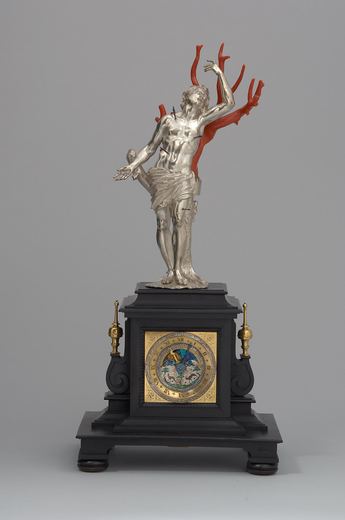
Table clock by #Hans_Christoph_II._Fesenmair_Künstler/in, Germany, 1600–1699
Fine Arts Museum Vienna
Clocks · 1600–1699
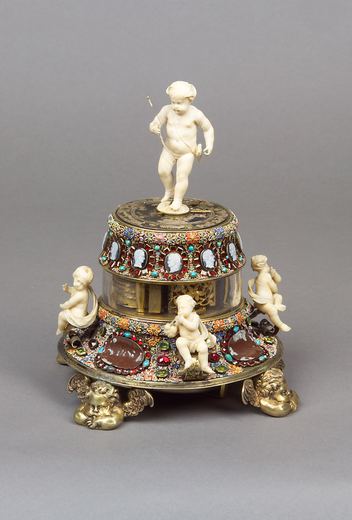
Table clock by Hans Jakob Mair (artist), Germany, 1600–1699
Fine Arts Museum Vienna
Clocks · 17th century
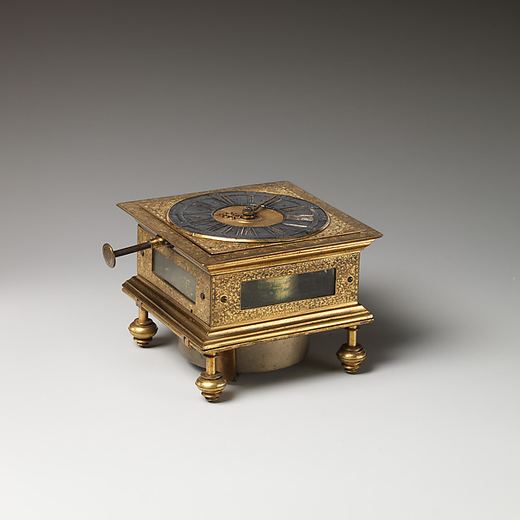
Table clock by Johann Heinrich Kleinschmidt, Germany, 17th century
The Metropolitan Museum of Art, New York
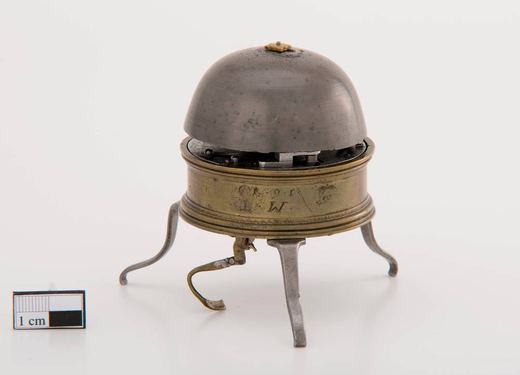
Clocks · 1600–1699
Table clock by unbekannt, deutsch, 17. Jh.; Uhrmacher, Germany, 1600–1699
Dresden State Art Collections. Royal Cabinet of Mathematical and Physical Instruments
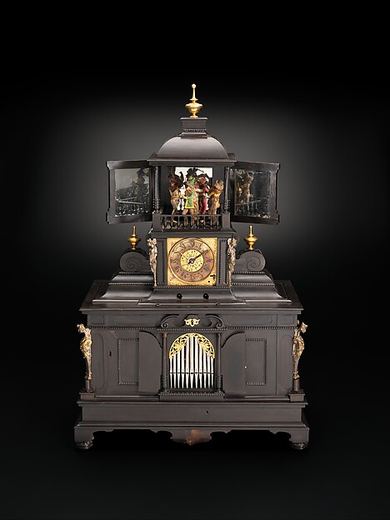
Clocks · ca. 1625
Musical clock with spinet and organ by Veit Langenbucher, Germany, ca. 1625
The Metropolitan Museum of Art, New York
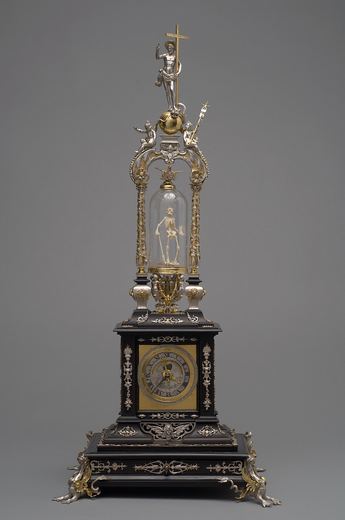
Clocks · 1624–1630
Table clock by Christoph Angermair (Künstler/in), Germany, 1624–1630
Fine Arts Museum Vienna
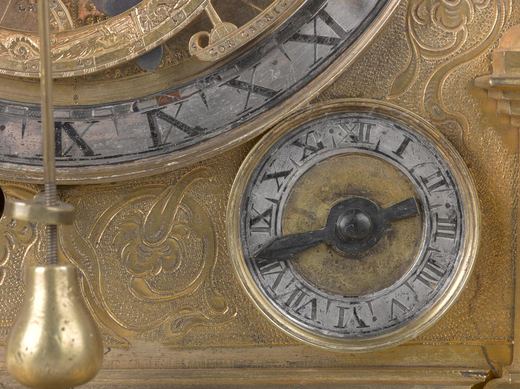
Clocks · 1625-1635
Upright table clock with winding key, by unknown maker, made in Augsburg, Germany, 1625-1635
Science Museum Group, London
Clocks · 1700–1799
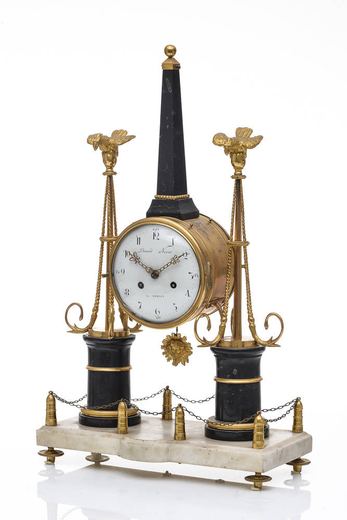
Mantel clock by David (Uhrmacher) Nevir, Germany, 1700–1799
City Museum Berlin