
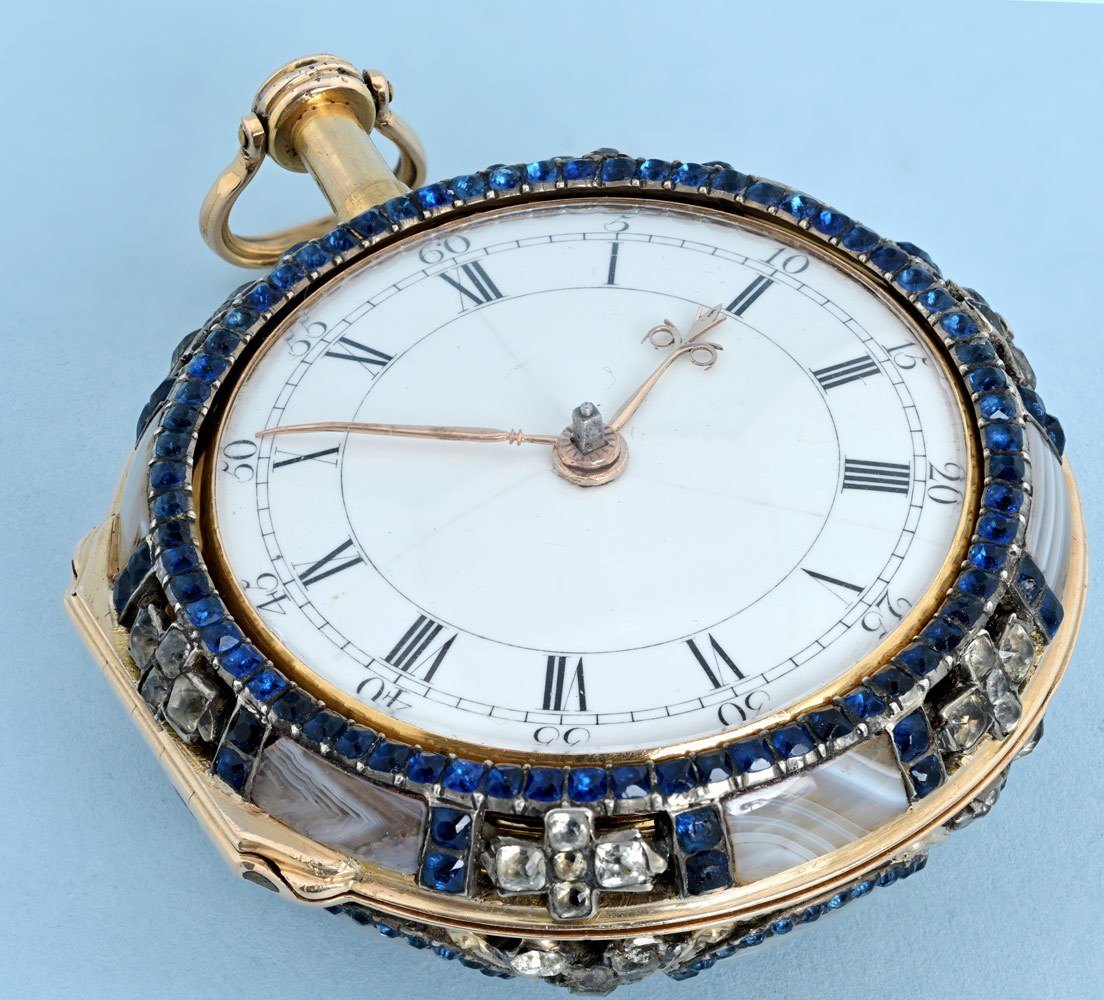
Pocket Watches · Quarter repeating pocket watch
Mudge & Dutton quarter-repeating gold and agate pocket watch
- Maker / attribution
- Mudge & Dutton (source attribution)
- Date
- c. 1780
- Historical period
- Precision & Scientific Horology (1750 – 1850)
- Country of origin
- United Kingdom
- Object type
- Quarter repeating pocket watch
- Materials / technique
- 22-karat gold
- Holding institution
- Zamanito
- Accession / object no.
- mudge-dutton-quarter-repeating-gold-and-agate-pocket-watch-a468feb2e1
- Credit line
- Zamanito
- Catalogue title (original)
- Rare Gold and Agate Repeater by Mudge & Dutton (English)
View the source record ↗ (opens another website in a new tab)Suggest a correction
Record summary
Held and catalogued by Zamanito (object number mudge-dutton-quarter-repeating-gold-and-agate-pocket-watch-a468feb2e1), this is a quarter repeating pocket watch attributed to Mudge & Dutton, made in United Kingdom, dated c. 1780. The Atlas places it in the Precision & Scientific Horology period (1750 – 1850) of its Pocket Watches collection. Materials and techniques recorded by the source: 22-karat gold. The record is illustrated with 1 photograph.
Assembled from the source record's structured fields. Dates and attributions are given as the source states them; where a field is missing the Atlas leaves it blank rather than estimating.
Catalogue description
Original object description
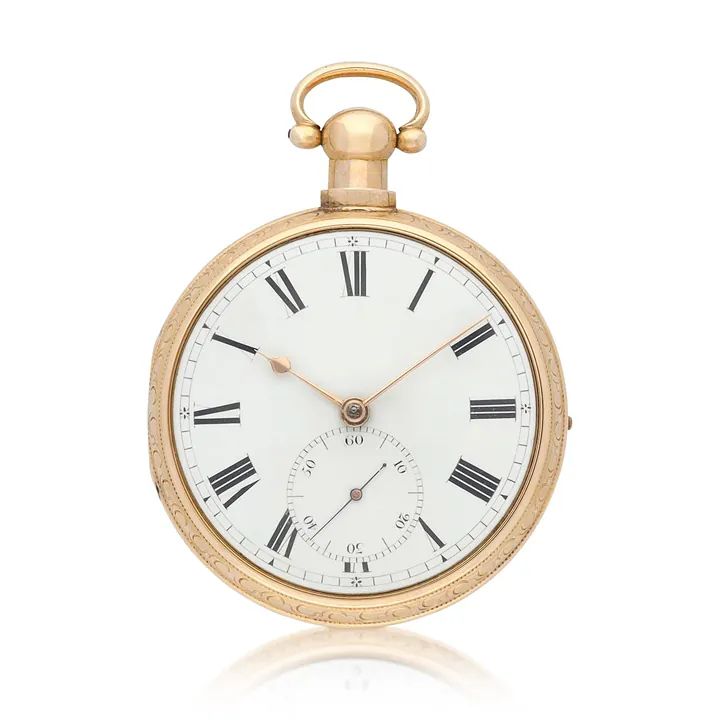
Bearing the signature of Mudge & Dutton and originating circa 1780, this pair-cased pocket watch features a quarter-repeating complication operated by depressing the pendant to ring an interior bell. Power is delivered by a fire-gilt full-plate movement with chain and fusee, regulated by a blued balance spring, a three-arm steel balance, and a polished steel cylinder escapement. The 22-karat gold inner case incorporates pierced acoustic apertures along the rim alongside chased depictions of fire dragons and floral scrolls. Set into the richly decorated outer case are six oval sections of banded agate, hexagonal panels of gray agate, clear stone accents, and blue sapphire framing surrounding both bezels. Gold hands of the beetle and poker variety travel over a white enamel dial marked with Arabic five-minute intervals and Roman hour numerals.
Historical context
Precision & Scientific Horology (1750 – 1850)
Harrison solves longitude; Mudge invents the lever; Breguet's Paris workshop defines the modern watch.
From 1750 to 1850 the watch became a precision instrument. Mudge's lever escapement, the cylinder escapement, Lépine's thin bar calibre, Breguet's innovations (overcoil, tourbillon, perpétuelle) and the pocket chronometer of Arnold and Earnshaw all date from this period, while verge watches remained common in cheaper production.
Read the period in the timelineMore pocket watches from this periodEarlier: Early Modern Horology
Atlas type guide
Repeating watches
Before electric light, telling the time in the dark was a real problem. Repeating watches strike the time on demand when a slide or push-piece is operated: quarter repeaters sound hours and quarters, minute repeaters hours, quarters and minutes. Edward Barlow and Daniel Quare disputed the invention in London in the 1680s. Early repeaters struck on a bell inside the case; Abraham-Louis Breguet introduced the gong (a coiled steel wire) around 1780, allowing thinner watches.
Repeaters require a separate train with racks, snails and a governor to control the striking speed, and are among the most demanding complications to make and adjust. Swiss makers of the Vallée de Joux specialised in repeating ébauches in the nineteenth century.
What to look for
- A slide on the case band or a push-piece through the pendant.
- Gongs encircling the movement (after c. 1780) or a bell in the case (earlier); pierced case for sound.
- The racks, snails and governor visible under the dial or on the movement.
- Terms such as 'Minutes', 'Quarts' or 'Répétition' on the dial or cuvette.
Dating clues
- Bell-striking quarter repeaters: c. 1690–1800.
- Gong repeaters and dumb repeaters (striking on the case): after c. 1780.
- Minute repeaters became more common after c. 1830 with Vallée de Joux ébauches.
General guidance written by the Atlas editors about this kind of object. It is not a statement about this particular piece; for that, rely on the source record above and on physical examination.
Read next:Minute repeater
Related records
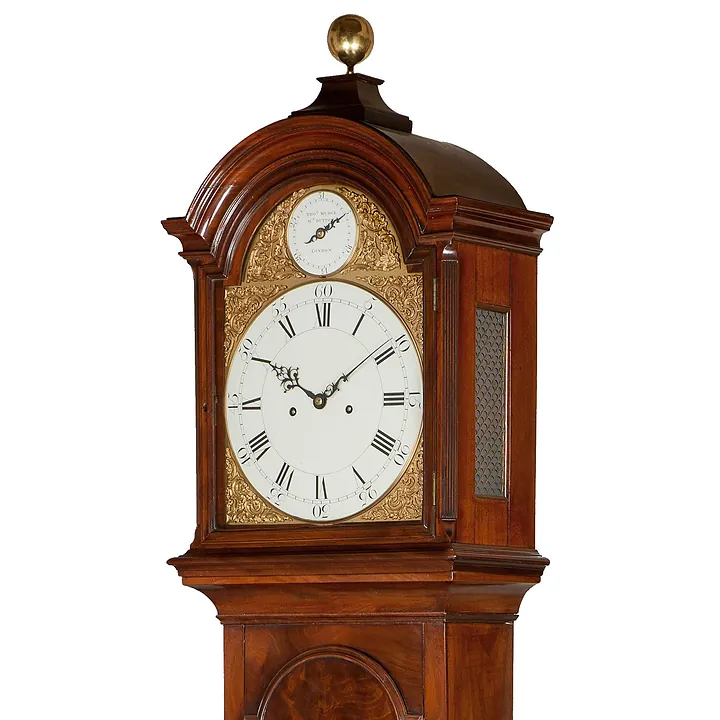
Clocks · c. 1770
Longcase clock with enamel dials by Mudge & Dutton
The Antique Clock Company (dealer), Dorset
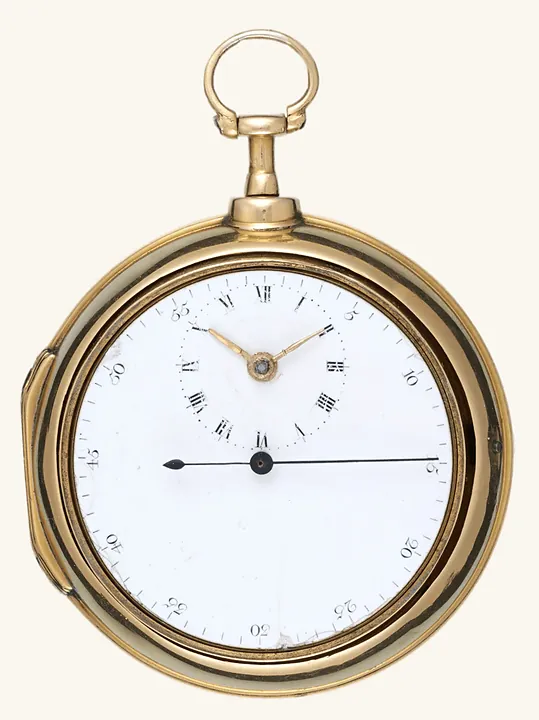
Pocket Watches · c. 1790
Gold Centre Seconds English Verge, c. 1790
WatchMuseum.org shop
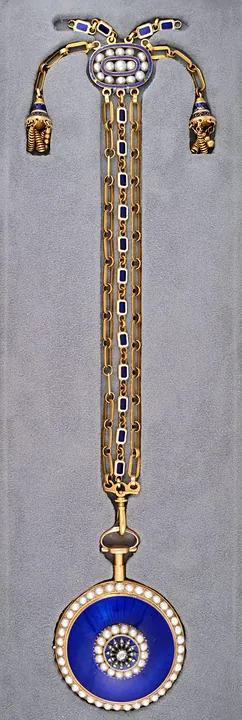
Pocket Watches · c. 1785
Pearl and Diamond Set Irish Verge with Chatelaine, circa 1785
Pieces of Time (dealer), London
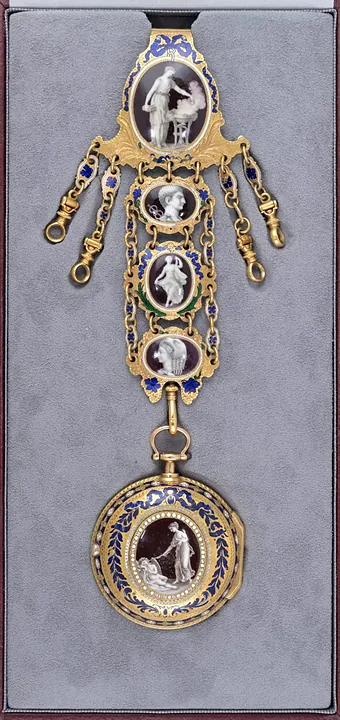
Pocket Watches · 1766 (hallmarked Chester)
Irish Gold and Enamel Chatelaine Watch, 1766
Pieces of Time (dealer), London
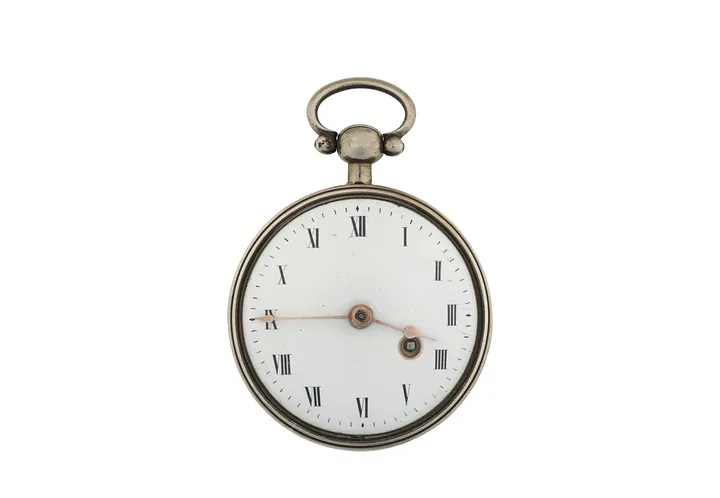
Pocket Watches · 1807
A Royal watch by Samuel Houston
Science Museum Group/The Clockmakers' Museum
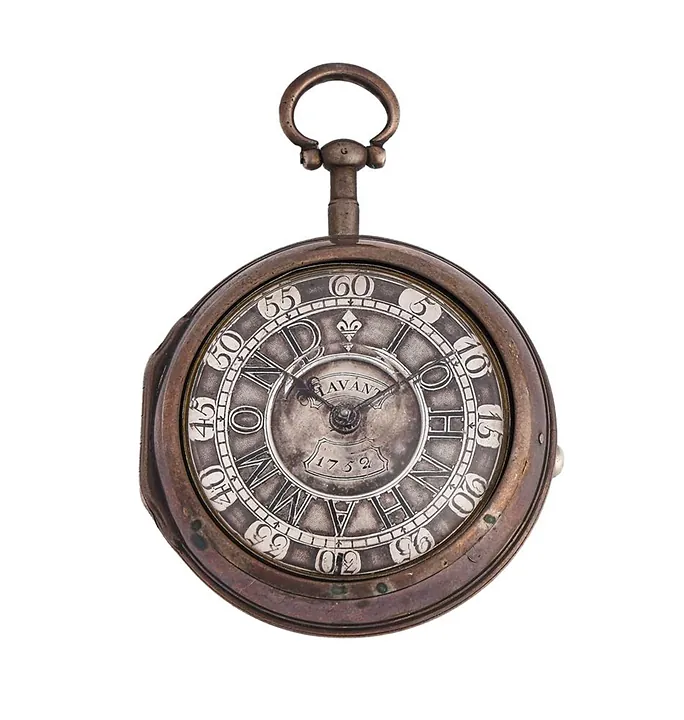
Pocket Watches · 1752
George II provincial silver pair-cased verge pocket watch by Jonathan Stripe
Dreweatts
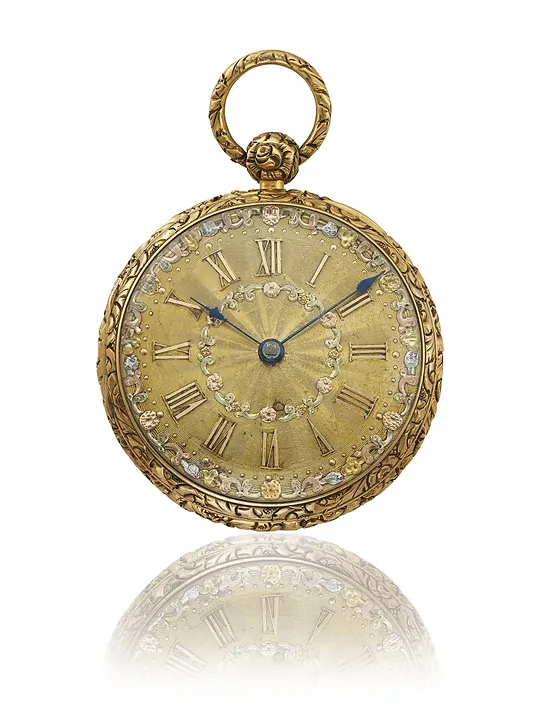
Pocket Watches · c. 1820-1821
Joseph Johnson 18K Gold Openface Keywound Lever Pocket Watch, No. 2811
Christie's
Pocket Watches · 1815–1816
Joseph Johnson No. 441 gold pair-cased pocket chronometer
Sotheby's