
Pocket Watches · Open-face keywound lever pocket watch
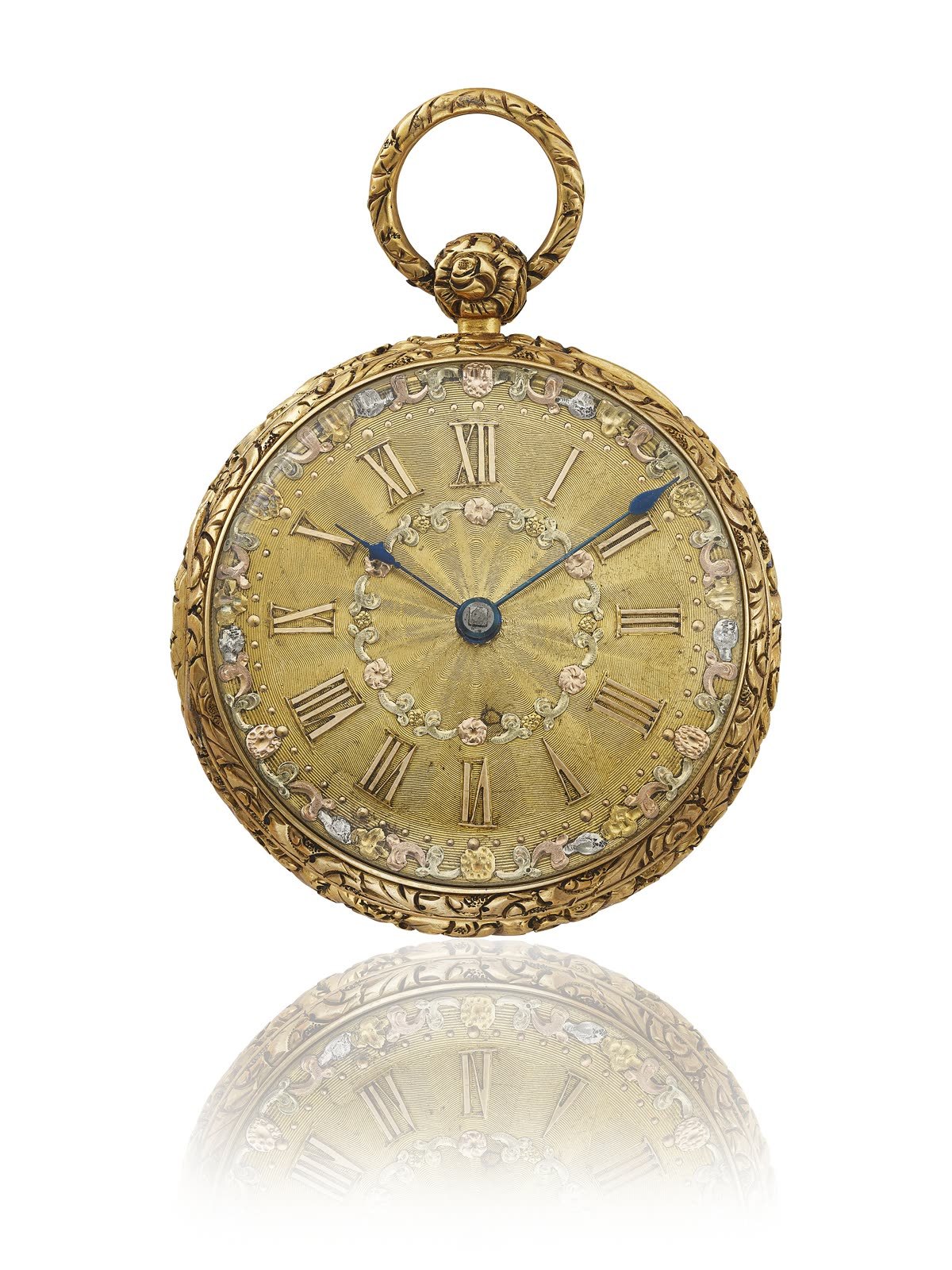
Joseph Johnson 18K Gold Openface Keywound Lever Pocket Watch, No. 2811
- Maker / attribution
- Joseph Johnson (source attribution)
- Date
- c. 1820-1821
- Historical period
- Precision & Scientific Horology (1750 – 1850)
- Country of origin
- United Kingdom
- Object type
- Open-face keywound lever pocket watch
- Materials / technique
- 18K gold
- Auction house
- Christie's
- Lot
- 469
- Credit line
- Christie's
- Catalogue title (original)
- JOSEPH JOHNSON, 18K GOLD OPENFACE KEYWOUND LEVER WATCH MADE FOR THE SPANISH MARKET, NO. 2811 | Christie’s (English)
View the source record (auction lot) ↗ (opens another website in a new tab)Suggest a correction
Record summary
Catalogued by Christie's (lot 469), this is an open-face keywound lever pocket watch attributed to Joseph Johnson, made in United Kingdom, dated c. 1820-1821. The Atlas places it in the Precision & Scientific Horology period (1750 – 1850) of its Pocket Watches collection. Materials and techniques recorded by the source: 18K gold. The record is illustrated with 1 photograph.
Assembled from the source record's structured fields. Dates and attributions are given as the source states them; where a field is missing the Atlas leaves it blank rather than estimating.
Catalogue description
Original object description
Bearing the number 2811, this openface, key-wound pocket watch was crafted by Joseph Johnson of Liverpool, with documentation noting it was made for the Spanish market. Its 48 mm 18-karat gold housing includes Birmingham assay stamps dated to 1820–1821. Chased engraving and leaf patterns embellish the bezel, round pendant, and suspension bow; the back of the case displays minor dents alongside light tarnishing. The dial, rendered in three-colour gold with signs of age-related surface dirt, combines a radial engine-turned field with raised leaf swags, applied Roman numerals, and blued steel hands with heart-shaped tips. Characterised as a manual time-only movement, the watch was not running when catalogued, has not been tested for timekeeping, and has no visible photographs showing calibre details or interior hallmarks.
Inscriptions & marks
2811
Historical context
Precision & Scientific Horology (1750 – 1850)
Harrison solves longitude; Mudge invents the lever; Breguet's Paris workshop defines the modern watch.
From 1750 to 1850 the watch became a precision instrument. Mudge's lever escapement, the cylinder escapement, Lépine's thin bar calibre, Breguet's innovations (overcoil, tourbillon, perpétuelle) and the pocket chronometer of Arnold and Earnshaw all date from this period, while verge watches remained common in cheaper production.
Read the period in the timelineMore pocket watches from this periodEarlier: Early Modern Horology
Atlas type guide
Hunter, half-hunter and open-face watches
In the nineteenth century the pocket watch case settled into a few standard forms. The hunter (French savonnette) has a hinged front lid protecting the crystal — reputedly for riders who could not risk broken glass — and is opened by pressing the crown or a push-piece. The half-hunter has a small window in the lid so the hands can be read when closed. The open-face (lépine) watch has no front cover, with the crown at 12; hunters normally carry the crown at 3.
Case types also changed with winding: key-wound watches gave way to keyless (stem-wound) mechanisms after Adrien Philippe's and others' designs of the 1840s, with pendant setting or lever setting.
What to look for
- Crown position relative to the seconds dial: at 3 for hunters, at 12 for open-face watches.
- Spring-loaded front cover with a push-piece in the pendant.
- Half-hunter chapter ring enamelled on the lid.
- Key holes in the inner dome (cuvette) versus keyless winding.
Dating clues
- Keyless winding spread after c. 1850 and became standard by c. 1890.
- English hallmarks inside gold and silver cases give the year of assay.
General guidance written by the Atlas editors about this kind of object. It is not a statement about this particular piece; for that, rely on the source record above and on physical examination.
Read next:Detached lever escapement
Related records
Pocket Watches · 1815–1816
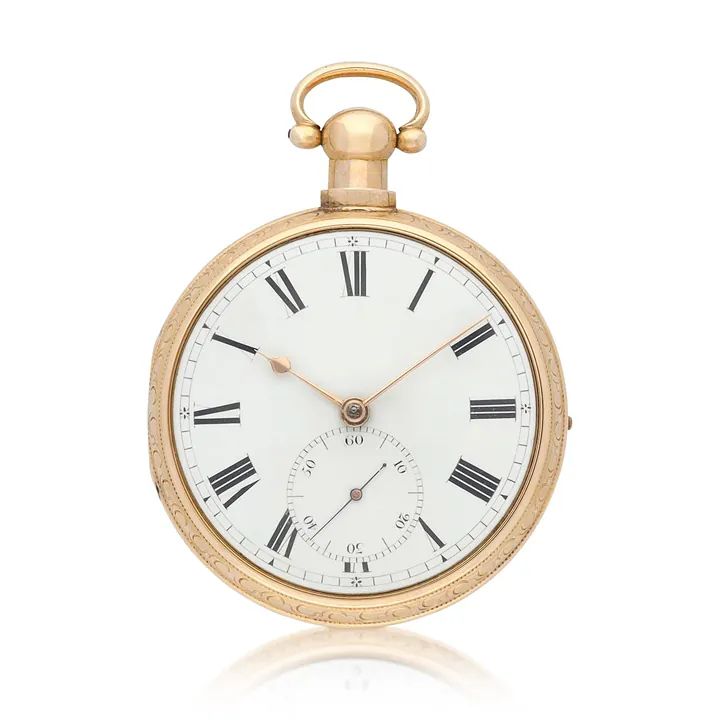
Joseph Johnson No. 441 gold pair-cased pocket chronometer
Sotheby's
Pocket Watches · 1856
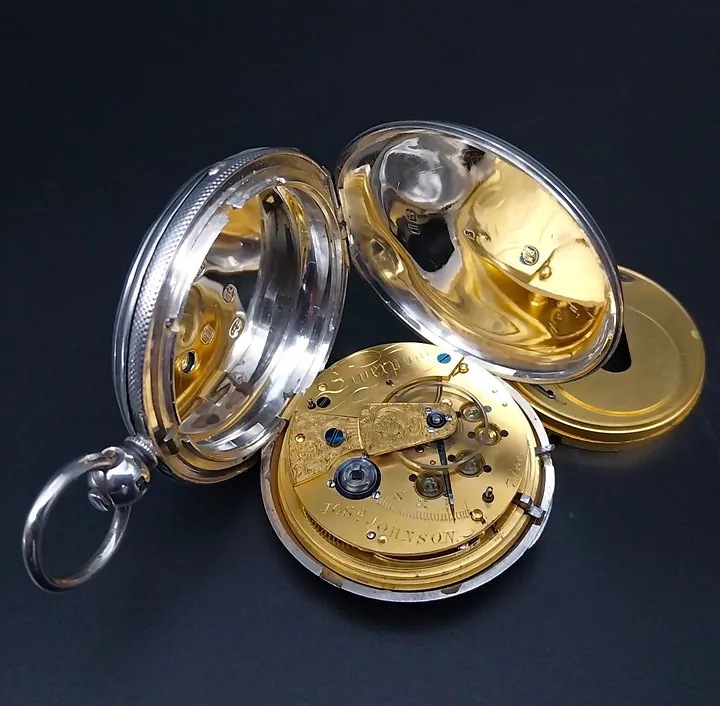
Joseph Johnson full hunter pocket watch with Liverpool jewelling
Antiquariato Cherubini Zorzella
Pocket Watches · c. 1802
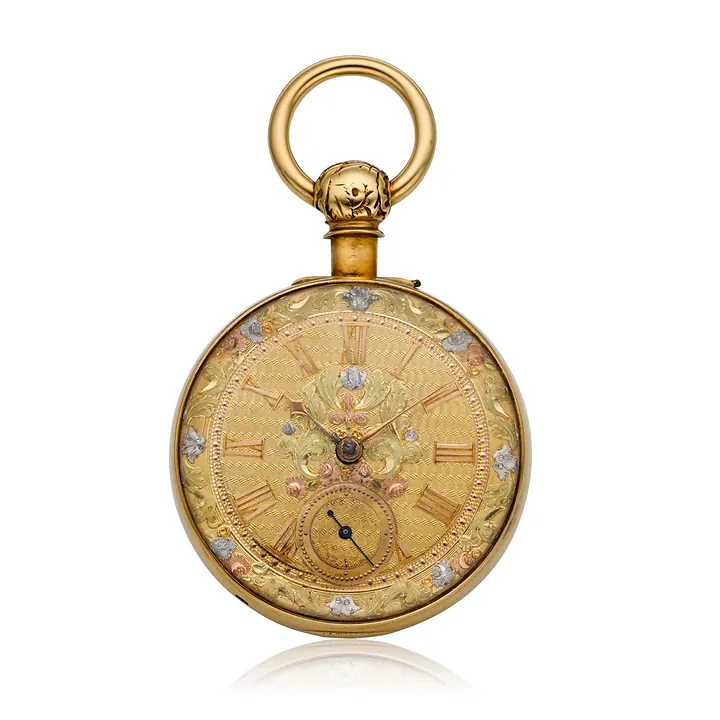
Joseph Johnson English Fusee Pair Case Pocket Watch
Christie’s
Pocket Watches · c. 1790
Gold Centre Seconds English Verge, c. 1790
WatchMuseum.org shop
Pocket Watches · c. 1785
Pearl and Diamond Set Irish Verge with Chatelaine, circa 1785
Pieces of Time (dealer), London
Pocket Watches · 1766 (hallmarked Chester)
Irish Gold and Enamel Chatelaine Watch, 1766
Pieces of Time (dealer), London
Pocket Watches · 1807
A Royal watch by Samuel Houston
Science Museum Group/The Clockmakers' Museum
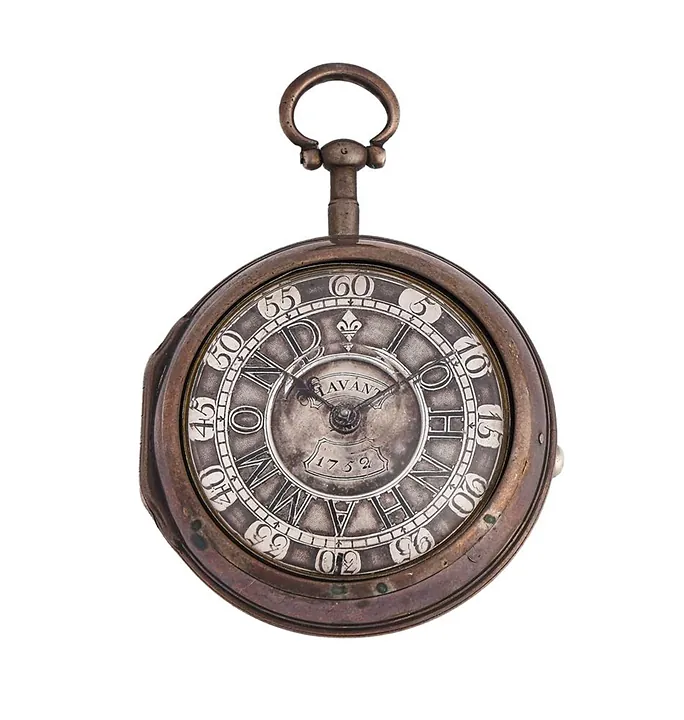
Pocket Watches · 1752
George II provincial silver pair-cased verge pocket watch by Jonathan Stripe
Dreweatts