
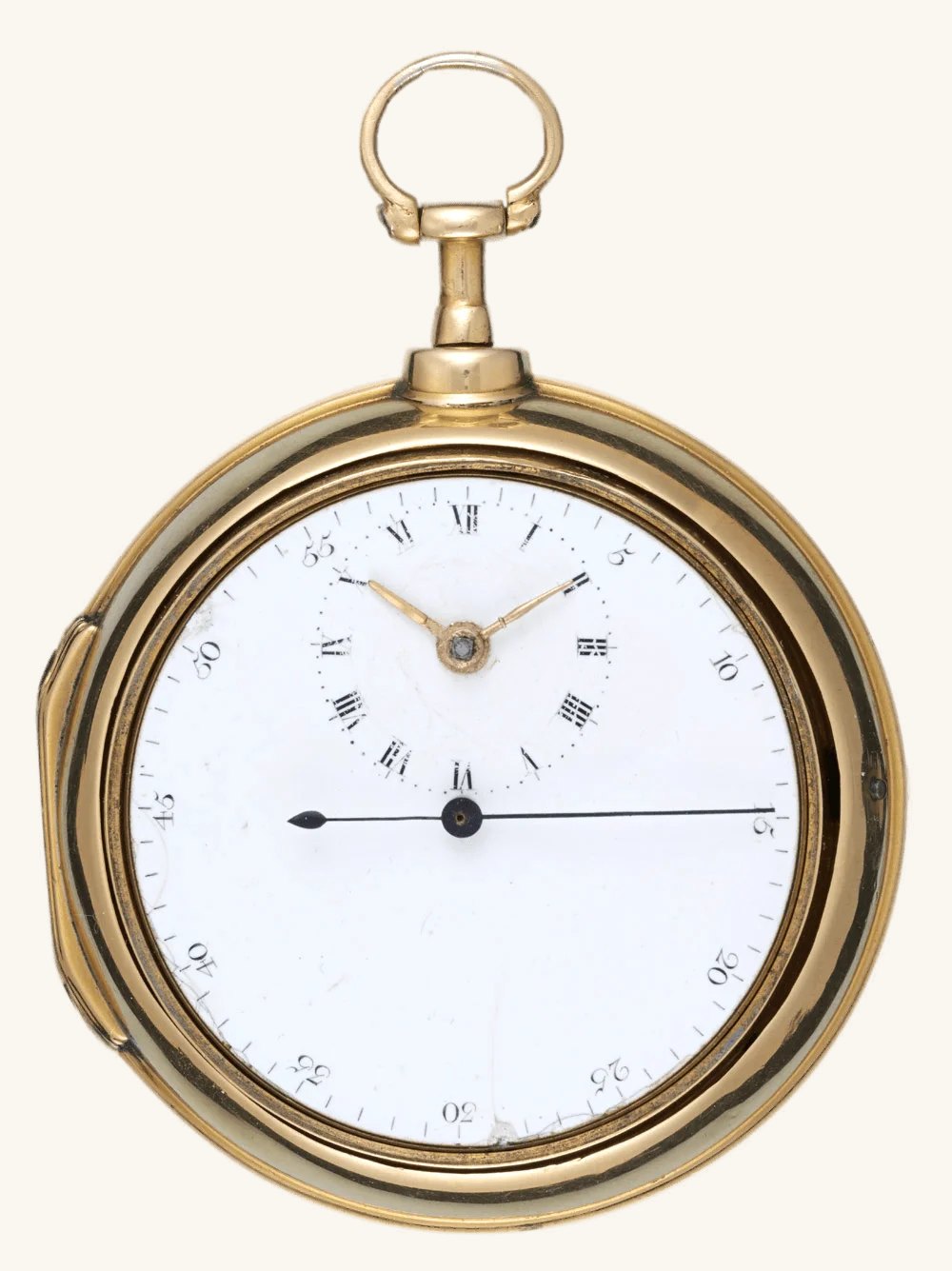
Pocket Watches · Pocket watch
Gold Centre Seconds English Verge, c. 1790
- Maker / attribution
- Unrecorded in source
- Date
- c. 1790
- Historical period
- Precision & Scientific Horology (1750 – 1850)
- Country of origin
- United Kingdom
- Object type
- Pocket watch
- Materials / technique
- gold
- Dealer
- WatchMuseum.org shop
- Stock no.
- Product 4715
- Credit line
- Dealer listing, WatchMuseum.org shop (product 4715)
- Catalogue title (original)
- Gold Centre Seconds English Verge (English)
View the source record (dealer listing) ↗ (opens another website in a new tab)Suggest a correction
Record summary
Catalogued by WatchMuseum.org shop (stock number Product 4715), this is a pocket watch, made in United Kingdom, dated c. 1790. The Atlas places it in the Precision & Scientific Horology period (1750 – 1850) of its Pocket Watches collection. Materials and techniques recorded by the source: gold. The record is illustrated with 5 photographs.
Assembled from the source record's structured fields. Dates and attributions are given as the source states them; where a field is missing the Atlas leaves it blank rather than estimating.
Catalogue description
Dealer description — WatchMuseum.org shop
Introducing the Gold Centre Seconds English Verge, a remarkable pocket watch that embodies the elegance and precision of late 18th-century horological craftsmanship. This exquisite timepiece, dating back to circa 1790, is a testament to the artistry and skill of its era, featuring a breathtaking gold pair case with distinctive hallmarks that speak to its rich heritage. The outer case, crafted from 22-carat gold and adorned with Dublin hallmarks, exudes opulence and sophistication. At the heart of this masterpiece lies a full plate fire gilt fusee movement, meticulously preserved and signed, showcasing the watchmaker’s dedication to excellence. The intricate details, such as the pierced and engraved masked cock, the diamond endstone set in polished steel, and the silver regulator disc, highlight the watch’s superior craftsmanship. The white enamel dial, adorned with Roman and Arabic numerals, is a vision of timeless beauty, enhanced by the blue steel sweep seconds hand and gilt hands that complete its classic aesthetic. With its unique hallmarks and exceptional design, this English verge pocket watch, signed by Jno Scott London, is not just a timekeeping instrument but a coveted collector’s item that captures the essence of a bygone era. Measuring 53 mm in diameter and 15 mm in depth, this watch is a true gem for enthusiasts who appreciate the intricate artistry and historical significance of vintage timepieces. Here we have a magnificent English verge pocket watch from the late 18th century. This timepiece features a stunning gold pair case, with the inner case showcasing unique hallmarks. The outer case is made of 22 carat gold and has Dublin hallmarks. The full plate fire gilt fusee movement is in excellent condition and is signed and numbered on the gilt dust cover. The pierced and engraved masked cock, along with the diamond endstone in a polished steel setting, adds a touch of elegance to the watch. The silver regulator disc and the plain three arm steel balance further enhance the movement’s quality. The white enamel dial is beautifully designed, with Roman and Arabic numerals, and a small chapter offset at twelve for the hours and minutes. The blue steel sweep seconds hand adds a pop of color to the dial, while the gilt hands complete the classic look. Overall, this English verge pocket watch is a true gem of horological craftsmanship. Its exquisite design, fine movement, and unique hallmarks make it a highly desirable piece for collectors and enthusiasts alike. Signed Jno Scott London Circa 1790 Diameter 53 mm Depth 15mm
Historical context
Precision & Scientific Horology (1750 – 1850)
Harrison solves longitude; Mudge invents the lever; Breguet's Paris workshop defines the modern watch.
From 1750 to 1850 the watch became a precision instrument. Mudge's lever escapement, the cylinder escapement, Lépine's thin bar calibre, Breguet's innovations (overcoil, tourbillon, perpétuelle) and the pocket chronometer of Arnold and Earnshaw all date from this period, while verge watches remained common in cheaper production.
Read the period in the timelineMore pocket watches from this periodEarlier: Early Modern Horology
Atlas type guide
Verge and pair-cased watches
After Christiaan Huygens and Robert Hooke applied the balance spring around 1675, the verge watch became a reasonably reliable timekeeper and the minute hand became standard. Through the eighteenth century the typical English watch was a pair-cased verge: a fusee movement with a pierced, engraved balance cock, housed in an inner case and a separate protective outer case, often of repoussé gold, shagreen, tortoiseshell or enamel.
French watches of the same period were thicker 'oignons', later replaced by elegant thinner watches following Jean-Antoine Lépine's bar-bridge calibre of c. 1770. Dutch, Swiss and German makers supplied international markets, and verge watches were made until the mid-nineteenth century as cheaper alternatives to the cylinder and lever.
What to look for
- The pierced balance cock on the backplate: winged (continental) or with a foot (English); its style dates the watch.
- Fusee and chain visible through the movement; key winding through the dial (early) or case back.
- Hallmarks inside English silver or gold cases, which give a date letter.
- Maker's name and serial number engraved on the backplate; watch papers inside outer cases.
- Enamel dials (after c. 1720) versus earlier champlevé metal dials.
Dating clues
- Champlevé dials: c. 1680–1730; white enamel dials thereafter.
- English case hallmarks give the year of assay to within a year.
- Verge watches persisted in cheap production until c. 1850.
General guidance written by the Atlas editors about this kind of object. It is not a statement about this particular piece; for that, rely on the source record above and on physical examination.
Related records
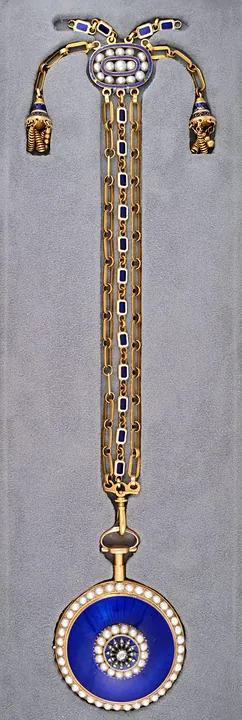
Pocket Watches · c. 1785
Pearl and Diamond Set Irish Verge with Chatelaine, circa 1785
Pieces of Time (dealer), London
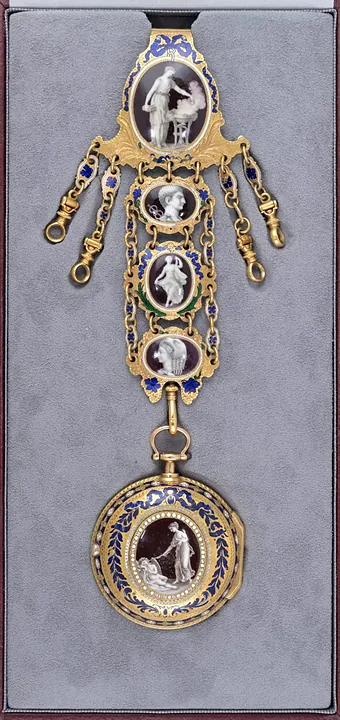
Pocket Watches · 1766 (hallmarked Chester)
Irish Gold and Enamel Chatelaine Watch, 1766
Pieces of Time (dealer), London
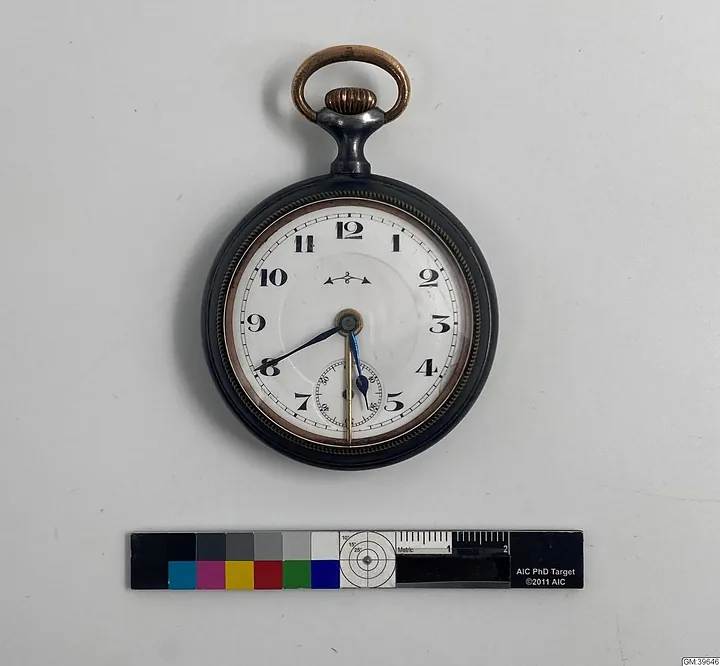
Pocket Watches · 1800–1899
Alarm pocket watch by Eterna w, Gothenburg, 1800–1899
Museum of Gothenburg
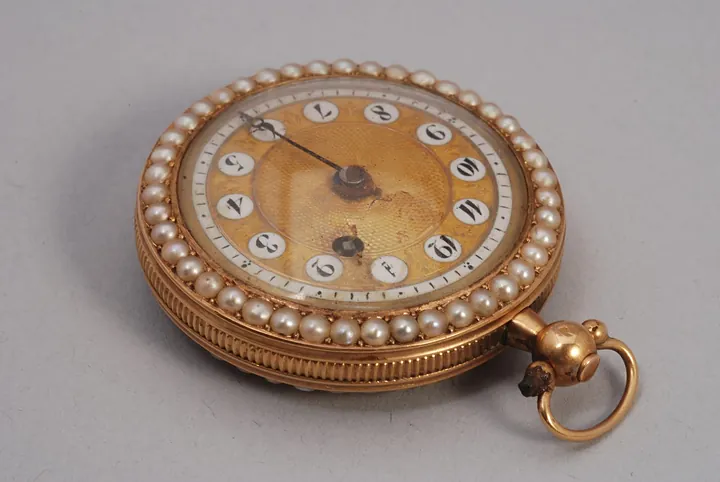
Pocket Watches · 1820
Pocket watch by Chevalier & Cochet, 1820
Museum Rotterdam
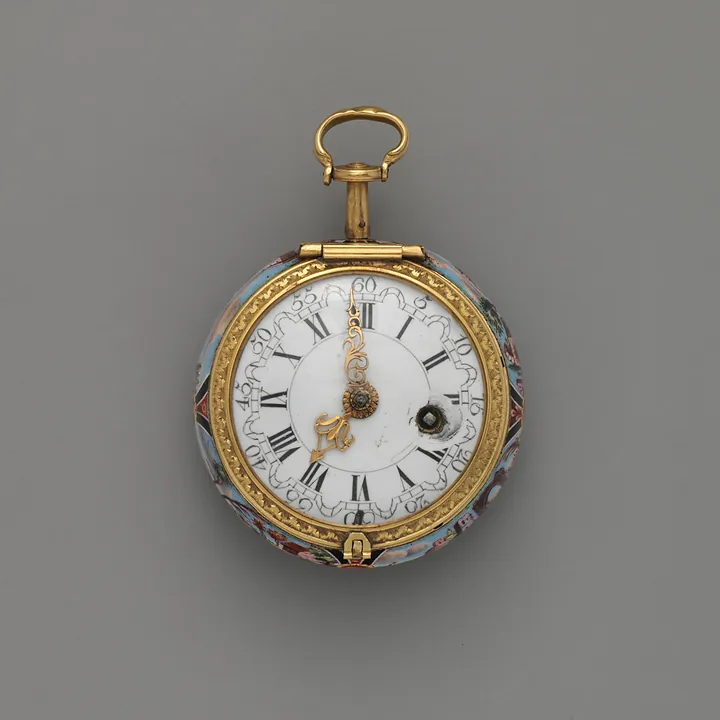
Pocket Watches · c. 1740–60
Watch by Charles Cabrier II, England, c. 1740–60 (The Met 17.190.1458)
The Metropolitan Museum of Art, New York
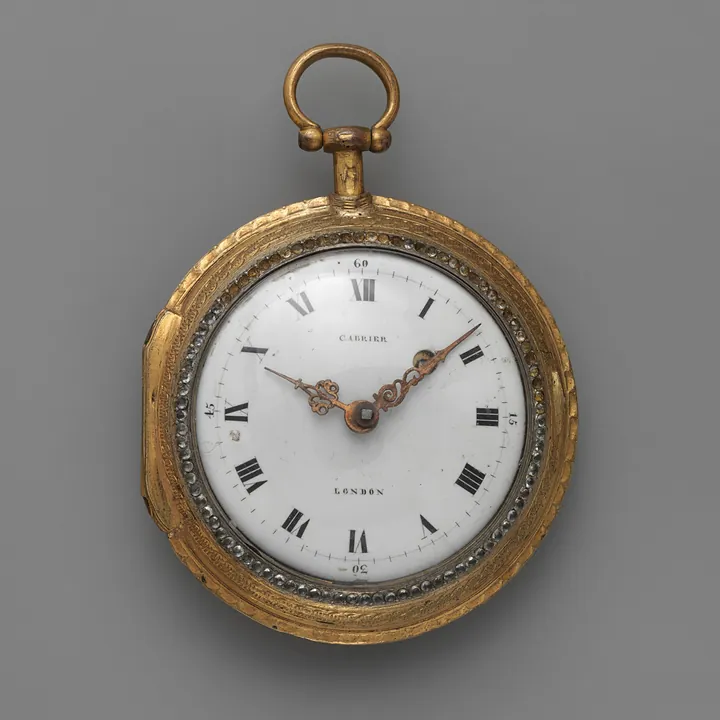
Pocket Watches · c. 1740–60
Watch by Charles Cabrier II, England, c. 1740–60 (The Met 17.190.1461)
The Metropolitan Museum of Art, New York
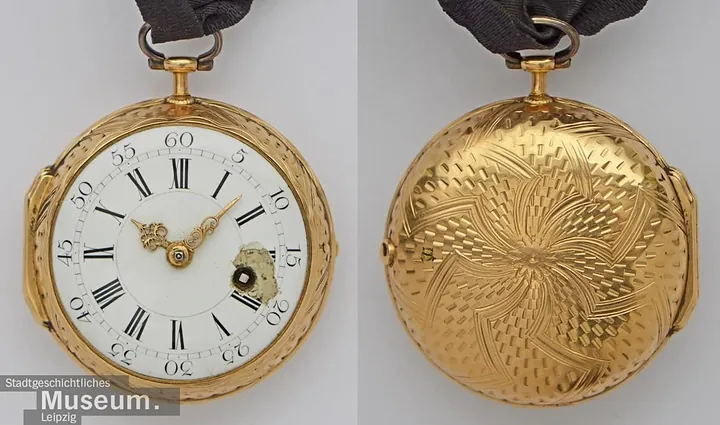
Pocket Watches · 1745–1755
Pocket watch by Jean Baptiste Baillon, France, 1745–1755
Museum of City History Leipzig
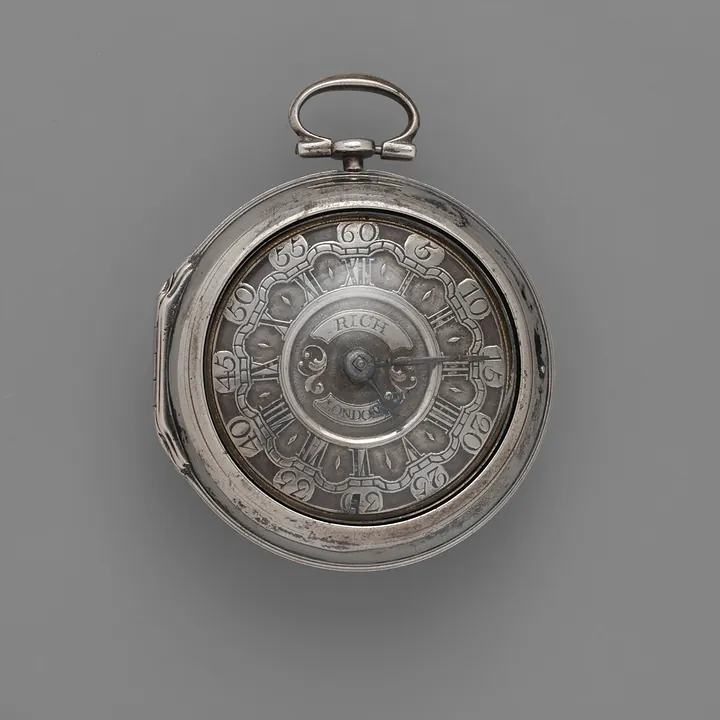
Pocket Watches · c. 1751–52
Watch by John Rich, England, c. 1751–52
The Metropolitan Museum of Art, New York