
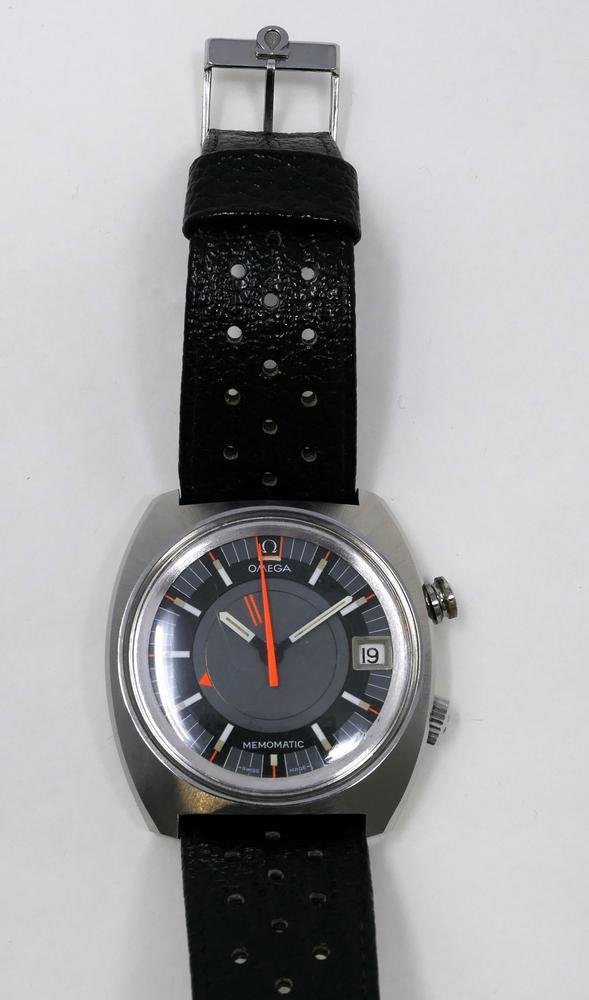
Wristwatches · Alarm watch
Automatic winding centre-seconds club-tooth wrist-watch with date mechanism. Stainless-steel case and black leather strap
- Maker / attribution
- Omega Watch Company (Made by)
- Date
- 1969–1970
- Historical period
- Quartz Revolution (1969 – 1990)
- Country of origin
- Switzerland
- Place
- Biel
- Object type
- Alarm watch
- Dimensions
- Diameter: 32.20 millimetres (dial) Length: 42 millimetres (case) Length: 231 millimetres (strap) Thickness: 14.80 millimetres Width: 39.50 millimetres (case)
- Holding institution
- British Museum
- Accession / object no.
- 1988,0601.5
- Credit line
- British Museum, London
- Catalogue title (original)
- Automatic winding centre-seconds club-tooth wrist-watch with date mechanism. Stainless-steel case and black leather strap (English)
View the source record ↗ (opens another website in a new tab)Suggest a correction
Record summary
Held and catalogued by British Museum (object number 1988,0601.5), this is an alarm watch by Omega Watch Company, made in Biel, Switzerland, dated 1969–1970. The Atlas places it in the Quartz Revolution period (1969 – 1990) of its Wristwatches collection. Recorded dimensions: Diameter: 32.20 millimetres (dial) Length: 42 millimetres (case) Length: 231 millimetres (strap) Thickness: 14.80 millimetres Width: 39.50 millimetres (case). The record is illustrated with 5 photographs.
Assembled from the source record's structured fields. Dates and attributions are given as the source states them; where a field is missing the Atlas leaves it blank rather than estimating.
Catalogue description
Description — British Museum
Automatic winding centre-seconds club-tooth wrist-watch with date mechanism. Stainless-steel case and black leather strap. Grey and black painted-metal dial with luminous-painted baton hour markers; revolving central disc and ring with orange indicators allow the alarm to be set to the minute. Luminous-painted hour and minute hands; orange-painted centre-seconds hand. Stainless-steel case with screw-on back; stylised sea-horse and trade-mark. Black leather wrist-strap with punched hole decoration; stainless-steel buckle.
Curator's comments — British Museum
Comment from Richard Good, Catalogue of Watches in the British Museum. Vol. V (Unpublished manuscript) Made by Omega Watch Co. Switzerland, c. 1970 Self winding wrist watch with alarm work and date indication, with a club tooth lever escapement. Signature: On the dial "OMEGA MEMOMATIC - SWISS MADE", also the trade mark the Greek letter omega. On the self winding weight "OMEGA SWISS NINETEEN 19 JEWELS". On the cock for the self winding ratchet wheels the number 30019135. Case: A stainless steel two part case. On the screw back is "SEAMASTER" and the Greek letter omega and a mythical sea beast, part horse. Inside the back is again the Greek letter omega and "OMEGA WATCH Co". Within a triangle is "FAB SUISSE MADE ACIER INOXYDABLE 166.072", and a trade mark, a representation of a keyhole. In addition to the winding button there are two push buttons in the case band. The original Omega strap is still fitted, the buckle bearing the Greek letter for omega and marked on the back "ACIER INOX" with a representation of the sun and "SWISS". Dial & Hands: The dial painted in grey and black. An inner grey ring with a double red baton for the alarm hour with outside of this an annular ring also in grey with a red triangle for the alarm minutes.(1) The black chapter ring has white batons with luminised ends for the hours. Between the batons three minute divisions are picked out in grey. The hands are black and are skeletonised but are mainly covered in luminous compound. The centre seconds hand is painted red. Movement: Ebauche Marks: The Greek letter for omega and the number 980. Frame: The plates are pink gilt. There is a bridge for the barrel and gear train, another for the self winding gears and alarm operating cam. There is a bridge for the pallets and a cock for the balance. Barrel and Mainspring: The barrel is sealed and has an external diameter of 11 mm., and an external height of 1.75 mm. The barrel drives both the going and the alarm trains and has a slipping mainspring. Train: All the wheels gilded, the centre, third and fourth wheels with five crossings. A high quality train. Jewelling: Jewelled bearings from the centre wheel onwards, all the jewels pressed in. 'Incabloc' shock resistant jewelling to the balance. The multi gear stack pivots are also jewelled. Escapement: A straight line layout, club tooth lever escapement with short lever, double roller and D-shaped impulse pin. The exposed pallet stones have flat acting faces. A steel escape wheel with four crossings. A mixed escapement. No. of teeth embraced 3½. Balance & Spring: a three arm monometallic balance without screws. Balance diameter 10.6 mm., thickness 0.62 mm. A 'self compensating' flat spiral spring with 12 turns and a Greiner collet.(2) Means of Regulation: An index on the balance cock registers against a divided scale and controlled micrometrically by an eccentrically headed screw. Train Counts and Beat Rate: Great wheel 92 (barrel) Centre wheel 64 pinion 12 Third wheel 75 pinion 8 Fourth wheel 96 pinion 10 Escape wheel 15 pinion 8 Beat rate 21,600 Motion work: cannon pinion 12 minute wheel 32, minute pinion 10 hour wheel 45 Self Winding Train: Weight wheel 56 driving 35 and 26 Multi stack:- Twin wheels 50 pinion 10 Planet wheel 15 Internal plastic contrate wheel 40 Plastic alarm hammer driving wheel 8 Inter wheel driving pinion 8 Inter wheel 66 pinion 10 Barrel ratchet wheel 50 The self winding work: This watch has a geared reduction system between the weight and the barrel that is unusually complex since it incorporates the alarm train. The description is based around a schematic drawing in the interests of clarity:- A an B are solid with pinion G and through the agency of the clicks that lie between them will revolve the pinion G in one direction only regardless of the direction of rotation of the weight ???. The plastic wheel PW is two part. One part operates the alarm hammer and the other is a contrate wheel with internally cut teeth. Whilst the alarm is not operating the plastic wheel is stationary and as a result the planetary pinion E which is integral with pinion F will be caused to rotate. It will thus complete the route for self winding to occur. However with the alarm released the barrel ratchet H will revolve because it can then turn the plastic wheel PW. It will be able to do this since it will turn pinion F the disc and the pinion E which is mounted on it and which in turn will revolve around pinion G. Of course during this period the self winding train will not be able to wind. The barrel arbor can only turn for just under one revolution in driving the alarm hammer since it is limited by a finger K revolving beneath the small ratchet wheel which is situated at the other end of the barrel arbor. The ratchet wheel J has a stop pin L integral with it. Calendar work: Intermediate wheel 21, pinion 14, calendar indexing wheel 60. Calendar (hour) disc gear 42, calendar (minute) disc pinion 10, fixed disc 110. Under dial alarm work: Y is the gear fixed to the hour alarm setting disc, but as this revolves it causes pinion X to rotate about a fixed gear Z. Pinion X is mounted on wheel W1 which in turn drives wheel W2 which is integral with the minute alarm setting disc. Pinion X has 10 leaves , the fixed gear Z has 110 teeth which through the epicyclic motion gives the correct ratio of 12:1. Winding and Setting System: Most unusual keyless work with three settings:- 1: With the side button pushed in then the button on the stem effects winding. The stem of this button is in two parts with a snap connection. 2: When the stem is pulled out then the hands can be set. 3: With the stem pulled out and also the side button pulled out the alarm discs can be set. Dimensions: Case diameter 40.0 mm., height 14.7 mm., over the glass. Movement diameter 31.4 mm., height 9.5 mm. Provenance: Purchased in 1986 with the aid of funds from the Dingwall Bequest. Notes: (1) The only mechanical alarm watch that can be set to the minute. (2).
Inscriptions & marks
inscription; SEAMASTER [outside case]; inscription; inside case back; OMEGA WATCH CO FAB SUISSE SWISS MADE ACIER INOXYDABLE 166.072; inscription; Omega [dial, surmounted by trade-mark]; inscription; MEMOMATIC SWISS MADE [dial]; inscription; OMEGA SWISS NINETEEN 19 JEWELS [winding weight]; inscription; ACIER INOX SWISS [buckle]; inscription; movement; 30019135
Provenance
Purchased from:, James Dowling
Historical context
Quartz Revolution (1969 – 1990)
Seiko's Astron begins mass quartz timekeeping; traditional industries contract sharply.
Quartz and digital watches transformed the market after 1969. Swiss employment collapsed, Japanese and Hong Kong production soared, and the Swatch (1983) helped the Swiss industry recover; mechanical watches survived as luxury goods.
Read the period in the timelineMore wristwatches from this periodEarlier: Modern Mechanical Horology
Atlas type guide
Automatic (self-winding) watches
Self-winding watches use the wearer's motion to wind the mainspring. Abraham-Louis Perrelet and Breguet made 'perpétuelle' pocket watches with oscillating weights in the late eighteenth century, but the principle only became practical in the wristwatch. John Harwood patented a bumper automatic in 1923; Rolex's Perpetual rotor (1931) winding in one direction, and later bidirectional rotors (Eterna, Felsa Bidynator), established the modern form. Micro-rotors (Universal Genève, Buren) and peripheral rotors made automatic watches thinner.
What to look for
- A semicircular rotor turning 360° over the movement, or a 'bumper' weight that rebounds between springs.
- 'Automatic', 'Perpetual' or 'Self-winding' on the dial.
- A sealed screw-back case, since automatic watches are wound less often by the crown.
Dating clues
- Bumper automatics: 1923–c. 1955.
- Full rotors: from 1931 (Rolex); widespread after c. 1950.
- Micro-rotors: from 1954–1958.
General guidance written by the Atlas editors about this kind of object. It is not a statement about this particular piece; for that, rely on the source record above and on physical examination.
Related records
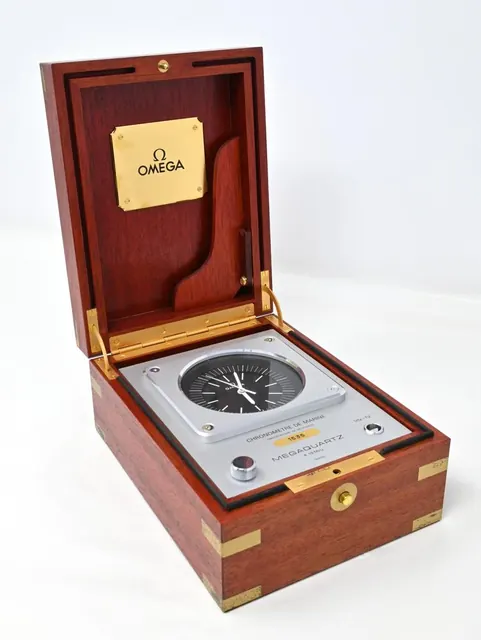
Instruments · 1983
Omega 'Megaquartz' marine-chronometer
British Museum
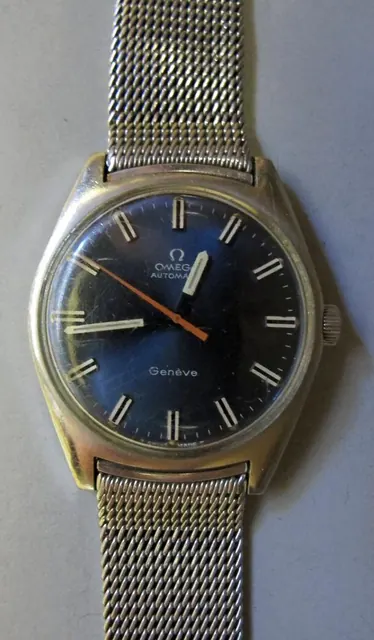
Wristwatches · c. 1970 (purchased new)
Omega 'Automatic Genève' stainless steel wrist-watch
British Museum
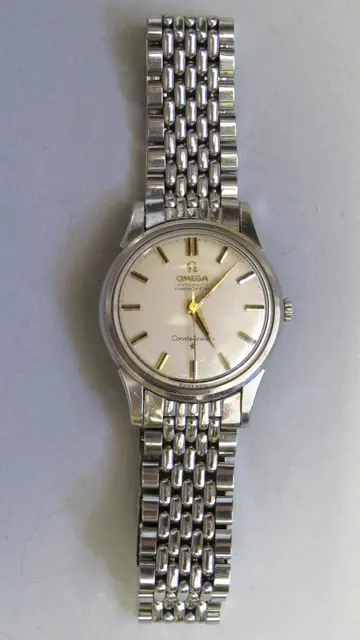
Wristwatches · c. 1962 (purchased new)
Omega 'Automatic Chronometer Constellation' stainless steel wrist-watch
British Museum
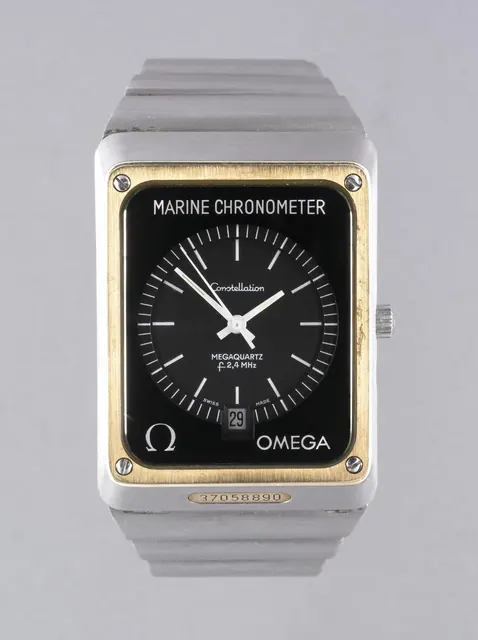
Wristwatches · 1976
Omega 'Constellation Megaquartz' Wrist-watch
British Museum

Wristwatches · 1970
Wristwatch by Heno, Switzerland, 1970
Museum Rotterdam

Wristwatches · 1960–1986
'Tri-Compax' calendar chronograph wristwatch in gold case, by Universal, Geneva, Switzerland, 1960–1986.
Science Museum Group, London

Wristwatches · 1969–1970
Beta 21 Quartz wristwatch movement, made in Switzerland, 1970.
Science Museum Group, London

Wristwatches · c. 1969
Omega Speedmaster Moonwatch, ref. 145022-69st, c. 1969
Antiquorum auction archive, Geneva