
Wristwatches · Wrist-watch
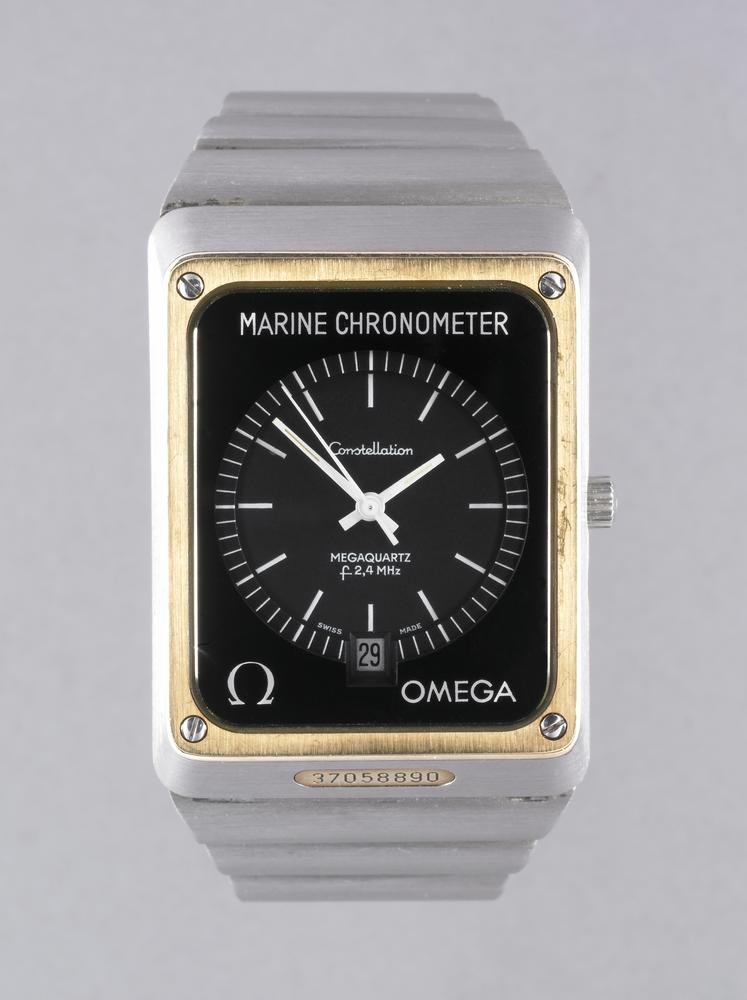
Omega 'Constellation Megaquartz' Wrist-watch
- Maker / attribution
- Omega Watch Company (Made by)
- Date
- 1976
- Historical period
- Quartz Revolution (1969 – 1990)
- Country of origin
- Switzerland
- Place
- Switzerland
- Object type
- Wrist-watch
- Materials / technique
- stainless steel
- Dimensions
- Length: 44.20 millimetres (case) Width: 32.50 millimetres (case)
- Holding institution
- British Museum
- Accession / object no.
- 2000,0707.1
- Credit line
- British Museum, London
- Catalogue title (original)
- Omega 'Constellation Megaquartz' Wrist-watch (English)
View the source record ↗ (opens another website in a new tab)Suggest a correction
Record summary
Held and catalogued by British Museum (object number 2000,0707.1), this is a wrist-watch by Omega Watch Company, made in Switzerland, dated 1976. The Atlas places it in the Quartz Revolution period (1969 – 1990) of its Wristwatches collection. Materials and techniques recorded by the source: stainless steel. Recorded dimensions: Length: 44.20 millimetres (case) Width: 32.50 millimetres (case). The record is illustrated with 2 photographs.
Assembled from the source record's structured fields. Dates and attributions are given as the source states them; where a field is missing the Atlas leaves it blank rather than estimating.
Catalogue description
Description — British Museum
Omega 'Constellation Megaquartz' Wrist-watch. Rectangular satinless-steel case with chamferred sides and a gold surround to the dial retained by four corner screws.The stainless steel back is also secured by four screws. Stainless steel flexible bracelet with adjustable clasp. The case back and bracelet clasp are both marked with the Omega trade mark. On one side a serial number in a gold oval reserve. A recessed reset button and a knurled hand-setting button in the case. Black enamel? dial surround with a recessed centre for a matt black dial with white baton hour markers, the recess for the dial is also calibrated for seconds around the edge. A small cut away at the bottom reveal a date indicator. The dial also has the maker's name and the product name above and below the centre. Battery powered quartz movement with jewelled motion work. With the watch a Besançon Observatory rating certificate dated 7th December 1976 and a guarantee from Spritzer + Fuhrmann, 15th November 1980.
Curator's comments — British Museum
Text from 'Watches', by David Thompson, London, 2008, p. 162-163. Omega Watch Company STAINLESS STEEL AND GOLD CASED WRISTWATCH LA CHAUX DE FONDS, c. 1980 SIGNED: 'Marine Chronometer Constellation Megaquartz f 2, 4 MHz Omega' (on the dial); '37058890' (on the case bezel) The first use of a quartz crystal in a horological context was in 1921, when Professor Walter G. Cady employed one to control the frequency of a tube oscillator or valve. His research derived from the observation by Pierre and Jacques Curie in 1880 of the piezoelectric effect, wherein a quartz crystal deforms when an electric current is applied to it, and if the electric current is phased correctly it will resonate at a very constant frequency, at the same time producing an electric potential at that frequency. The significance of this is that the frequency of vibration and of electrical emission is high and stable. Over the next decade further research culminated in the first quartz-controlled device, invented in 1932 by Warren Marrison and used by Bell Telephone to control radio transmissions. The concept of using a quartz crystal as a timekeeper was established when it was realized that the frequency of the crystal was more accurate than that of the Shortt Free Pendulum clocks then in use as the time standard. The quartz watch derives from these origins. Before the Second World War, quartz oscillators were large - almost room-sized - but by 1964 small, domestic-scale quartz-controlled clocks became available, and the following year a number of quartz-controlled pocket watches were submitted to the Neuchâtel observatory for assessment. More research and experimentation followed, the results of which were truly remarkable. The modern watch was born out of these experiments and developments. Now most watches contain a tuning-fork-shaped quartz crystal, which oscillates at a frequency of 32,768 cycles per second. This means that the crystal emits an electrical impulse at the same frequency and, using frequency dividers, the number of electrical impulses is halved until a suitable frequency is reached, usually one per second. This can then be used to activate a miniature stepping motor, which will advance the watch hands once per second. Like the earlier electronic and tuning-fork watches, the quartz watch relied on the development of a suitably miniaturized battery to provide the power, but also needed miniaturized electronics to perform the frequency division. The first company to develop and manufacture a commercial quartz wristwatch was the Suwa Seikosha Company (Seiko) in Japan, which in 1969 launched its model 3500 series, based on the SQ35, an earlier prototype developed in 1967. The Omega Watch Company has its origins in the watch business founded by Louis Brands in 1848, beginning with a watch assembly workshop in La Chaux de Fonds. The company then opened a watch manufactory, which expanded to become Switzerland's largest by the end of the nineteenth century. It is said that the name Omega was coined by a company accountant, Henri Rieckel, for a new design that went on sale in 1894. Such was the name's success that the company adopted it as its brand name from 1903 onwards. Omega continued to make a wide range of high-quality mechanical watches. Unsurprisingly they also moved into the field of quartz watches, launching their first model, the Megaquartz 2400, at the Basel International Fair in 1970. Just four years later the Megaquartz marine chronometer wristwatch was launched, the first to be classified as a marine chronometer. The first version in 1970 contained Omega's 1500 movement, but later models used its 1511 and 1516 designs. Their accuracy was based on a quartz crystal with a frequency of 2.4 megahertz. A watch submitted for trial at the Neuchâtel observatory achieved a phenomenal accuracy of less than one second per month. With some sources claiming a mean variation of just 0.002 seconds per day for the Megaquartz marine chronometer, declarations that it was the most accurate wristwatch in the world were probably well founded.
Inscriptions & marks
maker's mark; dial surround; MARINE CHRONOMETER; OMEGA; maker's mark; dial; Constellation; MEGAQUARTZ; f 2,4 MHz; maker's mark; case side; 37058890; maker's mark; movement back; OMEGA SWISS (with the Omega trade mark); maker's mark; MOVEMENT BACK; THIRTEEN; 13 JEWELS; OMEGA; SWISS; maker's mark; movement back; 1516; 37058890; (with an Omega trade mark); trade mark; outside case back and on bracelet clasp; An Omega sign; maker's mark; inside bracelet clasp; 11 STAINLESS STEEL; 1209/202; OMEGA; (with an omega sign within a triangle); maker's mark; Inside case back; OMEGA WATCH CO.; FAB. SUISSE; SWISS MADE; ACIER INOXYDABLE; S.F.; 198 0082; 398 0832
Provenance
Donated by:, James Dowling
Historical context
Quartz Revolution (1969 – 1990)
Seiko's Astron begins mass quartz timekeeping; traditional industries contract sharply.
Quartz and digital watches transformed the market after 1969. Swiss employment collapsed, Japanese and Hong Kong production soared, and the Swatch (1983) helped the Swiss industry recover; mechanical watches survived as luxury goods.
Read the period in the timelineMore wristwatches from this periodEarlier: Modern Mechanical Horology
Atlas type guide
Quartz, digital and electronic watches
Electronic watches arrived in three steps. The Hamilton Electric 500 (1957) was the first battery-powered wristwatch, still with a balance; Bulova's Accutron (1960) used a tuning fork. On 25 December 1969 Seiko released the Astron 35SQ, the first quartz wristwatch, closely followed by the Swiss Beta 21 group. In 1972 Hamilton's Pulsar introduced the LED digital watch, and LCD displays soon made digital watches cheap.
The 'Quartz Crisis' that followed devastated the Swiss mechanical industry, which lost two-thirds of its workforce between 1970 and 1984 before recovering with the Swatch (1983) and the luxury mechanical revival. Solar, radio-controlled, kinetic and connected smartwatches continue the electronic line.
What to look for
- Battery hatch in the case back and calibre markings with 'Quartz' or a crystal frequency.
- Display technology: LED (red, push-button) versus LCD (always-on).
- Tuning-fork hum and a smoothly sweeping seconds hand on Accutrons.
- Model and reference numbers, often printed on the back.
Dating clues
- Electric balance watches: from 1957.
- Tuning-fork watches: 1960–c. 1977.
- Quartz analogue: from December 1969; LED digital: 1972–c. 1978; LCD from 1973.
General guidance written by the Atlas editors about this kind of object. It is not a statement about this particular piece; for that, rely on the source record above and on physical examination.
Read next:Seiko calibre 35A (Astron)
Related records
Instruments · 1983
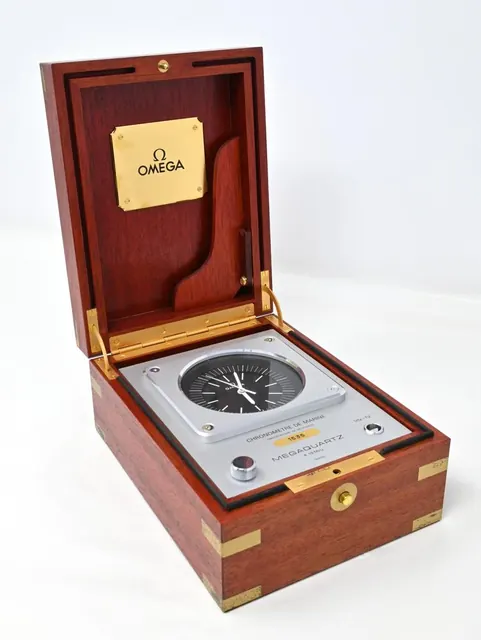
Omega 'Megaquartz' marine-chronometer
British Museum
Wristwatches · c. 1970 (purchased new)
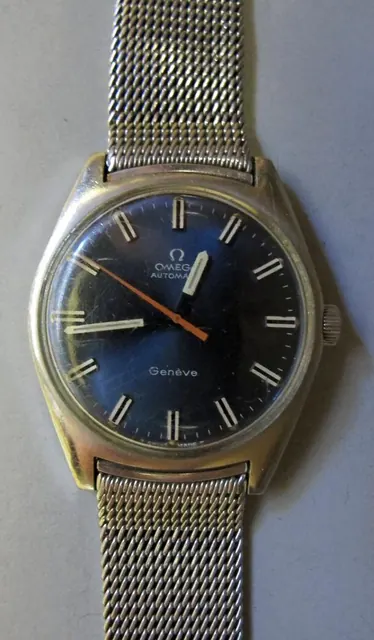
Omega 'Automatic Genève' stainless steel wrist-watch
British Museum
Wristwatches · 1969–1970
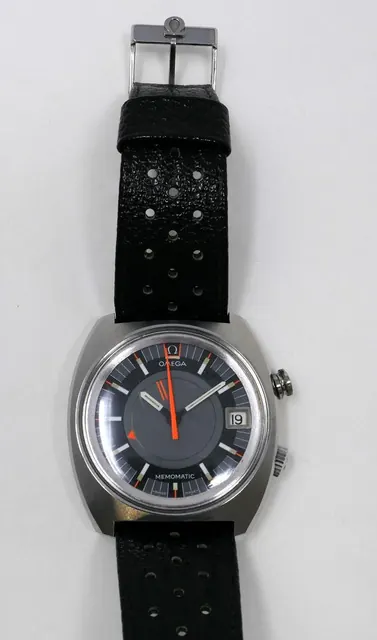
Automatic winding centre-seconds club-tooth wrist-watch with date mechanism. Stainless-steel case and black leather strap
British Museum
Wristwatches · c. 1962 (purchased new)
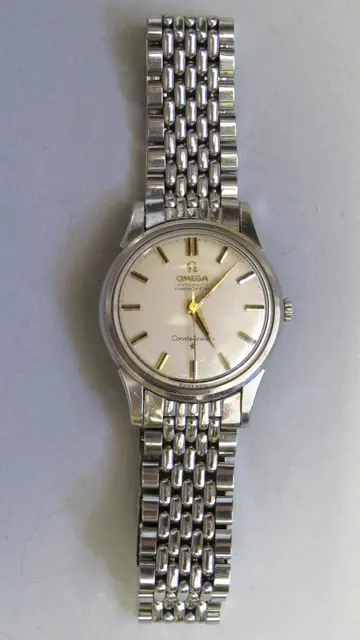
Omega 'Automatic Chronometer Constellation' stainless steel wrist-watch
British Museum

Wristwatches · 1970
Wristwatch by Heno, Switzerland, 1970
Museum Rotterdam

Wristwatches · 1960–1986
'Tri-Compax' calendar chronograph wristwatch in gold case, by Universal, Geneva, Switzerland, 1960–1986.
Science Museum Group, London

Wristwatches · 1969–1970
Beta 21 Quartz wristwatch movement, made in Switzerland, 1970.
Science Museum Group, London

Wristwatches · c. 1969
Omega Speedmaster Moonwatch, ref. 145022-69st, c. 1969
Antiquorum auction archive, Geneva