
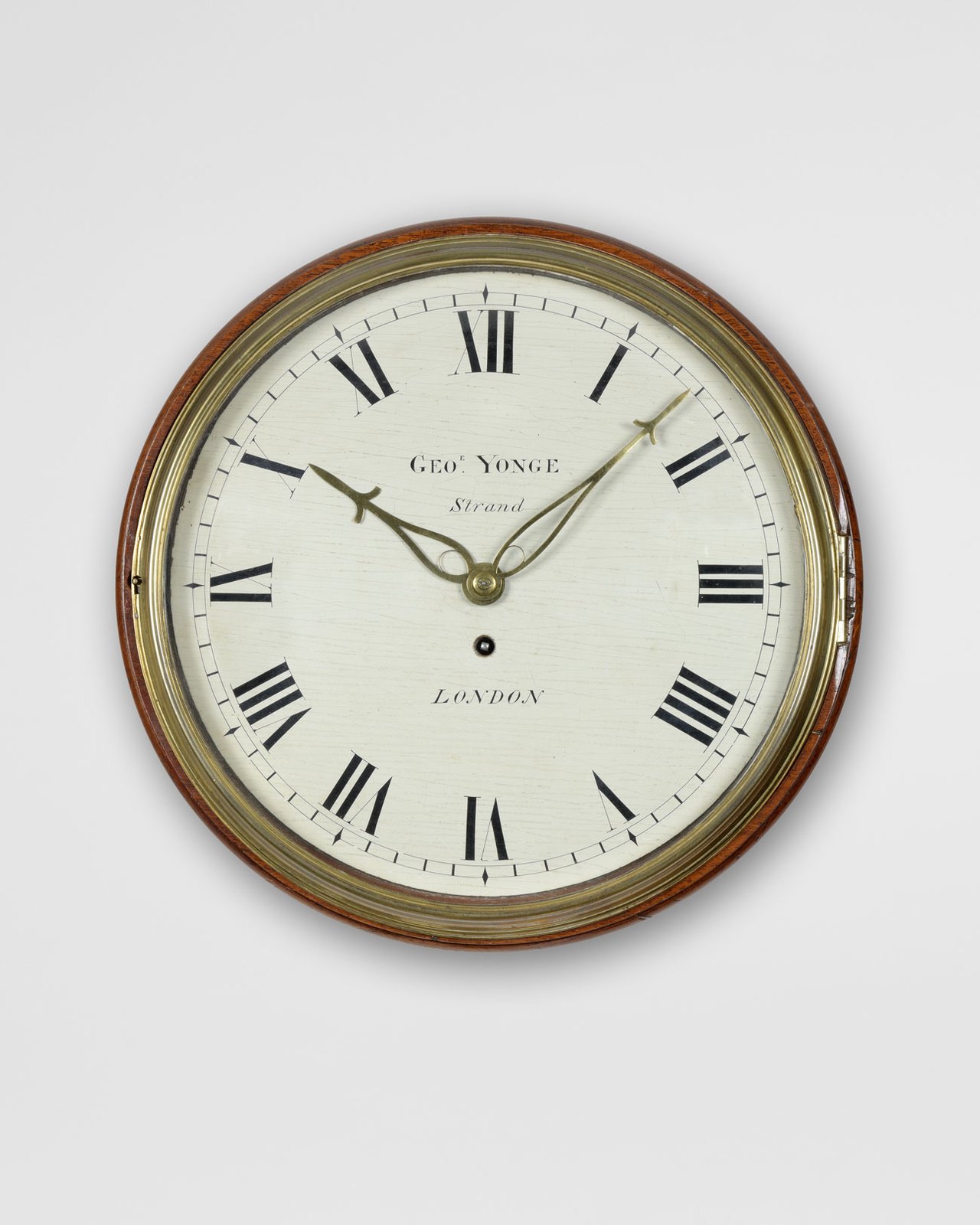
Clocks · Wall clock
Wall clock by George Yonge, c. 1816
- Maker / attribution
- George Yonge (maker)
- Date
- c. 1816
- Historical period
- Precision & Scientific Horology (1750 – 1850)
- Country of origin
- Unrecorded in source
- Object type
- Wall clock
- Materials / technique
- mahogany
- Stock no.
- Product 4874
- Credit line
- Dealer listing, Howard Walwyn (product 4874)
- Catalogue title (original)
- GEORGE YONGE. A fine Regency period mahogany fusee dial wall timepiece. (English)
View the source record (dealer listing) ↗ (opens another website in a new tab)Suggest a correction
Record summary
Catalogued by Howard Walwyn Fine Antique Clocks (dealer), London (stock number Product 4874), this is a wall clock by George Yonge, dated c. 1816. The Atlas places it in the Precision & Scientific Horology period (1750 – 1850) of its Clocks collection. Materials and techniques recorded by the source: mahogany. The record is illustrated with 2 photographs.
Assembled from the source record's structured fields. Dates and attributions are given as the source states them; where a field is missing the Atlas leaves it blank rather than estimating.
Catalogue description
Dealer description — Howard Walwyn
A fine Regency period mahogany fusee dial wall timepiece with wooden dial and with a movement supplied by Thwaites and Reed, London. The five pillar single fusee movement , with tapered plates measuring 7 ¾ inches high by 4 ¾ inches wide at the base, has an anchor escapement regulated by a lenticular bob pendulum. The frontplate is stamped T & R over serial number 5774 . The 12-inch circular integral cream painted Roman numeral wooden dial is inscribed GEO’E YONGE, Strand, LONDON to the centre and has pierced brass hands which are set behind a hinged convex glazed cast brass cavetto moulded bezel applied within slender caddy moulded wooden surround. The box case is secured by pegs incorporating a door to the right hand side and with a pendulum access flap to the curved underside. The rear of the dial panel is inscribed with notes for inscribing the dial for George Yonge dated 1816. Diameter : 14 ¼ in (36 cm) Depth : 7 in (18 cm) * George Yonge is recorded in G.H Baillie’s Watchmakers & Clockmakers of the World as a ‘fine maker’ working in London 1776-1815. Online sources indicate that he worked from 131 Strand, took his son into partnership in 1820 and worked up until 1832. Ainsworth Thwaites was apprenticed in 1735 and worked from Rosoman Row, Clerkenwell, London 1751-80. He was an accomplished maker who supplied the clock for the tower at the Horse Guards Parade. His son, John, was born in 1757 and took over the business presumably on the death of Ainsworth in 1780 before moving to Bowling Green Lane. He entered into partnership with Jeremiah Reed in 1808 and the firm subsequently became well known for supplying all forms of clocks and movements either wholesale for others to retail or signed by themselves. The partnership continued under John Thwaite’s leadership from several addresses in London until his death in 1842. The business has subsequently passed through a series of successors and is still trading today from Rottingdean near Brighton. Ronald E. Rose in his book English DIAL CLOCKS provides data allowing clocks by Thwaites and Reed to be dated from their serial number (Appendix III page 239); from this list the serial number of the movement of the current lot suggests that it was made around 1817. HW6571
Historical context
Precision & Scientific Horology (1750 – 1850)
Harrison solves longitude; Mudge invents the lever; Breguet's Paris workshop defines the modern watch.
The age of the deadbeat escapement, compensated pendulums and observatory regulators. Domestic clocks spread through the middle classes: English longcase and bracket clocks, French gilt-bronze mantel clocks, Viennese Biedermeier wall clocks, Black Forest painted-shield clocks, and the first American shelf clocks.
Read the period in the timelineMore clocks from this periodEarlier: Early Modern Horology
Atlas type guide
Regulators, wall and Vienna clocks
A regulator is a precision pendulum clock used as a time standard in observatories, workshops and railway offices. Typical features are a deadbeat or Graham escapement, a temperature-compensated pendulum (mercury jar, gridiron or later invar), maintaining power and a regulator dial that separates hours, minutes and seconds. George Graham's deadbeat escapement (c. 1715) and his mercury pendulum, together with Harrison's gridiron, set the pattern for two centuries.
Wall clocks span a much wider range: the elegant Viennese Laterndluhr and Dachluhr of the Biedermeier period, the Dutch stoelklok and staartklok, English 'dial' clocks used in schools, offices and railway stations, and mass-produced spring and weight wall clocks from Germany (Gustav Becker, Junghans, Kienzle) and America.
What to look for
- Deadbeat escapement and compensated pendulum (gridiron rods, mercury jar or wood rod).
- A regulator dial with a large central minute hand and separate hour and seconds dials.
- Vienna regulators: glazed cases, slender pendulum, small weights, enamel two-piece dials.
- German factory trademarks stamped on the backplate (e.g. Gustav Becker anchor and crown, Junghans star).
Dating clues
- Graham-type deadbeat regulators: from c. 1720.
- Viennese Laterndluhr: c. 1800–1850.
- German factory 'Vienna-style' regulators: c. 1870–1930; Gustav Becker serial numbers allow close dating.
General guidance written by the Atlas editors about this kind of object. It is not a statement about this particular piece; for that, rely on the source record above and on physical examination.
Related records
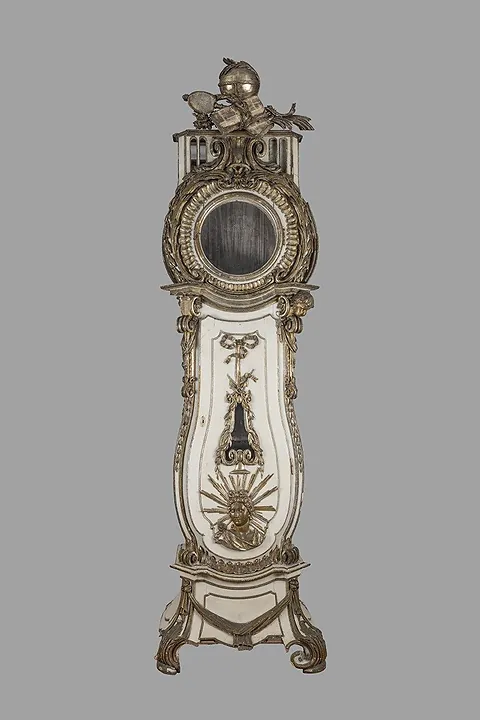
Clocks · c. 1780
Longcase clock by Louis George, Eberswalde, c. 1780
Museum Eberswalde
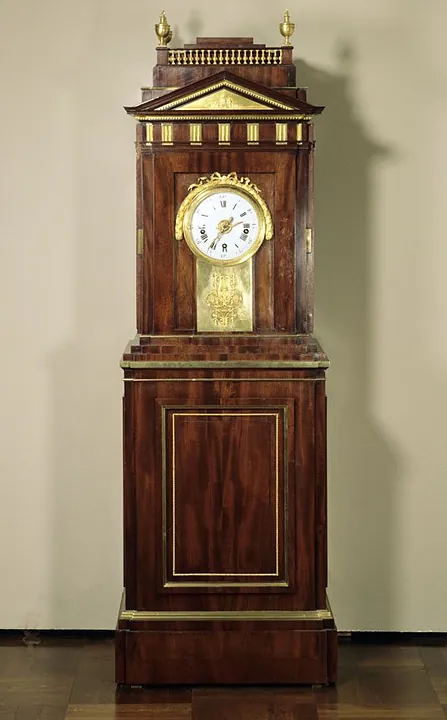
Clocks · 1780s (inferred: the museum dates the style to the 1780s and the music includes Gluck's Iphigénie en Tauride of 1779)
Musical longcase clock, Roentgen workshop, Neuwied, 1780s
Badisches Landesmuseum Karlsruhe
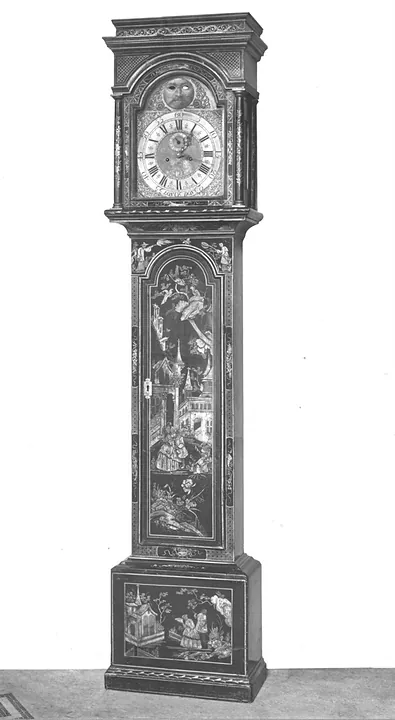
Clocks · 1740–1760
Longcase clock, English, 1740–1760, japanned wood, John Ellicott
Victoria and Albert Museum, London
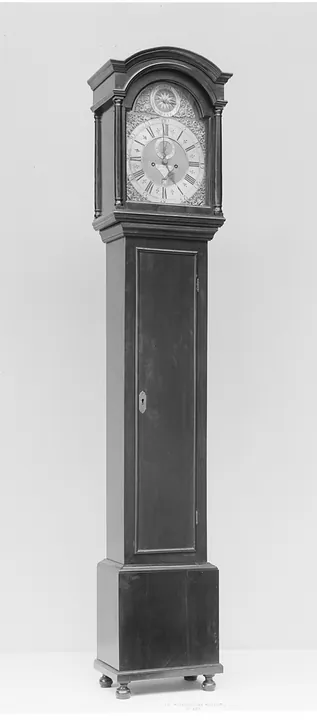
Clocks · 1740–60
Tall clock by Samuel Bagnall, United States, 1740–60
The Metropolitan Museum of Art, New York
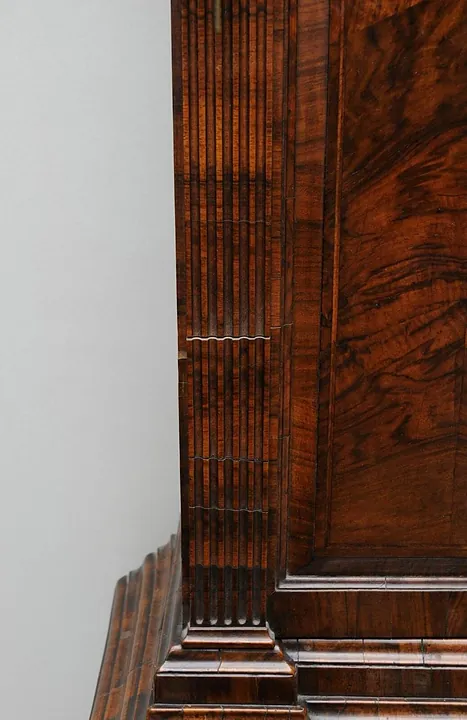
Clocks · c.1750
Long-case clock, English, ca. 1750, by Richard Peyton of Gloucester
Victoria and Albert Museum, London
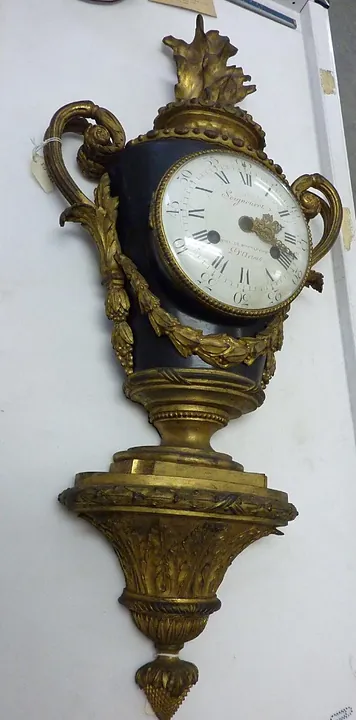
Clocks · 1750–1800
Bracket clock in metal case with scroll handles and flamed-shaped top signed by Pierre Seignoret, Clockmaket to the the Comte d'Artois
Victoria and Albert Museum, London
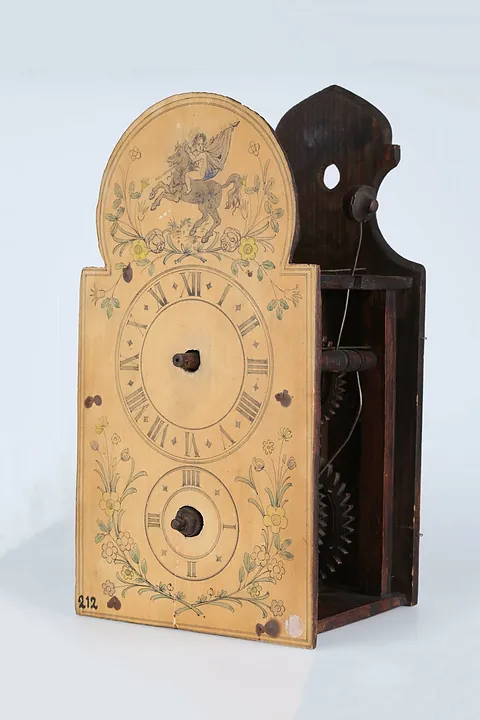
Clocks · c. 1750
Clock by Georg Gfell, Germany, c. 1750
German Clock Museum
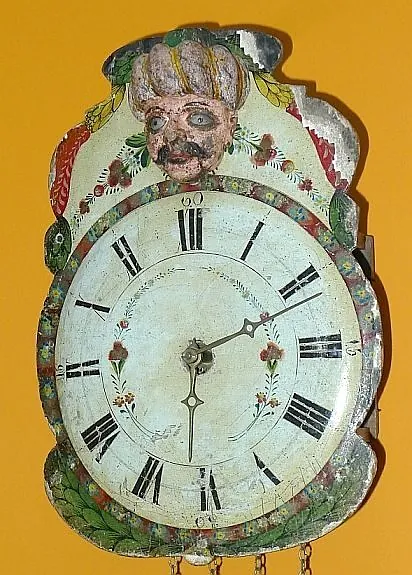
Clocks · 1750–1799
Cuckoo / black forest clock, Germany, 1750–1799
Badisches Landesmuseum Karlsruhe