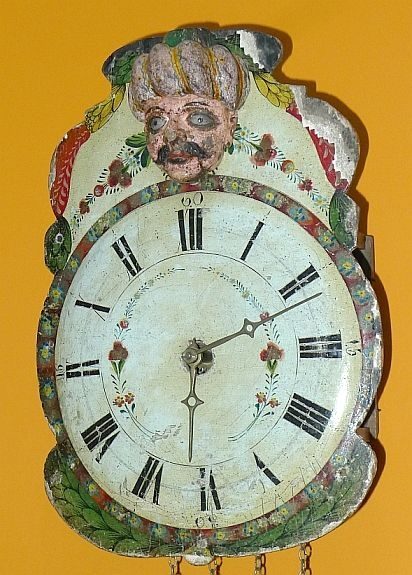
Clocks · Cuckoo / Black Forest clock
Cuckoo / black forest clock, Germany, 1750–1799
- Maker / attribution
- Unrecorded in source
- Date
- 1750–1799
- Historical period
- Precision & Scientific Horology (1750 – 1850)
- Country of origin
- Germany
- Place
- Schwarzwald
- Object type
- Cuckoo / Black Forest clock
- Holding institution
- Badisches Landesmuseum Karlsruhe
- Accession / object no.
- item_RQF5DWVBWWJXGQUSJWAXUAMNY3522XEV
- Catalogue title (original)
- Schwarzwalduhr mit Osmanen als Figurenautomaten, sog. Augenwenderuhr (German)
Record summary
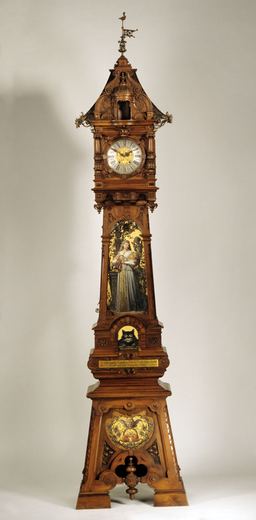
Held and catalogued by Badisches Landesmuseum Karlsruhe (object number item_RQF5DWVBWWJXGQUSJWAXUAMNY3522XEV), this is a cuckoo / black forest clock, made in Schwarzwald, Germany, dated 1750–1799. The Atlas places it in the Precision & Scientific Horology period (1750 – 1850) of its Clocks collection. The record is illustrated with 1 photograph.
Assembled from the source record's structured fields. Dates and attributions are given as the source states them; where a field is missing the Atlas leaves it blank rather than estimating.
Catalogue description
Catalogue description from Badisches Landesmuseum Karlsruhe (German)
Die Verwendung von Türkenfiguren als Automatenfiguren für Schwarzwalduhren beginnt im 18. Jh. und stellt eine ironische Brechung der Wirklichkeit dar. Denn bis zu den letzten Türkenkriegen im 18. Jh. galten die Soldaten des Osmanischen Reiches als der Inbegriff des Schreckens. In "harmlose Figuren" gewandelt, traten sie in der westeuropäischen Kulturgeschichte erst danach auf. Nun war die osmanische Kultur Gegenstand des politischen und kulturellen Diskurses, der publizistischen Auseinandersetzung, der Polemisierung und Verballhornung und vielfältiger kultureller Rezeptionen (Musik und Konsumgüter).Der sog. "Augenwender" ist eine beliebte Figur des Schwarzwälder Automatenbaus - die Augen sind mit dem Pendel synchronisiert. Beim Stundenschlag reißt die Figur den Mund auf. Das Lackschild würde für den Figurenautomaten ausgefräßt, war also ursprünglich nicht dafür gedacht. Offensichtlich hat der Kundenwunsch bzw. die Marktnachfrage zu dieser Anpassung geführt.
Shown in the original language of the source catalogue. An editor-reviewed English translation has not yet been published; we do not publish machine translations as authoritative text.
Historical context
Precision & Scientific Horology (1750 – 1850)
Harrison solves longitude; Mudge invents the lever; Breguet's Paris workshop defines the modern watch.
The age of the deadbeat escapement, compensated pendulums and observatory regulators. Domestic clocks spread through the middle classes: English longcase and bracket clocks, French gilt-bronze mantel clocks, Viennese Biedermeier wall clocks, Black Forest painted-shield clocks, and the first American shelf clocks.
Read the period in the timelineMore clocks from this periodEarlier: Early Modern Horology
Atlas type guide
Black Forest and cuckoo clocks
Clockmaking spread through the Black Forest in south-west Germany in the late seventeenth century as a winter occupation for farming families. Early clocks had wooden plates and wheels and a foliot ('Waaguhr') or short pendulum, with a painted wooden shield dial; pedlars (Uhrenträger) carried them across Europe. The cuckoo clock, which imitates the bird's call with two small bellows-driven pipes, appeared in the mid-eighteenth century.
The industry was organised around Furtwangen, Triberg, Schwenningen and Lenzkirch. The Furtwangen clockmaking school (1850) introduced the railway-house cuckoo clock design, and from the late nineteenth century factories such as Junghans, Kienzle and Hamburg-Amerikanische Uhrenfabrik produced clocks by the million. The German Clock Museum in Furtwangen preserves the region's history.
What to look for
- Wooden plates and wheels (earlier) versus brass movements (later).
- Painted shield dials (Lackschilduhr) with floral or figurative decoration.
- Cuckoo bellows and pipes, the carved 'railway house' or hunting-scene case.
- Trademarks and movement stamps of Black Forest factories.
Dating clues
- Wooden-wheeled foliot clocks: c. 1680–1750.
- Painted shield clocks: c. 1780–1880.
- Railway-house cuckoo clocks: after 1850; carved hunting-style cases after c. 1860.
General guidance written by the Atlas editors about this kind of object. It is not a statement about this particular piece; for that, rely on the source record above and on physical examination.
Read next:FoliotAnchor (recoil) escapement
Related records
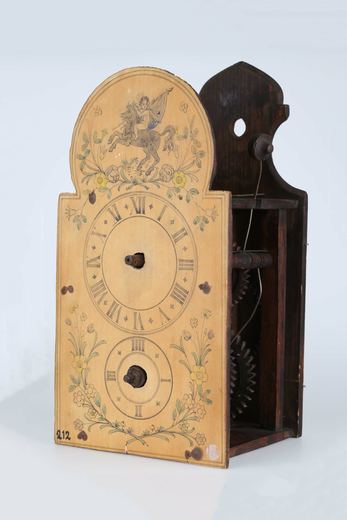
Clocks · 1750
Clock by Georg Gfell, Germany, 1750
German Clock Museum
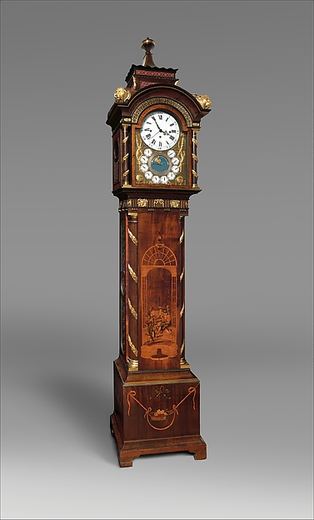
Clocks · ca. 1774–75
Longcase clock by Hermann Achenbach, Germany, ca. 1774–75
The Metropolitan Museum of Art, New York
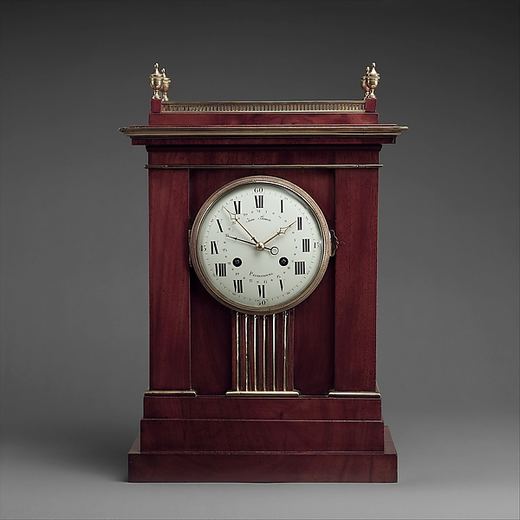
Clocks · ca. 1780–90
Clock by Workshop of David Roentgen, Germany, ca. 1780–90
The Metropolitan Museum of Art, New York
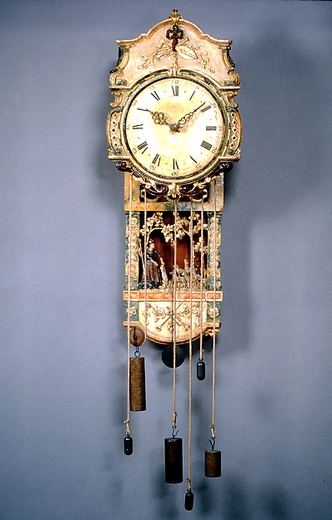
Clocks · ca. 1800
Musical clock by Martin Vanlo?, Germany, ca. 1800
The Metropolitan Museum of Art, New York
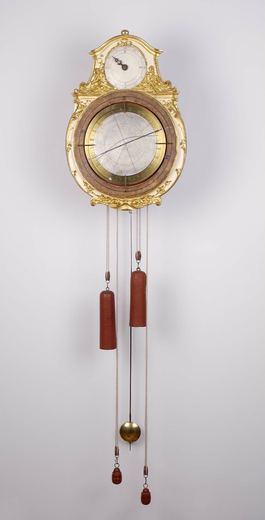
Clocks · 1787
Astronomical clock, Germany, 1787
German Clock Museum
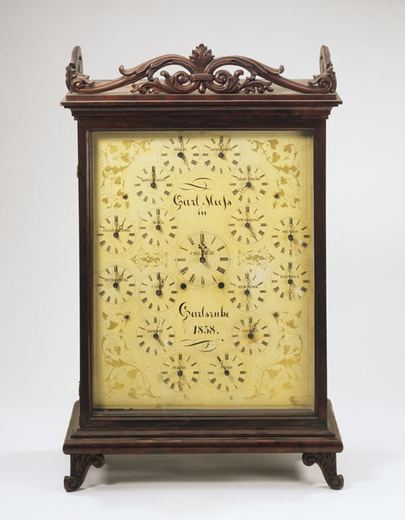
Clocks · 1800–1899
Clock by Carl Meeß, Germany, 1800–1899
Badisches Landesmuseum Karlsruhe
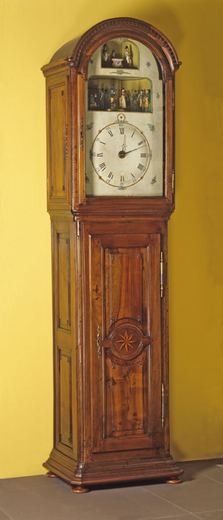
Clocks · 1800–1899
Clock by Ignaz Bruder, Germany, 1800–1899
Badisches Landesmuseum Karlsruhe
Clocks · 1800–1899
Longcase clock by August Gehrig, Germany, 1800–1899
Badisches Landesmuseum Karlsruhe