Clocks · Astronomical clock
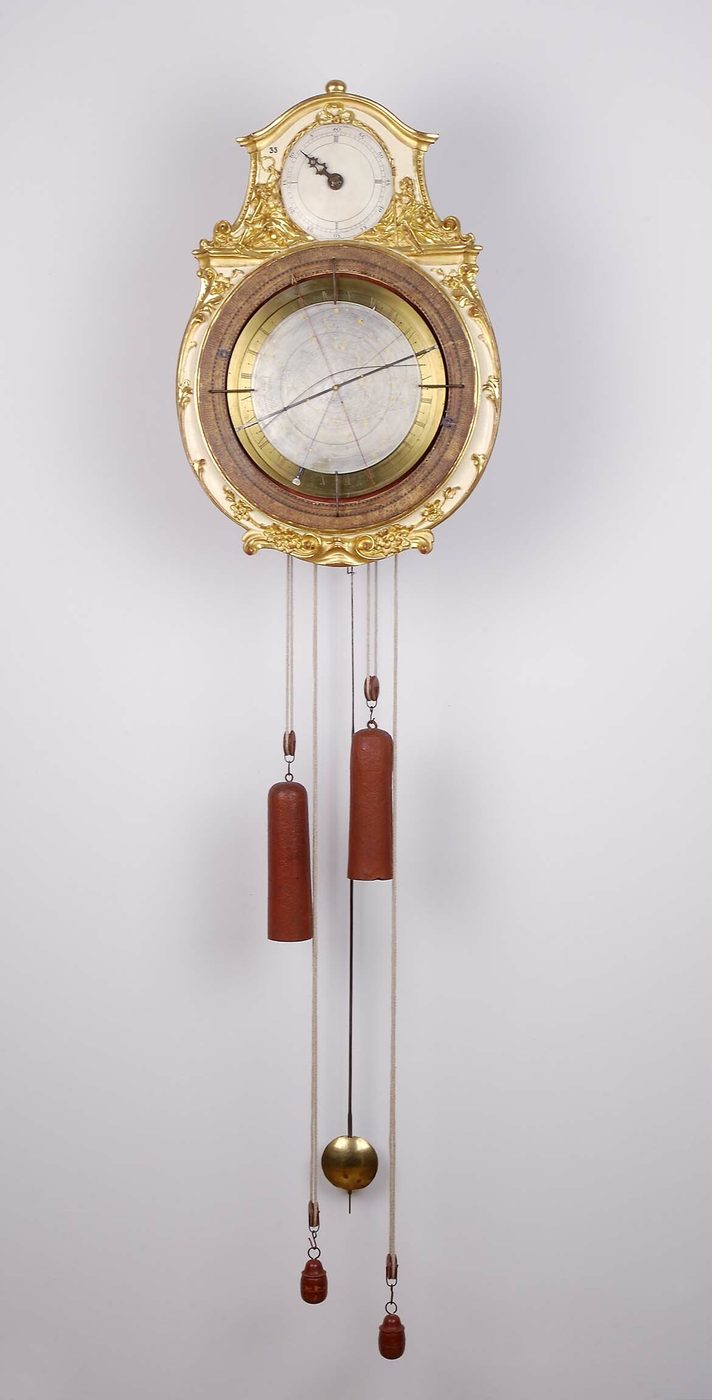
Astronomical clock, Germany, 1787
- Maker / attribution
- Unrecorded in source
- Date
- 1787
- Historical period
- Precision & Scientific Horology (1750 – 1850)
- Country of origin
- Germany
- Place
- Germany
- Object type
- Astronomical clock
- Holding institution
- German Clock Museum
- Accession / object no.
- Museu_ProvidedCHO_museum_digital_57908__technical_number_
- Catalogue title (original)
- Astronomische Uhr, Thaddäus Rinderle, Matthias Faller, St. Peter, 1787 (German)
Record summary
Held and catalogued by German Clock Museum (object number Museu_ProvidedCHO_museum_digital_57908__technical_number_), this is an astronomical clock, made in Germany, dated 1787. The Atlas places it in the Precision & Scientific Horology period (1750 – 1850) of its Clocks collection. The record is illustrated with 1 photograph.
Assembled from the source record's structured fields. Dates and attributions are given as the source states them; where a field is missing the Atlas leaves it blank rather than estimating.
Catalogue description
Catalogue description from German Clock Museum (German)
Astronomisch-geographische Kalenderuhr mit 24 Stunden Anzeige von Thaddäus Rinderle, St. Peter, 1787. Das Schild wird Matthias Faller zugeschrieben. Bereits in Franz Steyrers "Geschichte der Schwarzwälder Uhrenmacherkunst" aus dem Jahr 1796 wird diese astronomisch-geografische Uhr von Thaddäus Rinderle erwähnt. In nicht weniger als 44 Absätzen werden dort die verschiedenen Anzeigen beschrieben. Im Zentrum der Uhr sieht man die sich drehende Erde, dazu den Auf- und Untergang der Sonne, den Wechsel der Jahreszeiten, sowie das Zu- und Abnehmen des Mondes. Zusätzlich zeigt die Uhr auch die selten stattfindenden Mond- und Sonnenfinsternisse. Alle diese Abläufe werden mit großer Genauigkeit dargestellt, auch noch nach vielen Jahren bleiben die Anzeigen der Uhr korrekt. Dessen ungeachtet ist das Werk relativ einfach. Auf der Basis eines Schwarzwälder Holzplatinenwerks konstruierte Thaddäus Rinderle das Getriebe für die astronomischen Anzeigen mit nur vier Räderpaaren. Rinderle wollte, wie er selbst schrieb, dass seine Uhr einfach nahzubauen sei. Dennoch blieb sie ein Einzelstück. Seit 1859 befindet sich die Uhr in der Furtwanger Sammlung. (Deutsches Uhrenmuseum Furtwangen)
Shown in the original language of the source catalogue. An editor-reviewed English translation has not yet been published; we do not publish machine translations as authoritative text.
Historical context
Precision & Scientific Horology (1750 – 1850)
Harrison solves longitude; Mudge invents the lever; Breguet's Paris workshop defines the modern watch.
The age of the deadbeat escapement, compensated pendulums and observatory regulators. Domestic clocks spread through the middle classes: English longcase and bracket clocks, French gilt-bronze mantel clocks, Viennese Biedermeier wall clocks, Black Forest painted-shield clocks, and the first American shelf clocks.
Read the period in the timelineMore clocks from this periodEarlier: Early Modern Horology
Atlas type guide
Astronomical, musical and automaton clocks
Astronomical clocks display more than the hour: the positions of the sun and moon in the zodiac, the phase of the moon, the calendar, sometimes the planets and eclipses. From Richard of Wallingford's and Giovanni de' Dondi's fourteenth-century clocks to the Prague Orloj and the Strasbourg cathedral clocks, they demonstrated the order of the cosmos. Renaissance makers in Augsburg and Nuremberg built celestial globe clocks and monstrance clocks as princely treasures.
Automaton and musical clocks entertained as well as informed: figures move, birds sing, organs and carillons play tunes from pinned cylinders. The eighteenth-century trade with China ('sing-songs') and Ottoman Turkey created a market for elaborate English, Swiss and French automata.
What to look for
- Subsidiary dials for moon phase, calendar, zodiac and planetary positions.
- Celestial globes or armillary spheres turned by the movement.
- Pinned cylinders, bellows and pipes or bells for music.
- Figures on cams and levers; separate trains for automaton work.
Dating clues
- Renaissance astronomical table and globe clocks: c. 1550–1650.
- English and Swiss automaton clocks for the Chinese market: c. 1760–1820.
- Picture clocks (clockwork pictures) are mostly nineteenth century.
General guidance written by the Atlas editors about this kind of object. It is not a statement about this particular piece; for that, rely on the source record above and on physical examination.
Read next:Verge escapementFusee
Related records
Clocks · 1750
Clock by Georg Gfell, Germany, 1750
German Clock Museum
Clocks · 1750–1799
Cuckoo / black forest clock, Germany, 1750–1799
Badisches Landesmuseum Karlsruhe
Clocks · ca. 1774–75
Longcase clock by Hermann Achenbach, Germany, ca. 1774–75
The Metropolitan Museum of Art, New York
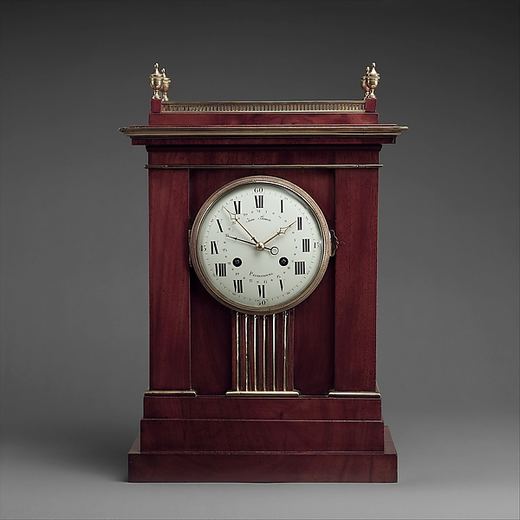
Clocks · ca. 1780–90
Clock by Workshop of David Roentgen, Germany, ca. 1780–90
The Metropolitan Museum of Art, New York
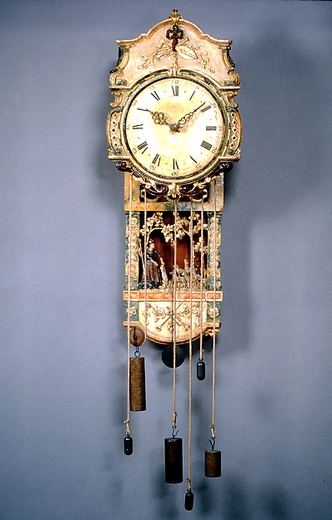
Clocks · ca. 1800
Musical clock by Martin Vanlo?, Germany, ca. 1800
The Metropolitan Museum of Art, New York
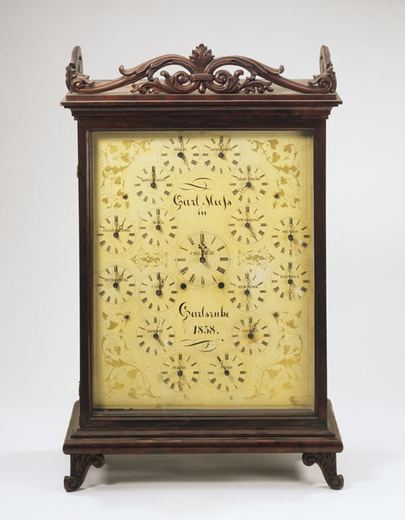
Clocks · 1800–1899
Clock by Carl Meeß, Germany, 1800–1899
Badisches Landesmuseum Karlsruhe
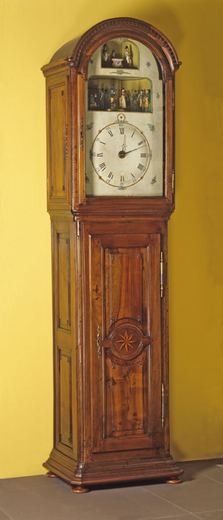
Clocks · 1800–1899
Clock by Ignaz Bruder, Germany, 1800–1899
Badisches Landesmuseum Karlsruhe
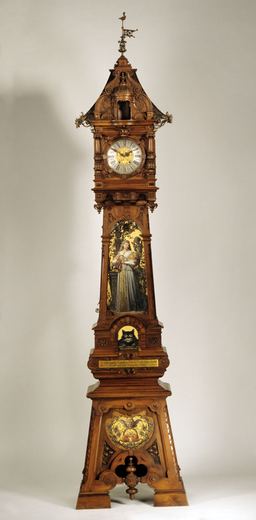
Clocks · 1800–1899
Longcase clock by August Gehrig, Germany, 1800–1899
Badisches Landesmuseum Karlsruhe