
Wristwatches · Diver's wristwatch
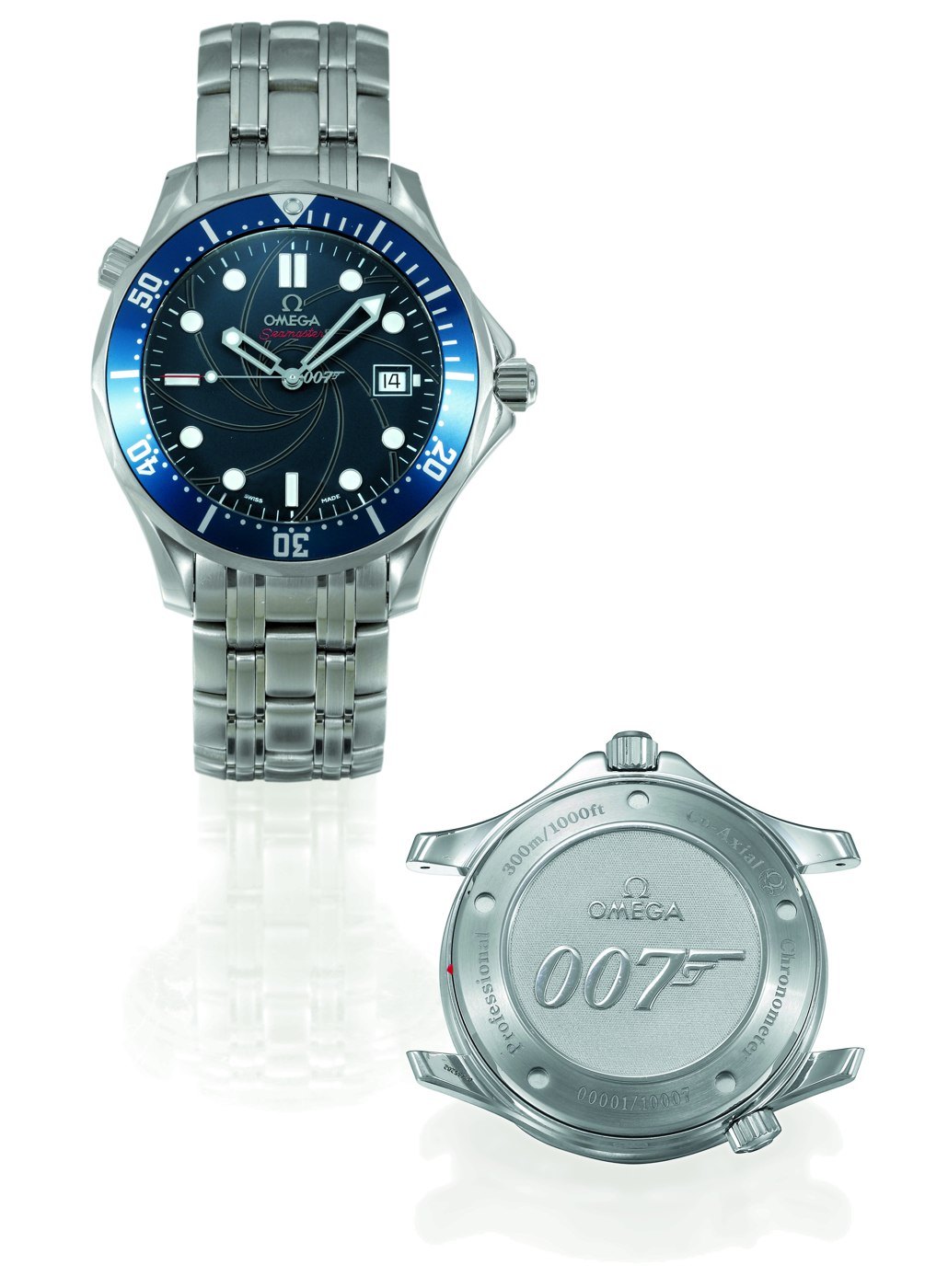
Omega Seamaster Professional 300m '007' No. 1
- Maker / attribution
- Omega (source attribution)
- Date
- 2006
- Historical period
- Mechanical Renaissance (1990 – 2010)
- Country of origin
- Switzerland
- Object type
- Diver's wristwatch
- Dimensions
- 41 mm
- Holding institution
- Antiquorum
- Accession / object no.
- 297
- Credit line
- Antiquorum
- Catalogue title (original)
- 'SEAMASTER ' 007, NO. 1' Omega, 'Seamaster, Co-Axial, Professional, 300m', No. 1, movement No. 81735282,\nRef. SU 368.1631. Made in a numbered edition of 10007 examples in 2006, to\ncoincide with the (English)
View the source record ↗ (opens another website in a new tab)Suggest a correction
Record summary
Held and catalogued by Antiquorum (object number 297), this is a diver's wristwatch attributed to Omega, made in Switzerland, dated 2006. The Atlas places it in the Mechanical Renaissance period (1990 – 2010) of its Wristwatches collection. Recorded dimensions: 41 mm. The record is illustrated with 1 photograph.
Assembled from the source record's structured fields. Dates and attributions are given as the source states them; where a field is missing the Atlas leaves it blank rather than estimating.
Catalogue description
Original object description
This stainless steel diving wristwatch from 2006 represents piece 'No. 1' out of a limited series of 10,007 units produced in conjunction with the premiere of the James Bond film 'Casino Royale'. Extending an official cinematic affiliation initiated in 1995 with 'Golden Eye', this piece adapts the brand's core 300-meter professional diving platform. Its three-body steel case measures with polished and brushed surfaces, featuring lyre-style lugs, crown guards at the 3 o'clock position, a manual helium relief valve positioned at 10 o'clock, and a scalloped, unidirectional blue bezel graduated to 60 minutes for decompression timing. The screw-down caseback is inscribed with the specific edition number and brand hallmarks. Its matte black dial displays a silvered shutter graphic, luminous round and baton indexes, applied steel brand markers, red 'Seamaster' text beneath 12 o'clock, and an aperture for the date. Skeletal steel hands with luminous inserts are paired with a central seconds hand weighted by a red-accented '007' motif. Beating inside is the self-winding, rhodium-plated Calibre 2500 movement, which incorporates 27 jewels, a Co-Axial escapement, a shock absorber, a free-sprung monometallic balance wheel, and a self-compensating flat balance spring to power the calendar and sweep seconds. The case is fitted with an integrated steel bracelet featuring a deployant clasp, and the dial, movement, and case are recorded in 'as new' state.
Inscriptions & marks
81735282
Historical context
Mechanical Renaissance (1990 – 2010)
Mechanical watches return as cultural objects; independent watchmaking flourishes.
Mechanical watches returned as cultural and luxury objects. Complications, tourbillons and new materials proliferated; independent watchmakers such as George Daniels, F.P. Journe and Philippe Dufour revived artisanal watchmaking; collecting vintage watches became a major field.
Read the period in the timelineMore wristwatches from this periodEarlier: Quartz Revolution
Atlas type guide
Dive and water-resistant watches
Keeping water and dust out of a wristwatch was a long-standing challenge. Rolex's screw-down Oyster case (1926) and Omega's Marine (1932) were landmarks; in the early 1950s Blancpain's Fifty Fathoms and Rolex's Submariner defined the professional dive watch with rotating bezels for timing dives, luminous dials and high water resistance. The ISO 6425 standard (1982) later codified what a 'diver's watch' must do.
Dive watches became icons of post-war design and exploration, and their evolution — helium escape valves, ceramic bezels, saturation-diving depth ratings — records the history of underwater work.
What to look for
- Unidirectional or bidirectional rotating bezel with minute markings.
- Screw-down crown and case back; depth rating printed on the dial.
- Luminous hands and markers (radium before c. 1960, tritium c. 1960–1998, then Super-LumiNova).
- Reference numbers on the case between the lugs or inside the back.
Dating clues
- Screw-down Oyster cases: from 1926.
- Professional dive watches: from 1953.
- Tritium 'T' marks on dials: c. 1960–1998.
General guidance written by the Atlas editors about this kind of object. It is not a statement about this particular piece; for that, rely on the source record above and on physical examination.
Related records

Instruments · 1950–1976
Omega Megaquartz 2400 marine chronometer, 1950–1976
Science Museum Group, London

Instruments · 1960–1979
Stopwatch / timer by Omega, 1960–1979
Science Museum Group, London

Instruments · 1960–1979
Stopwatch / timer by Omega, Switzerland, 1960–1979
Science Museum Group, London

Instruments · 1960–1979
Stopwatch by Omega, Swiss made, single-button type reading 0 - 60 seconds in fifths and 0 - 5 minutes in minutes on subsidiary dial, 1960-79.
Science Museum Group, London
Wristwatches · 1991
Limited edition watch designed by Eta relating to David Bowie's Serious Moonlight live tour, 1991
Victoria and Albert Museum, London

Wristwatches · 2008
Wristwatch by Breitling?, 2008
Museum Rotterdam

Wristwatches · c. 1990s
Audemars Piguet Bamboo, c. 1990s
Antiquorum auction archive, Geneva

Wristwatches · c. 1990
Audemars Piguet Huitieme Perpetual Calendar, ref. 25696PT, c. 1990
Antiquorum auction archive, Geneva