
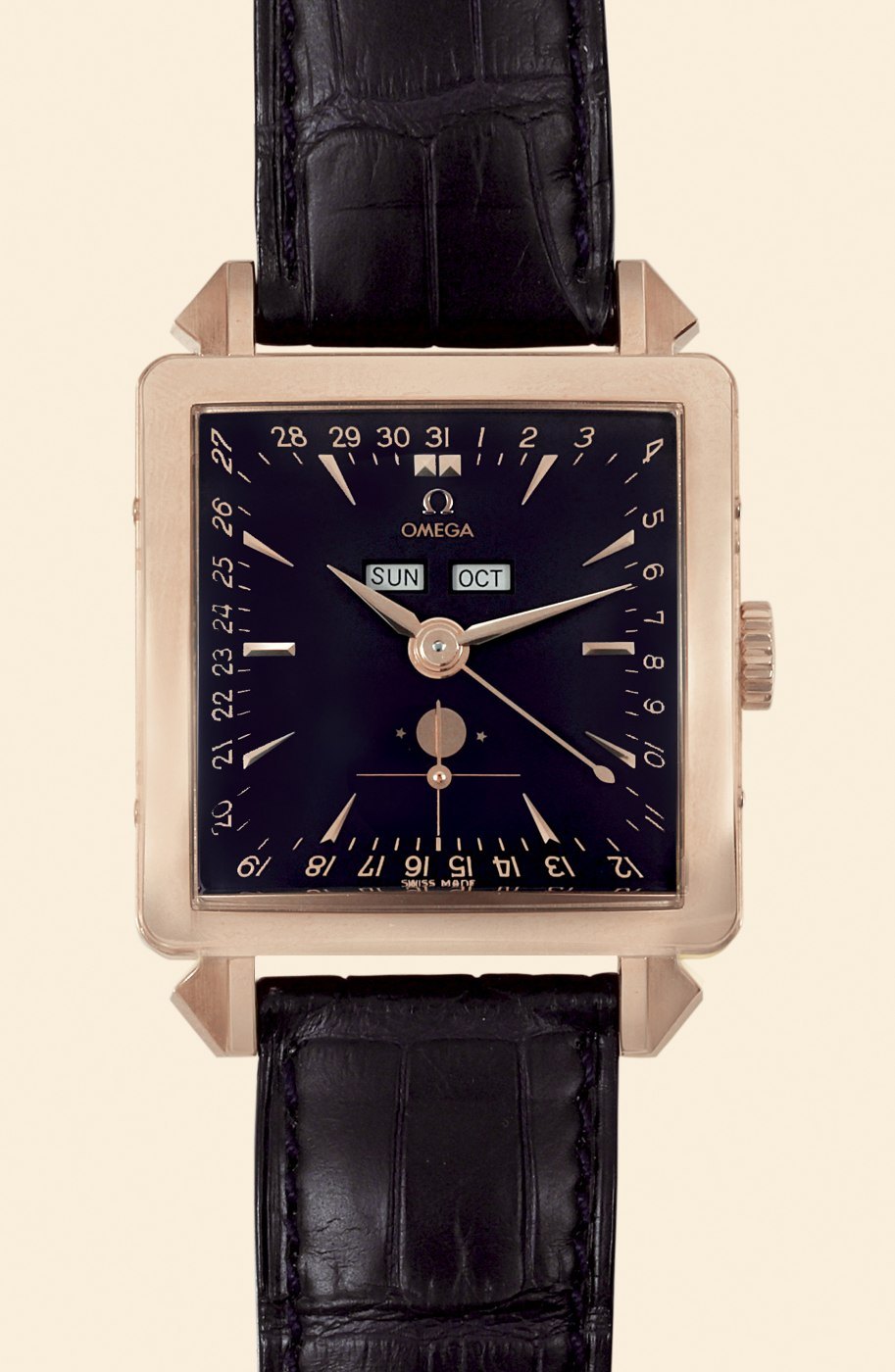
Wristwatches · Triple date wristwatch with moon phases
Omega Cosmic Collector's Series Number Two
- Maker / attribution
- Omega (source attribution)
- Date
- 2001
- Historical period
- Mechanical Renaissance (1990 – 2010)
- Country of origin
- Switzerland
- Object type
- Triple date wristwatch with moon phases
- Materials / technique
- 18K pink gold
- Dimensions
- 33.5 x 33 mm
- Holding institution
- Antiquorum
- Accession / object no.
- 254
- Credit line
- Antiquorum
- Catalogue title (original)
- '1951 Cosmic'\nOmega, 'Cosmic', No. 768/1951, case\nNo. 57977930, Ref. BG 156.2001. Collector`s\nSeries Number Two from the Museum Collection. Made\nin 2001.\nFine and rare, square, self-winding, wate (English)
View the source record ↗ (opens another website in a new tab)Suggest a correction
Record summary
Held and catalogued by Antiquorum (object number 254), this is a triple date wristwatch with moon phases attributed to Omega, made in Switzerland, dated 2001. The Atlas places it in the Mechanical Renaissance period (1990 – 2010) of its Wristwatches collection. Materials and techniques recorded by the source: 18K pink gold. Recorded dimensions: 33.5 x 33 mm. The record is illustrated with 1 photograph.
Assembled from the source record's structured fields. Dates and attributions are given as the source states them; where a field is missing the Atlas leaves it blank rather than estimating.
Catalogue description
Original object description
Forming part of the Museum Collection as Collector's Series Number Two to commemorate the year 1951, this Omega "Cosmic" wristwatch was manufactured in 2001. Its square three-body 18K pink gold case measures 33.5 by 33 mm with a depth of 11 mm, featuring stylized straight lugs, polished and satin-brushed finishing, a concave bezel, a sapphire crystal, lateral calendar pushers, and a water-resistant caseback incised with the series name and number 768/1951. Surrounding an inner display with apertures for the day and month, the black dial is decorated with applied pink gold baton, dagger, and pyramid hour markers, an outer date chapter in pink gold Arabic numerals, pink gold alpha hands, and a moon phase register located at 6 o'clock. Internal operation is driven by the 31-jewel Omega Caliber 2601, an automatic rhodium-plated movement enriched with fausses côtes that integrates a straight-line lever escapement, a micrometer regulator, a monometallic balance adjusted to five positions, and a flat self-compensating balance spring. Completed by an 18K pink gold Omega pin buckle, this fully signed example—marked on the dial, case, and movement—entered the market without reserve from a Swiss private collection.
Inscriptions & marks
57977930
Historical context
Mechanical Renaissance (1990 – 2010)
Mechanical watches return as cultural objects; independent watchmaking flourishes.
Mechanical watches returned as cultural and luxury objects. Complications, tourbillons and new materials proliferated; independent watchmakers such as George Daniels, F.P. Journe and Philippe Dufour revived artisanal watchmaking; collecting vintage watches became a major field.
Read the period in the timelineMore wristwatches from this periodEarlier: Quartz Revolution
Atlas type guide
Calendar, moon-phase and perpetual calendar watches
Calendar complications range from a simple date to the perpetual calendar, which automatically allows for months of different lengths and leap years until 2100. Pocket watches with perpetual calendars were made in the eighteenth and nineteenth centuries; Patek Philippe made the first perpetual calendar wristwatch in 1925, and series production followed in 1941. The annual calendar (Patek Philippe, 1996) needs correction only once a year.
Moon-phase displays use a disc with two moons and 59 teeth advanced daily, approximating the 29.5-day lunation; more precise trains reduce the error to one day in over a century.
What to look for
- Apertures or subsidiary dials for day, date, month and leap year.
- Moon disc under a 'bosom' shaped aperture.
- Recessed correctors on the case band for setting the calendar.
Dating clues
- Triple-date wristwatches: popular c. 1940–1955.
- Perpetual calendar wristwatches: from 1925 (unique) and 1941 (series).
General guidance written by the Atlas editors about this kind of object. It is not a statement about this particular piece; for that, rely on the source record above and on physical examination.
Related records

Instruments · 1950–1976
Omega Megaquartz 2400 marine chronometer, 1950–1976
Science Museum Group, London

Instruments · 1960–1979
Stopwatch / timer by Omega, 1960–1979
Science Museum Group, London

Instruments · 1960–1979
Stopwatch / timer by Omega, Switzerland, 1960–1979
Science Museum Group, London

Instruments · 1960–1979
Stopwatch by Omega, Swiss made, single-button type reading 0 - 60 seconds in fifths and 0 - 5 minutes in minutes on subsidiary dial, 1960-79.
Science Museum Group, London
Wristwatches · 1991
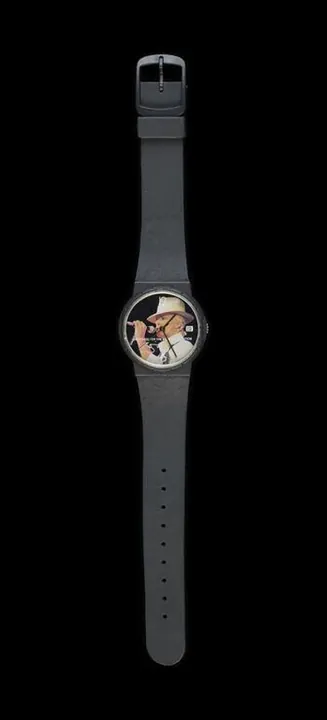
Limited edition watch designed by Eta relating to David Bowie's Serious Moonlight live tour, 1991
Victoria and Albert Museum, London

Wristwatches · 2008
Wristwatch by Breitling?, 2008
Museum Rotterdam

Wristwatches · c. 1990s
Audemars Piguet Bamboo, c. 1990s
Antiquorum auction archive, Geneva

Wristwatches · c. 1990
Audemars Piguet Huitieme Perpetual Calendar, ref. 25696PT, c. 1990
Antiquorum auction archive, Geneva