
Instruments · Marine chronometer
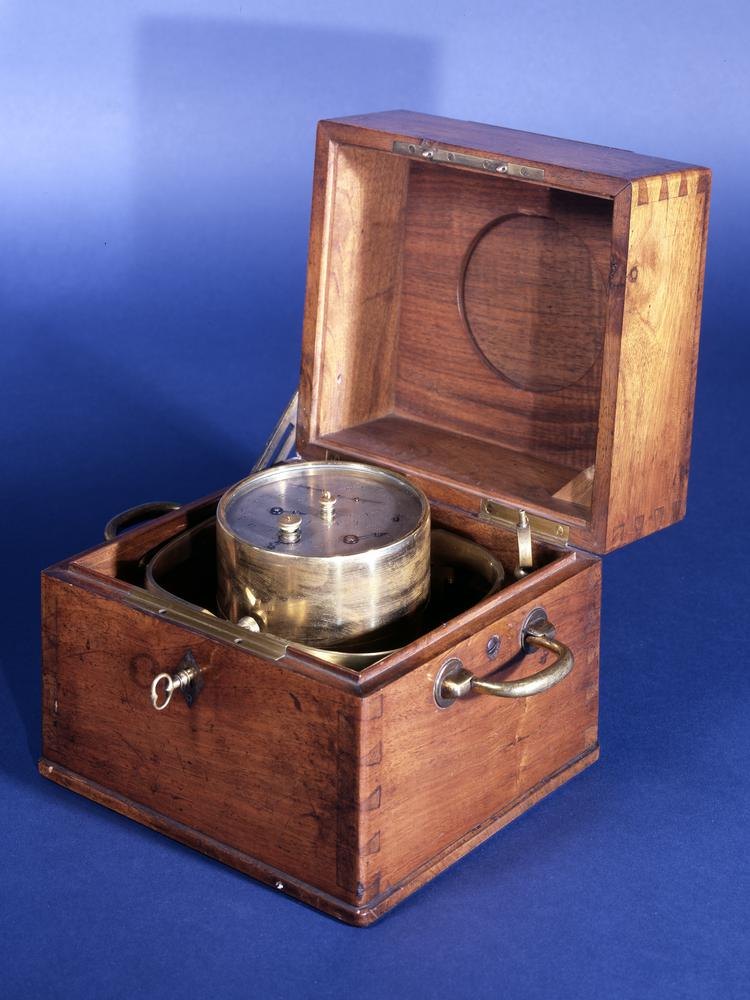
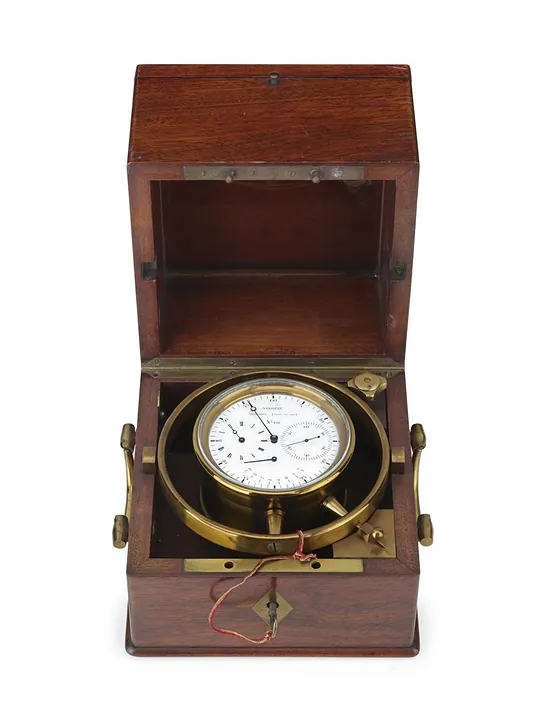
Marine chronometer by Abraham Louis Breguet
- Maker / attribution
- Abraham Louis Breguet (Made by)
- Date
- 1795–1805
- Historical period
- Precision & Scientific Horology (1750 – 1850)
- Country of origin
- France
- Place
- Paris (France)
- Object type
- Marine chronometer
- Materials / technique
- brass, oak
- Holding institution
- British Museum
- Accession / object no.
- 1958,1006.2121
- Credit line
- British Museum, London
- Catalogue title (original)
- Marine chronometer; constant force escapement with three detents; movement in brass canister gimballed in oak box; tipsy key in corner; heavy brass engraved and silvered dial; blued steel hands (English)
View the source record ↗ (opens another website in a new tab)Suggest a correction
Record summary
Held and catalogued by British Museum (object number 1958,1006.2121), this is a marine chronometer by Abraham Louis Breguet, made in Paris (France), dated 1795–1805. The Atlas places it in the Precision & Scientific Horology period (1750 – 1850) of its Instruments collection. Materials and techniques recorded by the source: brass, oak. The record is illustrated with 6 photographs.
Assembled from the source record's structured fields. Dates and attributions are given as the source states them; where a field is missing the Atlas leaves it blank rather than estimating.
Catalogue description
Description — British Museum
Marine chronometer; constant force escapement with three detents; movement in brass canister gimballed in oak box; tipsy key in corner; heavy brass engraved and silvered dial; blued steel hands.
Curator's comments — British Museum
Comment from Anthony G. Randall and Richard Good, Catalogue of Watches in the British Museum. Vol. VI (1990) Made by Breguet, c. 1800 Marine Chronometer Signature: On the dial 'Breguet No 428'. Box: The movement contained in a brass canister, the top half sliding into the bottom, and with a bayonet fixing and a single locking screw. Both ends of the canister are glazed, and there is a small brass levelling weight screwed to the edge of the bottom. The bottom half of the canister is gimballed in an oak box. The gimbal ring is square, with rounded corners, and there is no lock, it is pivoted on brass screws set in the wood of the side of the box, with their ends formed into pivots. There is a-tipsy key numbered 4847, fitted in a corner. The sides of the box are fitted together with dovetail joints, and there is a sliding panel over a circular aperture in the top with an inset diamond-shaped brass plate numbered 426. The box has the usual lock and carrying handles, and there is a brass limit stop for the top, fitted on the outside. Base 208 mm square, sides 204 mm square, h. 187 mm. Dial and hands: The dial a heavy brass plate, engraved and silvered on a granular surface, the engraving filled with black wax. The dial is attached directly to the front plate by four turned pillars and pins, leaving room for the under dial work, at the back it is engraved or punched 428. The indications are as follows: the three large central dials, starting at the top and going round clockwise, are for seconds, minutes and hours. The sector at the bottom is for reserve of going and the small dial below this records each time the machine is wound. The sector on the upper left-hand side indicates temperature, and the small dial beneath the hand indicates each time the temperature rises above a certain value. The right-hand small dial hand advances one division each time the machine is twisted as in starting. Winding and hand setting are controlled by two squared arbors of different sizes, through the dial and holes in the glass; these holes are normally covered by brass caps. Hands are of blued steel. Movement: Front plate diam. 100.3 mm; middle plate diam. 100.3 mm; back plate diam. 100.3 mm; frame h. over the front and middle plates 37.3 mm; frame h. over the middle and back plates 19.1 mm; frame h. over the front and back plates 53.5 mm. Frame: Built up in two layers. The front and middle plates are separated by four cylindrical pillars riveted to the middle plate and with the front plate held by pins. Between these plates are planted the two barrels, the winding work and the going train, as far as and including the fourth arbor. All the escapement and balance components are planted on the back plate between a series of cocks and potances and the plate. The back plate has four cylindrical pillars which pass into holes in the middle plate, which is retained by taper pins. Each plate is numbered 428. Going barrels: Each drives the centre arbor. Each barrel arbor carries a large brass winding wheel which meshes with a common steel wheel on the winding arbor having a steel click pivoted in the frame. Breguet's stop-work is fitted on one barrel cover, the reserve of going indicator operating mechanism on the other. The latter mechanism is similar to that described for Breguet et fils No. 2741, registration no. 1958,1201.2066, except that the nut moving up and down on the threaded piece on the barrel arbor is cone-shaped and brass. The arm, spring loaded against the side of the cone, moves towards or away from the arbor as the cone moves up and down. This motion is transferred to a toothed sector engaging with another on which the indicating hand is carried. Stop-work is also incorporated in the reserve of going operation mechanism, so that each mainspring can be set up a pre-determined amount. The mainspring in the barrel with reserve of going is marked 'D Juin '67'. It is hooked with an eye to a steel hook piece held by a screw to the barrel wall partly in a rectangular slot as for solid hooking. The arbor has a brass unsnailed boss and steel hook. The other barrel is allowed four turns of going by its stop-work and is set up 4½ turns. Its spring is also signed 'D Juin '67', otherwise it resembles the other in every detail. Each spring has a bride. The barrel with reserve of going indication has had two teeth carefully replaced. Going train: The centre arbor is planted at the centre but does not drive the motion work or any of the hands. These are driven by a pinion on the third arbor meshing with the wheel turning once per hour and carrying the minute hand. The centre and fourth wheels are riveted to their pinions, the third to a collet on its arbor. The general quality of the finish is good without being remarkable. Jewelling: Only the pivots of the escapement run in jewelled bearings. The balance staff has conical pivots running in the usual jewelled holes with endstones. The remontoire wheel and fly arbor pivots run in pierced jewels, but the pivoted remontoire detent has tapered pivots with flattened ends running in blind holes in pieces of ruby. The pieces of ruby are set in detachable brass strips, the one on the inside of the frame with an endshake adjusting screw. Escapement: An example of Breguet's constant force escapement employing three detents. A pivoted counter-poised detent has a gold helical spring with terminal curves colleted to its arbor, and is held locked on the locking stone of a conventional spring detent having banking and a passing spring. The latter detent is released by a roller on the balance staff at the correct moment for the pivoted detent to be released in its turn, to transmit impulse to the balance. The free acting end of the pivoted detent is formed into a crescent, at the far end of which is set a piece of ruby. This piece of ruby contacts a gold block set on an arm attached to and curving round the balance staff. At the end of impulse the end of the pivoted detent encounter.
Inscriptions & marks
signature; Breguet No 428 [dial]; mark; 4847 [key]; mark; 426 [box]; mark; 428 [plates and dial back]; inscription; D Juin '67 [mainspring and barrel spring]
Provenance
Previous owner/ex-collection:, Courtenay Adrian Ilbert, Previous owner/ex-collection:, Bennet; Donated by:, Gilbert Edgar; Acquired 1958
Historical context
Precision & Scientific Horology (1750 – 1850)
Harrison solves longitude; Mudge invents the lever; Breguet's Paris workshop defines the modern watch.
The longitude problem was solved by the marine chronometer and lunar distance methods; dividing engines made precision scales possible, and observatories set time by transit instruments.
Read the period in the timelineMore instruments from this periodEarlier: Early Modern Horology
Atlas type guide
Marine chronometers
A marine chronometer is a precision timekeeper carried at sea to find longitude: the navigator compares local noon, observed with a sextant, with the time at a reference meridian kept by the chronometer. Each hour of difference corresponds to fifteen degrees of longitude. John Harrison proved the method in the 1760s; Pierre Le Roy, Ferdinand Berthoud, John Arnold and Thomas Earnshaw then developed the detent escapement and the compensation balance that made chronometers practical to manufacture.
By the nineteenth century London, Liverpool, Le Locle and Glashütte supplied navies and merchant fleets. A typical box chronometer has a spring-detent escapement, a fusee to equalise mainspring torque, a bimetallic compensation balance with a helical balance spring, and is mounted in gimbals inside a wooden box so that it stays level.
What to look for
- Gimbals and a three-tier wooden box with a glazed inner lid.
- A power-reserve ('up and down') indicator on the dial, usually showing 56 hours on two-day instruments.
- Spring-detent escapement and a cylindrical (helical) balance spring visible through the movement.
- Admiralty or navy marks (broad arrow), and rating certificates from observatories.
- The maker's number on the dial and movement; many makers' registers survive, allowing dating.
Dating clues
- Earnshaw-type spring-detent chronometers became standard after about 1800.
- Auxiliary compensation devices on the balance appear from the mid-nineteenth century.
- Quartz and radio time signals ended routine use of mechanical chronometers in the 1970s and 1980s.
General guidance written by the Atlas editors about this kind of object. It is not a statement about this particular piece; for that, rely on the source record above and on physical examination.
Related records
Pocket Watches · 1783–1800
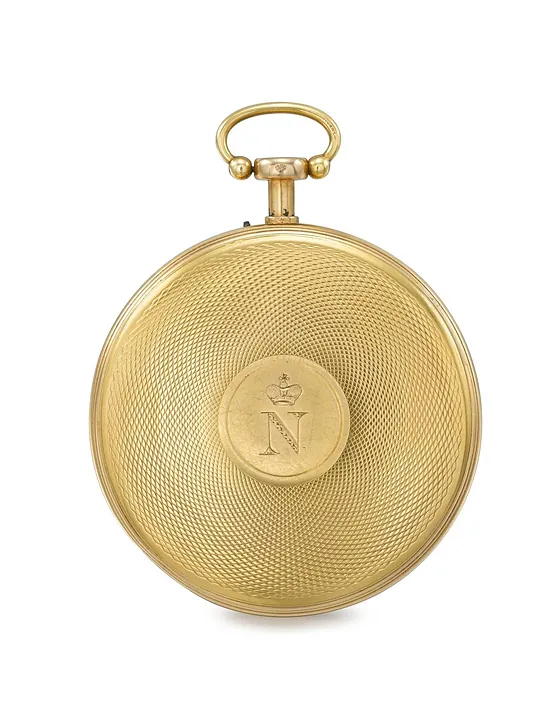
Pocket watch by Abraham Louis Breguet, France, 1783–1800
Science Museum Group, London
Pocket Watches · 1812
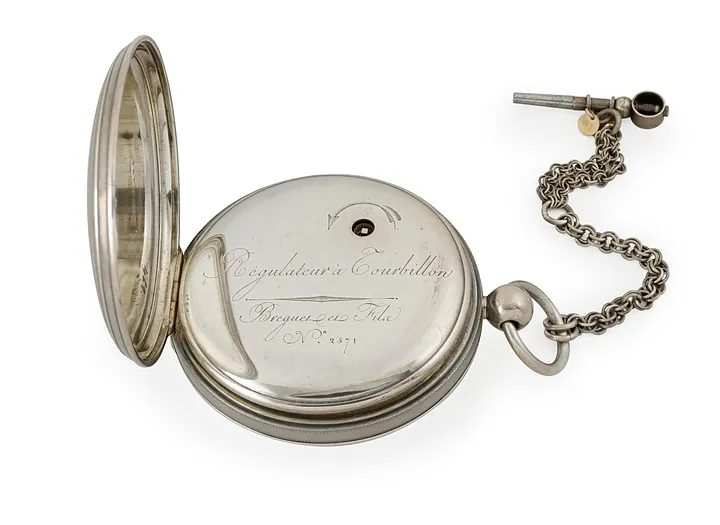
Pocket watch by Abraham Louis Breguet, England, 1812
Science Museum Group, London
Pocket Watches · 1905
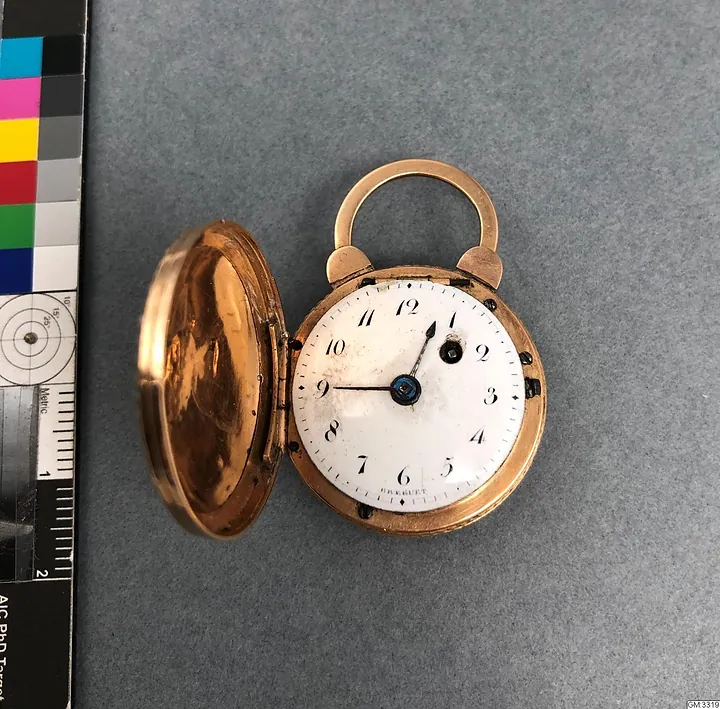
Pocket watch by Abraham Louis Breguet, France, 1905 (no. 24939)
Museum of Gothenburg
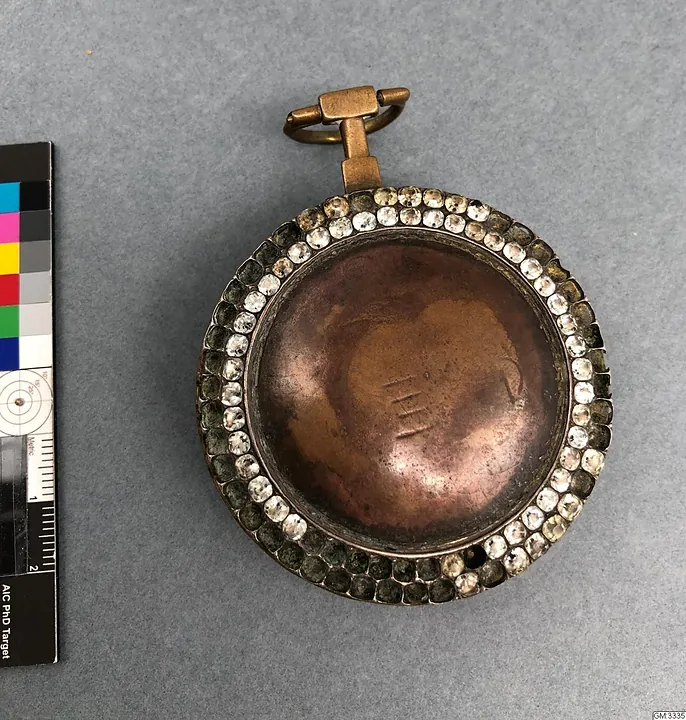
Pocket Watches · 1905
Pocket watch by Abraham Louis Breguet, France, 1905 (no. 25085)
Museum of Gothenburg
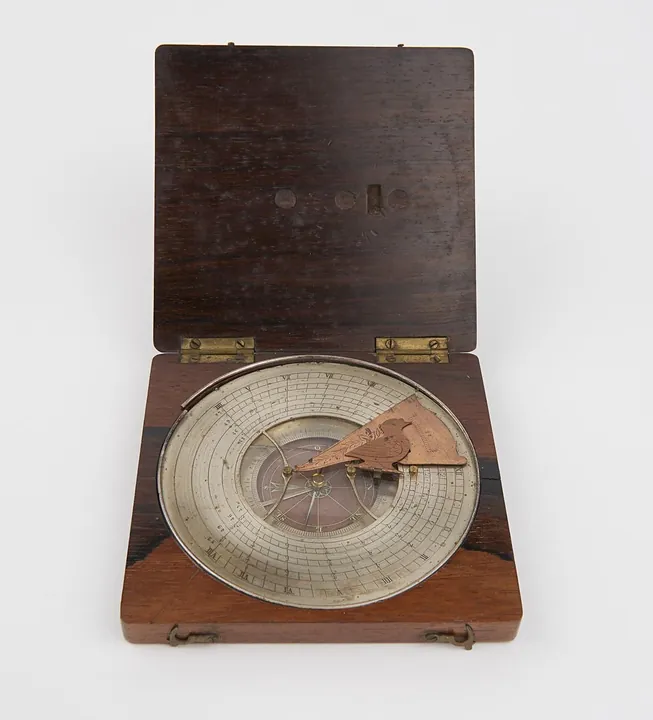
Instruments · 1751–1850
Horizontal compass sundial for latitudes 43 degrees, 46 degrees, 49 degrees, 52 degrees, in rosewood case French, c.1800 Cover glass cracked.
Science Museum Group, London
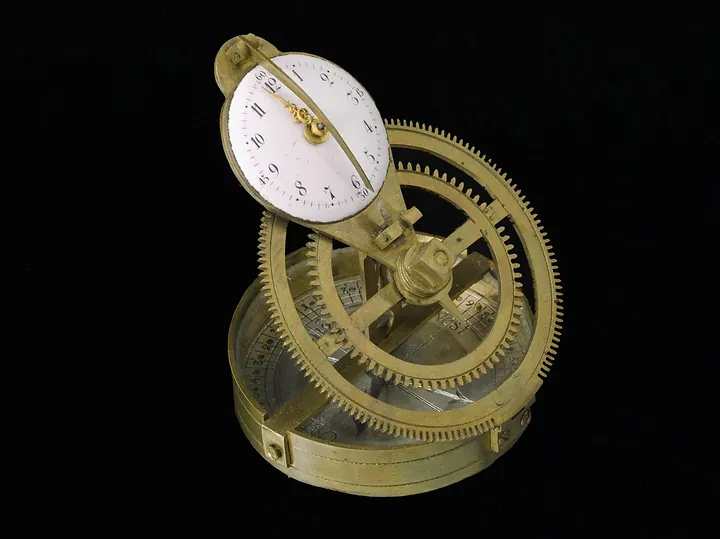
Instruments · 1751–1850
Mechanical equinoctial sundial for latitude 52 degrees, in original card case, one sight missing. French, c.1800
Science Museum Group, London
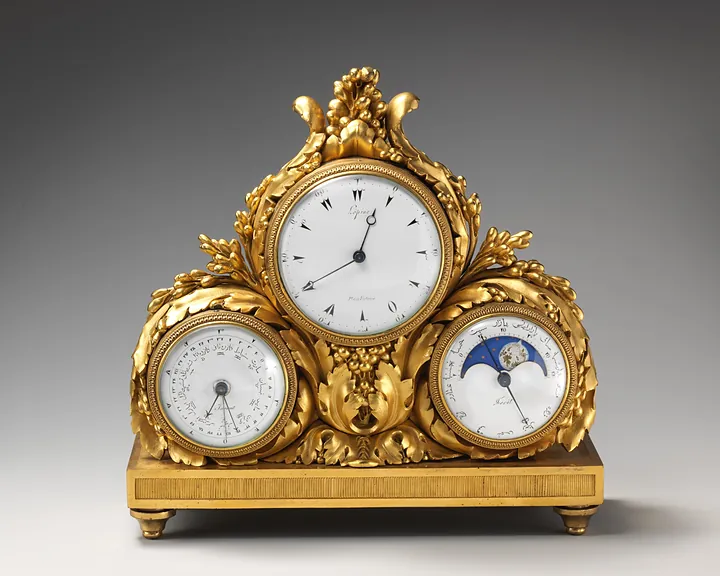
Instruments · last quarter 18th century
Clock by Jean Antoine Lépine, France, last quarter 18th century
The Metropolitan Museum of Art, New York
Instruments · 1780–1799
Marine chronometer by Vissière, France, 1780–1799
Science Museum Group, London