
Clocks · Hall clock
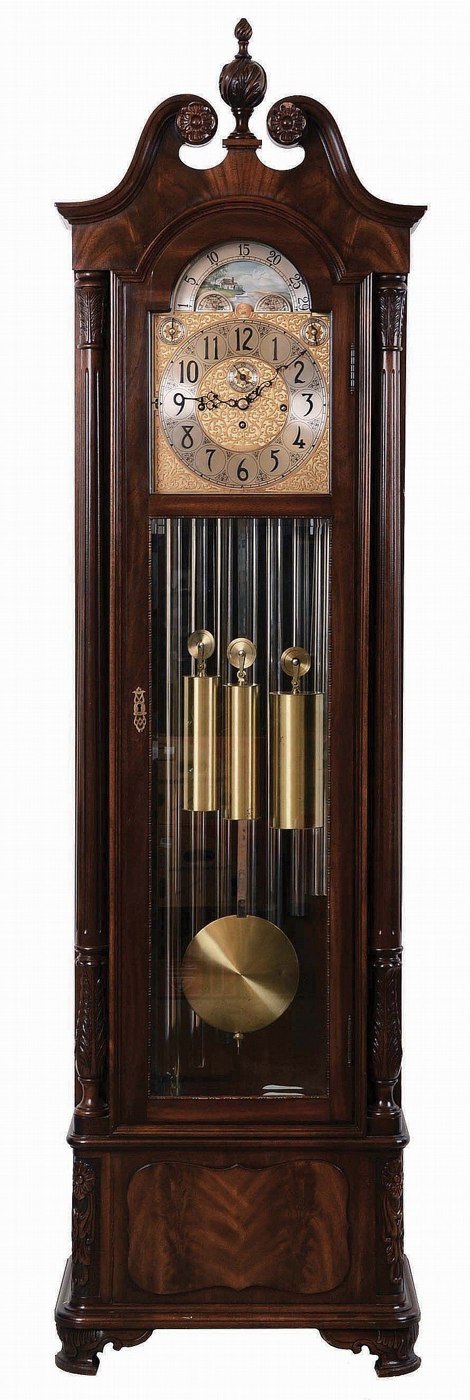
Herschede Haverford No. 294 Hall Clock
- Maker / attribution
- Herschede Clock Co. (source attribution)
- Date
- c. 1960
- Historical period
- Modern Mechanical Horology (1945 – 1969)
- Country of origin
- United States
- Object type
- Hall clock
- Dimensions
- 86 x 25 x 14.5 inches
- Holding institution
- Schmitt Horan & Co.
- Accession / object no.
- 839
- Credit line
- Schmitt Horan & Co.
- Catalogue title (original)
- Herschede Clock Co., Cincinnati, Ohio, \"Haverford No. 294\" hall clock, 8 days, time, strike & chime, three brass weight driven movement playing three tunes on 9 tubes, Westminster, Whittington, Cant (English)
View the source record ↗ (opens another website in a new tab)Suggest a correction
Record summary
Held and catalogued by Schmitt Horan & Co. (object number 839), this is a hall clock attributed to Herschede Clock Co., made in United States, dated c. 1960. The Atlas places it in the Modern Mechanical Horology period (1945 – 1969) of its Clocks collection. Recorded dimensions: 86 x 25 x 14.5 inches. The record is illustrated with 1 photograph.
Assembled from the source record's structured fields. Dates and attributions are given as the source states them; where a field is missing the Atlas leaves it blank rather than estimating.
Catalogue description
Original object description
Manufactured around 1960 by the Herschede Clock Co. in Cincinnati, Ohio, this "Haverford No. 294" hall clock carries serial number 628255. Its mahogany housing measures 86 inches tall, 25 inches across, and 14.5 inches deep, resting upon bracket feet beneath a figured wood base panel. The construction features glazed front and side apertures, fluted side columns crowned by carved acanthus capitals, and a broken-arch pediment adorned with carved petal details and a central finial. Driven by three weights in brass casings, the eight-day movement strikes on the hour and chimes Canterbury, Whittington, or Westminster sequences across nine tubular bells, with tunes selectable via levers mounted on the dial face. The dial is embellished with cast and engraved brass spandrels, silvered chapter rings, an auxiliary seconds register, and a lunar phase indicator in the arch. The clock retains its original Herschede-marked winding key and is reported to be in excellent condition, showing only a small ding on the pendulum bob.
Inscriptions & marks
628255
Historical context
Modern Mechanical Horology (1945 – 1969)
Tool watches for divers, pilots and astronauts; electric watches anticipate the electronic age.
Post-war clocks combined new materials and industrial design: plastic and metal cases, battery-powered transistor movements from the late 1950s, and design classics by George Nelson, Max Bill and others. The first caesium atomic clock (1955) moved the definition of time from astronomy to physics.
Read the period in the timelineMore clocks from this periodEarlier: Golden Age of Mechanical Watchmaking
Atlas type guide
Longcase (tall-case or grandfather) clocks
The longcase clock was born from two seventeenth-century innovations: Christiaan Huygens's pendulum (1656–57) and the anchor escapement (c. 1670). A long seconds pendulum, nearly a metre long, swings with a small arc, and enclosing it together with the driving weights in a tall wooden case protected the mechanism and created a new piece of furniture. London makers such as Ahasuerus Fromanteel, Thomas Tompion and Joseph Knibb set the pattern.
By the eighteenth century longcase clocks were made throughout Britain, the Netherlands, Scandinavia (the Swedish Mora clock), France (the Comtoise from the Franche-Comté), Germany and colonial America. Eight-day movements with two weights became standard in better clocks; thirty-hour clocks with one weight and a rope or chain were cheaper alternatives.
What to look for
- Winding holes in the dial: two (eight-day, going and striking) or none (thirty-hour, pulled up by a chain).
- Brass dials with applied chapter rings (earlier) versus painted iron 'white' dials (after c. 1770 in Britain).
- Moon-phase arches, date apertures, seconds dials and maker's name on the dial.
- Case woods and style: ebonised, walnut marquetry, lacquer, oak or mahogany; regional styles from London, Lancashire, Scotland or America.
- Whether the movement and dial match the case — 'marriages' are common.
Dating clues
- Square brass dials suggest c. 1670–1720; arched brass dials c. 1715–1790.
- Painted (white) dials were made by Birmingham dial-makers from about 1772.
- Comtoise clocks with repoussé pendulums are mostly nineteenth century.
General guidance written by the Atlas editors about this kind of object. It is not a statement about this particular piece; for that, rely on the source record above and on physical examination.
Read next:Anchor (recoil) escapementDeadbeat escapementAnchor escapement
Related records
Clocks · 1937; 1980
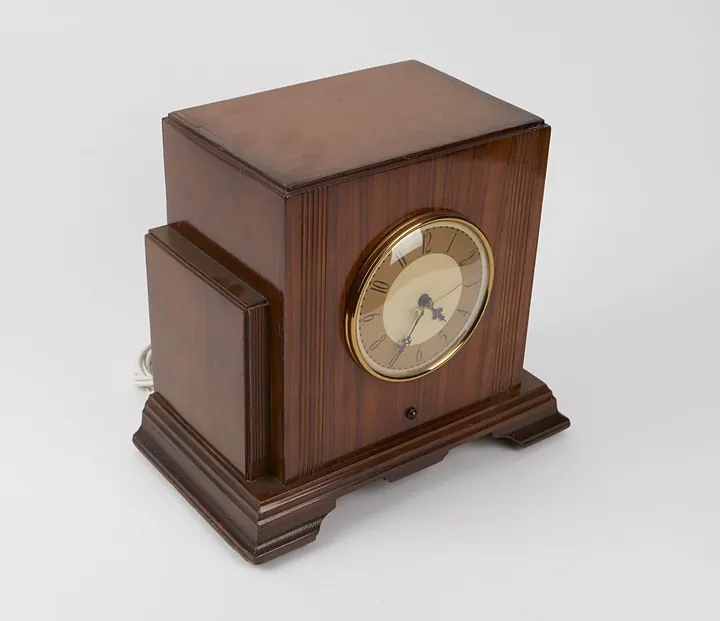
Clock by Bestone and Hammond, United States, 1937; 1980
Science Museum Group, London
Clocks · c. 1968
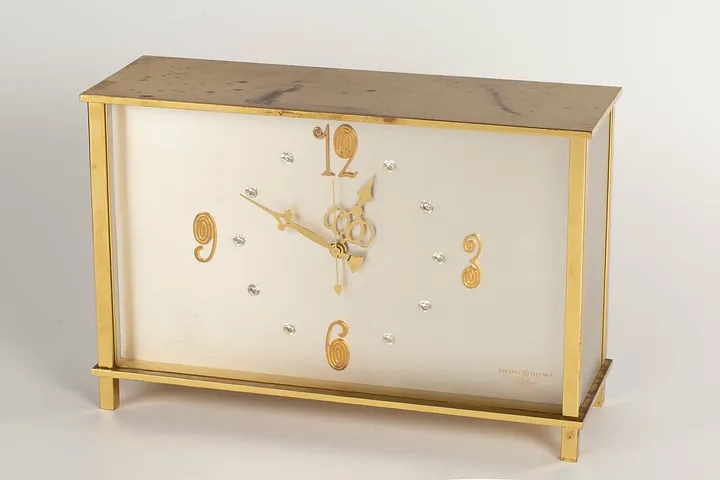
Table clock, United States, c. 1968
German Clock Museum
Clocks · c. 1960s
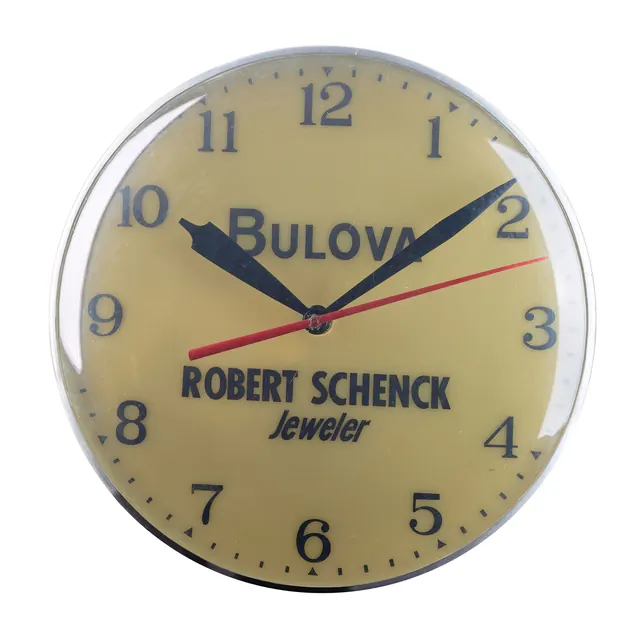
Bulova wall clock, Lighted Advertising Wall Clock for Robert Schenck Jeweler, circa 1960s
Antiquorum auction archive, Geneva
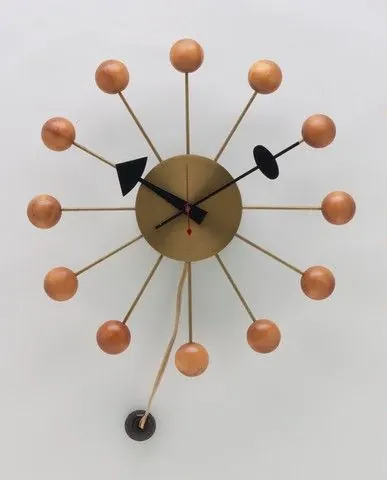
Clocks · designed 1947; manufactured by 1948–69
Ball Wall Clock, Model no. 4755 by George Nelson & Co., Inc
Yale University Art Gallery, New Haven
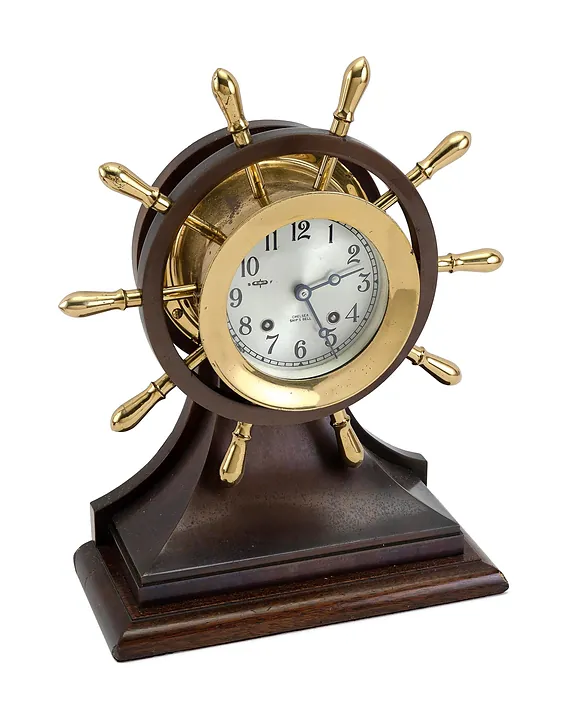
Clocks · c. 1960s
Chelsea Clock CO. "MARINER" SHIP's Bell Clock Boston, circa 1960s Dial
LiveAuctioneers auction archive
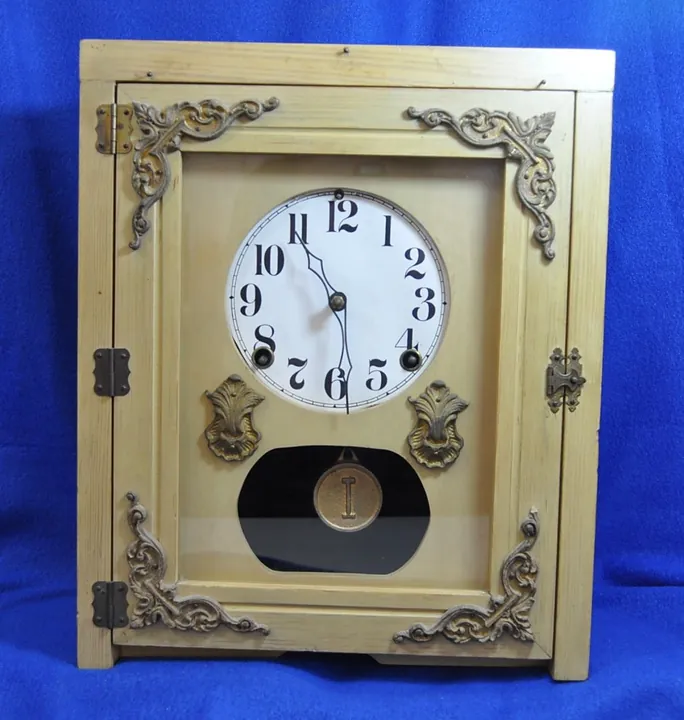
Clocks · 1950s
Ingraham 1950s Ornate Custom Cabinet Wall Clock Xt
LiveAuctioneers auction archive
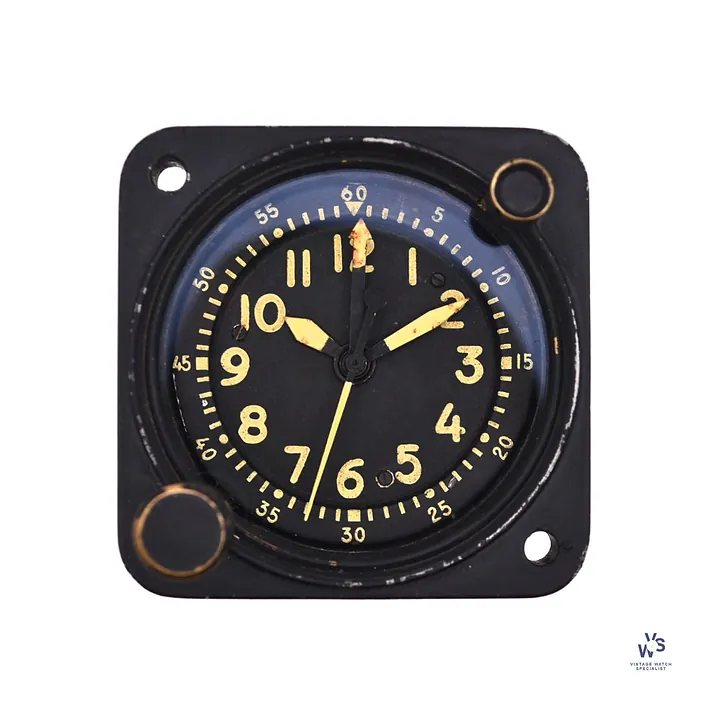
Clocks · c. 1960s
Waltham Aircraft Clock, ref. A-13A-1, circa 1960s
Vintage Watch Specialist (dealer), United Kingdom
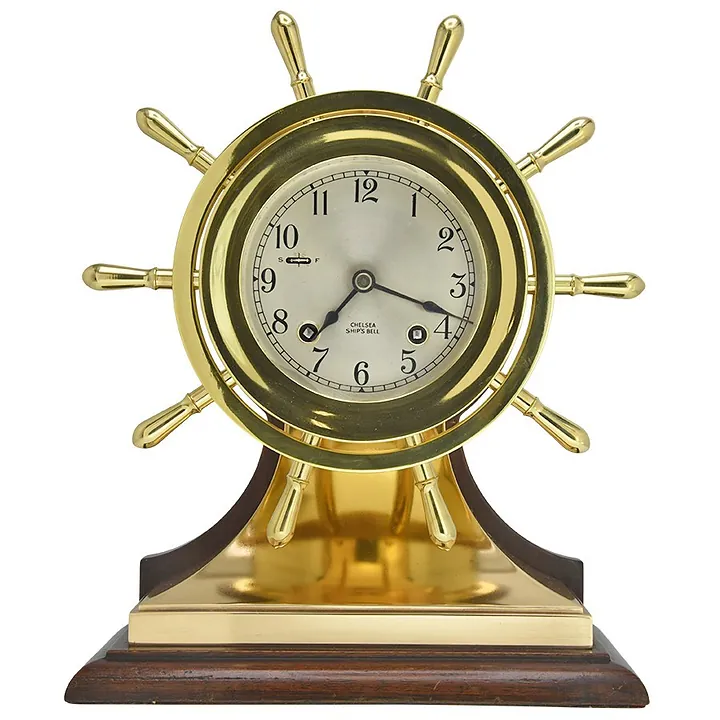
Clocks · c. 1953
Chelsea Clock Company 'Mariner' Yacht Wheel Ship's Bell Clock
Renaissance Antiques