
Wristwatches · Calendar watch
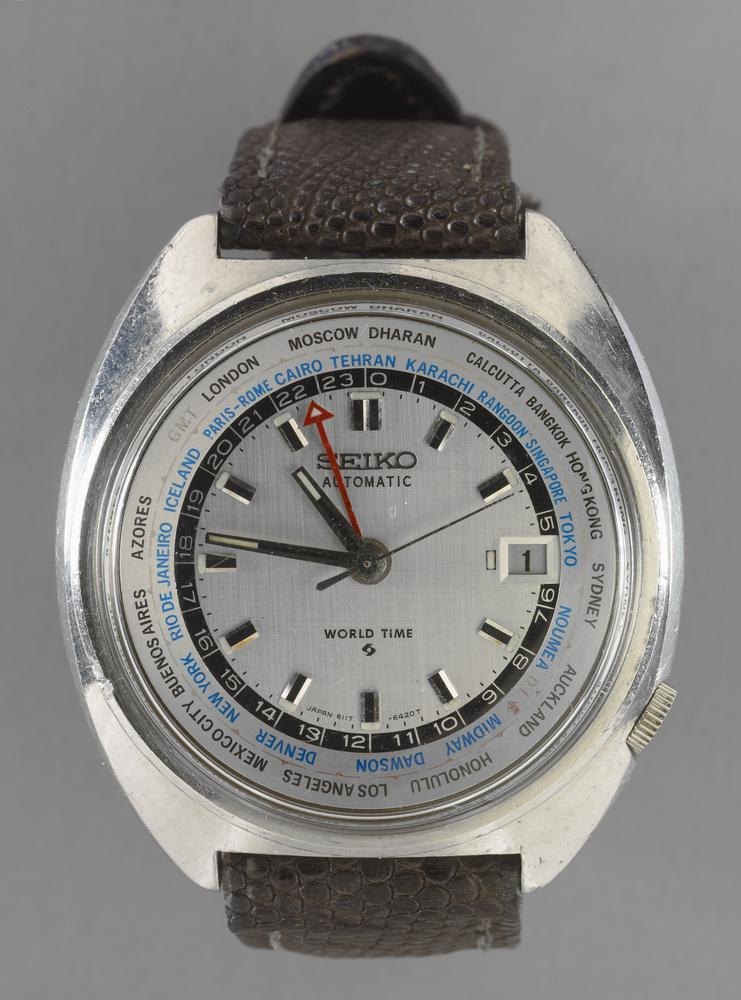
Chrome-plated cased centre-seconds jewelled lever automatic wrist-watch with date mechanism, world-time dial and black lizard-skin strap
- Maker / attribution
- Seiko (Made by)
- Date
- 1960–1970
- Historical period
- Modern Mechanical Horology (1945 – 1969)
- Country of origin
- Japan
- Place
- Japan
- Object type
- Calendar watch
- Materials / technique
- steel
- Dimensions
- Diameter: 31.30 millimetres (dial) Length: 240 millimetres (strap) Length: 45 millimetres Thickness: 13.10 millimetres Width: 41 millimetres
- Holding institution
- British Museum
- Accession / object no.
- 1989,0407.8
- Credit line
- British Museum, London
- Catalogue title (original)
- Chrome-plated cased centre-seconds jewelled lever automatic wrist-watch with date mechanism, world-time dial and black lizard-skin strap (English)
View the source record ↗ (opens another website in a new tab)Suggest a correction
Record summary
Held and catalogued by British Museum (object number 1989,0407.8), this is a calendar watch by Seiko, made in Japan, dated 1960–1970. The Atlas places it in the Modern Mechanical Horology period (1945 – 1969) of its Wristwatches collection. Materials and techniques recorded by the source: steel. Recorded dimensions: Diameter: 31.30 millimetres (dial) Length: 240 millimetres (strap) Length: 45 millimetres Thickness: 13.10 millimetres Width: 41 millimetres. The record is illustrated with 1 photograph.
Assembled from the source record's structured fields. Dates and attributions are given as the source states them; where a field is missing the Atlas leaves it blank rather than estimating.
Catalogue description
Description — British Museum
Movement with automatic rotary winding and club-tooth lever escapement. Balance has four arms. Silver coloured metal dial with outer rotating ring inscribed with locations around the world surrounding a black circle calibrated 0-24 for hours; date aperture at 3 o'clock; baton hour marks with luminous-painted tips. Stainless-steel hour, minute and centre-seconds hands; hour and minute hands with luminous-painted tips; red-painted 24 hour hand with arrow-head pointer. Stainless-steel case with screw-on back. Lizard skin wrist-strap.
Curator's comments — British Museum
Comment from Richard Good, Catalogue of Watches in the British Museum. Vol. V (Unpublished manuscript) Made by Seiko Watch Co. Japan, c. 1960 Self wound wrist watch with world time, date and a club tooth lever escapement. Signature: On the dial 'SEIKO AUTOMATIC' and 'WORLD TIME', the Seiko trade mark also 'JAPAN 61117 … 6420T'. On the self winding bridge 'DIANISEIKOSHA 17 JEWELS UNADJUSTED JAPAN 6117B'. (1) Case: A two part stainless steel case with a screw back. On the outside of the back is 'SEIKO STAINLESS STEEL 6117-6409 WATER RESIST JAPAN J', the Seiko trade mark and the number 020210. Inside the back is 'DIANISEIKOSHA CO LTD'. There is a settable silvered world time ring which has places marked both in black and in blue, there is also a gold ring marked GMT and DT for Greenwich Mean Time and Date Line respectively. The hand set and world time ring setting button is at 4 o'clock. With the watch is a strap, not original, with a gilt buckle and marked 'GENUINE LIZARD 3/4 REG.' Dial and Hands: A silvered dial with rhodium plated rectangular batons filled black and with luminous paint at their outer ends, a double baton at 12 o'clock. An aperture for the date indication at 3 o'clock. The date dial is printed black on a silver background. The minute circle is also black and is surrounded by a 24 hour dial for use with the world time ring. Rhodium plated baton hour and minute hands, with skeletonised tips filled with luminous paint. A rhodium plated centre seconds hand and a 24 hour hand painted red and with a triangular skeletonised tip filled luminous. Movement Ebauche Marks: none. Frame: A nickel silver movement. A bridge for the barrel and another for the train, a cock for the centre wheel, a bridge for the pallets and a cock for the balance. Barrel and Mainspring: A recessed cover to the barrel. Barrel: I diameter 11.2 mm., height 1.0 mm. Mainspring: height 1.0 mm., thickness 0.09 mm. Barrel Arbor: diameter 2.8 mm., snailed. Hooking: A slipping mainspring with the outer turn of the spring reinforced by a single turn of thicker spring. Train wheels of brass, gilded. The centre, third, and escape wheels (this latter steel) with five crossings, the fourth wheel with six. Jewelled: from the centre onwards the jewels pressed in, endstones to the escape wheel. Shock protected bearings to the balance of the KIF type but known in this watch as the "Diashock Shock Resistant Device". Escapement: A straight line layout club tooth escapement, short lever, double roller, the impulse pin D shaped. The pallet stones exposed with flat acting faces. The escape wheel of steel. Solid bankings on the pallet bridge. A mixed escapement. Number of teeth embraced 3 ½ Balance & Spring: a four arm monometallic balance a plain rim. Balance diameter 11.7 mm., thickness 0.4 mm. A 'self compensating' flat spiral spring with 13 ¾ turns. Means of Regulation: An index on the balance cock registers against a divided scale with + and - engraved on the balance cock table. Train Counts and Beat Rate: Great wheel 84 (barrel) Centre wheel 75 pinion 12 Third wheel 64 pinion 8 Fourth wheel 96 pinion 10 Escape wheel 15 pinion 8 An unusual train. Beat rate 21,600 Motion work: cannon pinion 12 minute wheel 36, minute pinion 8 hour wheel 32 Self Winding System: The weight runs on a ball race and carries a ratcheting lever which has click terminations that, as the weight revolves, alternatively pull and push on the fine tooth ratchet wheel. This latter wheel carries a pinion which meshes directly with the barrel ratchet wheel. Date Work: The hour wheel of 32 drives a pinion* of 16 so that this revolves once in a ¼ of a day. This pinion is integral with another of 12 leaves which in turn drives the calendar indexing wheel of 48, thus this revolves once a day. A cam* on the indexing wheel propels the date ring. * In registration no. 1986,0509.2 these two pieces are made of a plastic material. Winding System: Conventional positive stem set keyless work but there is no winding pinion so no provision for manual winding, only hand setting. Dimensions: Case: Diameter 41.0 mm., height 13.1 mm.(over the glass) Movement: Diameter 26.7 mm., height 7.5 mm. Provenance: Notes (1) This is unusual, the name Seikosha is recorded as being no longer used after 1923, see M. Cutmore 'Watches 1850-1980' London 1989 p.181. For an almost identical movement see registration no. 1996,0905.2.
Inscriptions & marks
signature; SEIKO S 020210 JAPAN STAINLESS STEEL 6117.6409 WATER RESIST [case back]; signature; DAINI SEIKOSHA CO. LTD [case back]; inscription; SEIKO AUTOMATIC WORLD TIME JAPAN 6117 6420 T [dial]; signature; 6117B DAINISEIKOSHA CO LTD JAPAN SEVENTEEN 17 JEWELS UNADJUSTED [rear plate]; inscription; GENUINE LIZARD 3/4 REG. [wrist-strap]
Provenance
Purchased from:, James Dowling
Historical context
Modern Mechanical Horology (1945 – 1969)
Tool watches for divers, pilots and astronauts; electric watches anticipate the electronic age.
The classic era of the mechanical wristwatch: dive watches, chronographs for motor racing and space flight, GMT watches for jet travel, slim dress watches, automatic calendars, and the rise of Japanese manufacturers alongside Swiss, American, German and Soviet industries.
Read the period in the timelineMore wristwatches from this periodEarlier: Golden Age of Mechanical Watchmaking
Atlas type guide
Calendar, moon-phase and perpetual calendar watches
Calendar complications range from a simple date to the perpetual calendar, which automatically allows for months of different lengths and leap years until 2100. Pocket watches with perpetual calendars were made in the eighteenth and nineteenth centuries; Patek Philippe made the first perpetual calendar wristwatch in 1925, and series production followed in 1941. The annual calendar (Patek Philippe, 1996) needs correction only once a year.
Moon-phase displays use a disc with two moons and 59 teeth advanced daily, approximating the 29.5-day lunation; more precise trains reduce the error to one day in over a century.
What to look for
- Apertures or subsidiary dials for day, date, month and leap year.
- Moon disc under a 'bosom' shaped aperture.
- Recessed correctors on the case band for setting the calendar.
Dating clues
- Triple-date wristwatches: popular c. 1940–1955.
- Perpetual calendar wristwatches: from 1925 (unique) and 1941 (series).
General guidance written by the Atlas editors about this kind of object. It is not a statement about this particular piece; for that, rely on the source record above and on physical examination.
Related records
Wristwatches · 1967
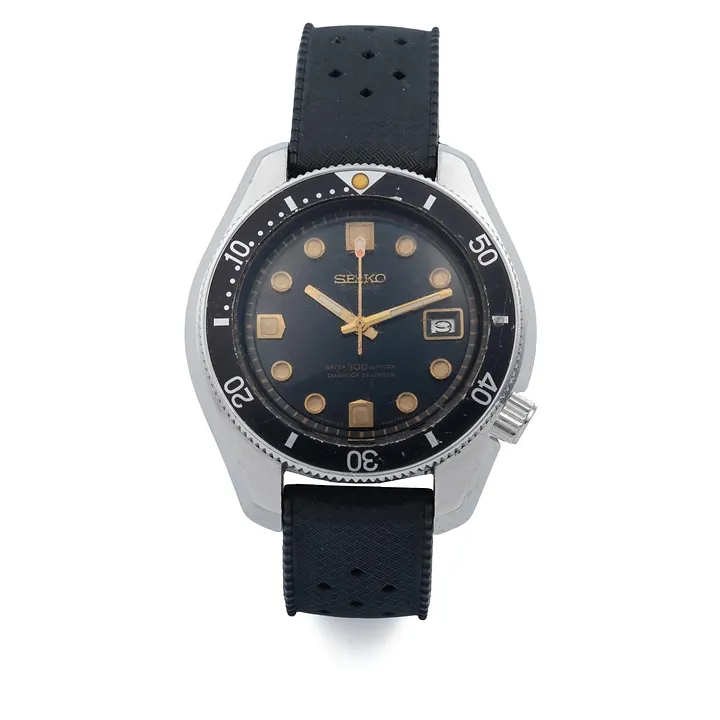
Seiko 300 M, ref. 6215-7000, 1967
Antiquorum auction archive, Geneva
Wristwatches · 1967
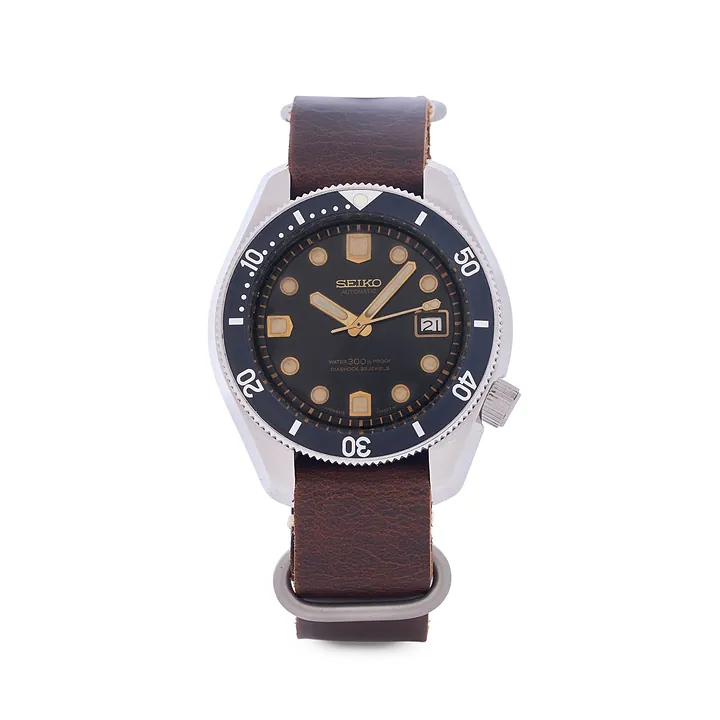
Seiko 300 Meter Diver, ref. 6215-7000, 1967
Antiquorum auction archive, Geneva
Wristwatches · c. 1968
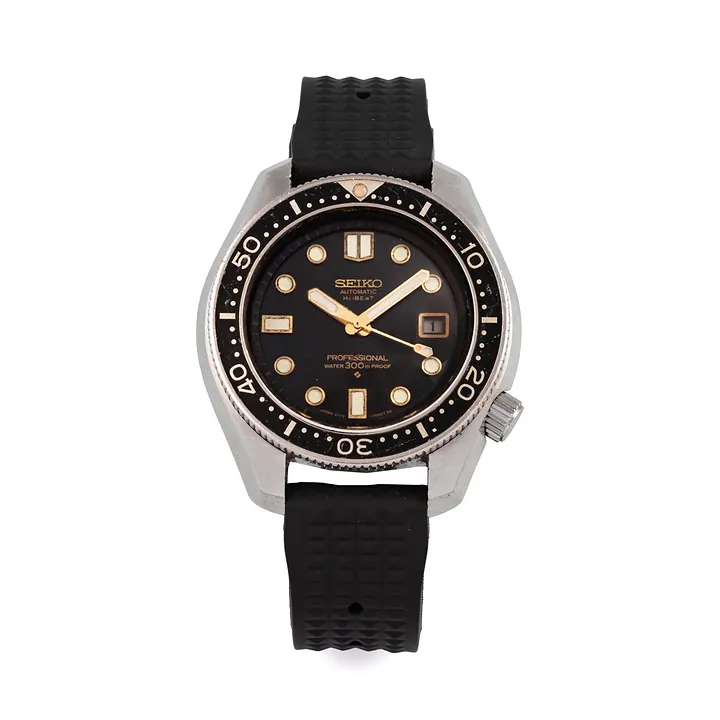
Seiko Hi-Beat, ref. 6159-7000, c. 1968
Antiquorum auction archive, Geneva
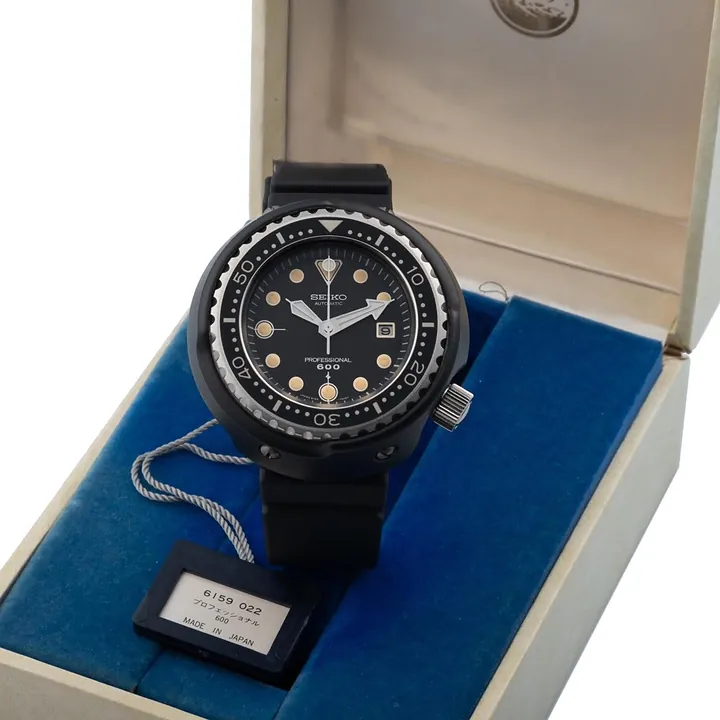
Wristwatches · 1975
Seiko Tuna Professional 600, ref. 6159-7010, 1975
Antiquorum auction archive, Geneva
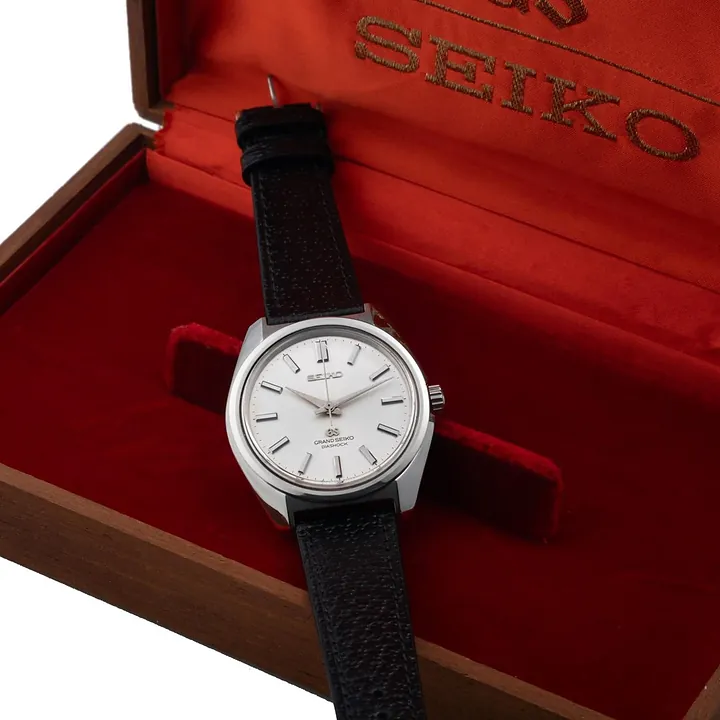
Wristwatches · 1967
Grand Seiko 44 GS, ref. 4420-9000, 1967
Antiquorum auction archive, Geneva
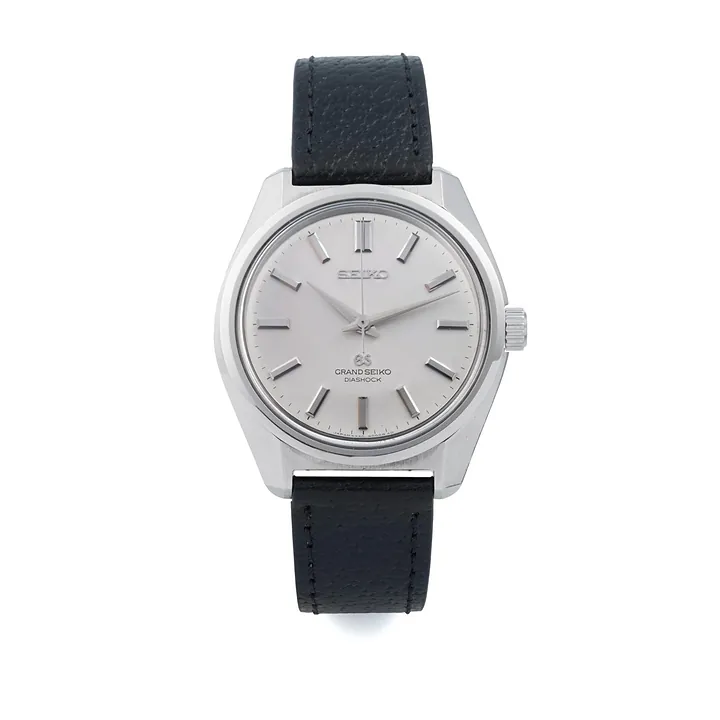
Wristwatches · c. 1967
Grand Seiko 44 GS, ref. 4420-9000, c. 1967
Antiquorum auction archive, Geneva
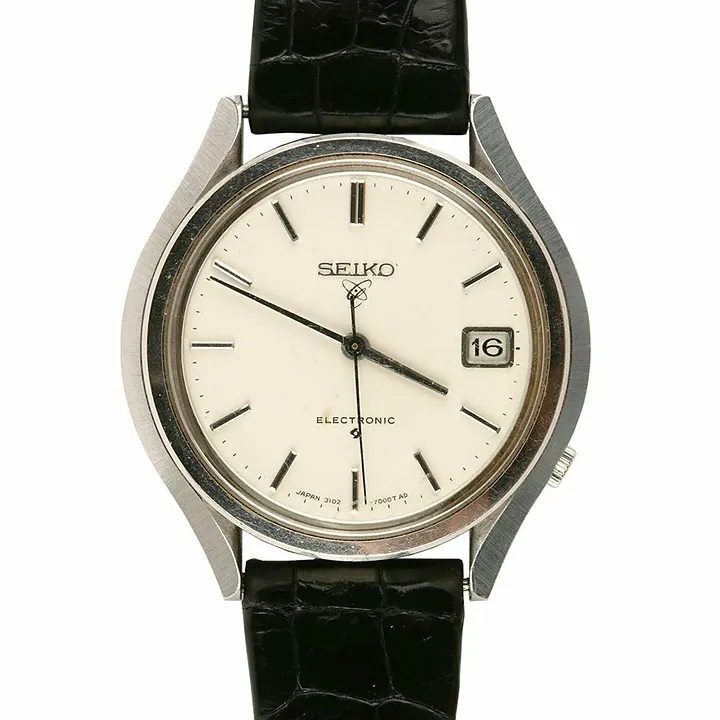
Wristwatches · 1968
Wristwatch, Japan, 1968
German Clock Museum
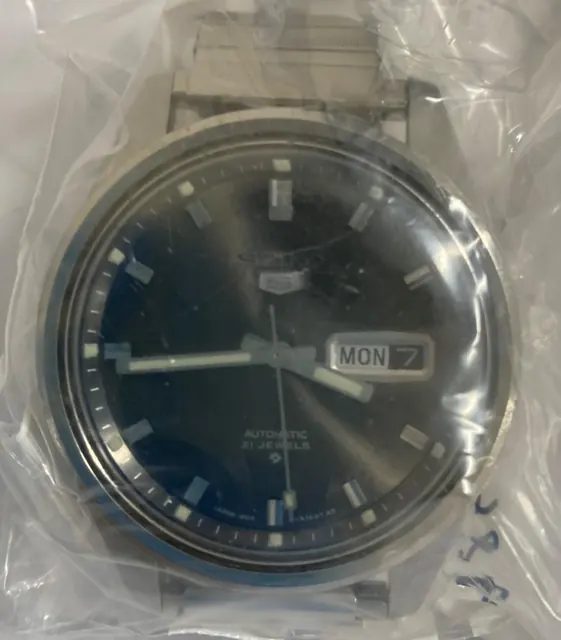
Wristwatches · 1957–1963
Stainless-steel cased self-winding lever wrist-watch with stainless-steel expanding bracelet
British Museum