
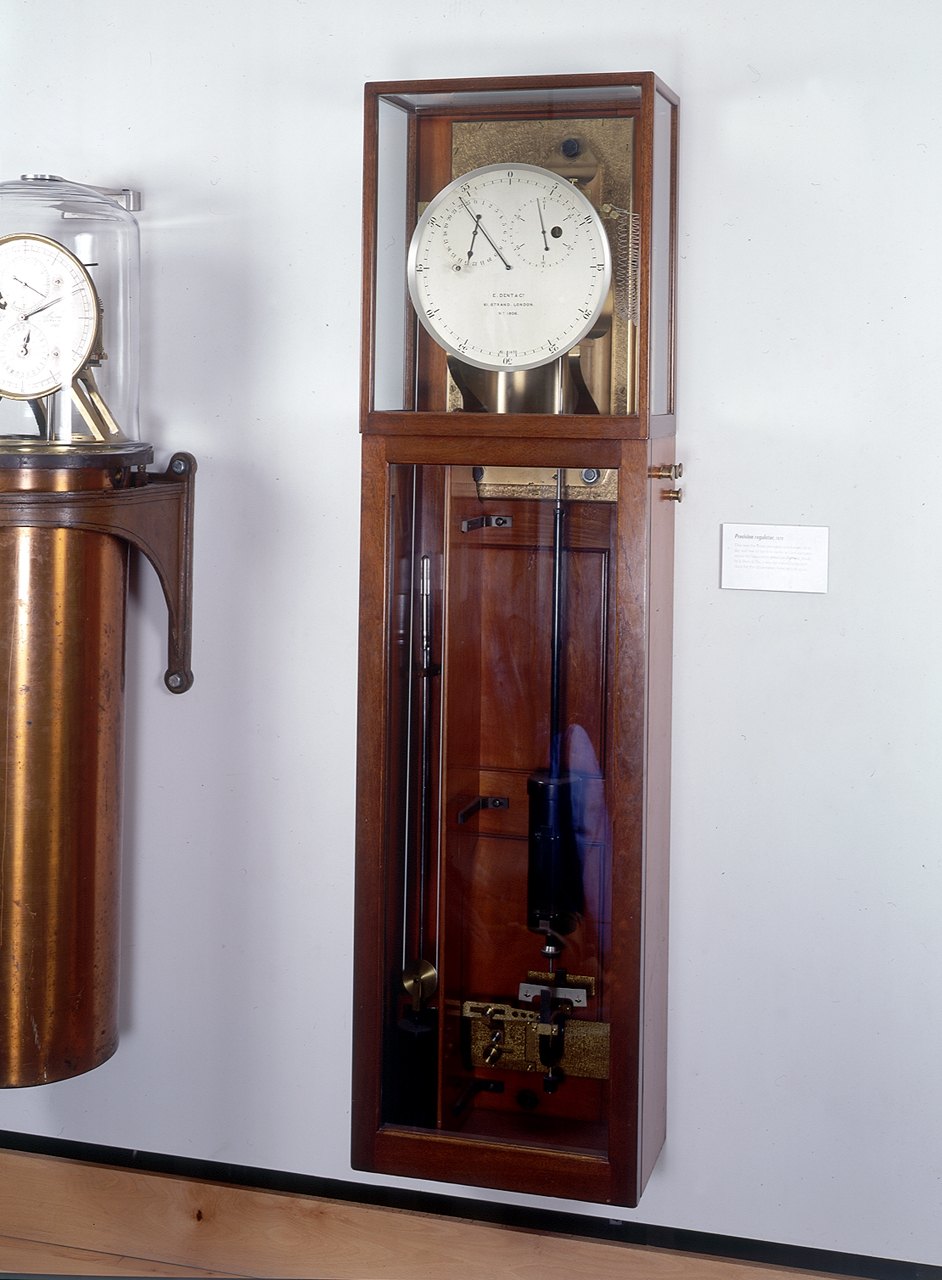
Clocks · Astronomical regulator
A wall mounted astronomical regulator with Airy’s spring detent escapement, manufactured by E. Dent & Co. No. 1906, c.1870
- Maker / attribution
- Edward John Dent & Co. (maker)
- Date
- 1870
- Historical period
- Industrial Revolution (1850 – 1900)
- Country of origin
- England
- Place
- Greenwich
- Object type
- Astronomical regulator
- Materials / technique
- mercury
- Dimensions
- Overall: 1600 x 435 x 243 mm
- Holding institution
- Royal Museums Greenwich
- Accession / object no.
- ZAA0601
- Credit line
- National Maritime Museum, Greenwich, London
- Catalogue title (original)
- A wall mounted astronomical regulator with Airy’s spring detent escapement, manufactured by E. Dent & Co. No. 1906, c.1870 (English)
View the source record ↗ (opens another website in a new tab)Suggest a correction
Record summary
Held and catalogued by Royal Museums Greenwich (object number ZAA0601), this is an astronomical regulator by Edward John Dent & Co., made in Greenwich, England, dated 1870. The Atlas places it in the Industrial Revolution period (1850 – 1900) of its Clocks collection. Materials and techniques recorded by the source: mercury. Recorded dimensions: Overall: 1600 x 435 x 243 mm. The record is illustrated with 6 photographs.
Assembled from the source record's structured fields. Dates and attributions are given as the source states them; where a field is missing the Atlas leaves it blank rather than estimating.
Catalogue description
Catalogue description — Royal Museums Greenwich
This clock was used as The Sidereal Standard at the Royal Observatory, Greenwich for over 50 years until it was superseded in 1922 by the Cottingham-Riefler. It has a highly sophisticated detached detent escapement designed by the seventh Astronomer Royal, Sir George Airy. One of the first of its type, the pendulum compensates for temperature and barometric pressure changes. The present glazed hood and door were replacements made for the clock when it was exhibited at the 1951 Festival of Britain. The four-wheel movement is enclosed by substantial rectangular plates, united by stout cylindrical pillars, and is mounted to a substantial cast bronze bracket. The great wheel has seven crossings and is mounted to the barrel arbor in conjunction with Harrison’s maintaining power. The centre and third wheel have six straight crossings and are mounted to high numbered pinions. The escape wheel is of the paddle-wheel type, formed from a single piece of brass with four curved crossings. The escapement is a form of George Biddell Airy’s detent escapement. The crutch is fitted with a fine regulation device (also designed by The Astronomer Royal) in the form of a brass block, suspended on a threaded rod that is moved up or down by turning a hand screw. This device enabled the clock’s timekeeping to be fine tuned without stopping the pendulum or adjusting the length of the suspension. The movement is finely finished with lacquered curling on all flat surfaces. The movement is fitted with two sets of electrical contacts: the first pair is closed by a 30 toothed wheel mounted to the escape wheel arbor, and visible through a circular aperture in the dial. The second set of contacts send out an electrical pulse every 30 seconds; the contacts are closed by two ruby pallets mounted behind the escape pinion. The black painted driving weight is separated from the temperature compensated pendulum by a thin mahogany baffle board; this is to avoid any air disturbance as the weight falls past the pendulum bob. In fact this regulator was so reliable in its rate, it was noted that a rise in barometric pressure equal to one inch of mercury led to a daily loss of 0.3 seconds. In 1873 Airy wrote to Dent proposing the barometric compensation that can be seen on the clock today. Inside the weight chamber is a mercury barometer tube and the float connects to a pivoted ‘see-saw’ like arm carrying a permanent magnet. Barometric changes will change the magnets position relative to the permanent magnet on the pendulum and by doing so will increase or lessen its influence on the clock’s rate. The mahogany case is largely in its original state, though the hood and front door were replaced with fully glazed replacements prior to exhibition at the festival of Britain on 1951. The nominal 12 inch silvered dial is laid out with an outer minute circle, enclosing the seconds and 24 hour subsidiaries which are both situated in the upper half of the dial plate. The lower half is signed by the manufacturer and discretely dated above the 30 minute mark. Due to the action of the escapement, the clock only beats every two seconds. The electrical contacts behind the dial were fitted in 1880 and the signal they produced was used to regulate another clock within the observatory. Dent 1906 was used as The Sidereal Standard at the Royal Observatory, Greenwich for over 50 years until it was superseded in 1922 by the Cottingham-Riefler.
Historical context
Industrial Revolution (1850 – 1900)
American interchangeable-parts manufacture; railroad time standards; Swiss and German factory systems.
Factory production transformed the clock into an everyday object. American makers (Seth Thomas, Ansonia, Waterbury) and German factories (Junghans, Gustav Becker, Lenzkirch) sold millions of shelf, wall and alarm clocks worldwide; France produced standardised Paris movements and carriage clocks; electric time distribution began.
Read the period in the timelineMore clocks from this periodEarlier: Precision & Scientific Horology
Atlas type guide
Regulators, wall and Vienna clocks
A regulator is a precision pendulum clock used as a time standard in observatories, workshops and railway offices. Typical features are a deadbeat or Graham escapement, a temperature-compensated pendulum (mercury jar, gridiron or later invar), maintaining power and a regulator dial that separates hours, minutes and seconds. George Graham's deadbeat escapement (c. 1715) and his mercury pendulum, together with Harrison's gridiron, set the pattern for two centuries.
Wall clocks span a much wider range: the elegant Viennese Laterndluhr and Dachluhr of the Biedermeier period, the Dutch stoelklok and staartklok, English 'dial' clocks used in schools, offices and railway stations, and mass-produced spring and weight wall clocks from Germany (Gustav Becker, Junghans, Kienzle) and America.
What to look for
- Deadbeat escapement and compensated pendulum (gridiron rods, mercury jar or wood rod).
- A regulator dial with a large central minute hand and separate hour and seconds dials.
- Vienna regulators: glazed cases, slender pendulum, small weights, enamel two-piece dials.
- German factory trademarks stamped on the backplate (e.g. Gustav Becker anchor and crown, Junghans star).
Dating clues
- Graham-type deadbeat regulators: from c. 1720.
- Viennese Laterndluhr: c. 1800–1850.
- German factory 'Vienna-style' regulators: c. 1870–1930; Gustav Becker serial numbers allow close dating.
General guidance written by the Atlas editors about this kind of object. It is not a statement about this particular piece; for that, rely on the source record above and on physical examination.
Read next:Deadbeat escapementAnchor (recoil) escapementGrasshopper escapement
Related records
Instruments · Unknown. Second half 19th century.
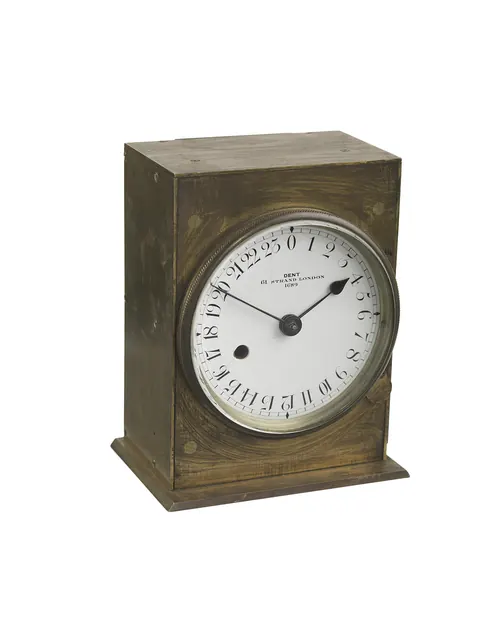
Chronometer no. 1689 by Edward John Dent & Co
Royal Museums Greenwich
Clocks · c. 1842
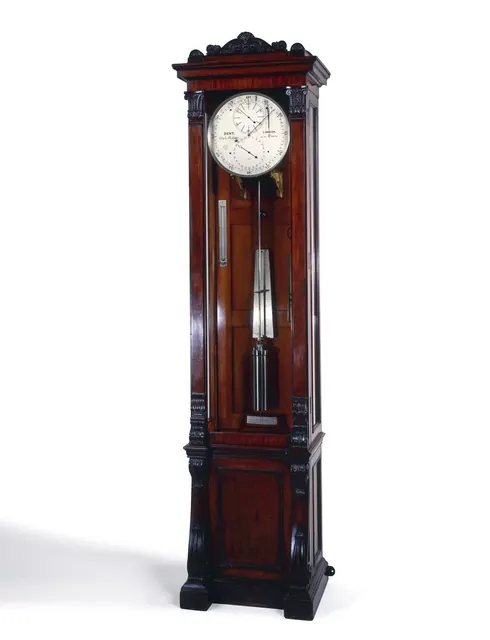
An astronomical longcase regulator by Dent of London, number 587, featuring G.B. Airy’s ‘Remontoir Dead-beat’ escapement, circa 1842
Royal Museums Greenwich
Clocks · c. 1870
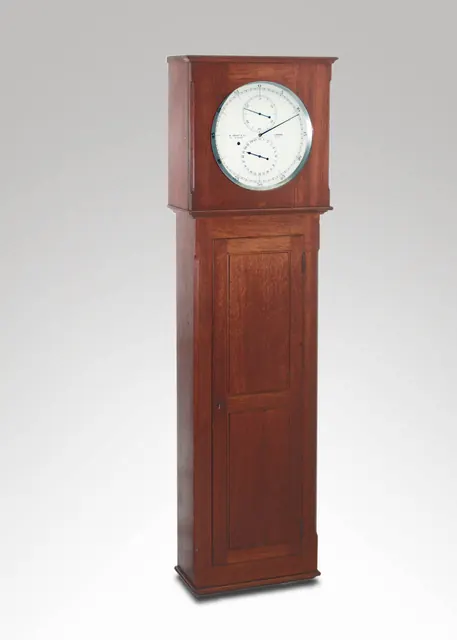
Astronomical regulator no. 2011 by Edward John Dent & Co
Royal Museums Greenwich
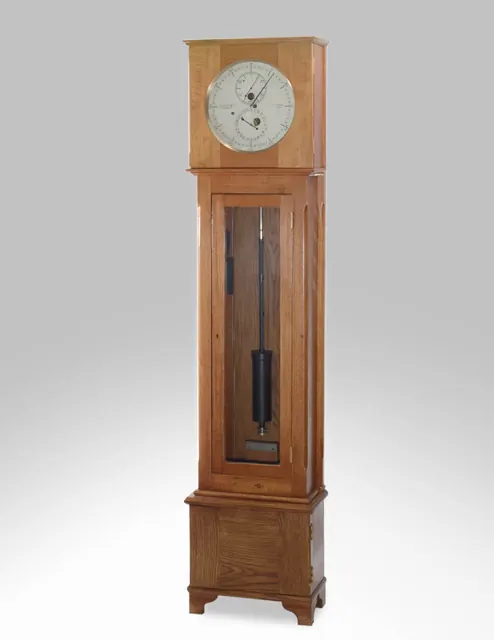
Clocks · 1870
Astronomical regulator no. 2010 by Edward John Dent & Co
Royal Museums Greenwich
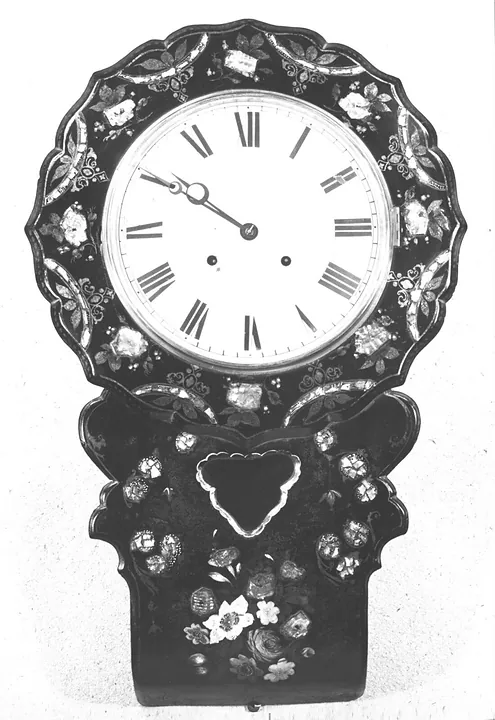
Clocks · 1830–1870
Wall clock in a papier mâché case with painted decoration. English, mid 19th century.
Victoria and Albert Museum, London

Clocks · 1840–1900
Alarm clock, mounted on model of coffin with skeleton, probably English, 1840–1900
Science Museum Group, London
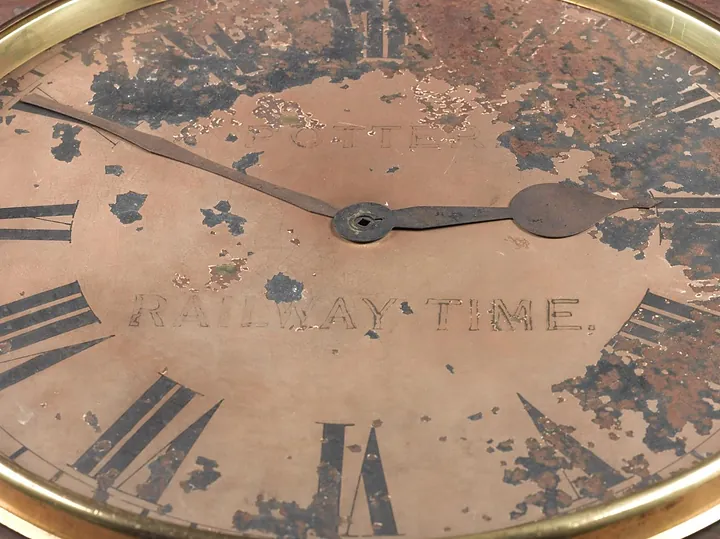
Clocks · 1840–1880
Clock dial marked "Potter, Railway Time" with two hands, unknown maker, British, 1840–1880
Science Museum Group, London
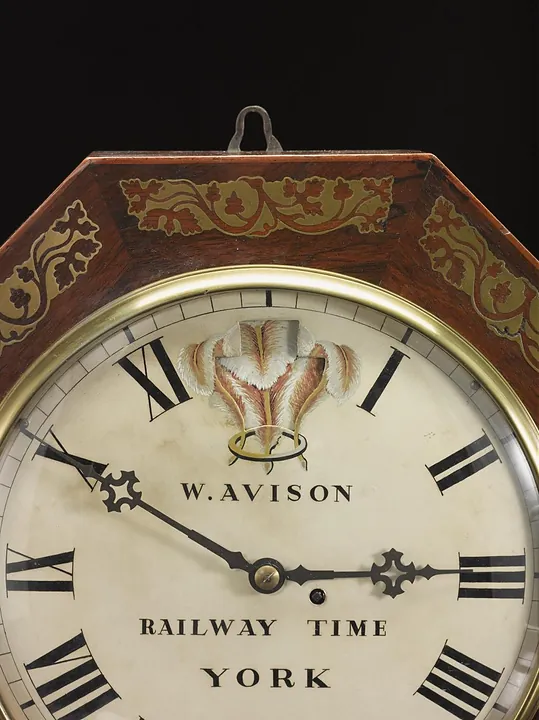
Clocks · 1840–1880
Wall Clock in octagonal case with Prince of Wales Feathers above makers name "W. Avison, Railway Time, York", made by William Avison, England, 1840–1880.
Science Museum Group, London