
Instruments · Chronometer
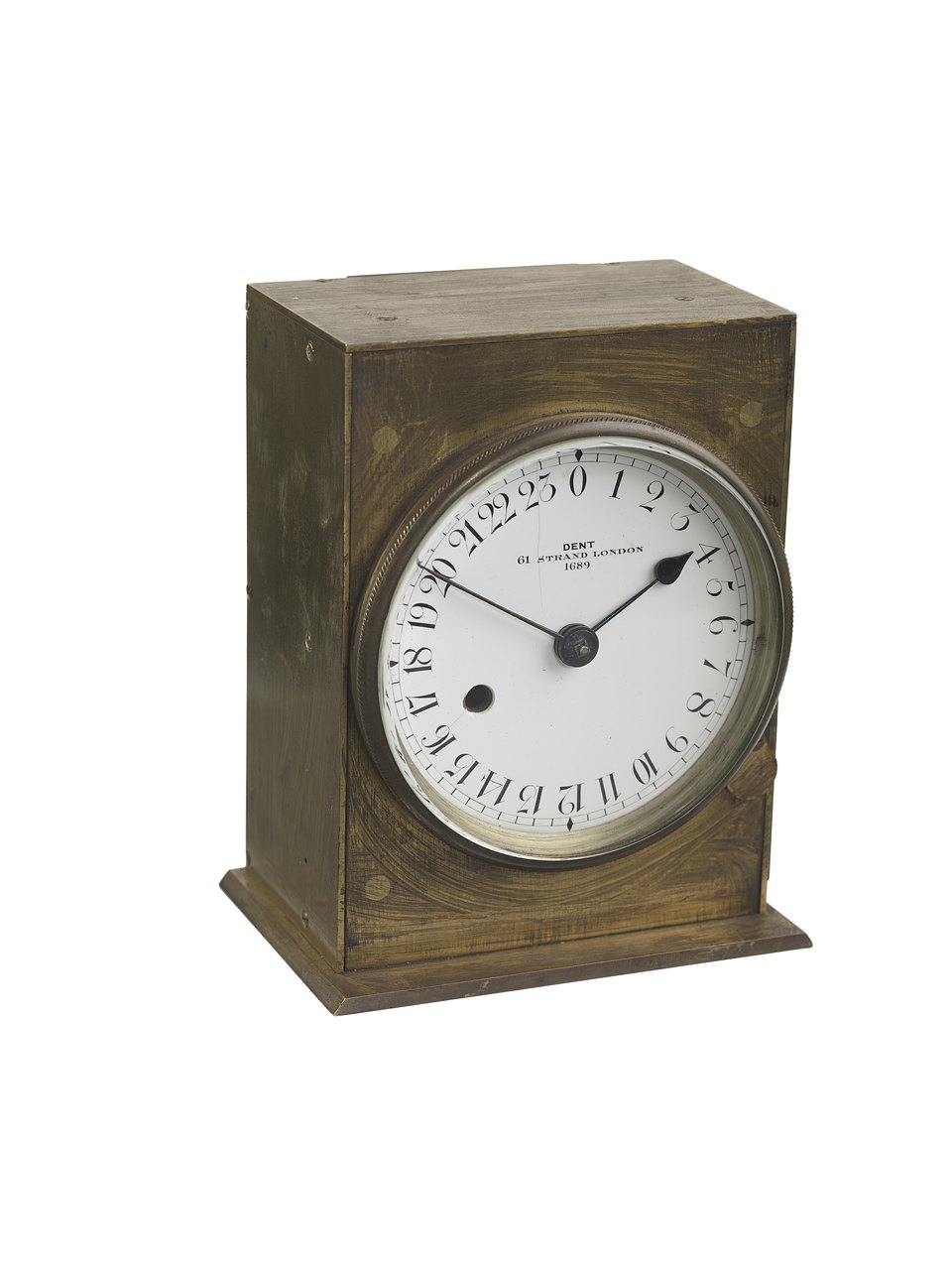
Chronometer no. 1689 by Edward John Dent & Co
- Maker / attribution
- Edward John Dent & Co. (maker)
- Date
- Unknown. Second half 19th century.
- Historical period
- Industrial Revolution (1850 – 1900)
- Country of origin
- England
- Object type
- Chronometer
- Dimensions
- Overall: 128 x 102 x 69 mm
- Holding institution
- Royal Museums Greenwich
- Accession / object no.
- ZAA0891
- Credit line
- National Maritime Museum, Greenwich, London
- Catalogue title (original)
- 1689 (English)
View the source record ↗ (opens another website in a new tab)Suggest a correction
Record summary
Held and catalogued by Royal Museums Greenwich (object number ZAA0891), this is a chronometer by Edward John Dent & Co., made in England, dated Unknown. Second half 19th century.. The Atlas places it in the Industrial Revolution period (1850 – 1900) of its Instruments collection. Recorded dimensions: Overall: 128 x 102 x 69 mm. The record is illustrated with 2 photographs.
Assembled from the source record's structured fields. Dates and attributions are given as the source states them; where a field is missing the Atlas leaves it blank rather than estimating.
Catalogue description
Catalogue description — Royal Museums Greenwich
Dent, London c.1863 No.1689 1 day driving chronometer in brass case Dent…… Box/Mounting The chronometer is housed in a sealed, lacquered brass box with a dovetailed plate forming the base, the whole measuring 127mm high, 108mm wide, and 80mm deep. The structure of the box is formed by the movement itself, the front being the dial plate, the rear being the backplate and the sides, top and bottom being removable plates all fixed to them with brass screws. The rear has all pivots protected with brass caps and there is a driving wheel on the rear fusee pivot at the back of the chronometer, for connecting to the mechanism to be driven. A small removable panel at the top of the backplate allows access to the platform escapement. The front of the case has a narrow brass, friction fitting bezel, with a flat beveled glass over the dial. On the front of the case, to the lower right, is a swiveling shutter, covering the winding square for the movement. A curved brass ‘patch’ on the right hand side of the case, accommodates one of the winding wheels which projects out if the plates on that side. Directly adjacent to this patch is a blanking piece covering a slot which appears to have allowed room for something fixed to the winding square within the case, now missing. Dial and hands The 80.7 mm Ø, flat white enamel dial is pinned to the brass dial plate with a silvered brass sight ring screwed over the front with 3 steel screws from behind. The dial has 24 arabic hour numerals, the 24th being represented with ‘0’. The dial is signed below the top: “DENT / 61 STRAND LONDON / 1689”. Between ‘16’ and ‘17’ in the dial centre is what appears to be a winding hole, with no obvious connection with anything beneath. The hole also penetrates the brass dial plate behind, and appears to have been present since manufacture. Movement Full-plate, vertical reverse-fusee movement with four baluster and finned pillars, the front plate pinned on. The general level of finish of the movement is very high with all movement parts flat-finished and curled. The fusee is wound via three brass transmission wheels, the first (with the winding square) and second (mounted on a stud on the inside of the backplate) having Dent’s differential stopwork, the third of these wheels being mounted on the end of the fusee. The set-up ratchet click is stamped “12” on its front surface. The movement appears originally to have had the fusee and barrel arranged in a more conventional position, the fusee centred on the exisiting winding hole in the dial, but no doubt rearranged (extremely neatly) during manufacture. The minute wheel pinion runs right through the movement and the rear pivot is of large diameter, now without a setting square but neatly domed over to run against the endplate which covers it. The strong, blued steel mainspring has a fixed hooking in the barrel and is signed as below. There is a four-wheel train and a great wheel, the wheels brass with the great pivots run in large removable brass bearings. All train holes have been plugged and re-pitched from new, and there is a plug at the foot of both plates where they were pinned during construction. Escapement, balance, spring and jewelling Right angle, ratchet-tooth, single table-roller lever escapement with highly polished steel pallets having red pallet stones, the balance roller with a clear impulse stone. The cock for the upper pallets and escapewheel pivots has had two other steady pins at some stage, not apparently on this platform. The two-arm brass and steel bimetal balance has tapered, steel arms. The rim segments, which are blued up to the junction with the arms, extend to about120° from the arms and have circular weights near the ends, with additional screws attached on top. Brass meantime nuts are attached at the end of the arms, each with a secondary brass screw alongside. The polished steel helical balance spring has terminals on both ends, the upper terminal with a fixed brass stud with side adjustment for fine isochronal adjustments. The jewelling, which is all of pink colouration and mounted in brass settings (lower balance diamond endstone, and upper balance red endstone are in polished steel settings), extends to the balance, pallets and escape wheel with endstones, and the escapement parts as mentioned. Alterations/condition The external brasswork is in sound condition but is stained and the laquer is breaking down, leaving it streaky and tarnished. The silvering of the sight ring is now rather tarnished and patchy. One of the screws `for the escapement panel at the rear is missing. The enamel dial is cracked from 23 down to the centre and from the hole in the dial to the left hand edge. The movement is in generally sound and unscrubbed condition, though it is quite dusty and there are traces of metal polish which has run inside and is now dried and green (this brushed off and cleaned as best as possible during inspection). The balance cock has had burrs raised under its feet, suggesting a new staff or repivoting at some stage. One of the upper escapewheel jewel hole screws has half the head missing The movement has only been very lightly cleaned, and has been re-oiled, during inspection. Commentary, Provenance, etc Potence Plate: H: 122.7 W:90.0 Pillar Plate: H: 122.7 W:90.0 Plate distance: 31.8 Inside barrel Ø: 39.7 Arbor Ø: 9.2 steel, not snailed. Thickness: 0.43 – 0.36 blued steel Height: 26.2 Output: 8 full turns maximum Signature: “M Sep 863” for M (possibly Meredith) September 1863. TRAIN COUNT Wheel / Pinion (+ext dia) Comment: Crossings? Marks?Jewelled? Fusee/Great: 96 / 41.3 No.of Turns:16 (Chain 104cms, 250 links) Driving wheel: 48 / 32.7 Brass Ratchet: 24 / 17.8 Brass, 1 steel click Maintaining Power: 90 / 35.7 Brass Fusee winding wheel: 23 / 21.1 Brass Inter winding wheel: 23 / 21.3 Brass Primary winding wheel: 24 / 21.8 Brass Centre: 64 / 27.1 + 8 / 4.0 4 curved crossings Third: 60 / 25.4 + 8 / 4.0 “ Contrate: 64 / 21.8 + 8 / 4.0 “ Escape: 15
Historical context
Industrial Revolution (1850 – 1900)
American interchangeable-parts manufacture; railroad time standards; Swiss and German factory systems.
Instruments spread into industry, science and sport: stopwatches, chronoscopes, metronomes, watchmen's clocks and time recorders.
Read the period in the timelineMore instruments from this periodEarlier: Precision & Scientific Horology
Atlas type guide
Marine chronometers
A marine chronometer is a precision timekeeper carried at sea to find longitude: the navigator compares local noon, observed with a sextant, with the time at a reference meridian kept by the chronometer. Each hour of difference corresponds to fifteen degrees of longitude. John Harrison proved the method in the 1760s; Pierre Le Roy, Ferdinand Berthoud, John Arnold and Thomas Earnshaw then developed the detent escapement and the compensation balance that made chronometers practical to manufacture.
By the nineteenth century London, Liverpool, Le Locle and Glashütte supplied navies and merchant fleets. A typical box chronometer has a spring-detent escapement, a fusee to equalise mainspring torque, a bimetallic compensation balance with a helical balance spring, and is mounted in gimbals inside a wooden box so that it stays level.
What to look for
- Gimbals and a three-tier wooden box with a glazed inner lid.
- A power-reserve ('up and down') indicator on the dial, usually showing 56 hours on two-day instruments.
- Spring-detent escapement and a cylindrical (helical) balance spring visible through the movement.
- Admiralty or navy marks (broad arrow), and rating certificates from observatories.
- The maker's number on the dial and movement; many makers' registers survive, allowing dating.
Dating clues
- Earnshaw-type spring-detent chronometers became standard after about 1800.
- Auxiliary compensation devices on the balance appear from the mid-nineteenth century.
- Quartz and radio time signals ended routine use of mechanical chronometers in the 1970s and 1980s.
General guidance written by the Atlas editors about this kind of object. It is not a statement about this particular piece; for that, rely on the source record above and on physical examination.
Read next:Spring detent (chronometer) escapementDetent escapement
Related records
Clocks · 1870
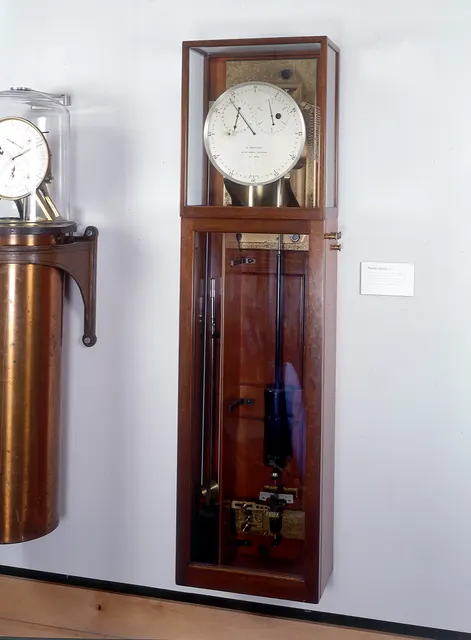
A wall mounted astronomical regulator with Airy’s spring detent escapement, manufactured by E. Dent & Co. No. 1906, c.1870
Royal Museums Greenwich
Clocks · c. 1842
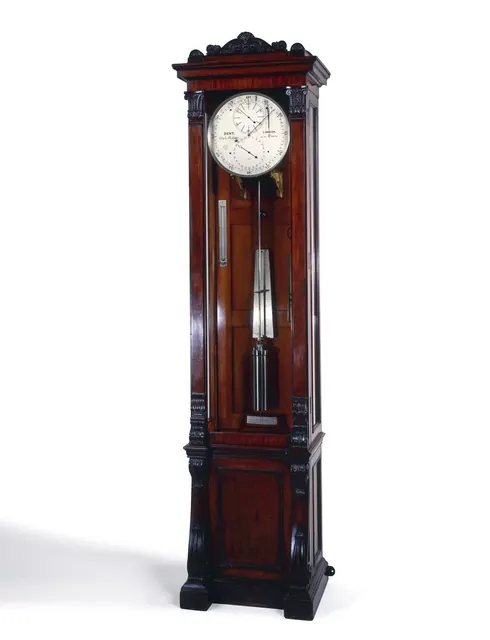
An astronomical longcase regulator by Dent of London, number 587, featuring G.B. Airy’s ‘Remontoir Dead-beat’ escapement, circa 1842
Royal Museums Greenwich
Clocks · c. 1870
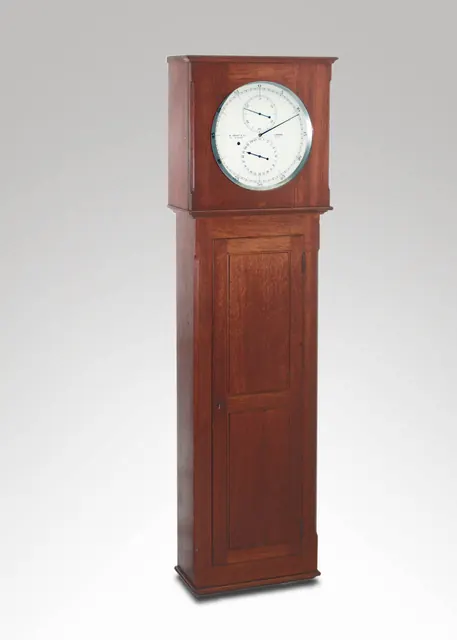
Astronomical regulator no. 2011 by Edward John Dent & Co
Royal Museums Greenwich
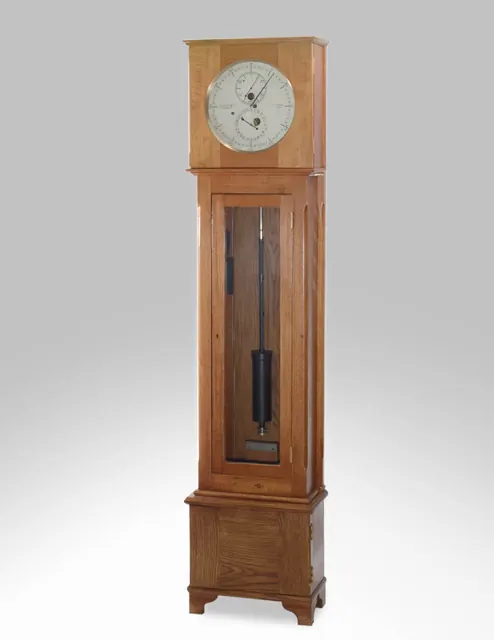
Clocks · 1870
Astronomical regulator no. 2010 by Edward John Dent & Co
Royal Museums Greenwich
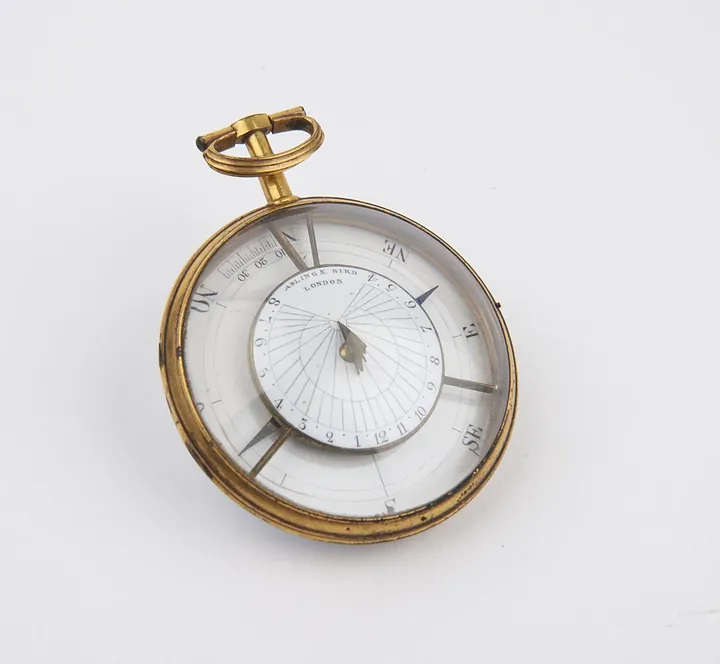
Instruments · 1831–1870
Horizontal compass sundial for latitude for 42 degrees, signed "Asling & Bird, London", in watch type case. English, c.1840.
Science Museum Group, London
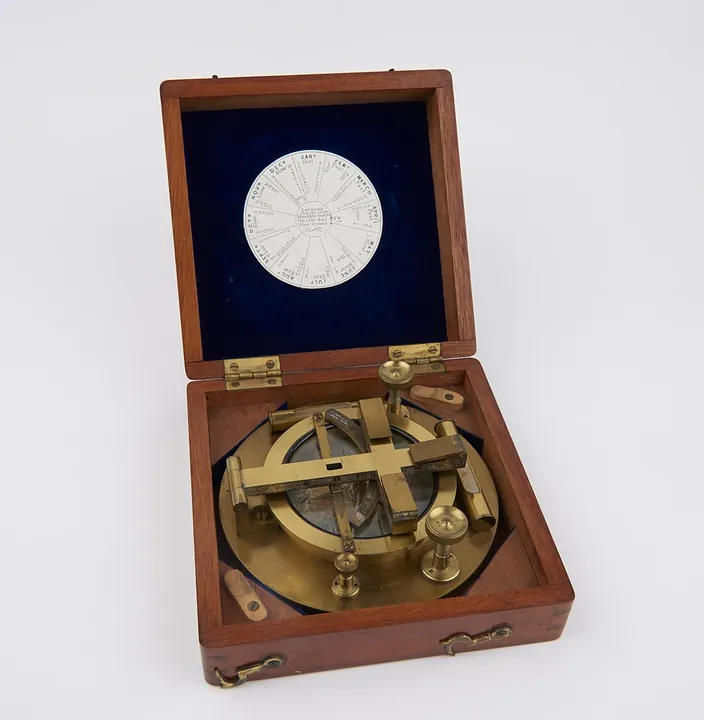
Instruments · 1831–1870
Sundial, in mahogany case
Science Museum Group, London
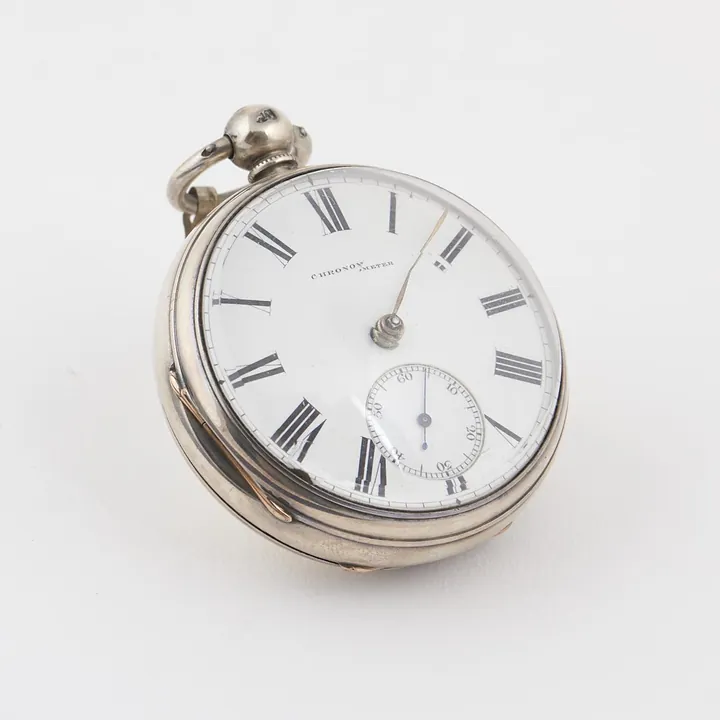
Instruments · 1850–1872
Chronometer watch in silver case by John Arnold and Son, London, no.454/755. Hall marked 1872
Science Museum Group, London
Instruments · 1850–1899
Hourglass, England, 1850–1899 (no. 01136)
Vasa Museum