
Clocks · Alarm clock
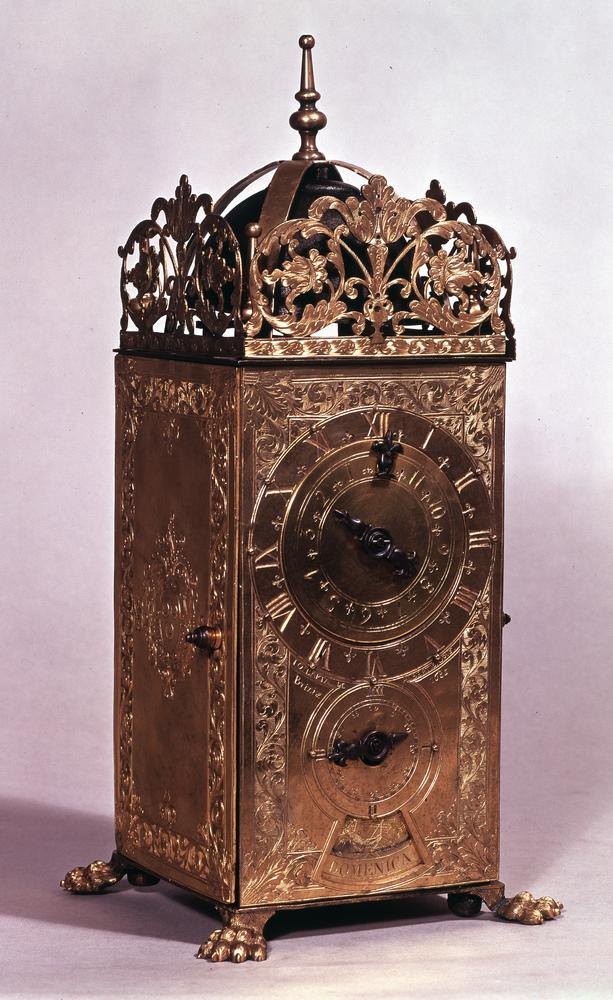
Wall bracket clock by Giovanni Baptista de Albertis
- Maker / attribution
- Giovanni Baptista de Albertis (Made by)
- Date
- 1685
- Historical period
- Early Modern Horology (1600 – 1750)
- Country of origin
- Italy
- Place
- Brescia
- Object type
- Alarm clock
- Dimensions
- Height: 14 inches
- Holding institution
- British Museum
- Accession / object no.
- 1958,1006.2105
- Credit line
- British Museum, London
- Catalogue title (original)
- Wall bracket clock; weight-driven; verge escapement with short pendulum; count-wheel striking; alarm missing; lower dial aperture originally showed the days of the week, but now contains a fixed plate (English)
View the source record ↗ (opens another website in a new tab)Suggest a correction
Record summary
Held and catalogued by British Museum (object number 1958,1006.2105), this is an alarm clock by Giovanni Baptista de Albertis, made in Brescia, Italy, dated 1685. The Atlas places it in the Early Modern Horology period (1600 – 1750) of its Clocks collection. Recorded dimensions: Height: 14 inches. The record is illustrated with 4 photographs.
Assembled from the source record's structured fields. Dates and attributions are given as the source states them; where a field is missing the Atlas leaves it blank rather than estimating.
Catalogue description
Description — British Museum
Wall bracket clock; weight-driven; verge escapement with short pendulum; count-wheel striking; alarm missing; lower dial aperture originally showed the days of the week, but now contains a fixed plate. Train-counts: Going. Gt wheel 50 2nd wheel 72/10 Contrate wheel 70/6 Crown wheel 25/5 Wheel of 40 on squared and extended 2nd wheel arbor gears with another wheel of 40 which carries hand to indicate quarters. A pinion of 5 on the first wheel of 40 drives hour wheel of 60. Going train much altered. Striking. Gt wheel 50 2nd wheel 70/10 Hoop wheel 54/7 Pin wheel 42/6 Fly 6.
Inscriptions & marks
signature; IO:BAPTAE: DE ALBERTIS.OPVS. Brixae 1685
Provenance
Previous owner/ex-collection:, Courtenay Adrian Ilbert; Donated by:, Gilbert Edgar
Historical context
Early Modern Horology (1600 – 1750)
Huygens' pendulum and balance spring transform accuracy; English makers develop the anchor and deadbeat escapements.
Huygens's pendulum (1656–57) improved clock accuracy from about a quarter of an hour to under a minute a day. The anchor escapement (c. 1670) and the long seconds pendulum created the longcase clock; London makers such as Fromanteel, Knibb, Tompion and Quare led European clockmaking, and French makers created the Boulle pendule.
Read the period in the timelineMore clocks from this periodEarlier: Renaissance Horology
Atlas type guide
Alarm clocks
Alarm work is among the oldest clock functions: monastic clocks woke monks for night prayers, and Renaissance table clocks often carried an alarm disc set by a pin. A separate spring or weight is released at the set time and drives a hammer against a bell. Some early alarms also lit a candle by striking a flint — the 'tinder pistol' alarm.
The cheap, mass-produced alarm clock arrived in the second half of the nineteenth century. American firms such as Seth Thomas and Westclox (the 'Big Ben' of 1910) and German makers such as Junghans and Kienzle made millions of drum-shaped alarms with pin-pallet escapements. Electric, quartz and digital alarm clocks followed in the twentieth century.
What to look for
- A separate alarm-setting dial or disc and an extra winding key.
- Twin bells on top (common after c. 1920) or a bell enclosed in the base.
- Pin-pallet escapements in inexpensive factory alarms.
- Trademarks and patent dates on dial or back.
Dating clues
- Renaissance alarm table clocks: sixteenth to seventeenth centuries.
- Drum alarm clocks: from the 1870s.
- Luminous dials with radium paint: c. 1910–1960.
General guidance written by the Atlas editors about this kind of object. It is not a statement about this particular piece; for that, rely on the source record above and on physical examination.
Read next:Anchor (recoil) escapement
Related records
Clocks · 1680–1690
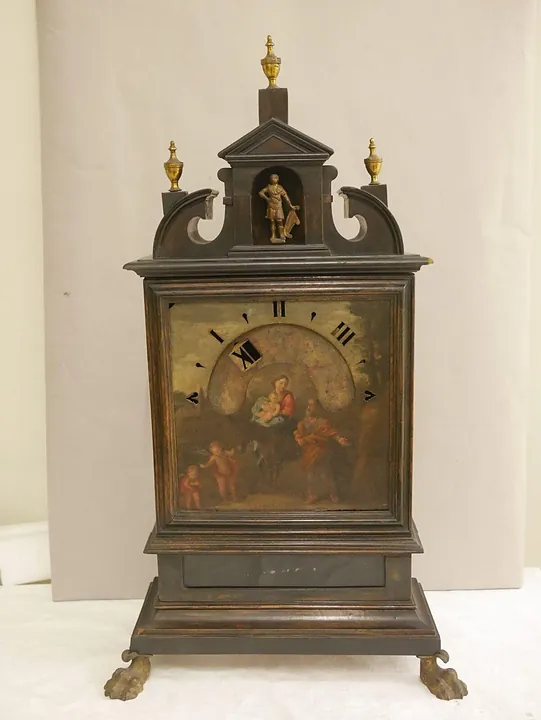
Bracket clock, Italian, 1680–1690,"Petrus Thomas Campanus Romae".
Victoria and Albert Museum, London
Clocks · 1704–1705
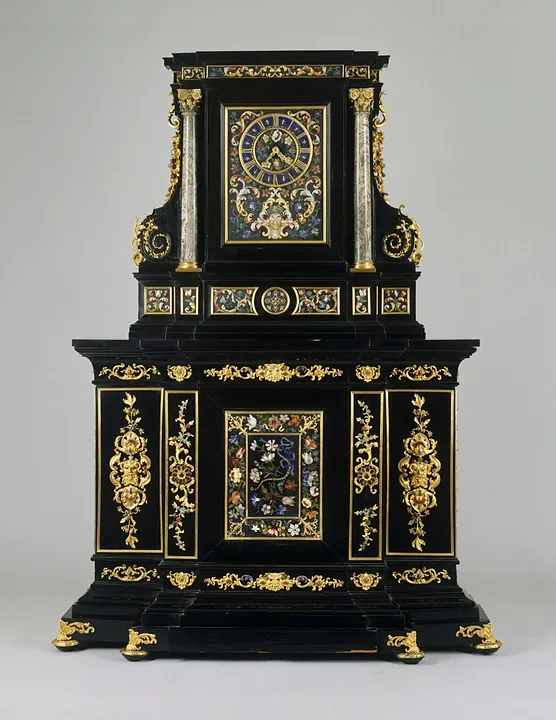
Florentine court cabinet and clock by Giovanni Battista Foggini, Italy, 1704–1705
Victoria and Albert Museum, London
Clocks · 17th century
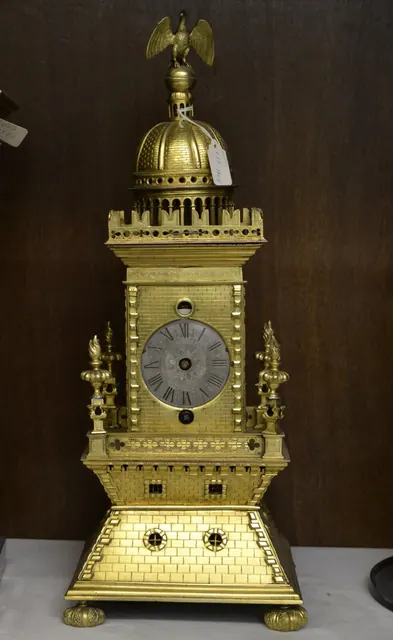
Clock, Italy, 17th century
Victoria and Albert Museum, London
Clocks · late 1600s-first half of the 1700s
Table clock, Italy, late 1600s-first half of the 1700s
Suomen kansallismuseo
Clocks · 1678
Clock by Giuseppe de Lellis, Italy, 1678
National Museum of Decorative Arts
Clocks · Reloj de sobremesa:c. 1690Reloj de bolsillo:1701–1775
Clock by Reloj de colgar: Coquerel, Jean, Italy, Reloj de sobremesa:1690[ca]Reloj de bols
National Museum of Decorative Arts
Clocks · early 18th century
Mantel clock, Italy, early 18th century
Museo Galileo, Florence
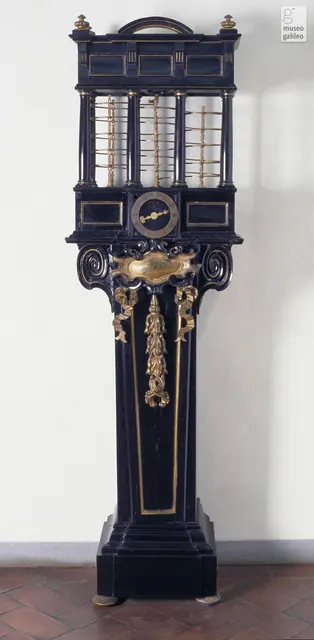
Clocks · c. 1660-1680
"Perpetual motion" clock, Italy, c. 1660-1680
Museo Galileo, Florence