
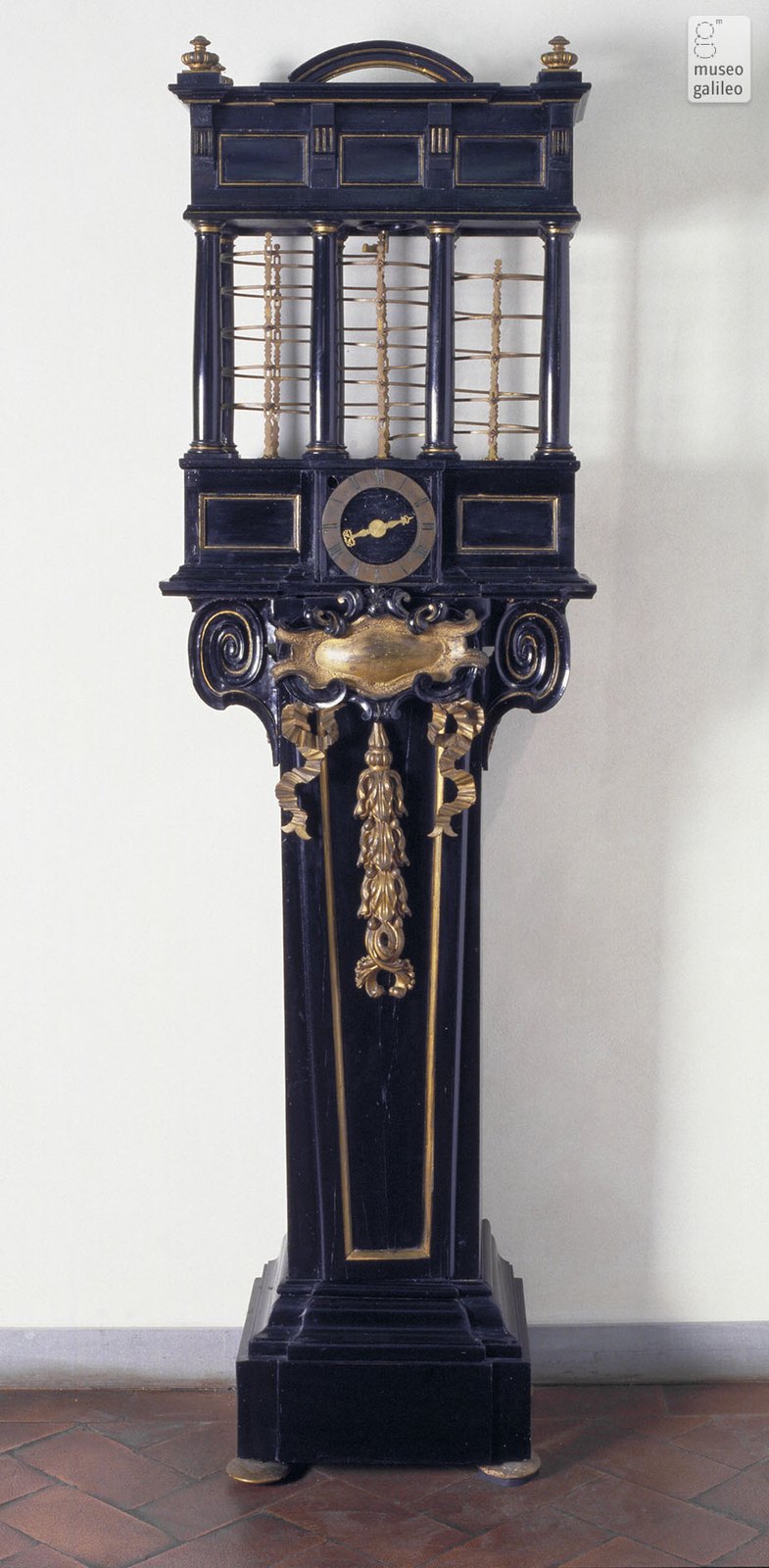
Clocks · "perpetual motion" clock
"Perpetual motion" clock, Italy, c. 1660-1680
- Maker / attribution
- Unrecorded in source
- Date
- c. 1660-1680
- Historical period
- Early Modern Horology (1600 – 1750)
- Country of origin
- Italy
- Place
- Central Italy
- Object type
- "perpetual motion" clock
- Materials / technique
- wood, iron, brass
- Dimensions
- 620x315x2070 mm
- Holding institution
- Museo Galileo, Florence
- Accession / object no.
- Inv. 713
- Credit line
- Museo Galileo, Florence
- Catalogue title (original)
- "Perpetual motion" clock (English)
View the source record ↗ (opens another website in a new tab)Suggest a correction
Record summary
Held and catalogued by Museo Galileo, Florence (object number Inv. 713), this is a "perpetual motion" clock, made in Central Italy, dated c. 1660-1680. The Atlas places it in the Early Modern Horology period (1600 – 1750) of its Clocks collection. Materials and techniques recorded by the source: wood, iron, brass. Recorded dimensions: 620x315x2070 mm. The record is illustrated with 1 photograph.
Assembled from the source record's structured fields. Dates and attributions are given as the source states them; where a field is missing the Atlas leaves it blank rather than estimating.
Catalogue description
Catalogue description — Museo Galileo
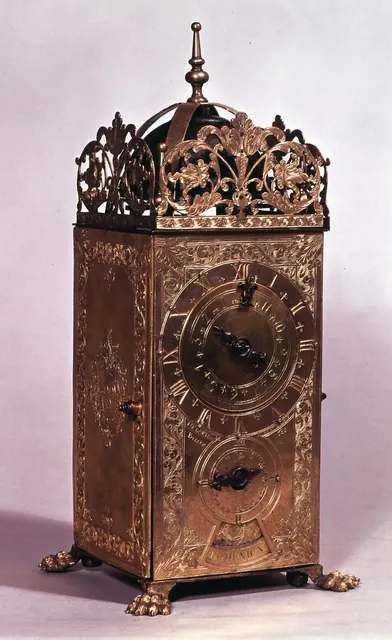
The unusual case is of ebonized pearwood, with gilt ornamentation, curlicues, and edges. The pedestal holds an eight-pillared loggia enclosing a light gilt brass structure consisting of curved-line sections imitating three helical spires. Just below the pillars, in a square at the center, is the dial with a silvered hour circle engraved with Roman hour numerals, quarter-hours, and half-hours. The winding hole is above. In 1797, glass panels were fitted to protect the curved brass structure. The machine is housed inside the case level with the dial. It is driven by a weight with rope, a drum, and a train comprising three iron wheels regulated by two brass flywheels. The train is arranged horizontally between two narrow iron plates. The regulation system consists of a small ball (originally, one assumes, of lead or gilt silver), which is dropped from the top of the case and travels down the curved path formed by the thin brass strip with siderails between the pillars of the loggia. The ball then falls into the launch tube and its weight releases the catapult mechanism. It is thus projected upward into the special hole at the top of the case. From there, the ball bounces onto an inclined plane that takes it to the opening at the top of the curved path. There it begins a new descent. Meanwhile, the clock movement reloads the launch mechanism. Each cycle lasts about 30 seconds. The exact duration depends on the ball's specific weight and the tilt of the brass strip. This clock is described in the 1692 inventory of the Medici Wardrobe (preserved at the Archivio di Stato in Florence) as a "...clock or instrument called perpetual motion..." Inside the pedestal is the inscription "Rassettato tutto nel 1797 a di 2 7mbre Sud.o Il legname da Pasquale Bassetti. Il meccanismo da Fe. Gori" ["All repaired on this day, September 2, 1797, the carpentry by Pasquale Bassetti, the mechanism by Fe[lice] Gori"]. The name "perpetual motion" originates in the seventeenth-century vogue for such contrivances.
Historical context
Early Modern Horology (1600 – 1750)
Huygens' pendulum and balance spring transform accuracy; English makers develop the anchor and deadbeat escapements.
Huygens's pendulum (1656–57) improved clock accuracy from about a quarter of an hour to under a minute a day. The anchor escapement (c. 1670) and the long seconds pendulum created the longcase clock; London makers such as Fromanteel, Knibb, Tompion and Quare led European clockmaking, and French makers created the Boulle pendule.
Read the period in the timelineMore clocks from this periodEarlier: Renaissance Horology
Atlas type guide
Domestic clocks
A clock combines four systems: a source of power (falling weight, coiled spring, or later electricity), a gear train that divides time, an escapement and oscillator that regulate it (foliot, pendulum or balance), and an indicating system of dial and hands or a bell. Its history runs from the large iron weight-driven clocks of the late thirteenth century to Renaissance spring-driven table clocks, the pendulum revolution of 1656, the factory clocks of the nineteenth century and electric and quartz clocks of the twentieth.
Domestic clocks also reflect regional furniture and decorative traditions — English longcase and bracket clocks, French pendules, Viennese regulators, Black Forest and American shelf clocks — and therefore record changing tastes as much as technical progress.
What to look for
- How the clock is powered: weights, spring barrel, fusee, electric coil.
- The oscillator: foliot, short pendulum, long seconds pendulum or balance.
- Whether it strikes: hour only (count wheel) or hours and quarters (rack striking).
- The maker or retailer's name on dial and movement, and any factory trademarks.
- Signs of alteration — replaced dials, converted escapements, 'married' cases.
Dating clues
- Before 1656 clocks used foliots or balances; after, most domestic clocks have pendulums.
- Anchor escapements spread after c. 1670; minute hands became common at the same time.
- Factory production in America and Germany transformed prices after c. 1840.
General guidance written by the Atlas editors about this kind of object. It is not a statement about this particular piece; for that, rely on the source record above and on physical examination.
Related records
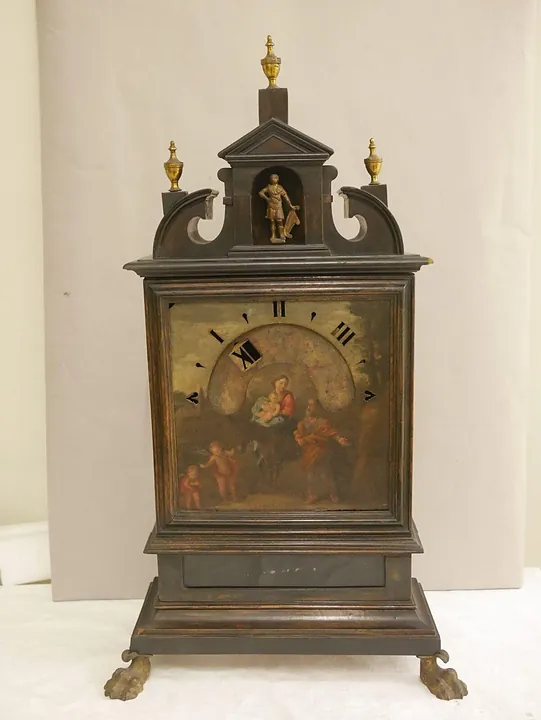
Clocks · 1680–1690
Bracket clock, Italian, 1680–1690,"Petrus Thomas Campanus Romae".
Victoria and Albert Museum, London
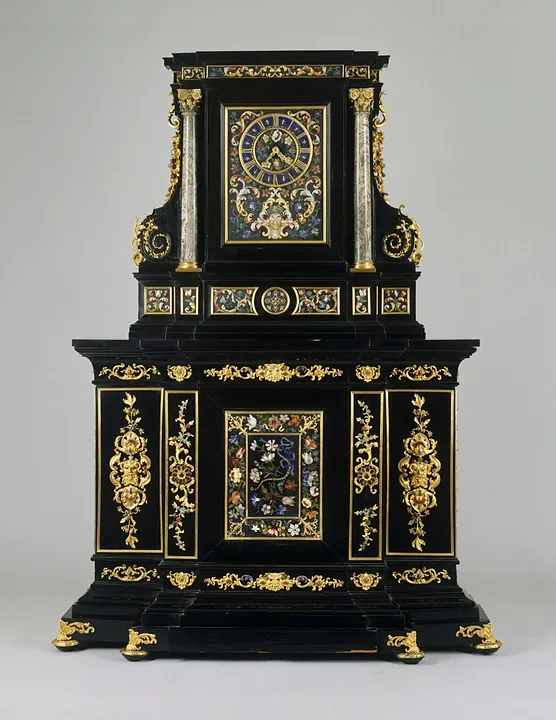
Clocks · 1704–1705
Florentine court cabinet and clock by Giovanni Battista Foggini, Italy, 1704–1705
Victoria and Albert Museum, London
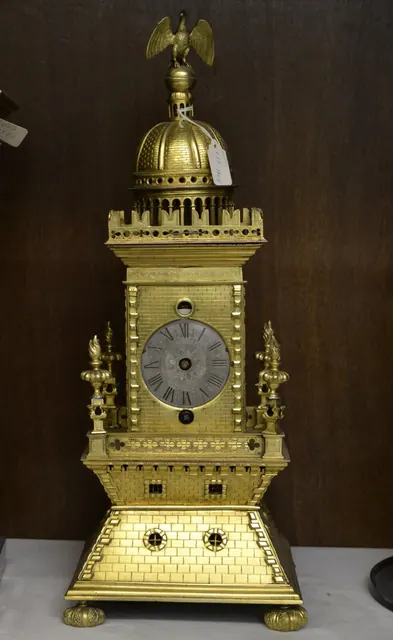
Clocks · 17th century
Clock, Italy, 17th century
Victoria and Albert Museum, London
Clocks · late 1600s-first half of the 1700s
Table clock, Italy, late 1600s-first half of the 1700s
Suomen kansallismuseo
Clocks · 1678
Clock by Giuseppe de Lellis, Italy, 1678
National Museum of Decorative Arts
Clocks · Reloj de sobremesa:c. 1690Reloj de bolsillo:1701–1775
Clock by Reloj de colgar: Coquerel, Jean, Italy, Reloj de sobremesa:1690[ca]Reloj de bols
National Museum of Decorative Arts
Clocks · early 18th century
Mantel clock, Italy, early 18th century
Museo Galileo, Florence
Clocks · 1685
Wall bracket clock by Giovanni Baptista de Albertis
British Museum