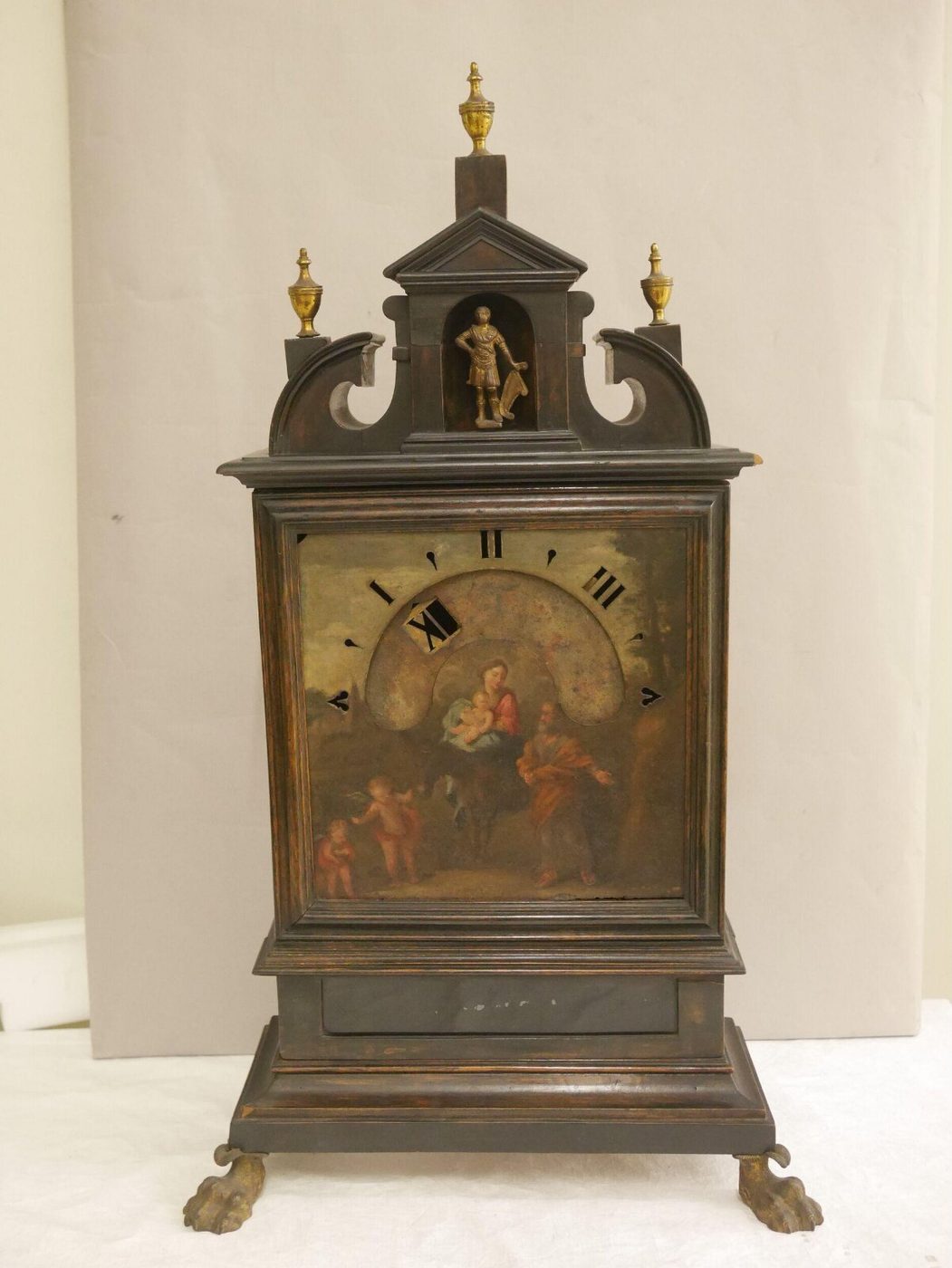
Clocks · Bracket clock
Bracket clock, Italian, 1680-1690,"Petrus Thomas Campanus Romae".
- Maker / attribution
- Pietro Tommaso Campani (maker)
- Date
- 1680-1690
- Historical period
- Early Modern Horology (1600 – 1750)
- Country of origin
- Italy
- Place
- Rome
- Object type
- Bracket clock
- Materials / technique
- Softwood veneered with ebonised fruitwood(?), with gilt metal and carved and gilded elements
- Dimensions
- Height: 76 cm; Width: 43 cm; Depth: 18.5 cm
- Holding institution
- Victoria and Albert Museum, London
- Accession / object no.
- W.72-1926
- Credit line
- Bequeathed by Lt. Col. G. B. Croft-Lyons FSA
Record summary
Held and catalogued by Victoria and Albert Museum, London (object number W.72-1926), this is a bracket clock by Pietro Tommaso Campani, made in Rome, Italy, dated 1680-1690. The Atlas places it in the Early Modern Horology period (1600 – 1750) of its Clocks collection. Materials and techniques recorded by the source: Softwood veneered with ebonised fruitwood(?), with gilt metal and carved and gilded elements. Recorded dimensions: Height: 76 cm; Width: 43 cm; Depth: 18.5 cm. The record is illustrated with 4 photographs.
Assembled from the source record's structured fields. Dates and attributions are given as the source states them; where a field is missing the Atlas leaves it blank rather than estimating.
Catalogue description
V&A — Physical description
Bracket night clock. Ebonised wood veneered on oak, surmounted by a scrolled classic pediment of solid wood carved in sections, on which are mounted three gilt metal vase finials and a gilt metal standing figure in Roman armour with a harp (Orpheus?) in the niche. The unglazed and pierced metal dial is painted with a representation of the Flight into Egypt; behind is a two-part circular metal plate, to which the circular clock mechanism is attached, and supported on a horizontal bracket screwed at each end to the case. The moulded plinth is supported on carved and gilded wood paw feet with gilt metal leaf ornament and turned and ebonised back feet. The softwood backing is nailed in place (with hand made nails). A deep door (held on a single, metal sprung clip at the right) occupies the front third of the clock body and contains the dial, window and clock mechanism. Below the painted face is a rectangular glass window, painted black on the reverse and held in place by two lumps of wax. The rear two thirds of the clock body is a static unit, the inside of which provides an empty, undecorated space in which a candle or oil lamp could be placed, a vent for which is placed centrally above (behind the central element of the pediment), over which a metal plate has been nailed, apparently at an early date. The mechanism engraved on the reverse: Petrus Thomas Campanus Inventor Romae Modifications and condition The window under the dial, originally intended to show the pendulum, has been painted black. The gilt brass vases and paw-feet are later additions or replacements, probably English, 19th-century. The veneer is chipped at the front left lower corner and the top right moulding. The painting 'quite worn'. Some signs of corrosion to the metal parts.
V&A — Historical context
The historical background to the invention of the night clock provides a fascinating insight into the practical considerations of the most important patrons of 17th century Rome. Cardinal Farnese, maggiordomo to Pope Alexander VII (1655-1667), was asked to provide a clock for the pope who was unable to sleep during the night due to the noisy ticking produced by the verge escapement on conventional clocks. Farnese commissioned the Campani brothers from San Felice dell'Umbria (Matteo, Pietro Tommaso and Giuseppe), Clockmakers to the Holy See, to create a silent clock that would show the hours during the night without the annoyance of a visible lamp. The time, which can be read through the placement of a lamp or candle behind the pierced dials, would have thus been revealed throughout the day and night. Brusa suggests that the duration of this type of night clock is usually 26-30 hours. This type of night clock was made by many different makers all over Italy for over 50 years, aimed at the wealthy, but were not more widely 'popular because of its high cost and complications.' Brusa notes that the majority of night clocks which have survived (over one hundred) have painted dials, and suggests that these tended to derive from church altars, and that clocks were often considered as symbols of the transience of human life. Around 1710 night clocks were superseded when more precise and less expensive clocks with pull repeating mechanisms were readily available. After the Campani commission, successfully completed in 1656 (a type of patent being confirmed in 1658), the Campani brothers disputed among themselves to whom the credit was due. They went on to create night clocks in a variety of sizes for princes, nobles, ambassadors and other members of the higher échelons of the clergy, as the fashion for such clocks intensified across Italy and the rest of Europe. Pietro Tommaso was the most prolific and renowned of the three. Guiseppe Campani made the celebrated night clock given to Louis XIV by Bernini and Cardinal Antonio Barberini in 1665. The monumental night clocks produced by the Campani brothers involved the collaboration of lapidiarists, sculptors, painters, jewellers, metalworkers, and cabinetmakers of the day including for instance the artist Carlo Maratta, and the German cabinet maker Giacomo Hermann. Similar, but grander clocks can be found in the British Museum, London and the Kunsthistorisches Museum in Vienna.
V&A — Object history
Bequeathed by Colonel G. B. Croft Lyons per Mill Stevenson Esq. FSA, 38 Ritherdon, SW7. (RP 26/6627) Formerly on loan from Colonel Croft Lyons to the museum. Comparable clocks A night clock by P T Campani, decorated with a similar scene, is in the Palazzo Senatorio (Rome), the painting of which has been attributed to Francesco Trevisani (1656-1746); the condition of the painting on the V&A clock does not permit a confident attribution. Literature G. Brusa, Italian Night Clocks, Antiquarian Horology, March 1975, pp.159-167 A. Griseri, 'Un orologico dipinto deal Trevisani', in Bolletino dei Musei Communali di Roma , VII (1960), pp.17-21 Gonzalez-Palacios, 'Bernini as a Furniture Designer', in Burlington Magazine, CXII (1970), p.719-22 E. Morpurgo, Dizionario degli Orologici Italiani (Milan, 1974), pp.32-5 P & D Colnaghi & Co., Objects for a 'Wunderkammer' 1981, pp.84-7
Inscriptions & marks
Petrus Thomas Campanus Inventor Romae
Historical context
Early Modern Horology (1600 – 1750)
Huygens' pendulum and balance spring transform accuracy; English makers develop the anchor and deadbeat escapements.
Huygens's pendulum (1656–57) improved clock accuracy from about a quarter of an hour to under a minute a day. The anchor escapement (c. 1670) and the long seconds pendulum created the longcase clock; London makers such as Fromanteel, Knibb, Tompion and Quare led European clockmaking, and French makers created the Boulle pendule.
Read the period in the timelineMore clocks from this periodEarlier: Renaissance Horology
Atlas type guide
Bracket, table and spring-driven clocks
Spring-driven clocks freed timekeeping from the hanging weight. The coiled mainspring, documented from the fifteenth century, made portable table clocks possible; to even out its declining force, makers used the fusee, a conical pulley connected to the barrel by a gut line or chain. Renaissance table clocks from Augsburg and Nuremberg — drum-shaped, square or tower-shaped in gilt brass — were luxury scientific objects, often with astronomical dials and alarms.
After the pendulum, English makers developed the bracket clock: a wooden case with a carrying handle, a short pendulum with a verge escapement, and often repeating work to sound the hours on demand at night. Later examples use the anchor escapement. In the nineteenth century, 'table clock' became a broad term for spring clocks of every nationality.
What to look for
- A fusee in the movement (cone-shaped pulley) and the type of line — gut or chain.
- Verge escapement with a short bob pendulum, often with a decoratively engraved backplate.
- Repeat cords or buttons that make the clock strike again on demand.
- Gilt-brass engraved cases and horizontal dials on Renaissance pieces.
- Case shapes: inverted bell, bell top, break-arch, lancet or balloon.
Dating clues
- Drum and tower table clocks: c. 1520–1650.
- Ebony veneered English bracket clocks with verge escapements: c. 1670–1800.
- Engraved backplates were usual on English clocks until c. 1800, then generally plain.
General guidance written by the Atlas editors about this kind of object. It is not a statement about this particular piece; for that, rely on the source record above and on physical examination.
Read next:FuseeAnchor (recoil) escapement
Related records
Clocks · 1704-1705
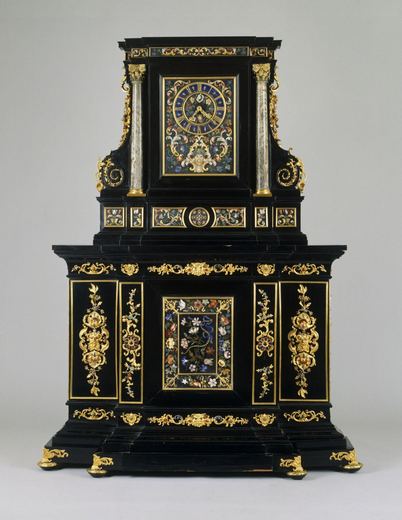
Florentine court cabinet and clock by Giovanni Battista Foggini, Italy, 1704-1705
Victoria and Albert Museum, London
Clocks · 1550–1650
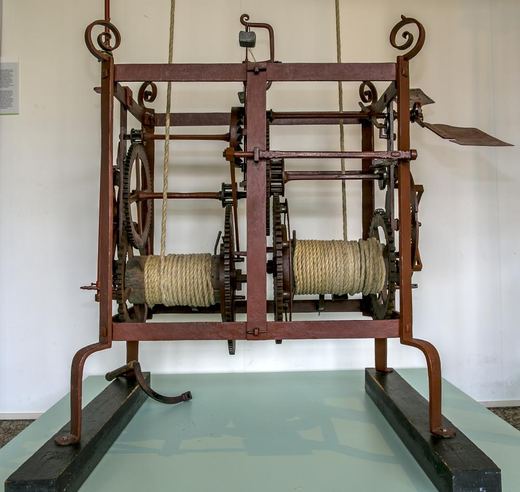
Turret clock, Netherlands, 1550–1650
Museum Klok & Peel
Clocks · case 1554, movement ca. 1680
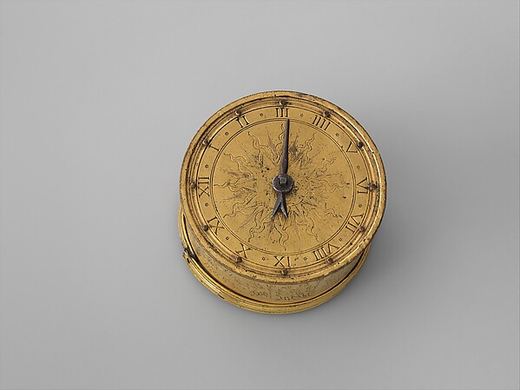
Table clock by Caspar Behaim (Chasparus Bohemus), Austria, case 1554, movement ca. 1680
The Metropolitan Museum of Art, New York
Clocks · 1590–1610
Clock, France, 1590–1610
MAK – Museum of Applied Arts
Clocks · 1598-1603
Circular table-clock with calendrical and lunar indications made by Nicholas Vallin in London between 1598 and 1603.
Science Museum Group, London
Clocks · 1600–1699
Clock by Joannes Volcker, Belgium, 1600–1699 (Royal Institute for Cultural Heritage AP_10156031)
Royal Institute for Cultural Heritage
Clocks · 1600–1699
Clock by Joannes Volcker, Belgium, 1600–1699 (Royal Institute for Cultural Heritage AP_10156032)
Royal Institute for Cultural Heritage
Clocks · 1600–1699
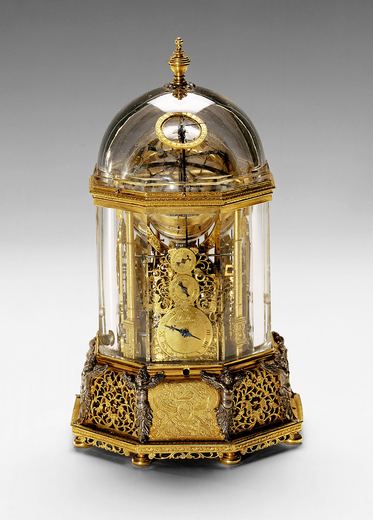
Clock by Jobst Bürgi (ascribed to), Czech Republic, 1600–1699
Fine Arts Museum Vienna