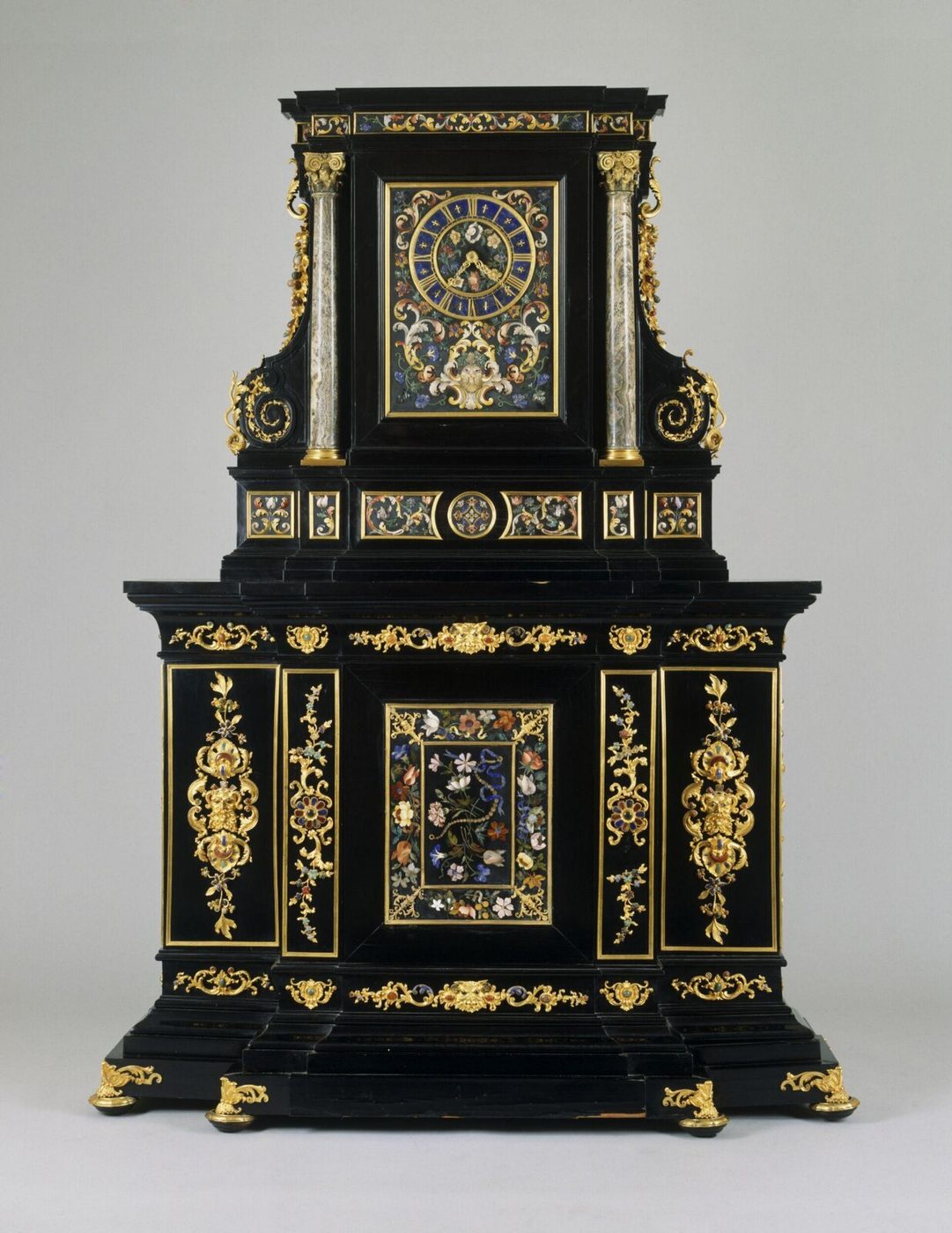
Clocks · Florentine court cabinet and clock
Florentine court cabinet and clock by Giovanni Battista Foggini, Italy, 1704-1705
- Maker / attribution
- Giovanni Battista Foggini (made); Johannes Hittorff (made)
- Date
- 1704-1705
- Historical period
- Early Modern Horology (1600 – 1750)
- Country of origin
- Italy
- Place
- Florence
- Object type
- Florentine court cabinet and clock
- Materials / technique
- Clock movement, pietre dure (hardstone), mother-of-pearl, gilt-bronze, ebonised wood, ebony and brass.
- Dimensions
- Height: 99.4 cm (top half); Height: 99.8 cm (bottom half); Width: 99.1 cm (top half); Width: 148.9 cm (bottom half); Depth: 20.9 cm (top half); Depth: 53 cm (bottom half)
- Holding institution
- Victoria and Albert Museum, London
- Accession / object no.
- LOAN:GILBERT.74:1 to 4-2008
- Credit line
- The Rosalinde and Arthur Gilbert Collection on loan to the Victoria and Albert Museum, London.
Record summary
Held and catalogued by Victoria and Albert Museum, London (object number LOAN:GILBERT.74:1 to 4-2008), this is a florentine court cabinet and clock by Giovanni Battista Foggini, made in Florence, Italy, dated 1704-1705. The Atlas places it in the Early Modern Horology period (1600 – 1750) of its Clocks collection. Materials and techniques recorded by the source: Clock movement, pietre dure (hardstone), mother-of-pearl, gilt-bronze, ebonised wood, ebony and brass. Recorded dimensions: Height: 99.4 cm (top half); Height: 99.8 cm (bottom half); Width: 99.1 cm (top half); Width: 148.9 cm (bottom half); Depth: 20.9 cm (top half); Depth: 53 cm (bottom half). The record is illustrated with 4 photographs.
Assembled from the source record's structured fields. Dates and attributions are given as the source states them; where a field is missing the Atlas leaves it blank rather than estimating.
Catalogue description
V&A — Summary
This extraordinary clock cabinet was made in the Grand Ducal workshops in Florence for the daughter of Grand Duke Cosimo III, Anna Maria Luisa de' Medici, who was married to the Elector Palatine, Johann Wilhelm von der Pfalz. When the elector died, Anna returned to Florence. She was the last of the Medici to live in the Pitti Palace. She left all the Medici treasures to the Florentine state, provided that nothing was ever removed from Florence. The cabinet was not amongst the objects taken back to Florence by the Electress. It was made by two of the greatest artists of the time: Leonard van der Vinne and Giovanni Battista Foggini (1652-1725). Foggini was first appointed Grand Ducal sculptor in 1687, and in 1695 court architect as well as director of the Galleria dei lavori (Grand Ducal workshops). During his tenure (1694-1725) he introduced innovative high-relief carvings to the production of commessi di pietre dure objects. Many if his designs were cenceived as part of extravagent furnishing schemes for the Medici. Among its elegant details was the use of chalcedony to represent pearls - one of the ways in which Florentine workers showed their skill in making hardstone mosaics in the 17th century. The face of Dionysos in the central panel of the top half of the cabinet was probably carved by the lapidarist Giuseppe Antonio Torricelli (1659-1719). The pink stone used for the skin is calcedonio di volterra, a stone that’s natural hues enhaced the realistic appearance of flesh and facial expressions. The top half and central mosaic below predate the cabinet's enlargement, probably in the 19th century. Hittorff's clock movement has replaced an earlier English movement by Ignatius Huggeford. The cabinet was later acquired for Dorchester House, Park Lane, London. Sir Arthur Gilbert and his wife Rosalinde formed one of the world's great decorative art collections, including silver, mosaics, enamelled portrait miniatures and gold boxes. Arthur Gilbert donated his extraordinary collection to Britain in 1996.
V&A — Physical description
Cabinet of ebonised wood with a projecting middle section and a high, moulded plinth. The facade has three doors with gilt bronze grotesque mounts. The upper cabinet is of ebony with stone mosaicc (commessi di pietre dure) panels and includes a clock with a lapis lazuli dial mounted on a pietre dure grotesque face. It is of architectural form with elaborate carved volutes and columns. The interior is lined with silk and embroidered with the initials of Anna Maria, Electress Palatine; the lower section, circa 1860, of ebonised wood, gilt bronze, brass, etc. with an earlier commesso panel, circa 1700.
V&A — Historical context
It is probable that the clock cabinet (the upper section) was made in 1704-05 as a present from Cosimo III de' Medici to his daughter Anna Maria Luisa (1667-1743) who had married the Elector Palatine, Johann Wilhelm von der Pfalz (r. 1690-1716), in 1691. Anna Maria Luisa returned to Florence after her husband's death where she enjoyed the Medici family collections.
V&A — Object history
Provenance: Anna Maria Luisa, Electress Palatine, Düsseldorf. Robert Staynor Holford. Sir George Lindsay Holford, Dorchester House, England. Sale, Christie's London, lot 81, 13-14 July 1927. Petite Musée, Montreal, Canada, 1974. Historical significance: The upper cabinet is the work of Leonardo van der Vinne (fl.1662-1713) and Giovanni Battista Foggini (1652-1725). The use of pietre dure in relief is typical of the Grand Ducal workshops under Foggini. His designs for similar work are contained in his journal of sketches preserved in Florence. The lower plinth was probably made for Robert Staynor Holford (1808-92) who bought the clock cabinet for display at his palatial London home, Dorchester House, Park Lane, which was designed by Lewis Vulliamy (1791-1871) based on the Villa Farnesina in Rome and built between 1857 and 1859. His collection included important Italian paintings, furniture and works of art. The lower plinth incorporates a panel which dates from about 1700 and incorporates the representation of a pearl necklace - a tromp l'oeil motif produced from the mid-17th century by the Florentine workshops. The art critic Filippo Baldinucci described a table made in 1658 for Cardinal Antonio Barberini (1608-71) citing 'the pearl necklace, so realistic that it deceives the eye and the hand too of anyone who touches it'.
V&A — Production note
Upper section 1704-05; central panel on lower section ca. 1700; lower section ca. 1860.
V&A gallery label
Mosaic cabinet and clock Upper section and central panel below: 1700-05 Lower section: about 1860 Giovanni Battista Foggini made this clock cabinet for Anna-Maria Luisa de' Medici (1667-1743), wife of the Elector Palatine. The panel included chalcedony to represent pearls. This was one of the ways in which Florentine craftsmen showed their skill in making hardstone mosaics ( comessi di pietre due ) in the 17th century. The plaque was set in its current base in the 19th century, and the cabinet was acquired for Dorchester House, Park Lane, London. This was the home of the art collector and MP Robert Stayner Holford (1808-92), and later became the Dorchester Hotel. Cabinet: Florence, Italy; upper section Grand Ducal Workshops, Giovanni Battista Foggini (1652-1725) Clock: Bonn, Germany; Johannes Hittorff (1757-1836) Pietre dure (hardstone mosaic), ebony, gilded bronze, brass, mother-of-pearl and ebonised wood Museum no. Loan:Gilbert.74:1, 2-2008
V&A gallery label
Mosaic cabinet and clock Upper section and central panel below: 1700–05 Lower section: about 1860 Giovanni Battista Foggini made this clock cabinet for Anna-Maria Luisa de’ Medici (1667–1743), wife of the Elector Palatine. The panel set in the base (a later addition) includes chalcedony to represent pearls. This was one of the ways in which Florentine pietre dure workers showed their skill in making hardstone mosaics in the 17th century. Cabinet: Florence, Italy; upper section Grand Ducal Workshops Giovanni Battista Foggini (1652–1725) Clock: Bonn, Germany; Johannes Hittorff (1757–1836) Pietre dure (hardstone mosaic), ebony, gilded bronze, brass, mother-of-pearl and ebonised wood Museum no. Loan:Gilbert.74:1, 2-2008
V&A gallery label
Mosaic cabinet and clock Upper section and central panel below: 1700-5 Foggini made this clock cabinet for Anna-Maria Luisa de' Medici (1667-1743), wife of the Elector Palatine. Among its elegant details in pietre dure was the use chalcedony to represent pearls, one of the ways in which the Florentine workers showed their skill in making hardstone mosaics in the 17th century. The top half and central mosaic below predate the cabinet's enlargement, probably in the 19th century. Hittorff's clock movement has replaced an earlier English movement by Ignatius Huggeford. The cabinet was later acquired for Dorchester House, Park Lane, London Cabinet: Italy, Florence: upper section Grand Ducal Workshops, Giovanni Battista Foggini (1652-1725) Clock: Germany, Bonn; Johannes Hittorff (1757-1836) Pietre dure (hardstone mosaic), ebony, gilded bronze, brass, mother-of-pearl and ebonised wood Museum no. Loan:Gilbert.74:1,2-2008
Inscriptions & marks
'AMEP' (for Anna Maria Electress Palatine) embroidered in gold thread and surmounted by the coronet of the palatinate on the silk lining inside the clock cabinet
Historical context
Early Modern Horology (1600 – 1750)
Huygens' pendulum and balance spring transform accuracy; English makers develop the anchor and deadbeat escapements.
Huygens's pendulum (1656–57) improved clock accuracy from about a quarter of an hour to under a minute a day. The anchor escapement (c. 1670) and the long seconds pendulum created the longcase clock; London makers such as Fromanteel, Knibb, Tompion and Quare led European clockmaking, and French makers created the Boulle pendule.
Read the period in the timelineMore clocks from this periodEarlier: Renaissance Horology
Atlas type guide
Domestic clocks
A clock combines four systems: a source of power (falling weight, coiled spring, or later electricity), a gear train that divides time, an escapement and oscillator that regulate it (foliot, pendulum or balance), and an indicating system of dial and hands or a bell. Its history runs from the large iron weight-driven clocks of the late thirteenth century to Renaissance spring-driven table clocks, the pendulum revolution of 1656, the factory clocks of the nineteenth century and electric and quartz clocks of the twentieth.
Domestic clocks also reflect regional furniture and decorative traditions — English longcase and bracket clocks, French pendules, Viennese regulators, Black Forest and American shelf clocks — and therefore record changing tastes as much as technical progress.
What to look for
- How the clock is powered: weights, spring barrel, fusee, electric coil.
- The oscillator: foliot, short pendulum, long seconds pendulum or balance.
- Whether it strikes: hour only (count wheel) or hours and quarters (rack striking).
- The maker or retailer's name on dial and movement, and any factory trademarks.
- Signs of alteration — replaced dials, converted escapements, 'married' cases.
Dating clues
- Before 1656 clocks used foliots or balances; after, most domestic clocks have pendulums.
- Anchor escapements spread after c. 1670; minute hands became common at the same time.
- Factory production in America and Germany transformed prices after c. 1840.
General guidance written by the Atlas editors about this kind of object. It is not a statement about this particular piece; for that, rely on the source record above and on physical examination.
Related records
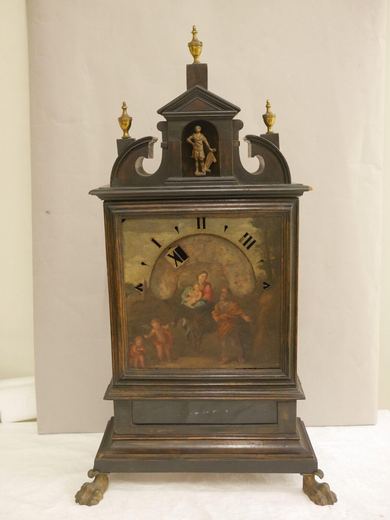
Clocks · 1680-1690
Bracket clock, Italian, 1680-1690,"Petrus Thomas Campanus Romae".
Victoria and Albert Museum, London
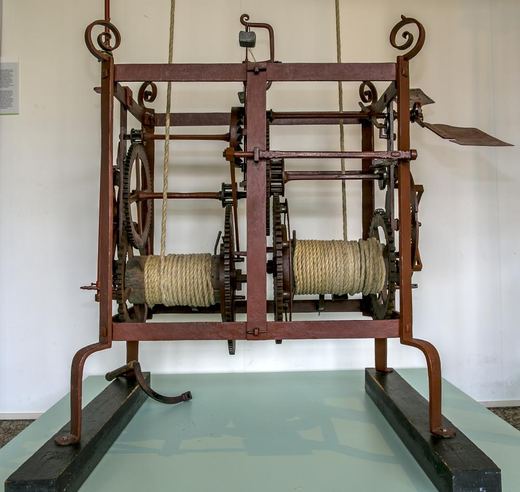
Clocks · 1550–1650
Turret clock, Netherlands, 1550–1650
Museum Klok & Peel
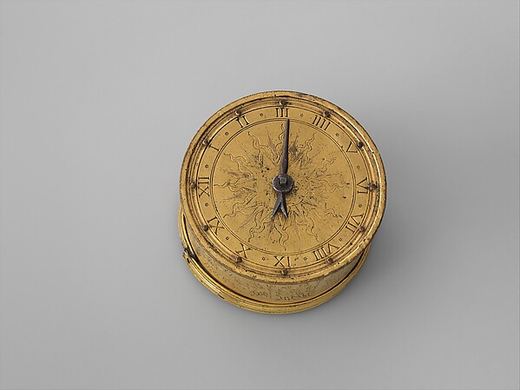
Clocks · case 1554, movement ca. 1680
Table clock by Caspar Behaim (Chasparus Bohemus), Austria, case 1554, movement ca. 1680
The Metropolitan Museum of Art, New York
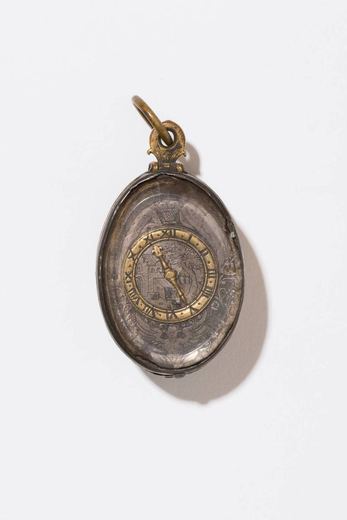
Clocks · 1590–1610
Clock, France, 1590–1610
MAK – Museum of Applied Arts
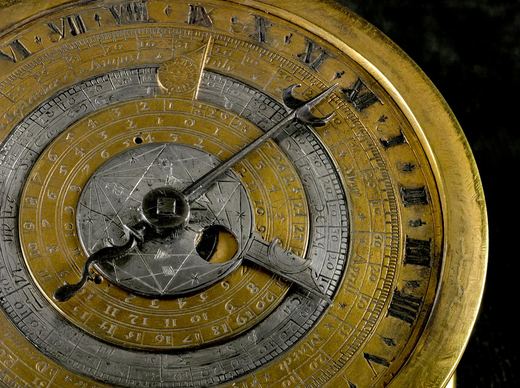
Clocks · 1598-1603
Circular table-clock with calendrical and lunar indications made by Nicholas Vallin in London between 1598 and 1603.
Science Museum Group, London
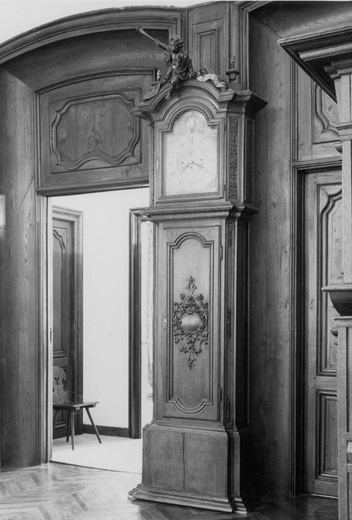
Clocks · 1600–1699
Clock by Joannes Volcker, Belgium, 1600–1699 (Royal Institute for Cultural Heritage AP_10156031)
Royal Institute for Cultural Heritage
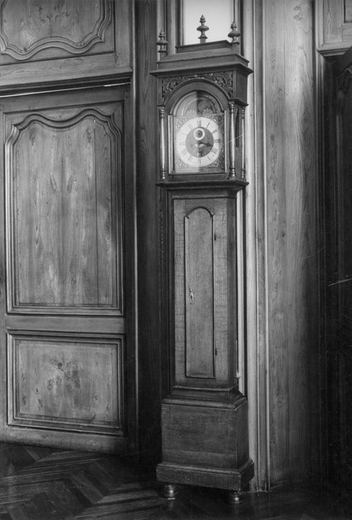
Clocks · 1600–1699
Clock by Joannes Volcker, Belgium, 1600–1699 (Royal Institute for Cultural Heritage AP_10156032)
Royal Institute for Cultural Heritage
Clocks · 1600–1699
Clock by Jobst Bürgi (ascribed to), Czech Republic, 1600–1699
Fine Arts Museum Vienna