
Wristwatches · Calendar watch
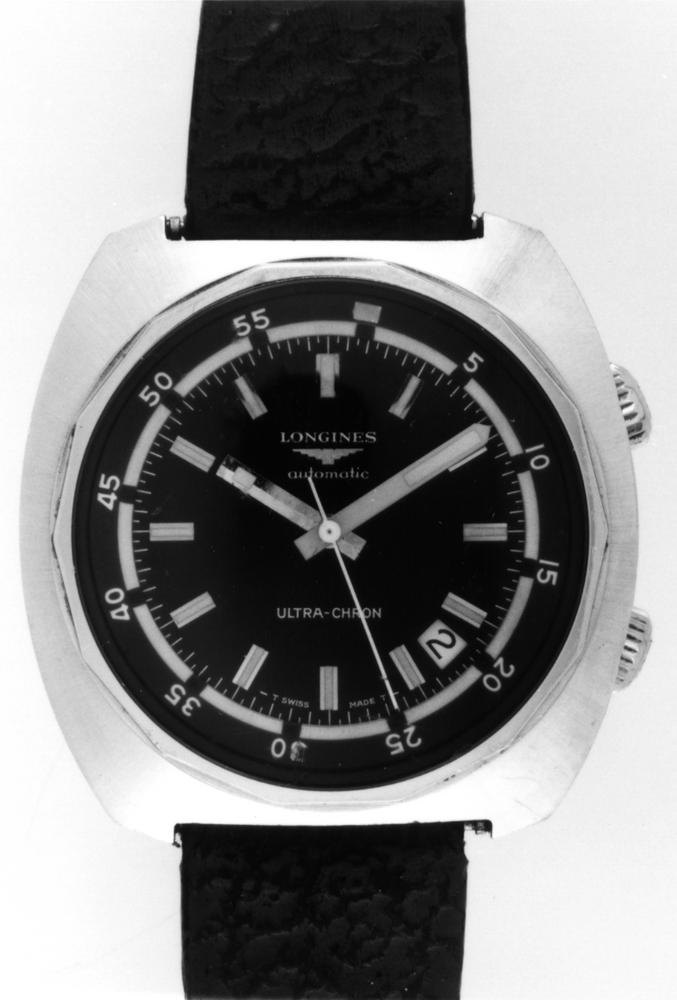
Stainless-steel cased automatic winding centre-seconds club-tooth lever wrist-watch with date mechanism and blue leather strap
- Maker / attribution
- Longines (Made by)
- Date
- c.1970
- Historical period
- Quartz Revolution (1969 – 1990)
- Country of origin
- Switzerland
- Place
- Switzerland
- Object type
- Calendar watch
- Materials / technique
- steel
- Dimensions
- Diameter: 38.80 millimetres (bezel)
- Holding institution
- British Museum
- Accession / object no.
- 1986,0509.3
- Credit line
- British Museum, London
- Catalogue title (original)
- Stainless-steel cased automatic winding centre-seconds club-tooth lever wrist-watch with date mechanism and blue leather strap (English)
View the source record ↗ (opens another website in a new tab)Suggest a correction
Record summary
Held and catalogued by British Museum (object number 1986,0509.3), this is a calendar watch by Longines, made in Switzerland, dated c.1970. The Atlas places it in the Quartz Revolution period (1969 – 1990) of its Wristwatches collection. Materials and techniques recorded by the source: steel. Recorded dimensions: Diameter: 38.80 millimetres (bezel). The record is illustrated with 1 photograph.
Assembled from the source record's structured fields. Dates and attributions are given as the source states them; where a field is missing the Atlas leaves it blank rather than estimating.
Catalogue description
Description — British Museum
Wrist-watch. Movement with automatic winding and fast beating train (10 beats per second); club-tooth lever escapement. Black painted dial with outer adjustable seconds ring, orange coloured and numbered every fifth division in Arabic; baton hour marks with luminous bands; sector aperture between 4 and 5 reveals date indication. Steel hour hand and orange coloured minute hand; white painted centre-seconds hand. Stainless steel case with screw-on bezel and back. Blue leather wrist-strap.
Curator's comments — British Museum
In around 1970 it seems Longines changed from numbering their movements moving to numbers starting 50#######, suggesting that this watch dates to not long after the change. Comment from Richard Good, Catalogue of Watches in the British Museum. Vol. V (Unpublished manuscript) Made by LONGINES WATCH Co. Switzerland, c. 1967 A self winding calendar wrist watch with a club tooth lever escapement and a fast beat rate. Signature: On the dial 'LONGINES' with their trade mark, 'automatic' and 'ULTRACHRON' also - 'T SWISS MADE T' -. On the self winding weight 'LONGINES'. On the train bridge 'LONGINES WATCH Co SWISS SEVENTEEN 17 JEWELS'. In a rectangle 431 and 50080793. Case: A tonneau shaped case of stainless steel. The screw back is marked inside 'LONGINES' with the trade mark below 'FAB SUISSE MADE ACIER INOXYDABLE 8221-2 431 SUPER COMPRESSOR BREVET + 317537 BREVET + 337462 DDE BREVET + 7633/66 11685/66 4678/67 4 69'. The threaded portion of this back is a separate piece held in place by a stout crinkle spring. Movement of the ring relative to the back in a circumferential way is prevented by lugs that penetrate four gaps in the screw ring flange. The object of this is to secure perfect alignment of the flange on the back where it meets the mating surface of the case, the part that carries the rubber sealing ring. The case is additionally fitted with a separate and moveable minute ring. This is finished red with black five minute marks and white five minute numerals. This can be set with a second button. Dial & Hands: A black dial with rhodium plated batons, each two bright strokes with luminous paint between. There is a calendar aperture between 4 and 5 o'clock. The minute and hour hands are also rhodium plated and of skeltonised baton design filled luminous. The centre seconds hand is white. Movement: Ebauche Marks: None Frame: A plated nickel silver movement with a bridge for the barrel another carries the weight and contains the reduction gears for the self winding work. Beneath this is a further bridge for the train and another for the centre wheel. A cock for the pallets and another for the balance. Barrel and Mainspring: The barrel is marked 'Do not open' both in English and in French. Thus only external dimensions are given. Barrel: External diameter 11.0 mm., external height 1.4 mm. Hooking: A slipping mainspring. Train: All the brass wheels gilded, the centre, third and fourth wheels with five crossings. The steel escape wheel with four. Jewelling: Jewelled bearings from the centre wheel onwards, except for the idle centre seconds pinion. All the jewels pressed in. Shock protected bearings to the balance. Escapement: A straight line layout club tooth lever escapement with short lever, double roller and D-shaped impulse pin. The exposed pallet stones have flat acting faces. A steel escape wheel with four crossings. A mixed escapement. Solid banking. No. of teeth embraced 3½. Balance & Spring: a three arm monometallic balance with brass screws. Balance diameter 7.4 mm., thickness 0.45 mm. A 'self compensating' flat spiral spring with 14 turns. The stud is, most unusually, mounted beneath the cock. Means of Regulation: A micrometer regulator. The index on the balance cock has a yoked end embracing an eccentric screw - the slot of which registers against a divided scale with + and - engraved on the balance cock table. Train Counts and Beat Rate: Great wheel 85 (barrel) Centre wheel 72 pinion 12 Third wheel 75 pinion 9 Fourth wheel 100 pinion 10 Escape wheel 21 pinion 7 Beat rate 36,000 Motion work: cannon pinion 12 minute wheel 32, minute pinion 8 hour wheel 36 on which is mounted the calendar driving gear of 23 teeth which drives the calendar indexing wheel of 46. Self Winding System: Winding in both directions utilising rocking gears engaging with the reduction gear train. Winding System: Conventional positive stem set keyless work Dimensions: Case: Width 43.0 mm., length 41.0 mm., height 13.3 mm., (over the glass). Movement: Diameter 25.9 mm., height 6.7 mm. Provenance: Purchased in 1986 with the aid of funds made available by the late Stanley Burton. Note: An Ultrachron is shown in Marozzi, D. & Toselli, G. Longines Bologna 1990 p. 322. Although the same basic calibre it differs in many of its detail characteristics.
Inscriptions & marks
signature; dial; LONGINES automatic ULTRA-CHRON; signature; winding-weight; LONGINES; signature; back-plate; LONGINES WATCH Co SWISS SEVENTEEN17JEWELS 431 50080793; trade mark; wrist-strap buckle; Longines insignia.
Provenance
Purchased from:, William Skeen
Historical context
Quartz Revolution (1969 – 1990)
Seiko's Astron begins mass quartz timekeeping; traditional industries contract sharply.
Quartz and digital watches transformed the market after 1969. Swiss employment collapsed, Japanese and Hong Kong production soared, and the Swatch (1983) helped the Swiss industry recover; mechanical watches survived as luxury goods.
Read the period in the timelineMore wristwatches from this periodEarlier: Modern Mechanical Horology
Atlas type guide
Calendar, moon-phase and perpetual calendar watches
Calendar complications range from a simple date to the perpetual calendar, which automatically allows for months of different lengths and leap years until 2100. Pocket watches with perpetual calendars were made in the eighteenth and nineteenth centuries; Patek Philippe made the first perpetual calendar wristwatch in 1925, and series production followed in 1941. The annual calendar (Patek Philippe, 1996) needs correction only once a year.
Moon-phase displays use a disc with two moons and 59 teeth advanced daily, approximating the 29.5-day lunation; more precise trains reduce the error to one day in over a century.
What to look for
- Apertures or subsidiary dials for day, date, month and leap year.
- Moon disc under a 'bosom' shaped aperture.
- Recessed correctors on the case band for setting the calendar.
Dating clues
- Triple-date wristwatches: popular c. 1940–1955.
- Perpetual calendar wristwatches: from 1925 (unique) and 1941 (series).
General guidance written by the Atlas editors about this kind of object. It is not a statement about this particular piece; for that, rely on the source record above and on physical examination.
Related records
Instruments · c. 1940
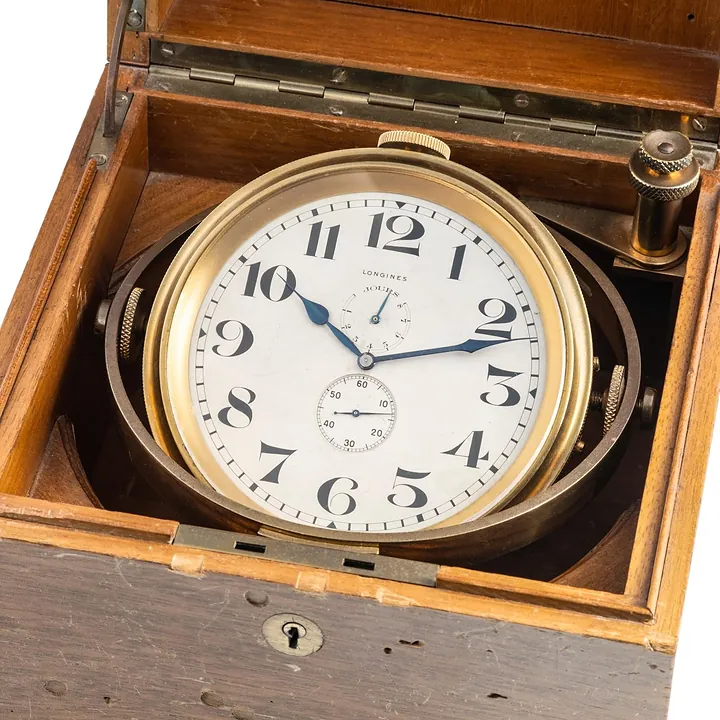
Longines marine chronometer, c. 1940
Antiquorum auction archive, Geneva
Pocket Watches · c. 1910-1920s
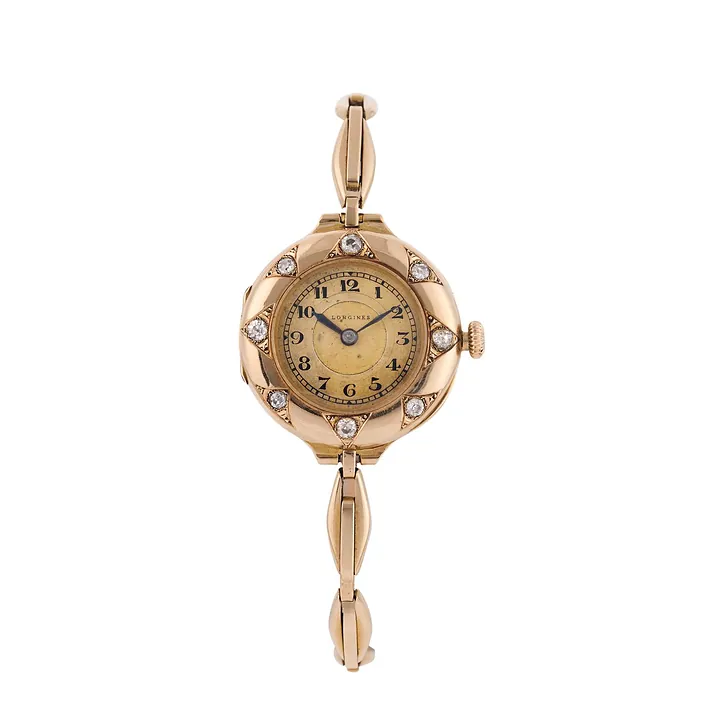
Longines watch, c. 1910-1920s
Antiquorum auction archive, Geneva
Pocket Watches · c. 1915
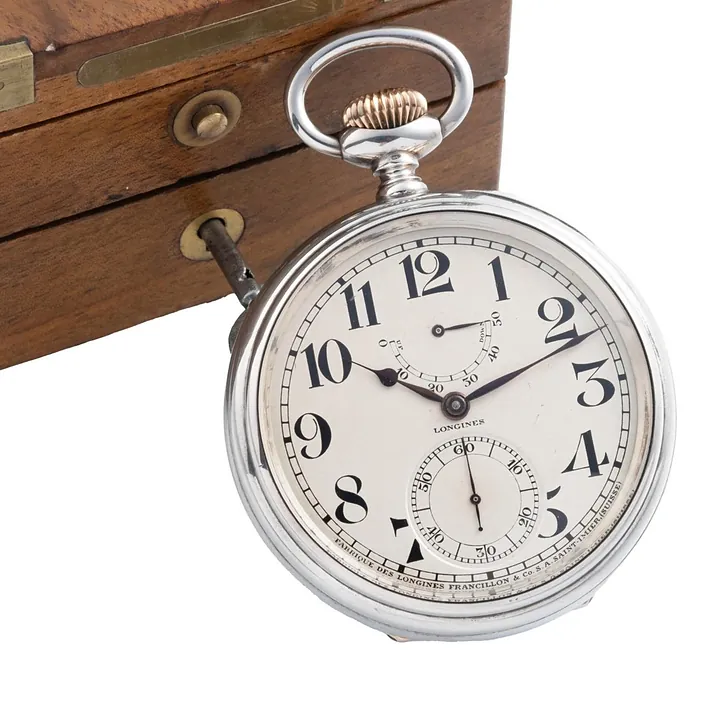
Longines ''torpedo-Boat Watch'', c. 1915
Antiquorum auction archive, Geneva
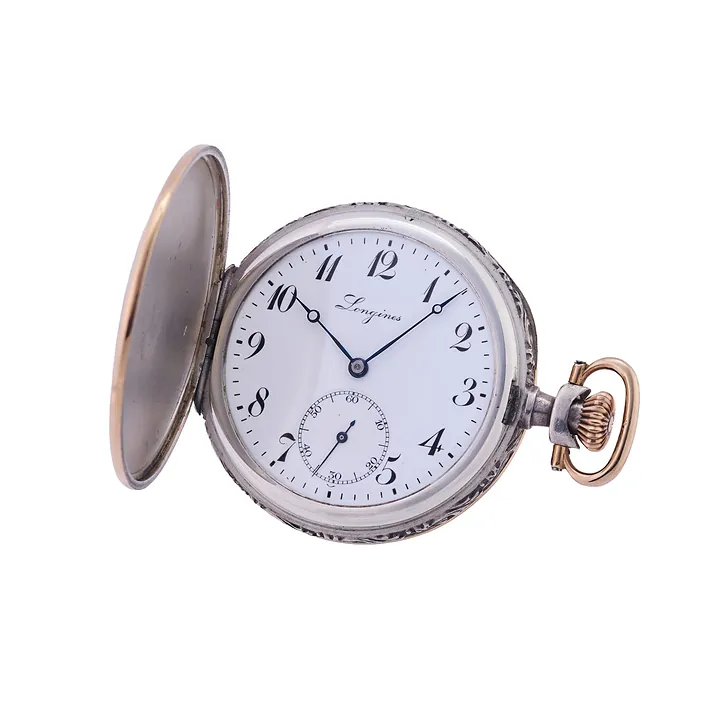
Pocket Watches · c. 1920s
Longines pocket watch, c. 1920s (Antiquorum Lot 389-59)
Antiquorum auction archive, Geneva

Wristwatches · 1970
Wristwatch by Heno, Switzerland, 1970
Museum Rotterdam

Wristwatches · 1960–1986
'Tri-Compax' calendar chronograph wristwatch in gold case, by Universal, Geneva, Switzerland, 1960–1986.
Science Museum Group, London

Wristwatches · 1969–1970
Beta 21 Quartz wristwatch movement, made in Switzerland, 1970.
Science Museum Group, London

Wristwatches · c. 1969
Omega Speedmaster Moonwatch, ref. 145022-69st, c. 1969
Antiquorum auction archive, Geneva