
Wristwatches · Self-winding watch
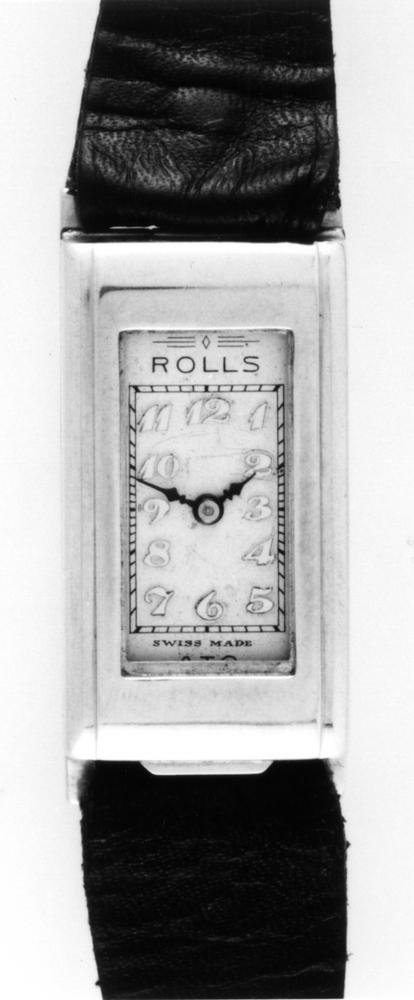
Self-winding gold-cased lever wrist-watch with brown leather strap
- Maker / attribution
- Blancpain Rayville Watch Manufacturing Co Ltd (Made by)
- Date
- 1930–1935
- Historical period
- Golden Age of Mechanical Watchmaking (1900 – 1945)
- Country of origin
- Switzerland
- Place
- Switzerland, Glasgow
- Object type
- Self-winding watch
- Materials / technique
- gold
- Dimensions
- Length: 32.20 millimetres (case) Length: 20.30 millimetres (dial) Length: 210 millimetres (strap) Thickness: 7.90 millimetres Width: 17 millimetres (case) Width: 9.30 millimetres (dial)
- Holding institution
- British Museum
- Accession / object no.
- 1984,0202.2
- Credit line
- British Museum, London
- Catalogue title (original)
- Self-winding gold-cased lever wrist-watch with brown leather strap (English)
View the source record ↗ (opens another website in a new tab)Suggest a correction
Record summary
Held and catalogued by British Museum (object number 1984,0202.2), this is a self-winding watch by Blancpain Rayville Watch Manufacturing Co Ltd, made in Switzerland, Glasgow, dated 1930–1935. The Atlas places it in the Golden Age of Mechanical Watchmaking period (1900 – 1945) of its Wristwatches collection. Materials and techniques recorded by the source: gold. Recorded dimensions: Length: 32.20 millimetres (case) Length: 20.30 millimetres (dial) Length: 210 millimetres (strap) Thickness: 7.90 millimetres Width: 17 millimetres (case) Width: 9.30 millimetres (dial). The record is illustrated with 2 photographs.
Assembled from the source record's structured fields. Dates and attributions are given as the source states them; where a field is missing the Atlas leaves it blank rather than estimating.
Catalogue description
Description — British Museum
Pedometer winding watch, wound by the movement of the watch within its case. Club-tooth lever escapement. Silvered metal dial with gilt Arabic numerals; blued steel hands. 9ct gold case with symbol for Glasgow import.
Curator's comments — British Museum
Comment from Richard Good, Catalogue of Watches in the British Museum. Vol. V (Unpublished manuscript) Made by ROLLS Switzerland, c. 1930 Gold cased self winding wrist watch with a club tooth escapement. Signature: On the dial ROLLS SWISS MADE ATO. On the movement is 'HATOT'S PATENTS(1) IN ALL COUNTRIES FIFTEEN 15 JEWELS THREE 3 ADJS SWISS MADE'. Case: A 9 ct. gold case with import marks for Glasgow 1930. Also marked 3 and 107026. A steel lining is within the case and is of channel section. The movement runs up and down inside this piece on ball bearings and in the process effects winding. An aperture reveals the dial. Dial & Hands: A silvered dial with raised gilt Arabic numerals. On the back of the dial is 9 539. The hands of blued-steel of modern mitre design. Movement: Ebauche Marks 340. Frame: A nickel silver movement. On the back plate is an additional thick bridge to add weight to the movement, this bears the inscription detailed above and is held in place by a single screw. It also carries one of the buffer springs. The barrel bridge carries the other buffer spring. There is another bridge for the train and cocks for the escape wheel, the pallets and the balance. Under and on the escape wheel cock is 232, under the pallet cock is 34. Under the train bridge is 340. One of the barrel bridge securing screws is missing. Barrel and Mainspring: Going barrel: I diameter 7.0 mm., height 1.25 mm. Mainspring: height 1.20 mm., thickness 0.085 mm. Barrel Arbor: diameter 2.3 mm., snailed. Hooking: A slipping mainspring. There is a separate piece of mainspring just over a turn long which rests against the barrel wall and has a round hook which engages with the spring end. Train: All the brass wheels are gilded, the centre wheel, third and fourth wheels with five crossings. The steel escape wheel with four. Jewelling: Jewelled bearings from the third wheel onwards, all the jewels rubbed in. Ruby endstones to the balance jewels. Escapement: A straight line layout club tooth lever escapement with short lever, double roller and D-shaped impulse pin. The exposed pallet stones have flat acting faces. A steel escape wheel with four crossings. A mixed escapement. No. of teeth embraced 3½. Balance & Spring: A split bimetallic balance with brass screws. Balance diameter 6.9 mm, thickness 0.6 mm. A blued-steel flat spiral spring with 11 ¼ turns. Means of Regulation: An index on the balance cock registers against a divided scale with 'A R' engraved on the balance cock table. Train Counts and Beat Rate: Great wheel 68 (barrel) Centre wheel 64 pinion 10 Third wheel 60 pinion 8 Fourth wheel 60 pinion 8 Escape wheel 15 pinion 6 Beat rate: 18,000 Motion work: cannon pinion 10 minute wheel 30, minute pinion 8 hour wheel 32 Self Winding System: The movement H has grooved edges to locate the the ball bearings b. 1,2,3 and 4 also run in matching grooves in the channel insert in the case. Lever L has a forked end which engages with a pin P fixed to the case edge. Movement travel is limited by stops and cushioned by the buffer springs a1 and a2. Ratchet C1 is fixed to the lever L which gathers teeth on the ratchet wheel R which is provided with a second ratchet to prevent backward motion. Wheel R, which has 80 teeth carries a pinion of 8 which meshes directly with the barrel ratchet wheel of 50 teeth. Winding system: When the case is opened a serrated wheel is disclosed at about 2 o'clock. On pressing this in a gear which it carries engages with the minute wheel and the hands can be set. Dimensions: Case: length 31.6 mm., width 17.0 mm., height 9.0 mm., over the glass. Movement: length 25.5 mm., width 13.0 mm., height 6.0 mm. Provenance: Purchased in 1982 with the aid of funds made available by Stanley H Burton. Note: (1) French patents number 704910, 38984 and 39523 were taken out by Leon Hatot. These patents covered many different designs, the Rolls being one. Literature: For a write up on Leon Hatot by Henry L Belmont see 'Horlogerie Ancienne', No. 12/2/1982. The Rolls is discussed on pp. 101 and 102.
Inscriptions & marks
signature; ROLLS ATO SWISS MADE.; inscription; HATOT'S PATENTS PENDING IN ALL COUNTRIES.; hallmark; 1930 [case]; maker's mark; 107026 [case]
Provenance
Purchased from:, Simon Bull
Historical context
Golden Age of Mechanical Watchmaking (1900 – 1945)
The wristwatch displaces the pocket watch; waterproof cases, self-winding and grand complications.
The wristwatch overtook the pocket watch. Military use in the First World War, aviation, water-resistant cases (1926), automatic winding (1923–31), rectangular Art Deco designs and early chronographs and calendars defined the period.
Read the period in the timelineMore wristwatches from this periodEarlier: Industrial Revolution
Atlas type guide
Automatic (self-winding) watches
Self-winding watches use the wearer's motion to wind the mainspring. Abraham-Louis Perrelet and Breguet made 'perpétuelle' pocket watches with oscillating weights in the late eighteenth century, but the principle only became practical in the wristwatch. John Harwood patented a bumper automatic in 1923; Rolex's Perpetual rotor (1931) winding in one direction, and later bidirectional rotors (Eterna, Felsa Bidynator), established the modern form. Micro-rotors (Universal Genève, Buren) and peripheral rotors made automatic watches thinner.
What to look for
- A semicircular rotor turning 360° over the movement, or a 'bumper' weight that rebounds between springs.
- 'Automatic', 'Perpetual' or 'Self-winding' on the dial.
- A sealed screw-back case, since automatic watches are wound less often by the crown.
Dating clues
- Bumper automatics: 1923–c. 1955.
- Full rotors: from 1931 (Rolex); widespread after c. 1950.
- Micro-rotors: from 1954–1958.
General guidance written by the Atlas editors about this kind of object. It is not a statement about this particular piece; for that, rely on the source record above and on physical examination.
Related records

Wristwatches · 1931
Rolex 'Oyster Perpetual' rotor self-winding wrist-watch, lever escapement, in steel case with glass in back, Montres Rolex SA, Geneva, Switzerland, 1931
Science Museum Group, London

Wristwatches · 1900–1999
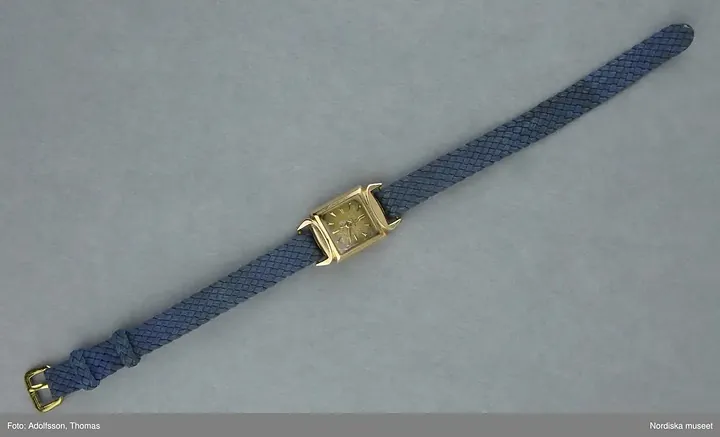
Wristwatch by Certina, Switzerland, 1900–1999
Nordic Museum Foundation
Wristwatches · 1900–1999
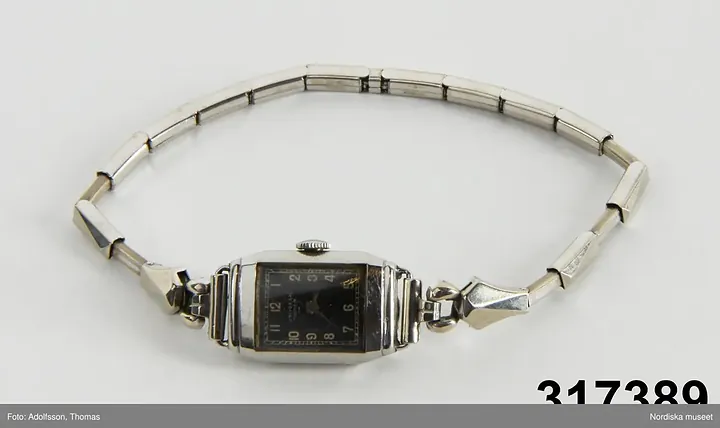
Wristwatch by Omega, Västerås, 1900–1999
Nordic Museum Foundation
Wristwatches · 1900–1999
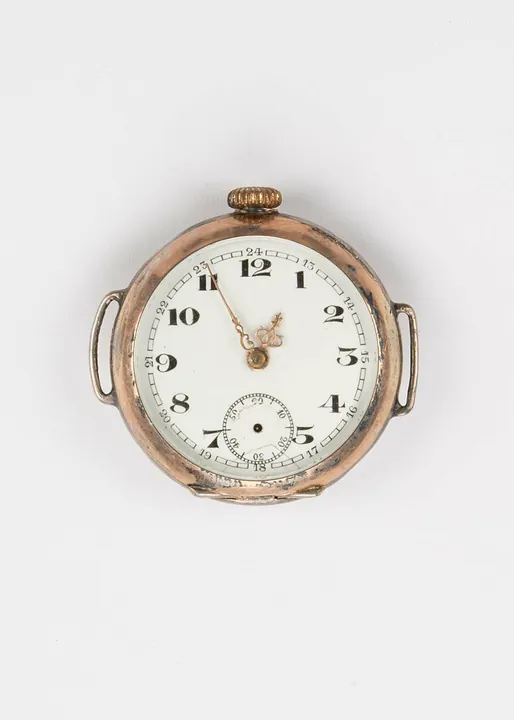
Wristwatch by Universal, Switzerland, 1900–1999
Nordic Museum Foundation
Wristwatches · c. 1900
Wristwatch, probably Switzerland, c. 1900 (no. 57124)
German Clock Museum
Wristwatches · c. 1900
Wristwatch, probably Switzerland, c. 1900 (no. 57216)
German Clock Museum
Wristwatches · c. 1915
Wristwatch by S.S.und Co., Stauffer, Son und Co., Switzerland, c. 1915
German Clock Museum
Wristwatches · c. 1920s
Movado Chronometre, ref. 41536, c. 1920s
Antiquorum auction archive, Geneva