
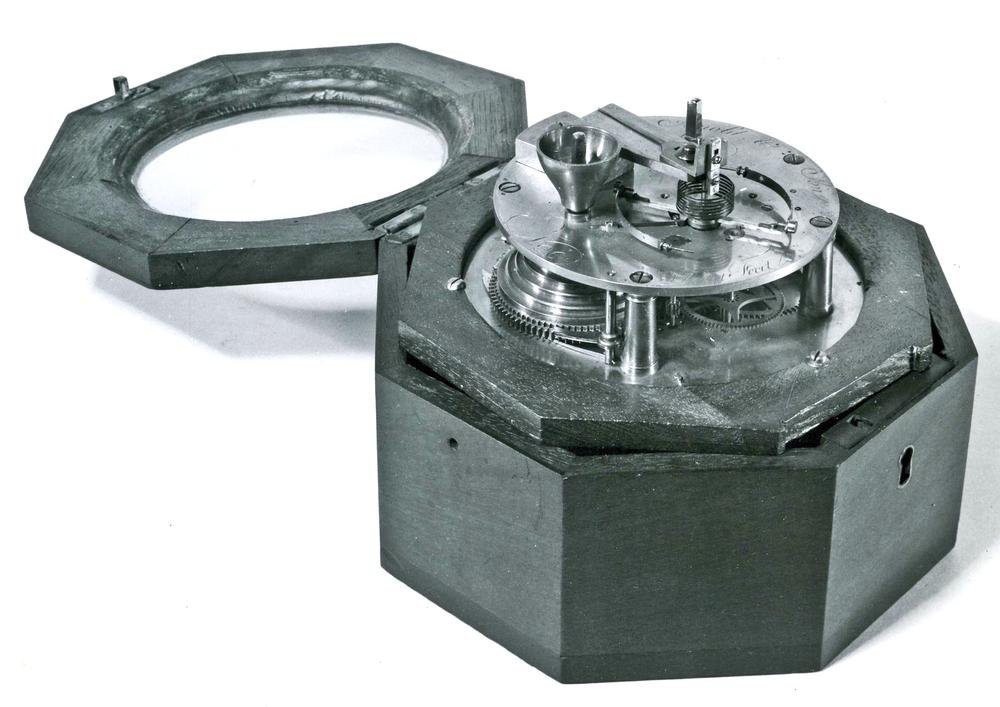
Instruments · Marine chronometer
Marine chronometer by John Arnold
- Maker / attribution
- John Arnold (Made by)
- Date
- 1790–1800
- Historical period
- Precision & Scientific Horology (1750 – 1850)
- Country of origin
- England
- Place
- London (England)
- Object type
- Marine chronometer
- Materials / technique
- mahogany
- Holding institution
- British Museum
- Accession / object no.
- 1958,1006.1952
- Credit line
- British Museum, London
- Catalogue title (original)
- Marine chronometer; thirty-hour movement; bimetallic balance; helical balance spring with spring detent escapement; circular white enamelled dial; mahogany case (English)
View the source record ↗ (opens another website in a new tab)Suggest a correction
Record summary
Held and catalogued by British Museum (object number 1958,1006.1952), this is a marine chronometer by John Arnold, made in London (England), dated 1790–1800. The Atlas places it in the Precision & Scientific Horology period (1750 – 1850) of its Instruments collection. Materials and techniques recorded by the source: mahogany. The record is illustrated with 5 photographs.
Assembled from the source record's structured fields. Dates and attributions are given as the source states them; where a field is missing the Atlas leaves it blank rather than estimating.
Catalogue description
Description — British Museum
Marine chronometer; thirty-hour movement; bimetallic balance; helical balance spring with spring detent escapement; circular white enamelled dial; mahogany case. Train-count: Gt wheel 80 Centre wheel 80/10 3rd wheel 75/10 4th wheel 80/10 Escape wheel 15/10.
Curator's comments — British Museum
Comment from Anthony G. Randall and Richard Good, Catalogue of Watches in the British Museum. Vol. VI (1990) Made by John Arnold and Son, c. 1790.(1) Marine Chronometer Signature: On the back plate 'John Arnold and Son London No 26 Invt et Fecit'. On the dial 'John Arnold London No 26'. Box: For box details see registration no. 1958,1201,2069. Box across the flats 162 mm, h. 80 mm. Dial and hands: Flat enamel dial, cracked, secured to the front plate by three feet and pins. Faintly marked in red in the enamel of the back 26, and also marked 'No 26'. Blued steel hands, the minute hand held by a screw in its boss to a square on the cannon pinion. The seconds hand screwed to a pipe having a blind hole. Movement: Front plate diam. 121.3 mm, reduced to 112.3 mm; back plate diam. 94.4 mm; frame h. 33.0 mm. Frame: Full plate construction built up on a massive front plate double recessed under the dial. Four turned pillars, the back plate held by recessed blued steel screws. The balance potence without the usual moulded edge to its foot. The movement held by the front plate, adjusted into a hole in an octagonal wooden board fitting into a rebate in the box. The front plate is secured to the board by three screws passing through from the back into the flange of the front plate resting on the front of the board. The brass parts finished smooth and with a scratchy polish but not decorated. Fusee: Fitted with Harrison's maintaining power, the ratchet wheel brass and planted in bushes standing proud of both front and back plate. On the winding square is fitted a large brass dust-excluding cup. There is no signature anywhere on the inside of the fusee or great wheel parts, the number 26 is scratched on the inside of the great wheel under the brass maintaining spring, the latter is probably a replacement. Setting-up-work is fitted on the inside of the front plate, under the end of the barrel. There is an extended square for setting up on the back plate end of the barrel arbor. The tapered mainspring is hooked with an eye to a steel hook set in the barrel wall, and similarly at the inner end to a hook passing through both the snailed brass boss and the arbor. Going train: The usual design and layout, the centre, third and fourth wheels riveted to their pinions. The steel arbors and pivots polished, the ends of the pinions, undercuts and rivets left grained. Jewelling: The pivots of the fourth and escape pinion arbors and those of the balance staff run in pierced jewels. Endstones are fitted for both balance staff and escape pinion bearings, and the fourth rear bearing. A very small diamond endstone set in a blued steel ring is fitted in a deep recess in the balance cock. The jewel assemblies with endstones are not made to hold oil between the endstone and the jewel except for the pierced jewels for the balance staff pivots which have curved oil retaining sinks on both sides. The fourth lower jewel resembles and works as on ordinary train jewel, the end of the pivot resting on the endstone instead of the shoulder on the pierced jewel. The pierced jewel for the escape pinion arbor back plate pivot is flat on both sides and has no means of retaining oil, but that in the front plate resembles those for the balance staff. The jewel settings themselves are brass discs adjusted into sinks in the plates, only the fourth pierced jewel settings are double sunk. Escapement: Arnold spring detent escapement, the teeth of the brass escape wheel notched on their acting cycloidal faces as a result of wear on the corner of the impulse jewel. The detent fitted with a later brass passing spring. Both rollers and the detent are jewelled. Banking for the detent provided against a brass screw set in a slot in the back plate on the edge of the detent slot. Balance: Bimetallic 'z' type balance, the two short steel and brass rims attached by brackets to the steel crossbar. The central boss is secured by two screws to a brass boss on the balance staff. Notches for poising have been filed in the underside of one of the arms, near the outer end. Timing screws are set in the rims at the ends of the arms, and a tapped hole is provided near the free end of each rim. The compensation can be adjusted by turned and slotted brass nuts on threaded pieces integral with the free ends of the rims. The steel parts of the rim have been blued. Diam. of rim 47.4 mm, h. 3.0 mm. Balance spring: Blued steel helical spring of 6½ turns, with terminal curves, pinned with a square peg in a square hole in the steel poised collet. The other end of the spring is clamped by a screw and plate to a steel bar, itself screwed to the end of a brass piece like an index on the top of the balance cock. These clamping and fixing arrangements are to position accurately and to centre the spring. The long tail on the brass piece like an index is presumably to enable fine adjustment to be made for beat, or for resetting up to be accurately carried out if the spring is disturbed as, for instance, during cleaning. Normally the whole system is held tightly clamped by screws, but the massive balance cock would permit the various screws to be released and tightened without pinching the pivots of the balance staff. Going-train counts: Great wheel (fusee) 80 teeth Centre pinion 10 leaves, wheel 80 teeth, 4 arms Third pinion 10 leaves, wheel 75 teeth, 4 arms Fourth pinion 10 leaves, wheel 80 teeth, 4 arms Escape pinion 10, leaves, wheel 15 teeth, 4 arms Beats per hour: 14,400 Motion work: Cannon pinion 12 leaves, minute pinion 14 leaves. Hour wheel 42 teeth, minute wheel 48 teeth Provenance: Ilbert collection; Ilbert purchased this chronometer from Malcolm Gardner in 1932. Presented by Mr Gilbert Edgar C.B.E. in 1958. Note: (1) Ilbert mentions that Arnold No. 35 is dated 1785 and John Arnold and Son No. 492 is dated 1793. [See Mercer Arnold & Son p. 218 (suggests a date of 1791).] Bibliography: Britten, 1982, 9th edn, pp. 220, 221, pl. 138a and b.
Inscriptions & marks
signature; John Arnold, London, No.26
Provenance
Previous owner/ex-collection:, Courtenay Adrian Ilbert; Donated by:, Gilbert Edgar; Acquired 1958
Historical context
Precision & Scientific Horology (1750 – 1850)
Harrison solves longitude; Mudge invents the lever; Breguet's Paris workshop defines the modern watch.
The longitude problem was solved by the marine chronometer and lunar distance methods; dividing engines made precision scales possible, and observatories set time by transit instruments.
Read the period in the timelineMore instruments from this periodEarlier: Early Modern Horology
Atlas type guide
Marine chronometers
A marine chronometer is a precision timekeeper carried at sea to find longitude: the navigator compares local noon, observed with a sextant, with the time at a reference meridian kept by the chronometer. Each hour of difference corresponds to fifteen degrees of longitude. John Harrison proved the method in the 1760s; Pierre Le Roy, Ferdinand Berthoud, John Arnold and Thomas Earnshaw then developed the detent escapement and the compensation balance that made chronometers practical to manufacture.
By the nineteenth century London, Liverpool, Le Locle and Glashütte supplied navies and merchant fleets. A typical box chronometer has a spring-detent escapement, a fusee to equalise mainspring torque, a bimetallic compensation balance with a helical balance spring, and is mounted in gimbals inside a wooden box so that it stays level.
What to look for
- Gimbals and a three-tier wooden box with a glazed inner lid.
- A power-reserve ('up and down') indicator on the dial, usually showing 56 hours on two-day instruments.
- Spring-detent escapement and a cylindrical (helical) balance spring visible through the movement.
- Admiralty or navy marks (broad arrow), and rating certificates from observatories.
- The maker's number on the dial and movement; many makers' registers survive, allowing dating.
Dating clues
- Earnshaw-type spring-detent chronometers became standard after about 1800.
- Auxiliary compensation devices on the balance appear from the mid-nineteenth century.
- Quartz and radio time signals ended routine use of mechanical chronometers in the 1970s and 1980s.
General guidance written by the Atlas editors about this kind of object. It is not a statement about this particular piece; for that, rely on the source record above and on physical examination.
Read next:Detent escapement
Related records
Instruments · 1771
Marine chronometer by John Arnold, England, 1771
Science Museum Group, London
Instruments · 1775
Marine chronometer by John Arnold, England, 1775
Science Museum Group, London
Instruments · c. 1783
Marine chronometer by John Arnold, England, c. 1783
German Clock Museum
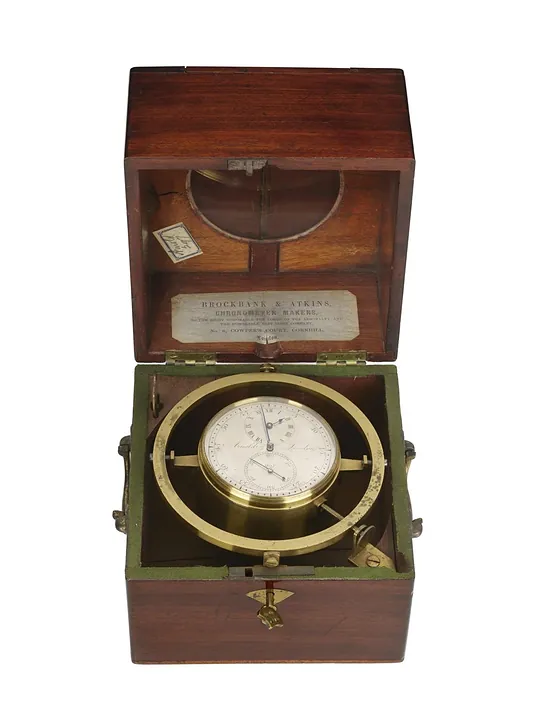
Instruments · 1802
Marine chronometer by John Arnold, England, 1802
Science Museum Group, London
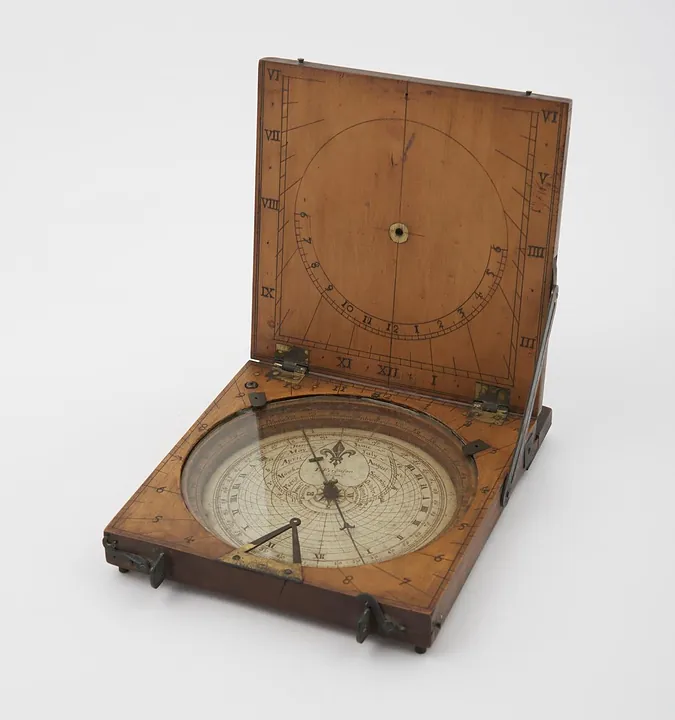
Instruments · 1731–1776
Azimuth compass sundial by James Ferguson, London, England, 1731–1776. Could also be used as a tablet sundial - string gnomon is missing (see note).
Science Museum Group, London
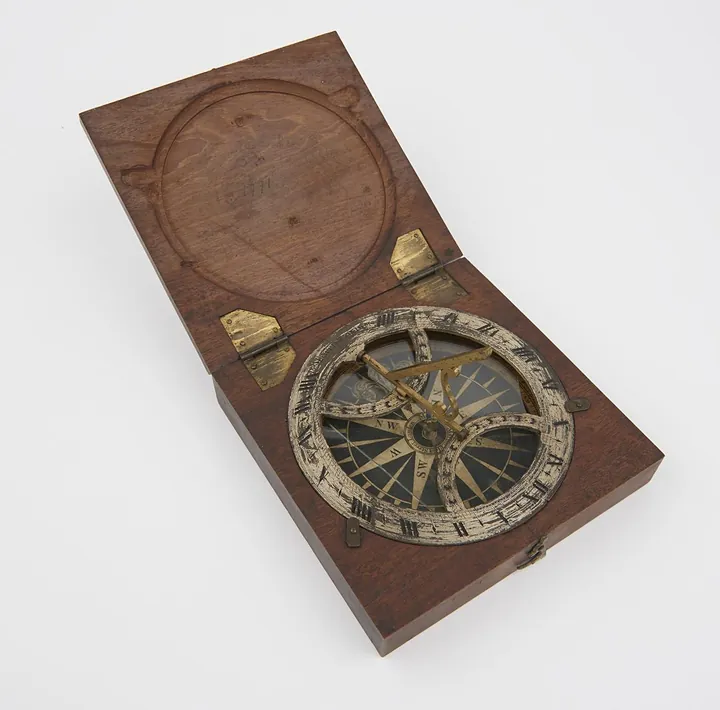
Instruments · 1738–1777
Azimuth sundial 4 3/8" diam, with folding gnomon fitted in mahogany case, made by B. Martin
Science Museum Group, London
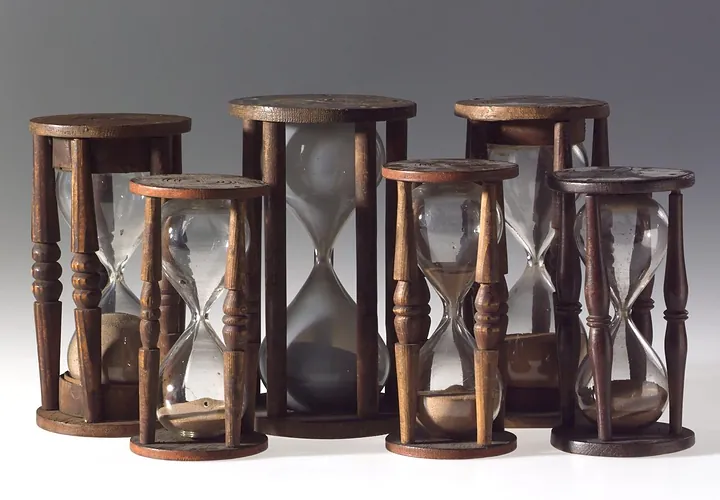
Instruments · 1750–1800
Single sand glass in four pillared wooden mount. 17 minutes. Horne Type B. Second half of the 18th century
Science Museum Group, London
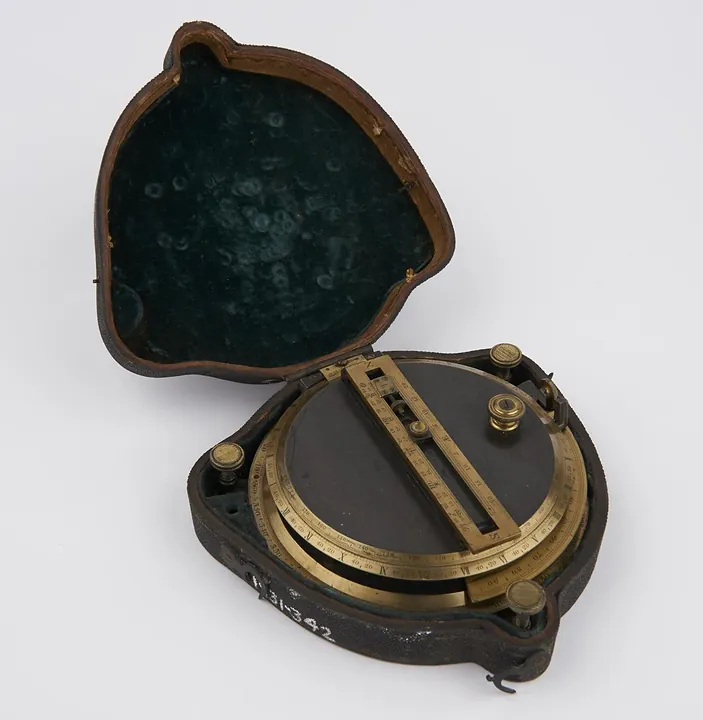
Instruments · 1751–1825
Sundial, by Troughton, in case. Invented and made by Troughton
Science Museum Group, London