
Wristwatches · Aviator's wristwatch
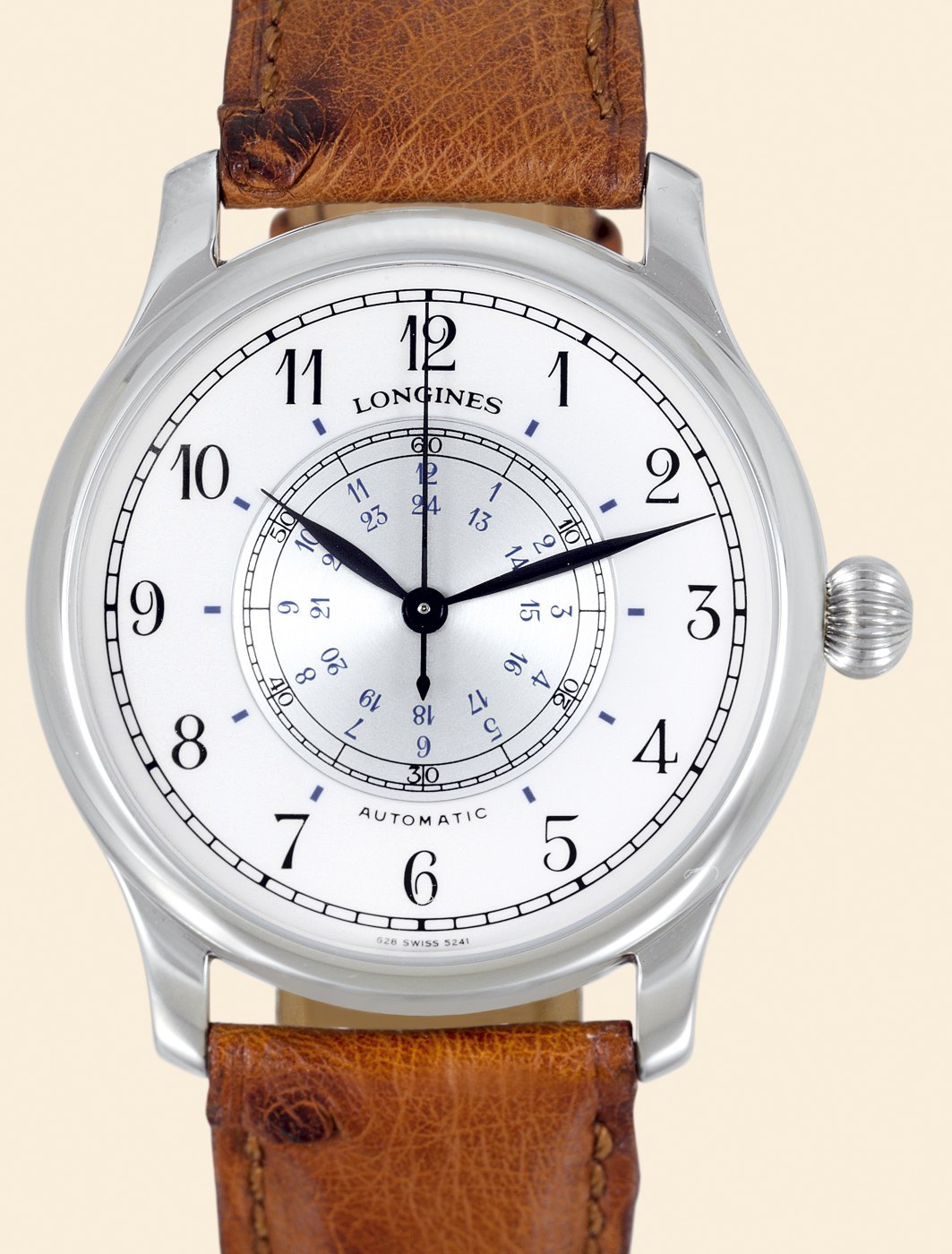
Longines 'Weems Navigation' Special Edition for Swiss Air
- Maker / attribution
- Longines (source attribution)
- Date
- 1980s
- Historical period
- Quartz Revolution (1969 – 1990)
- Country of origin
- Switzerland
- Object type
- Aviator's wristwatch
- Materials / technique
- Stainless steel
- Holding institution
- Antiquorum
- Accession / object no.
- 96
- Credit line
- Antiquorum
- Catalogue title (original)
- Longines, 'Weems Navigation',\nNo. 766, Ref.\n6285241.\nMade in Special Edition for Swiss Air\nExclusive in the 1980s. Sold in 1989.\nFine and unusual, hour angle, centerseconds,\ntwo-time zone, stain (English)
View the source record ↗ (opens another website in a new tab)Suggest a correction
Record summary
Held and catalogued by Antiquorum (object number 96), this is an aviator's wristwatch attributed to Longines, made in Switzerland, dated 1980s. The Atlas places it in the Quartz Revolution period (1969 – 1990) of its Wristwatches collection. Materials and techniques recorded by the source: Stainless steel. The record is illustrated with 1 photograph.
Assembled from the source record's structured fields. Dates and attributions are given as the source states them; where a field is missing the Atlas leaves it blank rather than estimating.
Catalogue description
Original object description
Numbered 766, this Longines 'Weems Navigation' wristwatch was manufactured in the 1980s under a special commission for Swiss Air and retailed in 1989. The three-piece stainless steel case measures 38 mm in diameter and 11 mm in thickness, detailed with a mirror polish, curved lugs, a rounded bezel, a ball-shaped crown, and sapphire crystals on both the front and the see-through case back. Its white enamel dial displays painted black Arabic numerals, blued steel leaf-shaped hands, and an adjustable central disc in matte silver used for monitoring an alternate time zone. Power is provided by the rhodium-plated, 21-jewel Longines caliber L628.1, an automatic movement featuring a lever escapement, monometallic balance, self-compensating flat balance spring, shock-protection system, and a hacking stop-seconds mechanism. Dial, case, and movement are each stamped with Longines signatures. Graded in condition 'A' by the auction house, the piece is accompanied by its original fitted box, operational manual, and warranty document.
Inscriptions & marks
766
Historical context
Quartz Revolution (1969 – 1990)
Seiko's Astron begins mass quartz timekeeping; traditional industries contract sharply.
Quartz and digital watches transformed the market after 1969. Swiss employment collapsed, Japanese and Hong Kong production soared, and the Swatch (1983) helped the Swiss industry recover; mechanical watches survived as luxury goods.
Read the period in the timelineMore wristwatches from this periodEarlier: Modern Mechanical Horology
Atlas type guide
Military, pilot and travel watches
The wristwatch owes much of its adoption by men to warfare and aviation. Wristlets — small pocket watches soldered with lugs and worn on a strap — were used in colonial campaigns and became standard equipment in the First World War, with protective grilles over the crystal ('shrapnel guards'). Louis Cartier's Santos (1904), designed for the aviator Alberto Santos-Dumont, is often cited as an early purpose-made pilot's watch.
In the Second World War governments specified watches in detail: the German B-Uhr observation watches, the American A-11, and the British 'W.W.W.' (the 'Dirty Dozen' set of 1945). After the war, jet travel brought GMT and world-time watches, which show two or more time zones at once — Louis Cottier's world-time mechanism and the Rolex GMT-Master (1955) are examples.
What to look for
- Military markings on the case back: broad arrow, issue numbers, 'W.W.W.', 'A.T.P.'
- High-legibility black dials with luminous Arabic numerals; oversized crowns for gloved hands.
- 24-hour hands and rotating 24-hour bezels or city rings on GMT/world-time watches.
- Wire lugs on early wristlets converted from pocket watches.
Dating clues
- Wire-lug wristlets: c. 1900–1925.
- Military specifications of the Second World War: 1939–1945.
- GMT and world-time wristwatches: mainly after 1950.
General guidance written by the Atlas editors about this kind of object. It is not a statement about this particular piece; for that, rely on the source record above and on physical examination.
Related records
Instruments · c. 1940
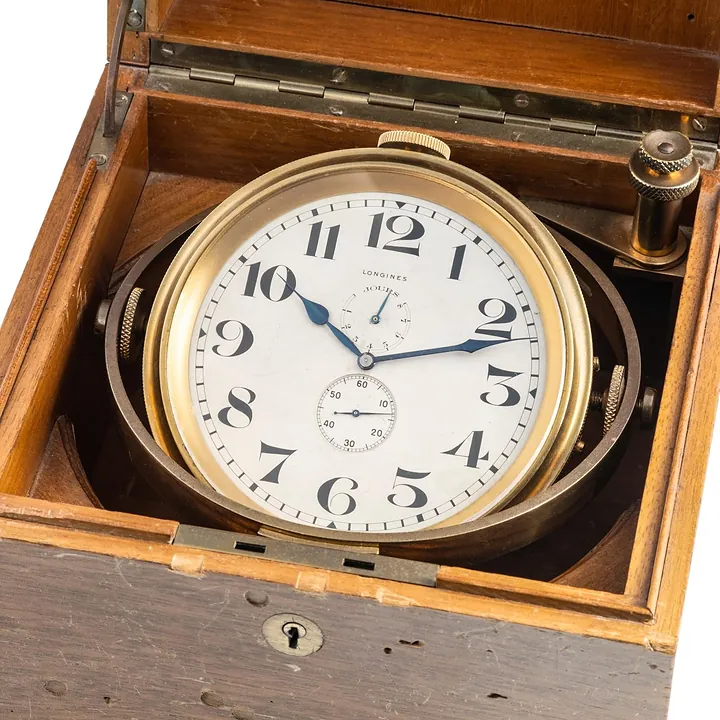
Longines marine chronometer, c. 1940
Antiquorum auction archive, Geneva
Pocket Watches · c. 1910-1920s
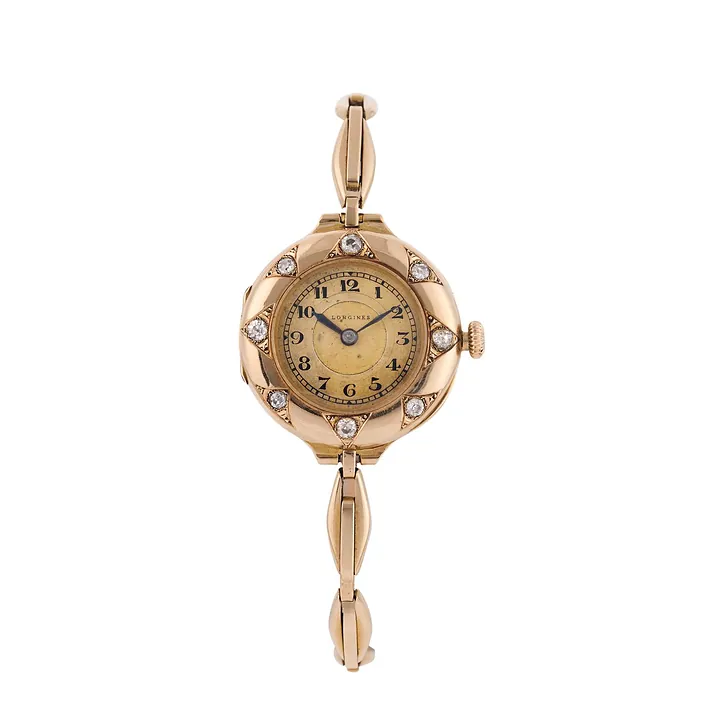
Longines watch, c. 1910-1920s
Antiquorum auction archive, Geneva
Pocket Watches · c. 1915
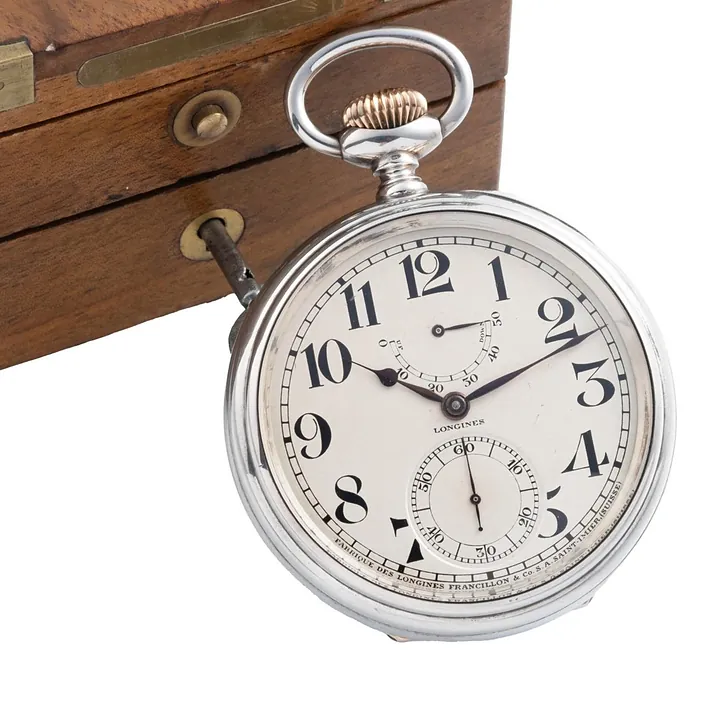
Longines ''torpedo-Boat Watch'', c. 1915
Antiquorum auction archive, Geneva
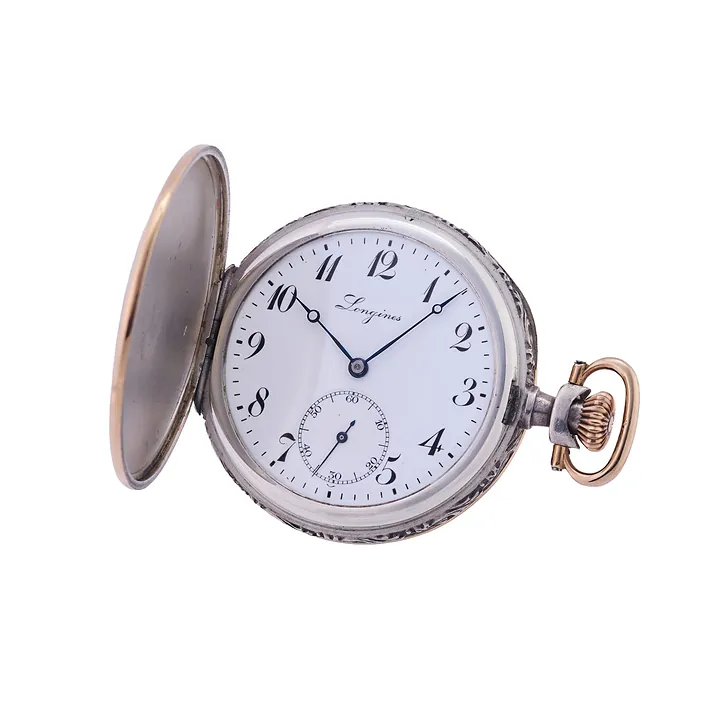
Pocket Watches · c. 1920s
Longines pocket watch, c. 1920s (Antiquorum Lot 389-59)
Antiquorum auction archive, Geneva

Wristwatches · 1970
Wristwatch by Heno, Switzerland, 1970
Museum Rotterdam
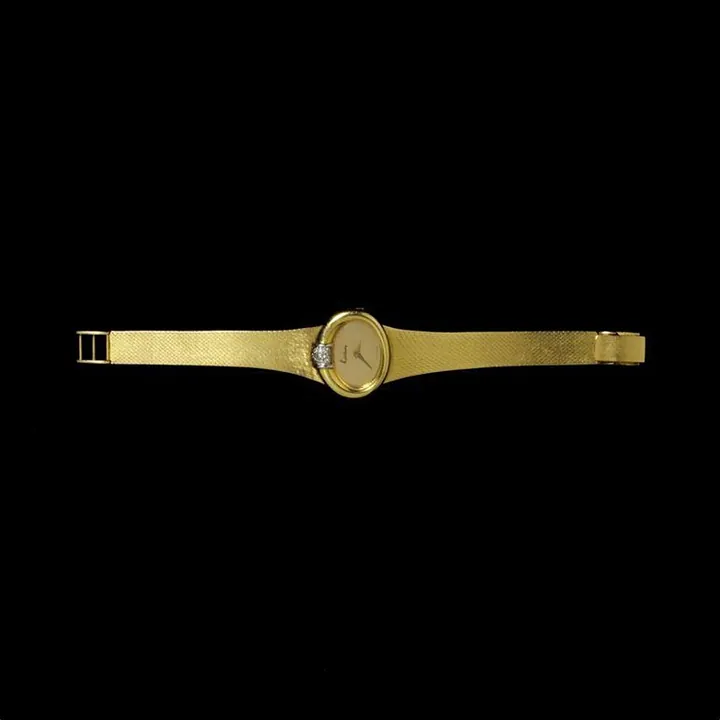
Wristwatches · 1973
Woman's watch, gold with diamonds set in platinum. Made for Kutchinsky, London by Chopard et Cie. Switzerland, 1973
Victoria and Albert Museum, London
Wristwatches · 1985–1991
Swatch dummy watch: Blue Leaves GN104 design
Victoria and Albert Museum, London
Wristwatches · 1985–1991
Swatch dummy watch: Technosphere GK101 design
Victoria and Albert Museum, London