
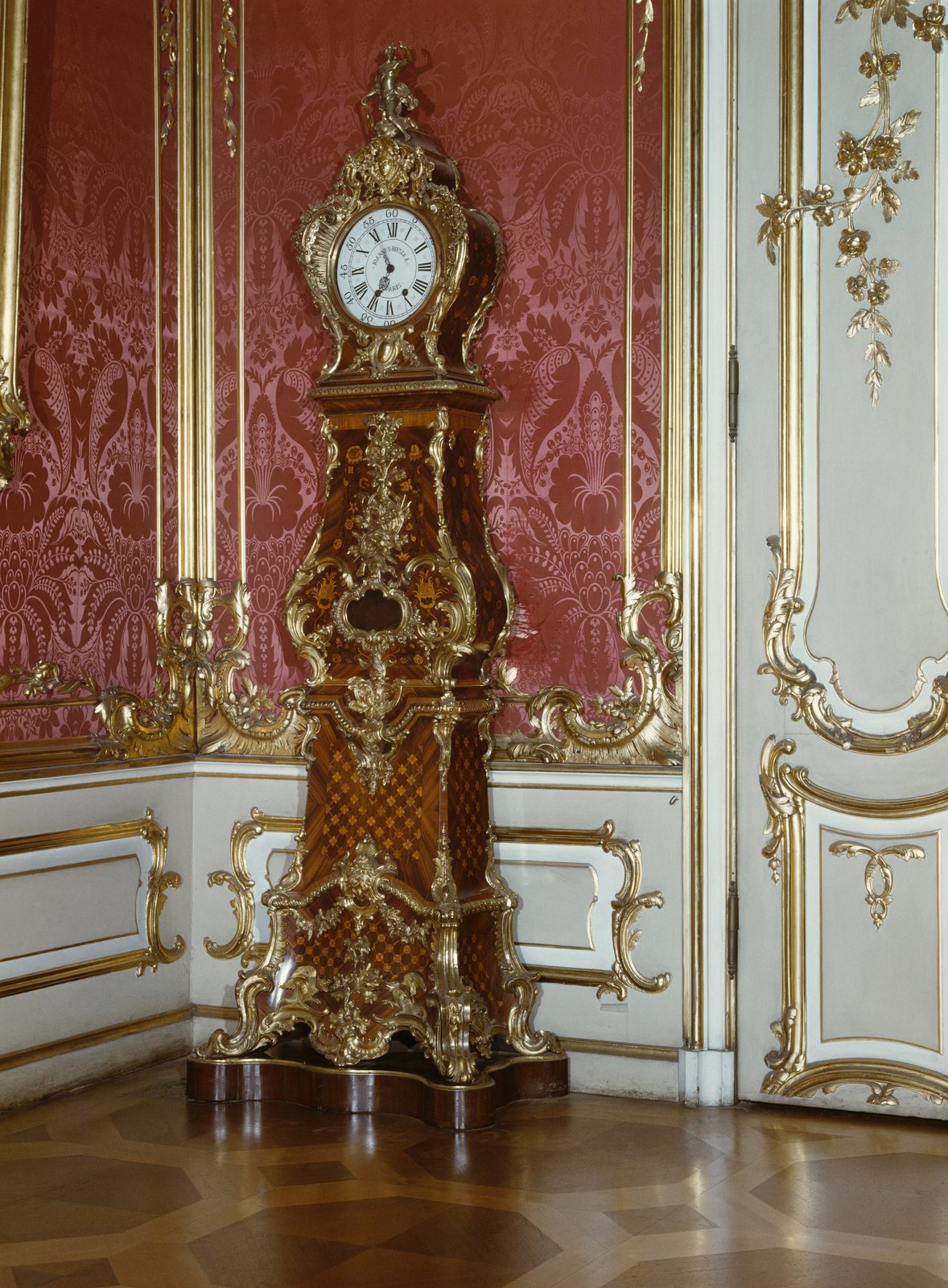
Clocks · Longcase clock
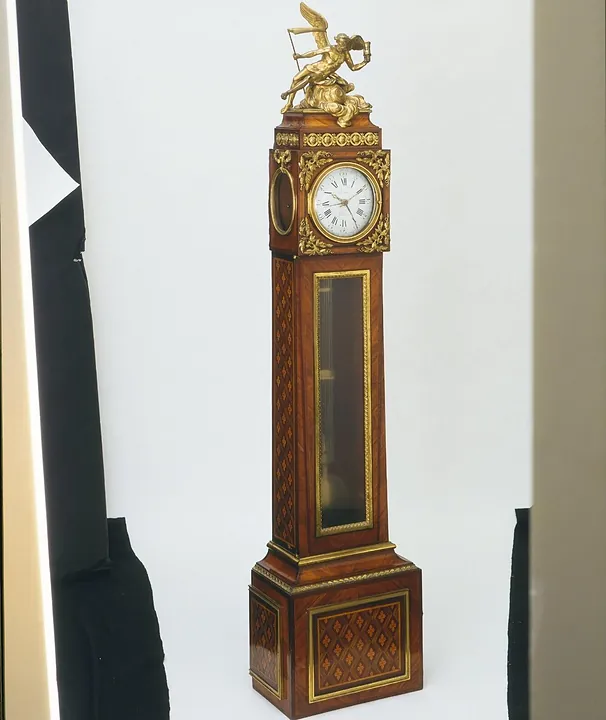
Longcase clock by Jean Biesta, France, 1754
- Maker / attribution
- Jean Biesta (Created); Jean-Pierre Latz (Created)
- Date
- 1754
- Historical period
- Precision & Scientific Horology (1750 – 1850)
- Country of origin
- France
- Place
- Paris
- Object type
- Longcase clock
- Materials / technique
- Gehäuse: Holz, furniert - Zeiger: Stahl, gebläut - Applikationen: Bronze, vergoldet - Uhrwerk: Messing - Zifferblatt: Kunststoff, ehemals Email
- Dimensions
- Außenmaß: Breite: 290.00 cm Breite: 92.00 cm Tiefe: 52.00 cm - Uhrwerk: Höhe: 16.50 cm Breite: 16.50 cm Tiefe: 4.80 cm
- Holding institution
- Stiftung Preußische Schlösser und Gärten Berlin-Brandenburg
- Accession / object no.
- V 4
- Credit line
- Stiftung Preußische Schlösser und Gärten Berlin-Brandenburg
- Catalogue title (original)
- Bodenstanduhr mit Glockenspiel (German)
View the source record ↗ (opens another website in a new tab)Suggest a correction
Record summary
Held and catalogued by Stiftung Preußische Schlösser und Gärten Berlin-Brandenburg (object number V 4), this is a longcase clock by Jean Biesta, made in Paris, France, dated 1754. The Atlas places it in the Precision & Scientific Horology period (1750 – 1850) of its Clocks collection. Materials and techniques recorded by the source: Gehäuse: Holz, furniert - Zeiger: Stahl, gebläut - Applikationen: Bronze, vergoldet - Uhrwerk: Messing - Zifferblatt: Kunststoff, ehemals Email. Recorded dimensions: Außenmaß: Breite: 290.00 cm Breite: 92.00 cm Tiefe: 52.00 cm - Uhrwerk: Höhe: 16.50 cm Breite: 16.50 cm Tiefe: 4.80 cm. The record is illustrated with 1 photograph.
Assembled from the source record's structured fields. Dates and attributions are given as the source states them; where a field is missing the Atlas leaves it blank rather than estimating.
Catalogue description
Catalogue description from Stiftung Preußische Schlösser und Gärten Berlin-Brandenburg (German)
Die vor 1945 im Potsdamer Stadtschloss, jetzt im Neuen Palais platzierte Pariser Bodenstanduhr mit Glockenspiel stammt aus der Werkstatt des Ebenisten Jean-Pierre Latz (1691-1754), (vgl. Hawley, 1970). In seinem Nachlass-Inventar wird eine Uhr für den König von Preußen erwähnt. Dasselbe Dokument nennt "le sieur Biesta, horloger" als Schuldner von Latz. Möglicherweise hatte der Ebenist bei dem in Den Haag geborenen, seit etwa 1735 in Paris tätigen Uhrmacher Johannes Biesta (1712-1791) einen Abschlag für ein Uhrwerk gezahlt, das er bis zu seinem Tod noch nicht erhalten hatte. Mit diesem Hinweis auf eine Zusammenarbeit zwischen Latz und Biesta liegt die Vermutung nahe, dass es sich genau um diese Uhr handelt, die bei Latz` Tod noch nicht beendet worden war. Da seine Witwe das Geschäft zwei Jahre weitergeführt hatte, dürfte das noch fehlende Uhrwerk noch 1754 eingebaut worden sein (vgl. auch eine 1754 datierte Zugfeder im Werk). Noch im selben Jahr ging ein sehr hoher Betrag aus der Privatschatulle Friedrichs II. von Preußen an seinen Agenten Petit nach Paris für eine "Pendulle du Roy à Carillon". Ebenfalls 1754 wurden die renovierten Gästezimmer im nordwestlichen Kopfbau des Potsdamer Stadtschlosses fertig gestellt, in denen die Uhr erstmals inventarmäßig aufgeführt wird. Silke Kiesant
Shown in the original language of the source catalogue. An editor-reviewed English translation has not yet been published; we do not publish machine translations as authoritative text.
Provenance
Literature: : Augarde, Jean-Dominique: Les ouvriers du temps. La pendule á Paris de Louis XIV à Napoléon ler. Ornamental clocks and clockmakers in eighteenth century Paris, Genf 1996 (); : Baer, Winfried: Some clocks of Frederick the Great, in: The connoisseur, 195, 1977, S. 22-29, S. 24, Abb. S. 25 (); : Das Stadtschloss in Potsdam, bearb. v. Hans Huth, Berlin 1933 (Amtlicher Führer) (); : Hawley, Henry: Jean-Pierre Latz. cabinet maker, in: The bulletin of the Cleveland Museum of Art, 57, 1970 ()
Historical context
Precision & Scientific Horology (1750 – 1850)
Harrison solves longitude; Mudge invents the lever; Breguet's Paris workshop defines the modern watch.
The age of the deadbeat escapement, compensated pendulums and observatory regulators. Domestic clocks spread through the middle classes: English longcase and bracket clocks, French gilt-bronze mantel clocks, Viennese Biedermeier wall clocks, Black Forest painted-shield clocks, and the first American shelf clocks.
Read the period in the timelineMore clocks from this periodEarlier: Early Modern Horology
Atlas type guide
Longcase (tall-case or grandfather) clocks
The longcase clock was born from two seventeenth-century innovations: Christiaan Huygens's pendulum (1656–57) and the anchor escapement (c. 1670). A long seconds pendulum, nearly a metre long, swings with a small arc, and enclosing it together with the driving weights in a tall wooden case protected the mechanism and created a new piece of furniture. London makers such as Ahasuerus Fromanteel, Thomas Tompion and Joseph Knibb set the pattern.
By the eighteenth century longcase clocks were made throughout Britain, the Netherlands, Scandinavia (the Swedish Mora clock), France (the Comtoise from the Franche-Comté), Germany and colonial America. Eight-day movements with two weights became standard in better clocks; thirty-hour clocks with one weight and a rope or chain were cheaper alternatives.
What to look for
- Winding holes in the dial: two (eight-day, going and striking) or none (thirty-hour, pulled up by a chain).
- Brass dials with applied chapter rings (earlier) versus painted iron 'white' dials (after c. 1770 in Britain).
- Moon-phase arches, date apertures, seconds dials and maker's name on the dial.
- Case woods and style: ebonised, walnut marquetry, lacquer, oak or mahogany; regional styles from London, Lancashire, Scotland or America.
- Whether the movement and dial match the case — 'marriages' are common.
Dating clues
- Square brass dials suggest c. 1670–1720; arched brass dials c. 1715–1790.
- Painted (white) dials were made by Birmingham dial-makers from about 1772.
- Comtoise clocks with repoussé pendulums are mostly nineteenth century.
General guidance written by the Atlas editors about this kind of object. It is not a statement about this particular piece; for that, rely on the source record above and on physical examination.
Read next:Anchor (recoil) escapementDeadbeat escapementAnchor escapement
Related records
Clocks · 1750–1800
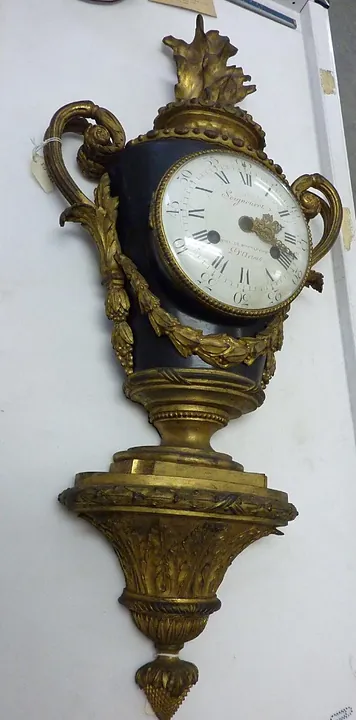
Bracket clock in metal case with scroll handles and flamed-shaped top signed by Pierre Seignoret, Clockmaket to the the Comte d'Artois
Victoria and Albert Museum, London
Clocks · 1756
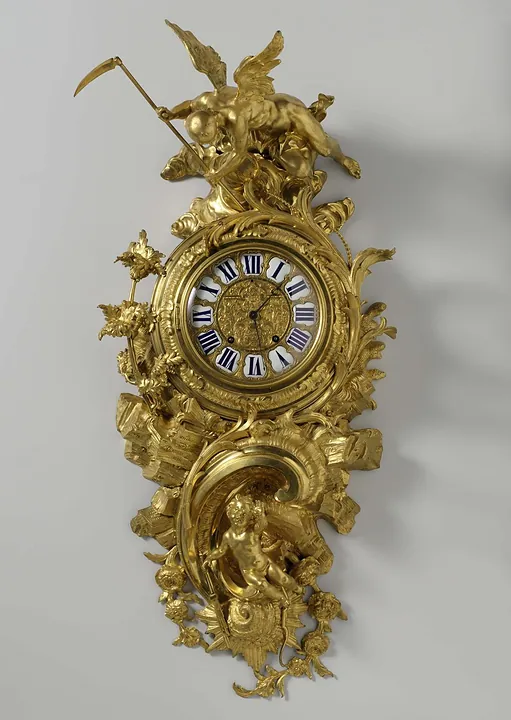
Mantel clock, France, 1756
Rijksmuseum
Clocks · c. 1764–70
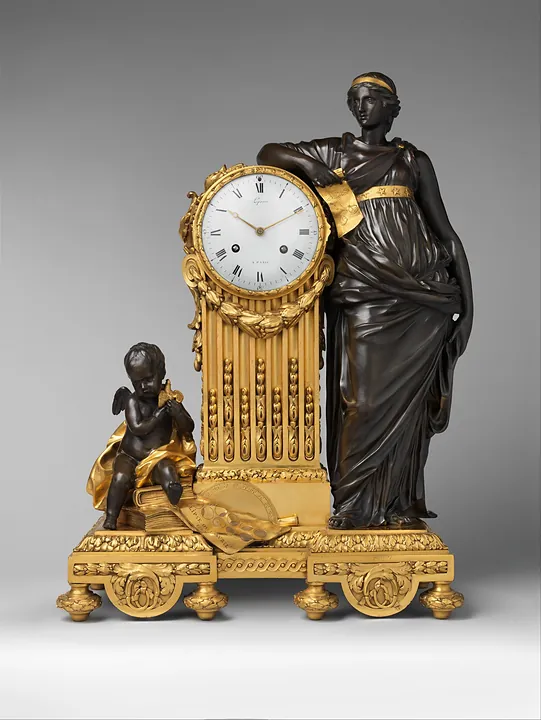
Mantel clock by Jean-André Lepaute, France, c. 1764–70
The Metropolitan Museum of Art, New York
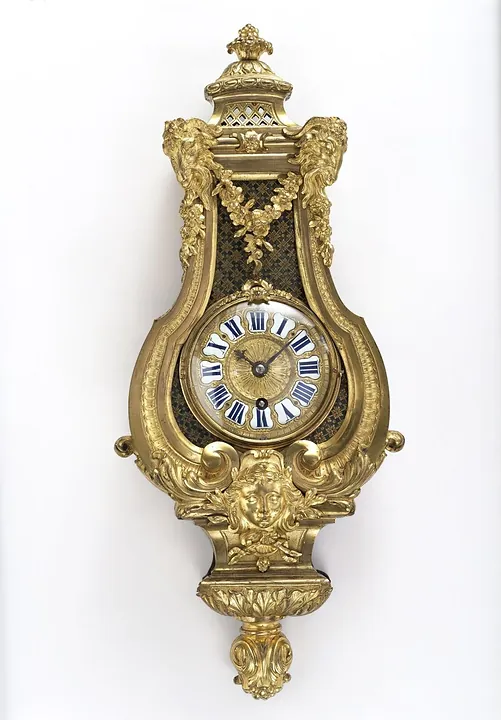
Clocks · 1760–1860
'Pendule d'alcove' wall clock, gilt-bronze and boulle marquetry, Paris, 1760-1860
Victoria and Albert Museum, London
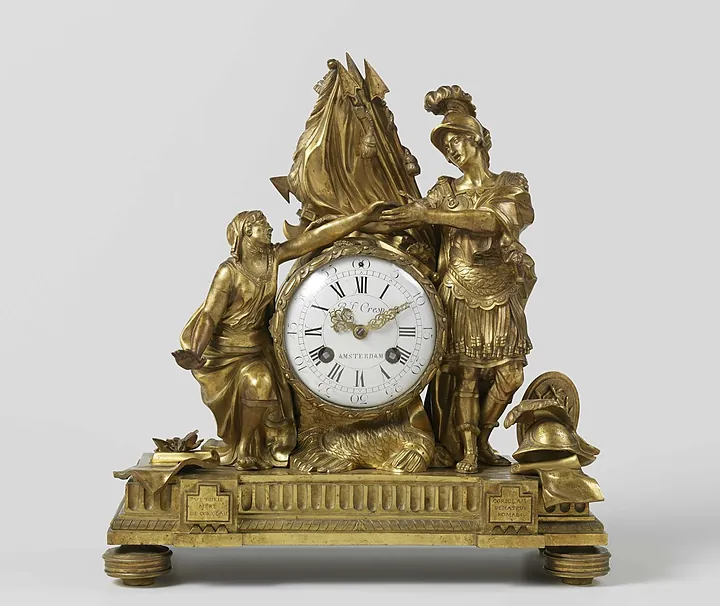
Clocks · 1760
Mantel clock, France, 1760
Rijksmuseum
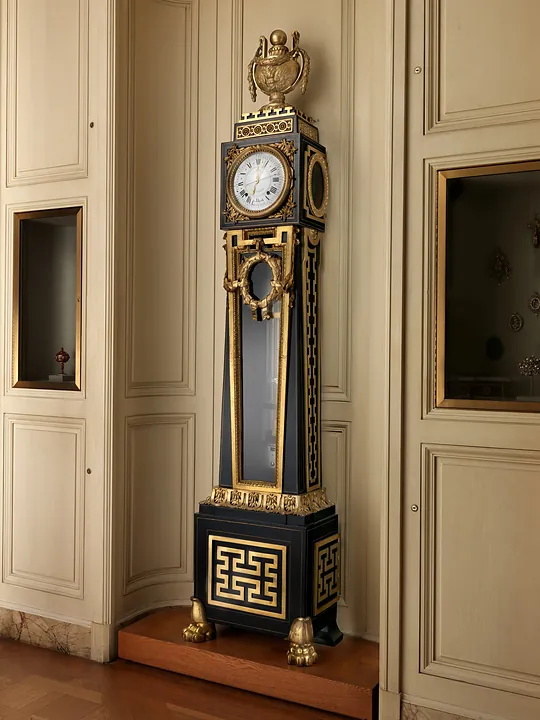
Clocks · c. 1768–70
Longcase astronomical regulator by Ferdinand Berthoud, France, c. 1768–70
The Metropolitan Museum of Art, New York
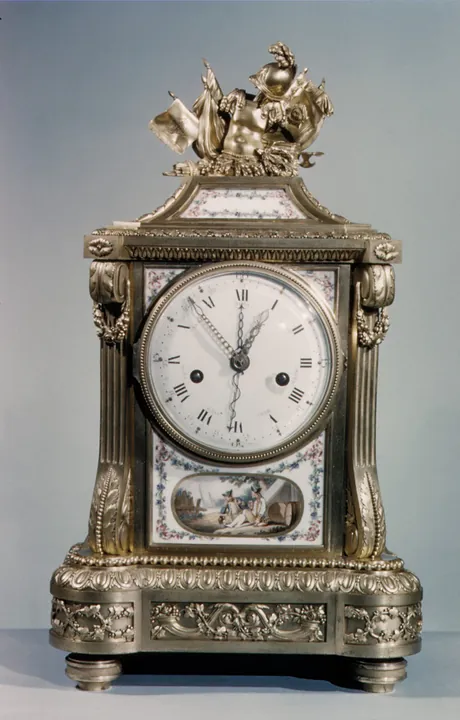
Clocks · c. 1775
Clock by Porcelain plaques by Sèvres Manufactory, France, c. 1775
The Metropolitan Museum of Art, New York
Clocks · 1770–1775
Longcase clock (régulateur) by Robert Robin, France, 1770–1775
Victoria and Albert Museum, London