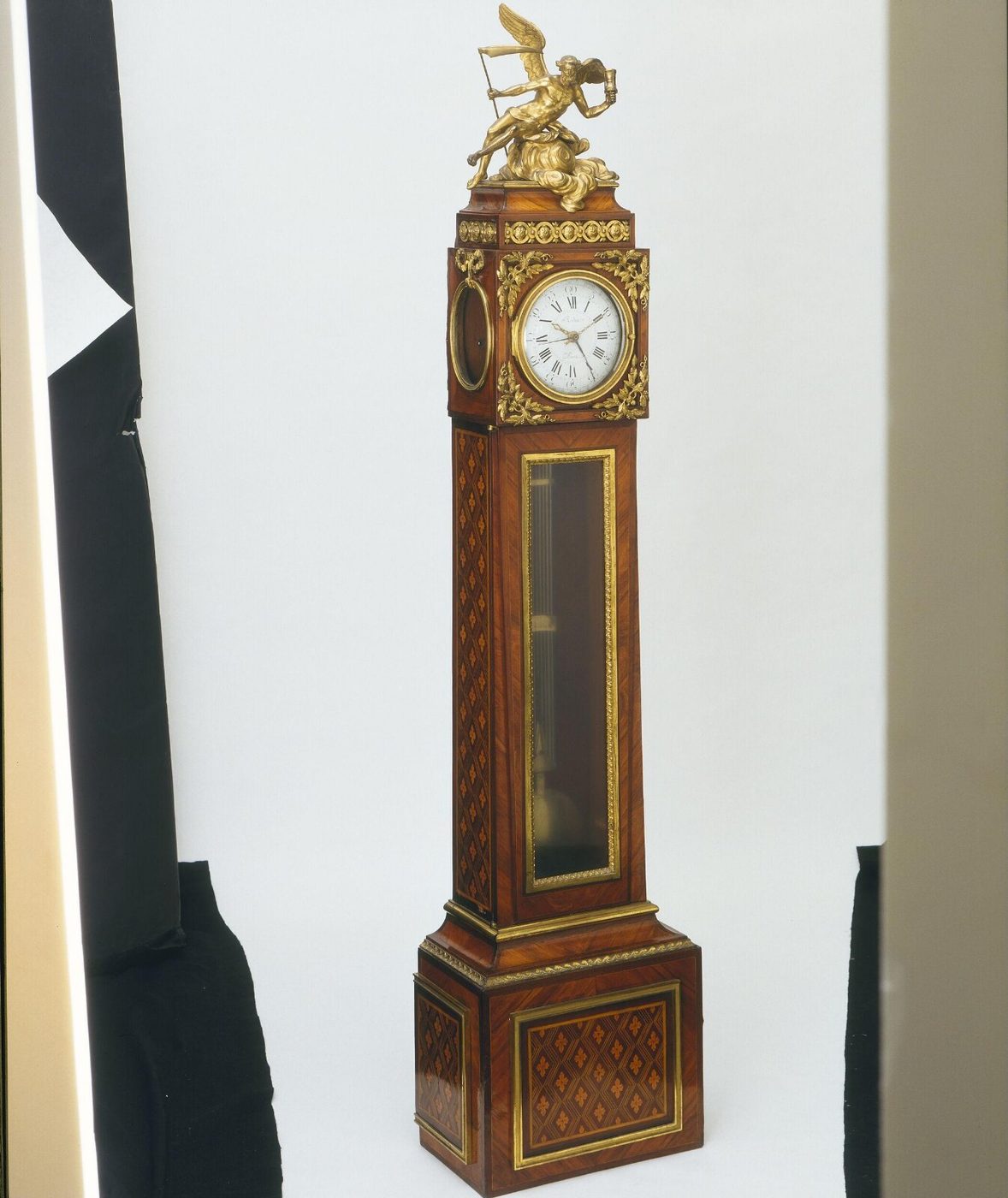
Clocks · Longcase clock (régulateur)
Longcase clock (régulateur) by Robert Robin, France, 1770-1775
- Maker / attribution
- Robert Robin (clockmaker); Balthazar Lieutaud (cabinet-maker)
- Date
- 1770-1775
- Historical period
- Precision & Scientific Horology (1750 – 1850)
- Country of origin
- France
- Place
- Paris
- Object type
- Longcase clock (régulateur)
- Materials / technique
- Tulipwood and other woods on a carcase of oak, set with a marquetry panel and with gilt-bronze mounts; the movement of steel and brass; the dial enamelled black on white
- Dimensions
- Height: 2635 mm (with figure); Width: 450 mm; Depth: 280 mm
- Holding institution
- Victoria and Albert Museum, London
- Accession / object no.
- 1011:1 to 3&A -1882
- Credit line
- Bequeathed by John Jones
Record summary
Held and catalogued by Victoria and Albert Museum, London (object number 1011:1 to 3&A -1882), this is a longcase clock (régulateur) by Robert Robin, made in Paris, France, dated 1770-1775. The Atlas places it in the Precision & Scientific Horology period (1750 – 1850) of its Clocks collection. Materials and techniques recorded by the source: Tulipwood and other woods on a carcase of oak, set with a marquetry panel and with gilt-bronze mounts; the movement of steel and brass; the dial enamelled black on white. Recorded dimensions: Height: 2635 mm (with figure); Width: 450 mm; Depth: 280 mm. The record is illustrated with 4 photographs.
Assembled from the source record's structured fields. Dates and attributions are given as the source states them; where a field is missing the Atlas leaves it blank rather than estimating.
Catalogue description
V&A — Summary
Robert Robin, the maker of this clock, was one of the most celebrated clockmakers in 18th-century Paris. He was clockmaker to Louis XV and continued to produce his finely engineered movements even after the French Revolution of 1789. In Paris at that time, the different trades were tightly controlled by the guild system and Robin did not make the wooden cases of his clocks. This case is stamped ‘B. LIEUTAUD’, the mark of the cabinetmaker Balthazar Lieutaud, who worked frequently with Robin. Several cases of this shape exist, each with slightly different decoration in marquetry and gilt bronze. Some show figures of Apollo and his chariot as the cresting decoration at the top. Others, like this one, use the figure of Father Time with his scythe. This clock would originally have been slightly higher, with a low plinth section below the base.
V&A — Physical description
Calendar equation regulator (régulateur), the case veneered in tulipwood and other woods on a carcase of oak, the front face of the base with a panel of lozenge marquetry, the case mounted with gilt-bronze mounts, including the figure of Time, with his scythe, as a cresting. The dial and dial plate are marked 'Robin a Paris' and the case is stamped four times with the stamp B.LIEUTAUD. The clock is missing its base, but a replacement base was made by the Museum in 2015, for display.
V&A — Object history
Acquired by John Jones before 1882
V&A gallery label
Long-case clock About 1770–75 The clock-case is severely rectilinear in outline, and most of its decoration is geometric. This combination is characteristic of much French Neoclassical furniture of its time. Other decoration includes cast laurel leaves and bands of guilloche ornament (flower heads encircled by bands). These were copied from classical architecture. The figure of Time, however, was a type common in art of the period. France (Paris) Case by Balthazar Lieutaud Movement by Robert Robin Oak and softwood, veneered with tulipwood, purpleheart, sycamore and boxwood; glass; gilded copper alloy mounts; modern plinth Bequeathed by John Jones
Inscriptions & marks
B.LIEUTAUD; Robin a Paris; Barbezat; LESIEUR 1817
Historical context
Precision & Scientific Horology (1750 – 1850)
Harrison solves longitude; Mudge invents the lever; Breguet's Paris workshop defines the modern watch.
The age of the deadbeat escapement, compensated pendulums and observatory regulators. Domestic clocks spread through the middle classes: English longcase and bracket clocks, French gilt-bronze mantel clocks, Viennese Biedermeier wall clocks, Black Forest painted-shield clocks, and the first American shelf clocks.
Read the period in the timelineMore clocks from this periodEarlier: Early Modern Horology
Atlas type guide
Longcase (tall-case or grandfather) clocks
The longcase clock was born from two seventeenth-century innovations: Christiaan Huygens's pendulum (1656–57) and the anchor escapement (c. 1670). A long seconds pendulum, nearly a metre long, swings with a small arc, and enclosing it together with the driving weights in a tall wooden case protected the mechanism and created a new piece of furniture. London makers such as Ahasuerus Fromanteel, Thomas Tompion and Joseph Knibb set the pattern.
By the eighteenth century longcase clocks were made throughout Britain, the Netherlands, Scandinavia (the Swedish Mora clock), France (the Comtoise from the Franche-Comté), Germany and colonial America. Eight-day movements with two weights became standard in better clocks; thirty-hour clocks with one weight and a rope or chain were cheaper alternatives.
What to look for
- Winding holes in the dial: two (eight-day, going and striking) or none (thirty-hour, pulled up by a chain).
- Brass dials with applied chapter rings (earlier) versus painted iron 'white' dials (after c. 1770 in Britain).
- Moon-phase arches, date apertures, seconds dials and maker's name on the dial.
- Case woods and style: ebonised, walnut marquetry, lacquer, oak or mahogany; regional styles from London, Lancashire, Scotland or America.
- Whether the movement and dial match the case — 'marriages' are common.
Dating clues
- Square brass dials suggest c. 1670–1720; arched brass dials c. 1715–1790.
- Painted (white) dials were made by Birmingham dial-makers from about 1772.
- Comtoise clocks with repoussé pendulums are mostly nineteenth century.
General guidance written by the Atlas editors about this kind of object. It is not a statement about this particular piece; for that, rely on the source record above and on physical examination.
Related records
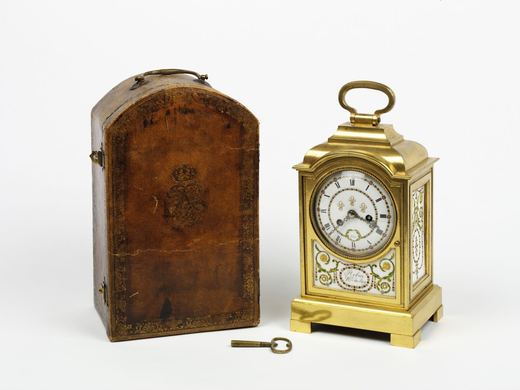
Clocks · 1780-1785
Carriage clock by Robert Robin, France, 1780-1785
Victoria and Albert Museum, London
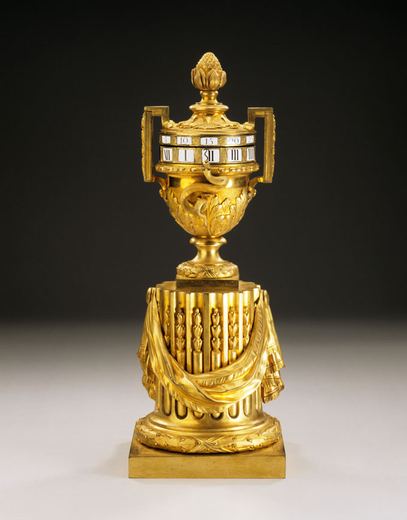
Clocks · 1723–1811
Table clock by Louis Montjoye, France, 1723–1811
Badisches Landesmuseum Karlsruhe
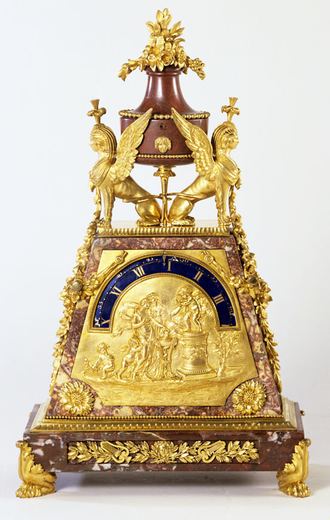
Clocks · 1738–1814
Table clock by Jean Simon Bourdier, France, 1738–1814
Badisches Landesmuseum Karlsruhe
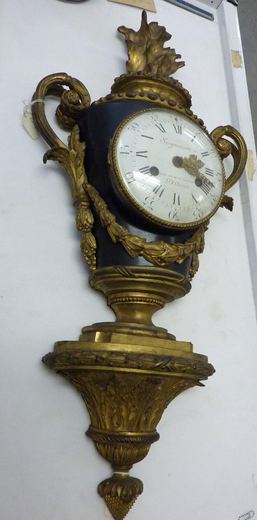
Clocks · 1750-1800
Bracket clock in metal case with scroll handles and flamed-shaped top signed by Pierre Seignoret, Clockmaket to the the Comte d'Artois
Victoria and Albert Museum, London
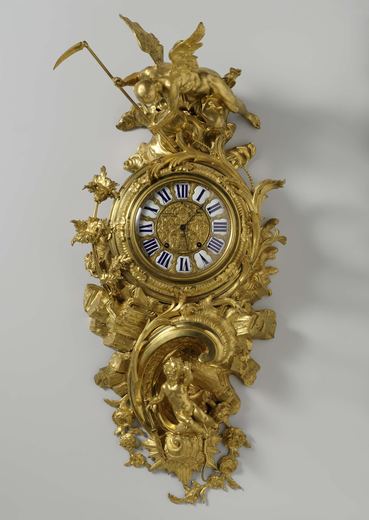
Clocks · 1756
Mantel clock, France, 1756
Rijksmuseum
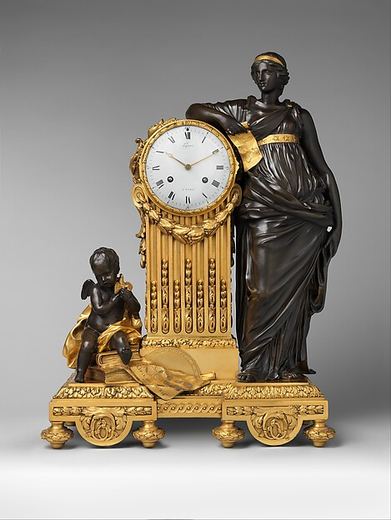
Clocks · ca. 1764–70
Mantel clock by Jean-André Lepaute, France, ca. 1764–70
The Metropolitan Museum of Art, New York
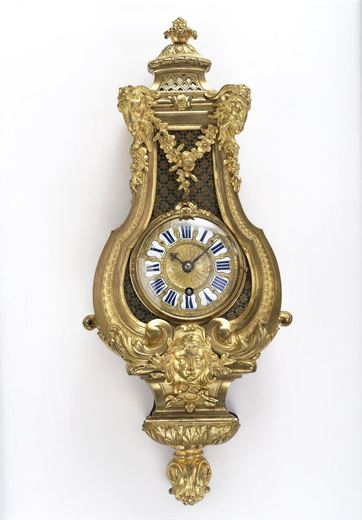
Clocks · 1760–1860
'Pendule d'alcove' wall clock, gilt-bronze and boulle marquetry, Paris, 1760-1860
Victoria and Albert Museum, London
Clocks · 1760
Mantel clock, France, 1760
Rijksmuseum