
Wristwatches · Wristwatch
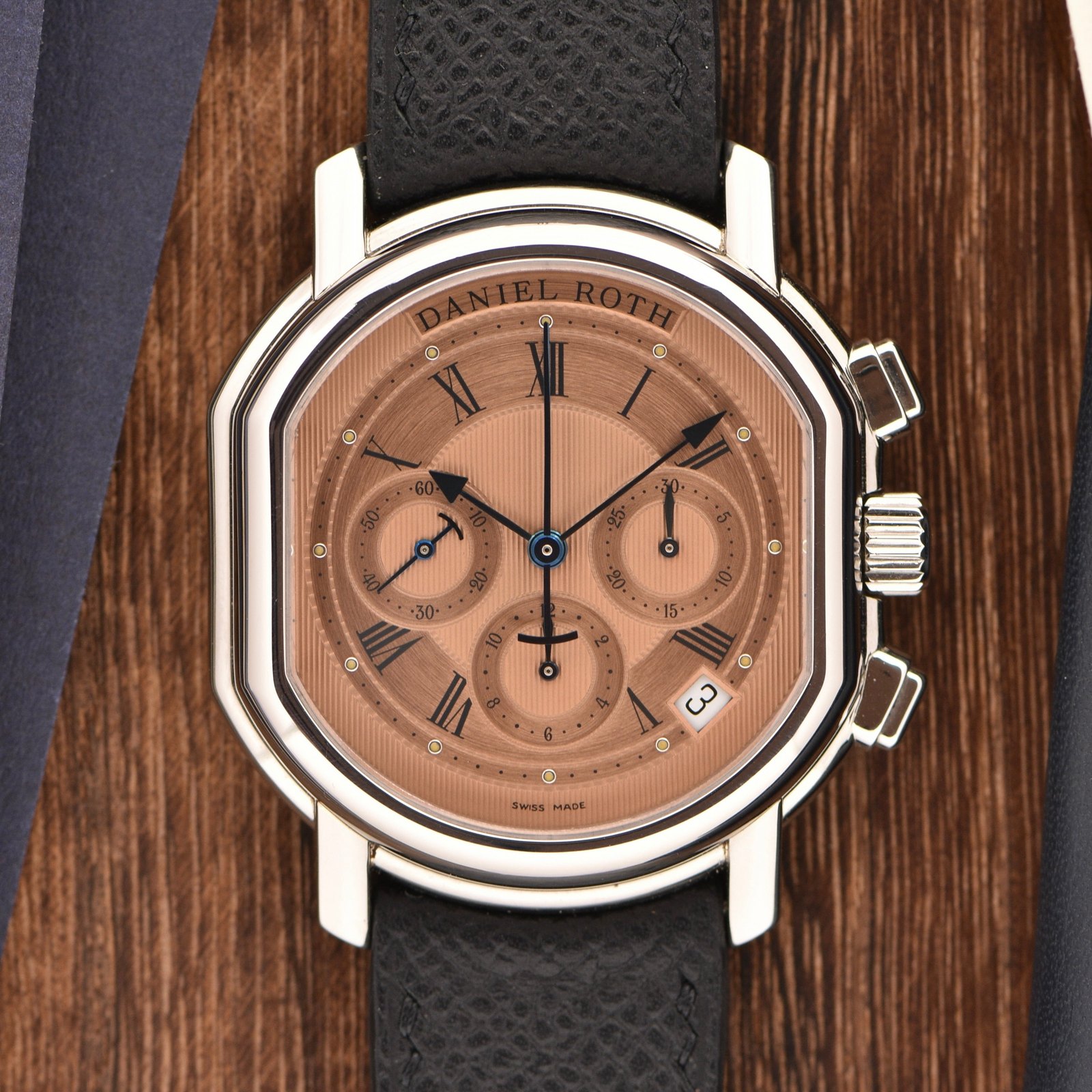
Daniel Roth Masters Chronograph Salmon, 2001
- Maker / attribution
- Daniel Roth (maker)
- Date
- 2001
- Historical period
- Mechanical Renaissance (1990 – 2010)
- Country of origin
- Switzerland
- Object type
- Wristwatch
- Dimensions
- Case 38 mm
- Stock no.
- Product 7575203184823
- Credit line
- Dealer listing, Huntington Company (product 7575203184823)
- Catalogue title (original)
- 2001 Daniel Roth Masters Chronograph Salmon - Complete Set (English)
View the source record (dealer listing) ↗ (opens another website in a new tab)Suggest a correction
Record summary
Catalogued by Huntington Company (dealer) (stock number Product 7575203184823), this is a wristwatch by Daniel Roth, made in Switzerland, dated 2001. The Atlas places it in the Mechanical Renaissance period (1990 – 2010) of its Wristwatches collection. Recorded dimensions: Case 38 mm. The record is illustrated with 6 photographs.
Assembled from the source record's structured fields. Dates and attributions are given as the source states them; where a field is missing the Atlas leaves it blank rather than estimating.
Catalogue description
Dealer description — Huntington Company
Ref. S247 Complete Set Specifications Year: 2001 Model: Masters Chronograph Case Diameter: 38mm Lug to Lug: 41mm Case: Steel Dial: Salmon Movement: Automatic Condition This is a very clean example overall. The dial is in fantastic shape with a subtle, rare configuration: lumed hour markers with no-lume hands. The watch comes with its original buckle and also its box and papers from 2001. The Story Daniel Roth, a renowned independent watchmaker, established his own manufacture in 1989 in Vallée de Joux. His unique aesthetic codes, including the double-ellipse case and pinstripe guilloché dials, set him apart from other watchmakers. His watches were known for their intricate designs, including the tourbillon with an 8-day power reserve, the instantaneous perpetual calendar, and the Westminster Grande Sonnerie Carillon. Daniel Roth was a key brand name in independent watchmaking in the 1990s before being acquired by the Bulgari Group in 2000. The steel Daniel Roth Masters Chronograph, S247 features a double ellipse case, stepped bezel, and straight lugs. The rare salmon, pink dial is hand-engraved with a line motif and guilloché pattern, with a brushed chapter ring with roman numerals. Daniel Roth uses three different shapes of hands: arrow-shaped for hours and minutes, lance-shaped for sub-chrono-dials, and anchor-shaped for chronograph seconds and small seconds. The dial displays chronograph sub-dials at 3, 6, and 9 seconds, with a date indication between 4 and 5. The Automatic Daniel Roth 400 movement, based on the El Primero, is a 50-hour chronograph movement, still in production after 51 years. The Brand Daniel Roth, born in 1946 in Nice, Switzerland, was a Swiss watchmaker who began his career in the Vallée de Joux. He worked briefly for Jaeger-LeCoultre and later at Audemars Piguet, where he gained mechanical aptitude. Roth's career began as mechanical watchmaking faced the executioner's blade. Breguet, a company owned by George Brown, was revived by the Chaumet brothers Pierre and Jacques. They revived the company, focusing on producing the finest watches. Roth studied Abraham-Louis Breguet's artistic style, techniques, and inventions, introducing a refined, minimalist design language that broke away from the baroque exuberance of the 18th century. He introduced complications within Breguet's aesthetic paradigm, such as the perpetual calendar and the Breguet ref. 3237. Roth also introduced the first tourbillon wristwatch ever produced under the Breguet name, the ref. 3350. In 1987, the company went through a change of hands, leading to the Chaumet brothers' bankruptcy and Roth leaving the company to start his own brand. Daniel Roth, a Swiss watchmaker, started his own brand in 1988 with the backing of Siber Hegner. He created watches with unconventional layouts, double-ellipse cases, and hand-made engine-turned dials, incorporating hand-finishing on his movements. Roth's work was influenced by his time at Breguet, and his Double Face Tourbillon ref. 187 showcased his unique case form. He commissioned 24 tourbillon watches from John Asprey in the early 1990s, which were certified by the Contrôle Officiel Suisse des Chronomètres (COSC). Roth also developed three types of chronographs, including the C147, C167, and C127. His collection also included time-only models, such as the C107, C167, and C127, each with its own unique features. The C127, for example, featured a retrograde hour hand inspired by a pocket watch created by George Daniels, a Breguet expert. Roth's unique approach to watchmaking reflects his commitment to precision and artistic pursuits.
Historical context
Mechanical Renaissance (1990 – 2010)
Mechanical watches return as cultural objects; independent watchmaking flourishes.
Mechanical watches returned as cultural and luxury objects. Complications, tourbillons and new materials proliferated; independent watchmakers such as George Daniels, F.P. Journe and Philippe Dufour revived artisanal watchmaking; collecting vintage watches became a major field.
Read the period in the timelineMore wristwatches from this periodEarlier: Quartz Revolution
Atlas type guide
Chronographs and split-seconds watches
A chronograph is a watch with an additional seconds hand that can be started, stopped and returned to zero independently of the timekeeping. Louis Moinet built an early example in 1816 and Nicolas Rieussec a recording 'chronographe' in 1821; Adolphe Nicole's heart-shaped reset cam (patented 1862) made the modern return-to-zero possible. Split-seconds (rattrapante) chronographs add a second hand that can be stopped for intermediate times; flyback chronographs restart instantly.
Chronographs were essential tools for doctors (pulsometer scales), artillery (telemeter), engineers and sport. In wristwatches, Valjoux, Venus, Lemania and later the automatic chronographs of 1969 (Zenith El Primero, the Chronomatic Calibre 11 group and Seiko 6139) are milestones.
What to look for
- Push-pieces on the case band or a single button in the crown (monopusher).
- Subsidiary registers for minutes and hours; tachymeter, telemeter or pulsometer scales.
- Column wheel versus cam control visible in the movement.
- Calibre markings of specialist makers (Valjoux, Lemania, Venus, Landeron).
Dating clues
- Pocket chronographs with heart cam reset: after 1862.
- Wrist chronographs: from c. 1910; two-button designs from the 1930s.
- Automatic chronographs: from 1969.
General guidance written by the Atlas editors about this kind of object. It is not a statement about this particular piece; for that, rely on the source record above and on physical examination.
Read next:Flyback chronographChronograph
Related records
Wristwatches · 1990s
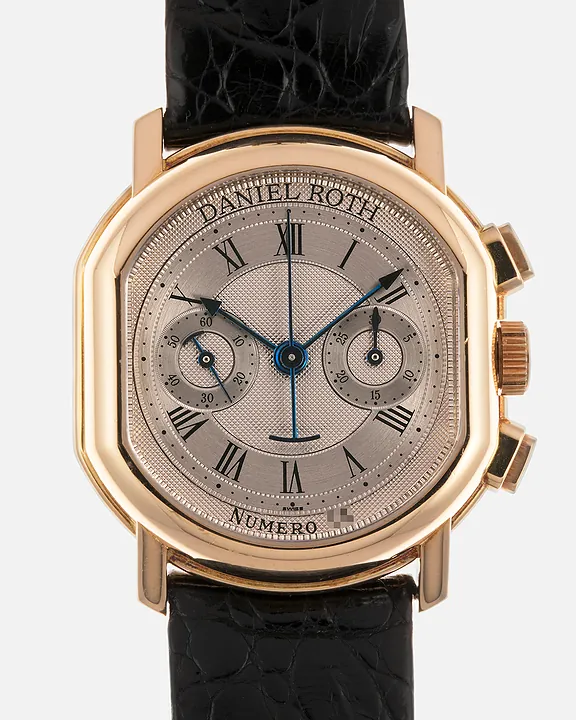
Daniel Roth Chronograph Lemania 2147 Clous De Paris, 1990s
S.Song Watches (dealer), Seattle
Wristwatches · 1990s
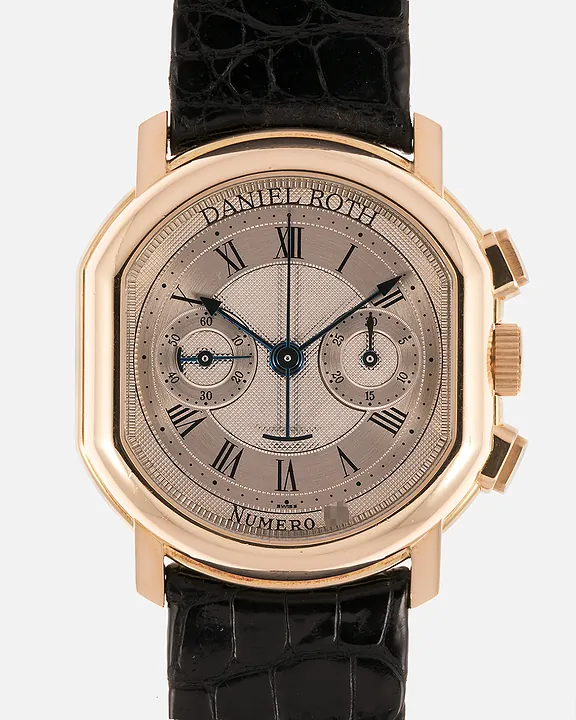
Daniel Roth Chronograph Lemania 2147 Clous De Paris, 1990s
S.Song Watches (dealer), Seattle
Wristwatches · 2025
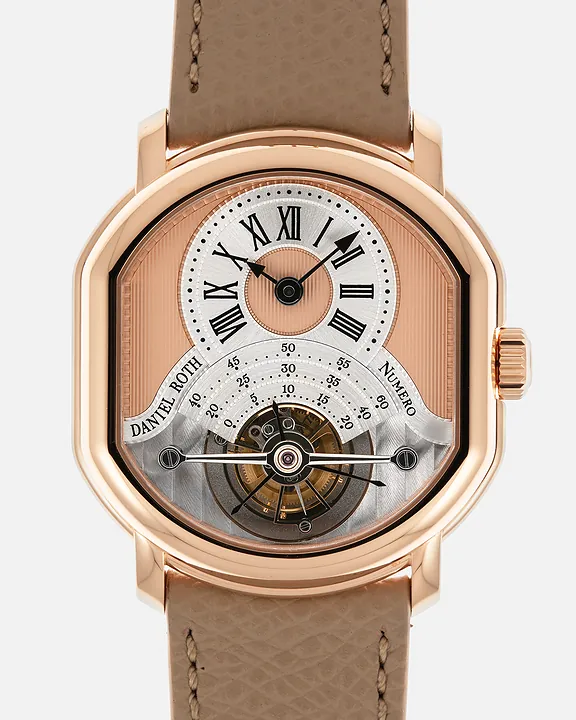
Daniel Roth Tourbillon Rose Gold DR 001, 2025
S.Song Watches (dealer), Seattle
Wristwatches · 1990s
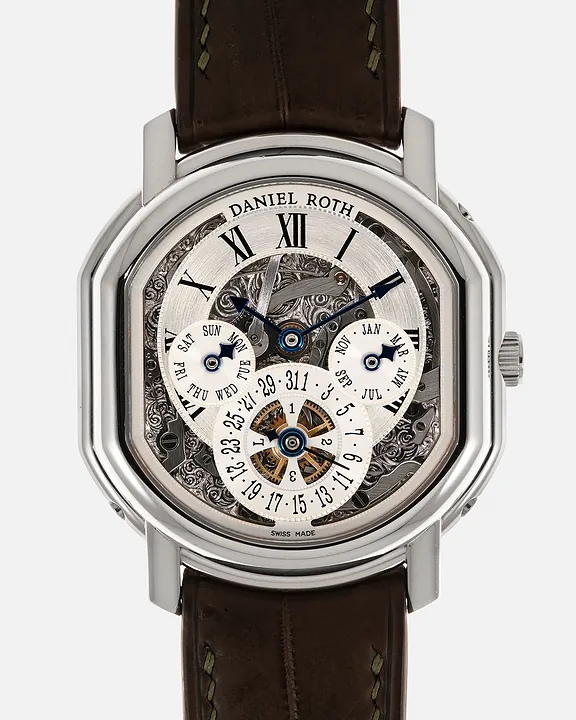
Daniel Roth Perpetual Calendar Skeleton 119.X.60 White Gold, 1990s
S.Song Watches (dealer), Seattle

Wristwatches · 2008
Wristwatch by Breitling?, 2008
Museum Rotterdam

Wristwatches · c. 1990s
Audemars Piguet Bamboo, c. 1990s
Antiquorum auction archive, Geneva

Wristwatches · c. 1990
Audemars Piguet Huitieme Perpetual Calendar, ref. 25696PT, c. 1990
Antiquorum auction archive, Geneva

Wristwatches · c. 1990
Breitling Chronomat, ref. b13050.1, c. 1990
Antiquorum auction archive, Geneva