
Wristwatches · Wristwatch
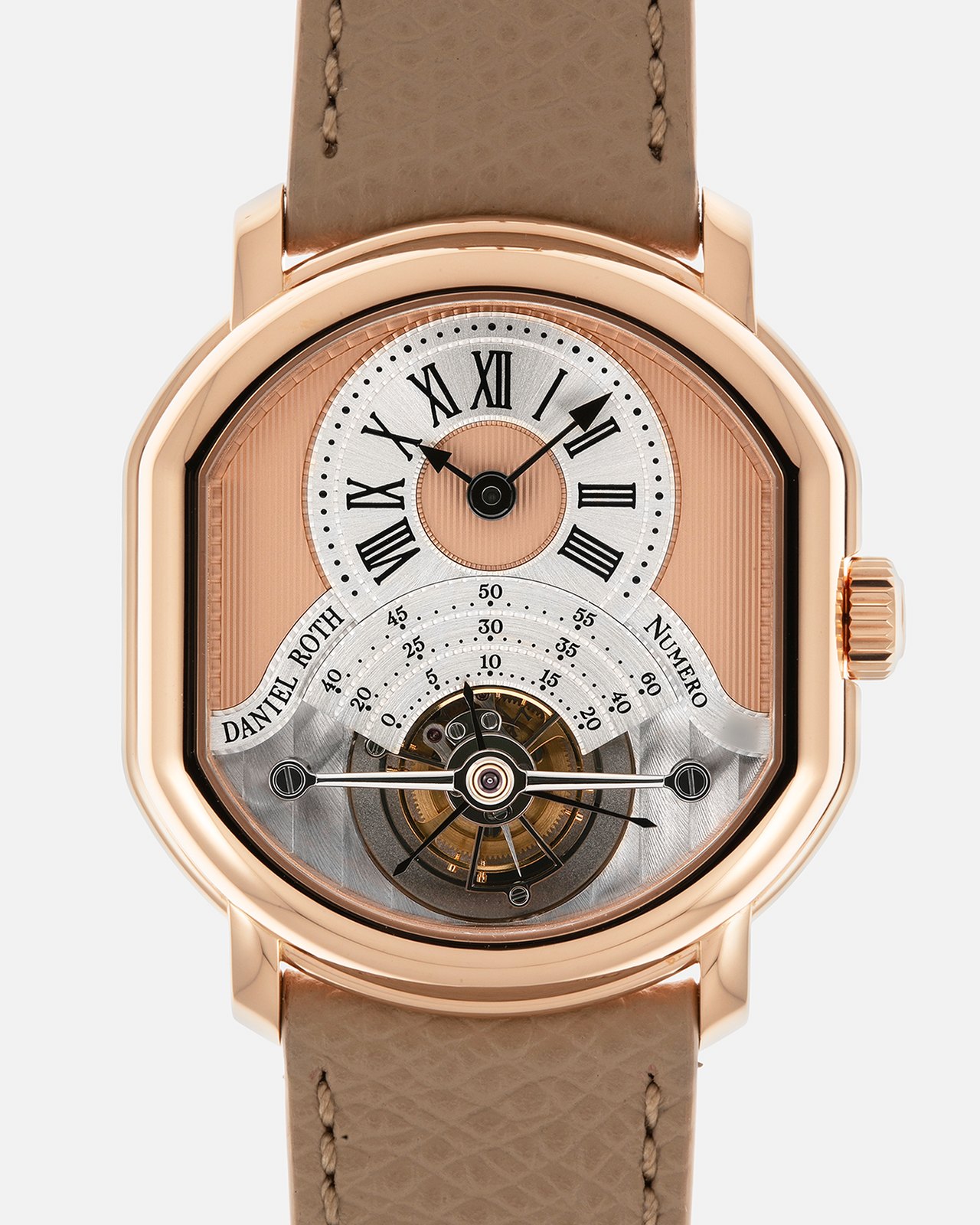
Daniel Roth Tourbillon Rose Gold DR 001, 2025
- Maker / attribution
- Daniel Roth (maker)
- Date
- 2025
- Historical period
- Contemporary Horology (2010 – Present)
- Country of origin
- Switzerland
- Object type
- Wristwatch
- Materials / technique
- rose gold
- Dimensions
- Case 35 mm
- Stock no.
- Product 7561606955095
- Credit line
- Dealer listing, S.Song Watches (product 7561606955095)
- Catalogue title (original)
- Daniel Roth Tourbillon Rose Gold DR 001 (English)
View the source record (dealer listing) ↗ (opens another website in a new tab)Suggest a correction
Record summary
Catalogued by S.Song Watches (dealer), Seattle (stock number Product 7561606955095), this is a wristwatch by Daniel Roth, made in Switzerland, dated 2025. The Atlas places it in the Contemporary Horology period (2010 – Present) of its Wristwatches collection. Materials and techniques recorded by the source: rose gold. Recorded dimensions: Case 35 mm. The record is illustrated with 6 photographs.
Assembled from the source record's structured fields. Dates and attributions are given as the source states them; where a field is missing the Atlas leaves it blank rather than estimating.
Catalogue description
Dealer description — S.Song Watches
When we think of modern independent watchmaking, names like Kari Voutilainen, Philippe Dufour, F.P. Journe, and Roger Smith often come to mind. Independent horology has grown so much in stature that owning at least one piece is now considered a hallmark of serious collecting. That being said, before this wave of recognition, there was Daniel Roth, a watchmaker who, in many ways, helped lay the foundation for today’s independent movement. To add some context, Daniel Roth was one of the most talented watchmakers of his generation and is responsible for many things we see in watchmaking today. For one, he was a leading figure who firmly established the design blueprint of the Breguet watches you see today. In the '60s and ’70s, Breguet had become a shadow of its former self with seemingly no future until it was acquired by Chaumet, who in turn brought in Daniel Roth to take the helm. The reference 3130, with its guilloché dial and straight-lugged case, set the tone for Breguet’s rebirth. Beyond design, Roth also contributed to the development of complex movements at Lemania, which, may I remind you, still supplied chronograph calibres to Patek Philippe and Vacheron Constantin until fairly recently. Daniel Roth’s history can be divided into three distinct eras: the uncompromising independent years, a transitional period under The Hour Glass, one of Asia’s largest watch retailers, and the post-founder chapter following its sale to Bulgari. The early independent watches remain the most collectable, defined by precious-metal construction and a level of quality that left little room for compromise. After The Hour Glass acquired a majority stake in 1995, execution became inconsistent, and although some attractive pieces occasionally emerged, the brand’s original clarity began to blur and was somewhat diluted. Bulgari’s later stewardship during the third and final era retained the ellipso-curvex case but scaled and stylised it beyond recognition, effectively severing the link to Roth’s original design language. Against this backdrop, a genuine revival of the Daniel Roth brand emerged in 2023, when LVMH, through its high-watchmaking manufacture La Fabrique du Temps Louis Vuitton in Geneva, reintroduced the name with the Tourbillon Souscription, a long-overdue course correction that reasserted Roth’s original proportions, discipline, and intent. The watch offered here, the Tourbillon Rose Gold, builds directly on that foundation. Conceived as a regular-production follow-up to the Souscription model, it faithfully preserves the original design and proportions while introducing subtle technical refinements, and most notably, a newly developed exhibition caseback that reveals the DR001 tourbillon movement in full (more on this later). The watch begins with its signature 35mm x 38mm ellipso-curvex rose gold case that has been thoughtfully refined for improved comfort and wearability. La Fabrique du Temps’ artistic director Matthieu Hegi noted that subtle adjustments were made to both the bezel-to-back ratio and the lug design, replacing the original’s angular forms with softly curved tips to improve wearability and create a more harmonious silhouette. The result is an exceptionally balanced case, with a presence that feels elegant and well- considered on any wrist. Encased within is a stunning dial produced by Comblémine SA, Voutilainen’s renowned high-end dial-making atelier. The layout closely mirrors the original: a hand-engraved pinstripe / vertical ligne guilloché base in 5N rose gold, topped by a satin silver sub-dial with Roman numerals. All markings, texts and numerals are finished in a glossy, contrasting black lacquer coating which enhances overall depth and legibility. Above the one-minute tourbillon at 6:00, a set of tri-layered plates serves as stepped seconds scales, with the three arm-like pointers of varying lengths mounted to the tourbillon carriage taking turns to indicate the seconds as time passes, in turn, creating a unique and captivating display. As briefly mentioned earlier, powering the Tourbillon Rose Gold from within is the newly developed DR001, a 19-jewel movement designed specifically to fit the ellipso-curvex case. The finishing is tastefully restrained and meticulously finished: Côtes de Genève adorn the large bridges with exquisite anglage on the edges, while perlage decorates the plates. The wheel driving the tourbillon is secured by a curved black-polished steel bridge between 3:00 and 4:00, with its pivot jewel set within a lustrous gold chaton. A linear winding click sits atop the barrel at 12:00, which is also black-polished. Thanks to the reworked case proportions, the movement sits noticeably closer to the exhibition caseback, offering an unhindered and immersive viewing experience, which I find extremely satisfying to look at. As for power reserve, the DR001 holds a charge of up to 80 hours on a full wind. As an avid follower of Daniel Roth’s work and legacy, it’s incredibly rewarding to see the brand finally return to form. With LVMH’s support, his work is finally receiving the admiration and recognition it’s long deserved. I also think this provides a fantastic opportunity for a new generation of collectors to engage with a truly remarkable work of mechanical horology. Having handled the originals myself, I can confidently say this iteration stands proudly alongside them.
Historical context
Contemporary Horology (2010 – Present)
Silicon components, connected watches, optical-lattice research clocks and a thriving independent scene.
Smartwatches became the world's best-selling watches, while mechanical watchmaking focuses on craft, innovation (silicon components, new escapements) and independent makers.
Read the period in the timelineMore wristwatches from this periodEarlier: Mechanical Renaissance
Atlas type guide
Wristwatches
Bracelet watches were worn by women from the early nineteenth century — Breguet made one for Caroline Murat, Queen of Naples, in 1810–12 — but the wristwatch only became a man's instrument with military use and aviation in the early twentieth century. Between the World Wars it overtook the pocket watch; the 1920s and 1930s brought rectangular Art Deco cases, water-resistant cases and the first automatic winding systems.
After 1945 the wristwatch became a carrier of identity — dress watches, sports and dive watches, chronographs, calendars — produced by Swiss, American, Japanese, German, Soviet and Chinese industries. The quartz revolution after 1969 and the mechanical renaissance since the 1990s, including the rise of independent watchmakers, complete the story.
What to look for
- The reference number (between the lugs or inside the case back) and serial number, the starting point for dating.
- The calibre: its maker and number are often stamped under the dial or on the bridge.
- Originality of dial, hands and crown — refinished ('redial') dials are common.
- Case material marks: 18K/750, 14K/585, stainless steel, gold-filled, plated.
Dating clues
- Wire-lug cases: before c. 1925.
- Water-resistant screw-down cases: from 1926.
- Quartz movements: from 1969; sapphire crystals widespread after c. 1980.
General guidance written by the Atlas editors about this kind of object. It is not a statement about this particular piece; for that, rely on the source record above and on physical examination.
Related records
Wristwatches · 2001
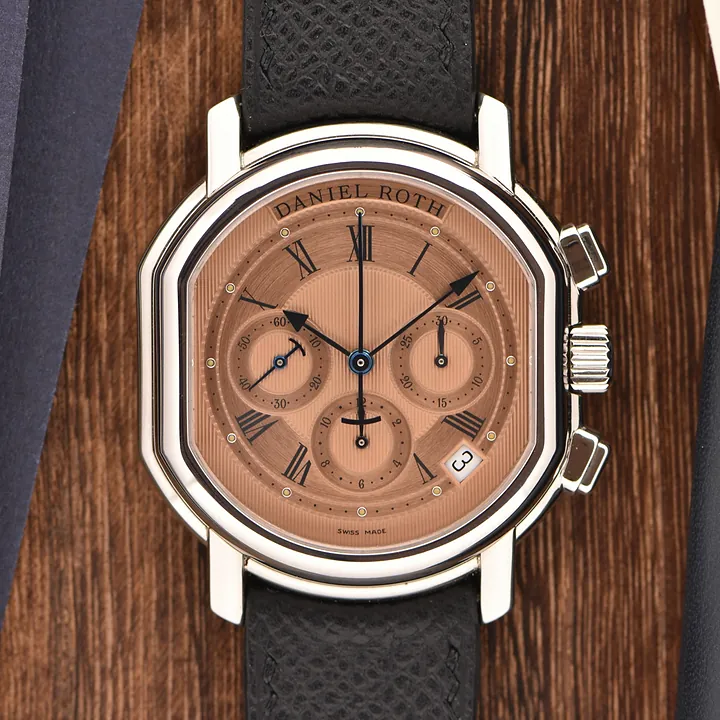
Daniel Roth Masters Chronograph Salmon, 2001
Huntington Company (dealer)
Wristwatches · 1990s
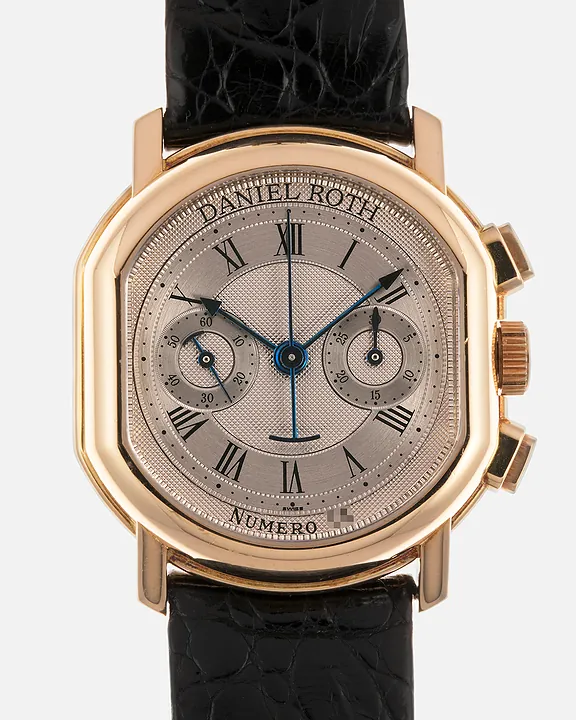
Daniel Roth Chronograph Lemania 2147 Clous De Paris, 1990s
S.Song Watches (dealer), Seattle
Wristwatches · 1990s
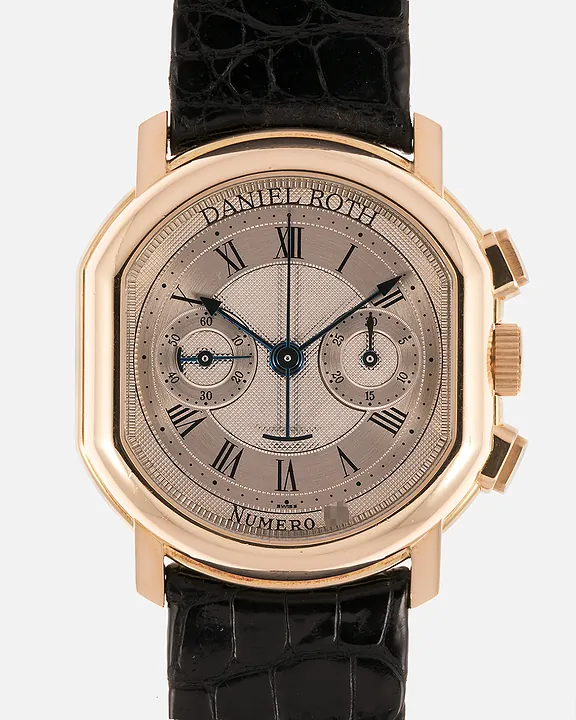
Daniel Roth Chronograph Lemania 2147 Clous De Paris, 1990s
S.Song Watches (dealer), Seattle
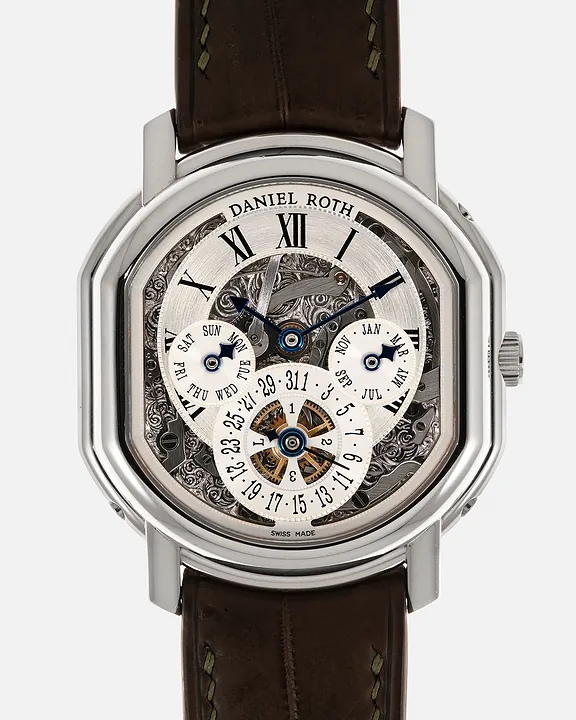
Wristwatches · 1990s
Daniel Roth Perpetual Calendar Skeleton 119.X.60 White Gold, 1990s
S.Song Watches (dealer), Seattle

Wristwatches · c. 2010s
Breguet Type XXI, ref. 3810, c. 2010s (Antiquorum Lot 381-24)
Antiquorum auction archive, Geneva

Wristwatches · c. 2010s
Breguet Type XXI, ref. 3810, c. 2010s (Antiquorum Lot 386-229)
Antiquorum auction archive, Geneva

Wristwatches · Sold in September 2010
Breitling Cosmonaute, ref. A 22322, Sold in September 2010
Antiquorum auction archive, Geneva

Wristwatches · c. 2010
Corum Bubble Chrono, ref. 396.150.20, c. 2010
Antiquorum auction archive, Geneva