
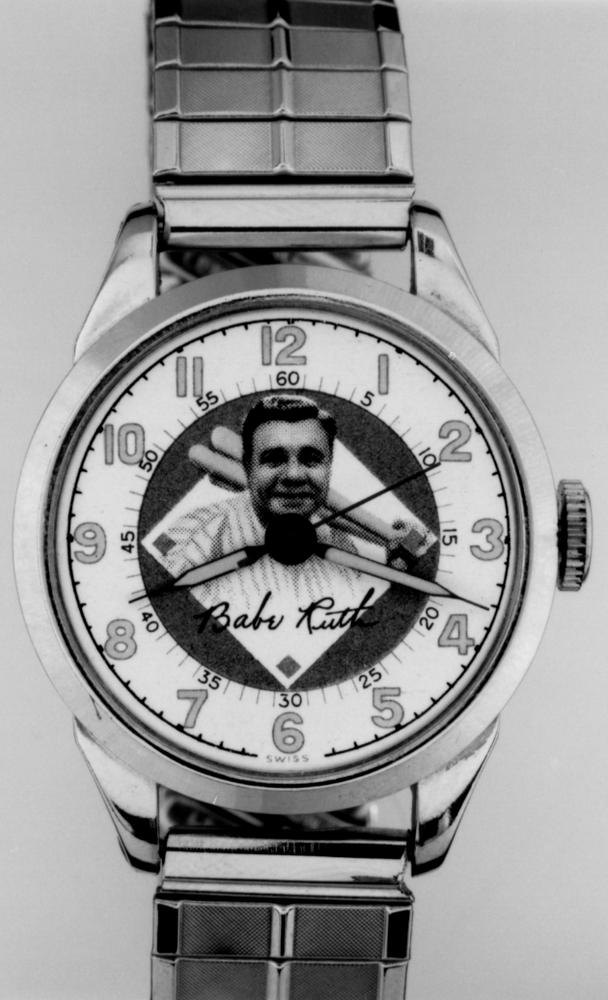
Wristwatches · Centre-seconds watch
Chrome-plated cased pin-pallet lever centre-seconds wrist-watch with expanding bracelet strap
- Maker / attribution
- Exacta Time Corporation (Made by)
- Date
- 1947–1953
- Historical period
- Modern Mechanical Horology (1945 – 1969)
- Country of origin
- Switzerland
- Place
- Switzerland, United States
- Object type
- Centre-seconds watch
- Materials / technique
- chromium, stainless steel, polystyrene
- Dimensions
- Diameter: 32.30 millimetres (bezel) Diameter: 76 millimetres (presentation case)
- Holding institution
- British Museum
- Accession / object no.
- 1983,1012.191
- Credit line
- British Museum, London
- Catalogue title (original)
- Chrome-plated cased pin-pallet lever centre-seconds wrist-watch with expanding bracelet strap (English)
View the source record ↗ (opens another website in a new tab)Suggest a correction
Record summary
Held and catalogued by British Museum (object number 1983,1012.191), this is a centre-seconds watch by Exacta Time Corporation, made in Switzerland, United States, dated 1947–1953. The Atlas places it in the Modern Mechanical Horology period (1945 – 1969) of its Wristwatches collection. Materials and techniques recorded by the source: chromium, stainless steel, polystyrene. Recorded dimensions: Diameter: 32.30 millimetres (bezel) Diameter: 76 millimetres (presentation case). The record is illustrated with 3 photographs.
Assembled from the source record's structured fields. Dates and attributions are given as the source states them; where a field is missing the Atlas leaves it blank rather than estimating.
Catalogue description
Description — British Museum
Centre-seconds wrist-watch. 3/4 plate movement with pin-pallet lever escapement. Printed card dial with Arabic hour numerals and minutes numbered every fifth division; at centre, within green circle is portrait of Babe Ruth holding three baseball bats with signature below. Hour, minute and centre-seconds hands. Chromium-plated case with snap-on stainless steel back. Chromium-plated expanding bracelet. Complete with original presentation case in form of baseball.
Curator's comments — British Museum
Comment from Richard Good, Catalogue of Watches in the British Museum. Vol. V (Unpublished manuscript) Maker anonymous Switzerland, c. 1960 "Babe Ruth" keyless wound wrist watch with pin pallet lever escapement. Signature: On the dial 'Babe Ruth' and 'SWISS'. On the movement back plate 'EXACTA TIME CORP and SWISS ONE 1 JEWEL UNADJUSTED' Case: A chrome plated two piece case with a snap on bezel. In the case back 'SWISS MADE' The case has spring bars and is complete with a chrome plated bracelet. With the watch is a presentation box shaped as a base ball and separating in the middle. The "seams' are decorated with red chevrons to simulate stitching and the ball is inscribed also in red 'OFFICIAL Babe Ruth WRIST WATCH SPORTS WATCH OF CHAMPIONS'. Dial and Hands: At the dial centre is a polychrome portrait of Babe Ruth with three baseball bats. The centre seconds hand is red and there are blued steel luminised skeletonised hands. The dial is secured by screws one at 12 o'clock and one at 6 o'clock. Movement: Ebauche marks: On the inside of the front plate is Brac in an oval cartouche and the number 40. Frame: Nickel silver plates, the back plate is supported by three pillars and secured by four screws, it covers the train and the barrel, there is a cock for the pallets and one for the balance. Barrel and mainspring: A going barrel with a steel cover which carries a slipping minute wheel. Barrel I diameter 15.8 mm., height 1.5 mm. Mainspring height 1.3 mm., thickness 0.15 mm. Arbor: Diameter 4.05 mm., snailed. Hooking: Pressed from the barrel wall. Train Wheels: not gilded the centre third and centre seconds wheels with 5 crossings the escape wheel with four. Jewelled: One jewel only; a ruby endstones in the balance cock. The jewel pressed in. Escapement: A pin pallet lever escapement with an obtuse angle layout. A long lever. Effectively a double roller with a brass impulse finger. The lever is brass and the pallet pins are steel. The escape wheel is brass with four crossings. An equidistant locking escapement. The number of teeth embraced 4 ½. Balance and Spring: A monometallic balance of brass with three arms. Balance diameter 10.6 mm., thickness 0.56 mm. A Ni-Span C balance spring with 9 ¼ turns. Means of regulation: An index on the balance cock registers against a centre mark and a + and -. Train Counts and Beat Rate: Great wheel (barrel) 112 (rotates once in four hours) Second wheel 84 pinion 7 Third wheel 60 pinion 7 Centre seconds wheel 48 Escape wheel 18 pinion 6 Beat rate 18,000 Motion work: cannon pinion 12, minute wheel 48, minute pinion 14, hour wheel 42. Winding system: Conventional positive set keyless work. Dimensions: The ball diameter is 75 mm. Case diameter 32.5 mm., height 12.3 mm., over the glass. Movement diameter 30.0 mm., height 7.3 mm. Provenance: Donated by the Heron Corporation Ltd. in 1983.
Inscriptions & marks
inscription; SWISS EXACTA TIME CORP ONE 1 JEWEL UNADJUSTED [movement]; inscription; LENDX SNAP-O-MAT [bracelet]; signature; Babe Ruth [dial]
Provenance
Donated by:, Heron Corporation
Historical context
Modern Mechanical Horology (1945 – 1969)
Tool watches for divers, pilots and astronauts; electric watches anticipate the electronic age.
The classic era of the mechanical wristwatch: dive watches, chronographs for motor racing and space flight, GMT watches for jet travel, slim dress watches, automatic calendars, and the rise of Japanese manufacturers alongside Swiss, American, German and Soviet industries.
Read the period in the timelineMore wristwatches from this periodEarlier: Golden Age of Mechanical Watchmaking
Atlas type guide
Wristwatches
Bracelet watches were worn by women from the early nineteenth century — Breguet made one for Caroline Murat, Queen of Naples, in 1810–12 — but the wristwatch only became a man's instrument with military use and aviation in the early twentieth century. Between the World Wars it overtook the pocket watch; the 1920s and 1930s brought rectangular Art Deco cases, water-resistant cases and the first automatic winding systems.
After 1945 the wristwatch became a carrier of identity — dress watches, sports and dive watches, chronographs, calendars — produced by Swiss, American, Japanese, German, Soviet and Chinese industries. The quartz revolution after 1969 and the mechanical renaissance since the 1990s, including the rise of independent watchmakers, complete the story.
What to look for
- The reference number (between the lugs or inside the case back) and serial number, the starting point for dating.
- The calibre: its maker and number are often stamped under the dial or on the bridge.
- Originality of dial, hands and crown — refinished ('redial') dials are common.
- Case material marks: 18K/750, 14K/585, stainless steel, gold-filled, plated.
Dating clues
- Wire-lug cases: before c. 1925.
- Water-resistant screw-down cases: from 1926.
- Quartz movements: from 1969; sapphire crystals widespread after c. 1980.
General guidance written by the Atlas editors about this kind of object. It is not a statement about this particular piece; for that, rely on the source record above and on physical examination.
Read next:Identification Centre
Related records

Wristwatches · 1945
Wristwatch by Eterna, 1945
Museum Rotterdam

Wristwatches · c. 1945
Breitling Premier, ref. 790, c. 1945
Antiquorum auction archive, Geneva

Wristwatches · c. 1945
Universal Genève Uni-Compax, ref. 22492, c. 1945
Antiquorum auction archive, Geneva

Wristwatches · c. 1950s
Baume & Mercier wristwatch, c. 1950s
Antiquorum auction archive, Geneva
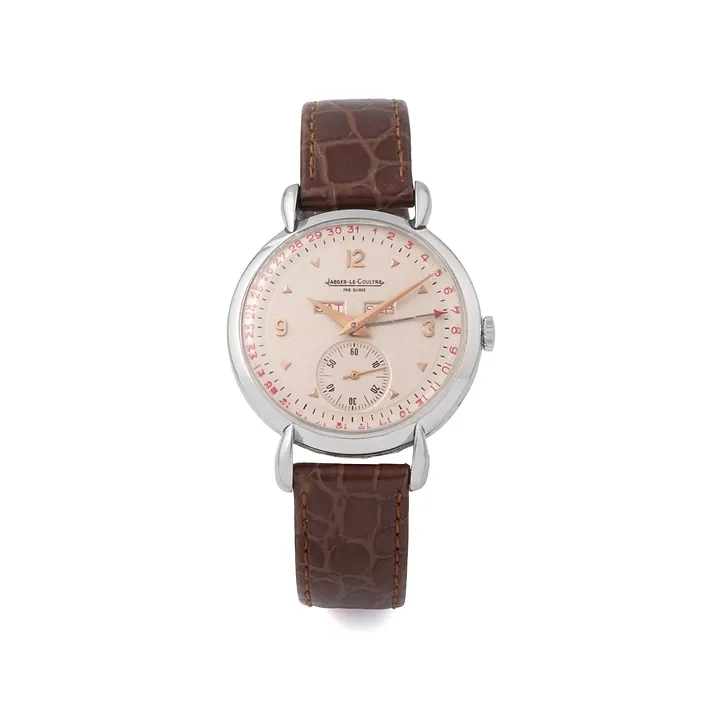
Wristwatches · c. 1950
Jaeger Lecoultre Triple Calendar, c. 1950
Antiquorum auction archive, Geneva
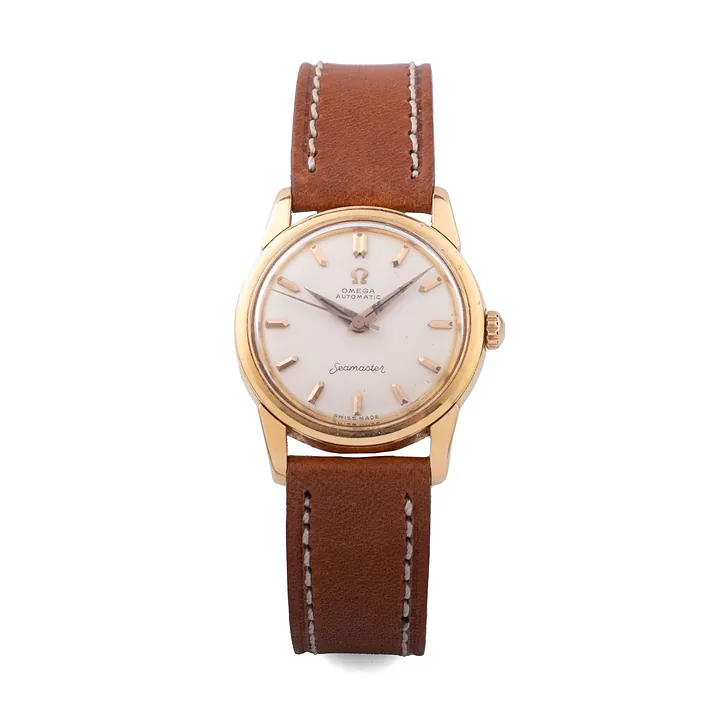
Wristwatches · c. 1950
Omega Seamaster Automatic, ref. 2991-1, c. 1950
Antiquorum auction archive, Geneva
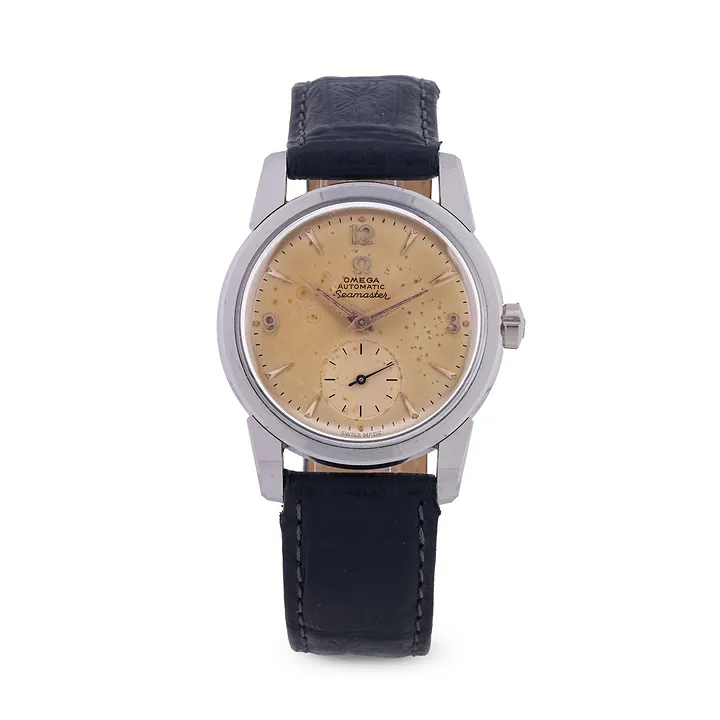
Wristwatches · c. 1950s
Omega Seamaster, ref. 2848, c. 1950s
Antiquorum auction archive, Geneva
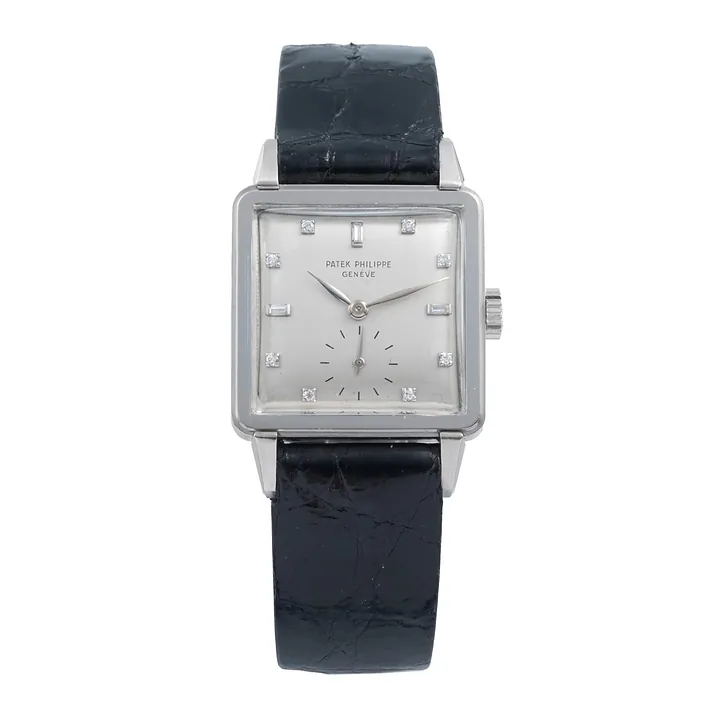
Wristwatches · 1950, sold in May 1951
Patek Philippe wristwatch, ref. 2422, 1950, sold in May 1951
Antiquorum auction archive, Geneva