
Wristwatches · Wristwatch
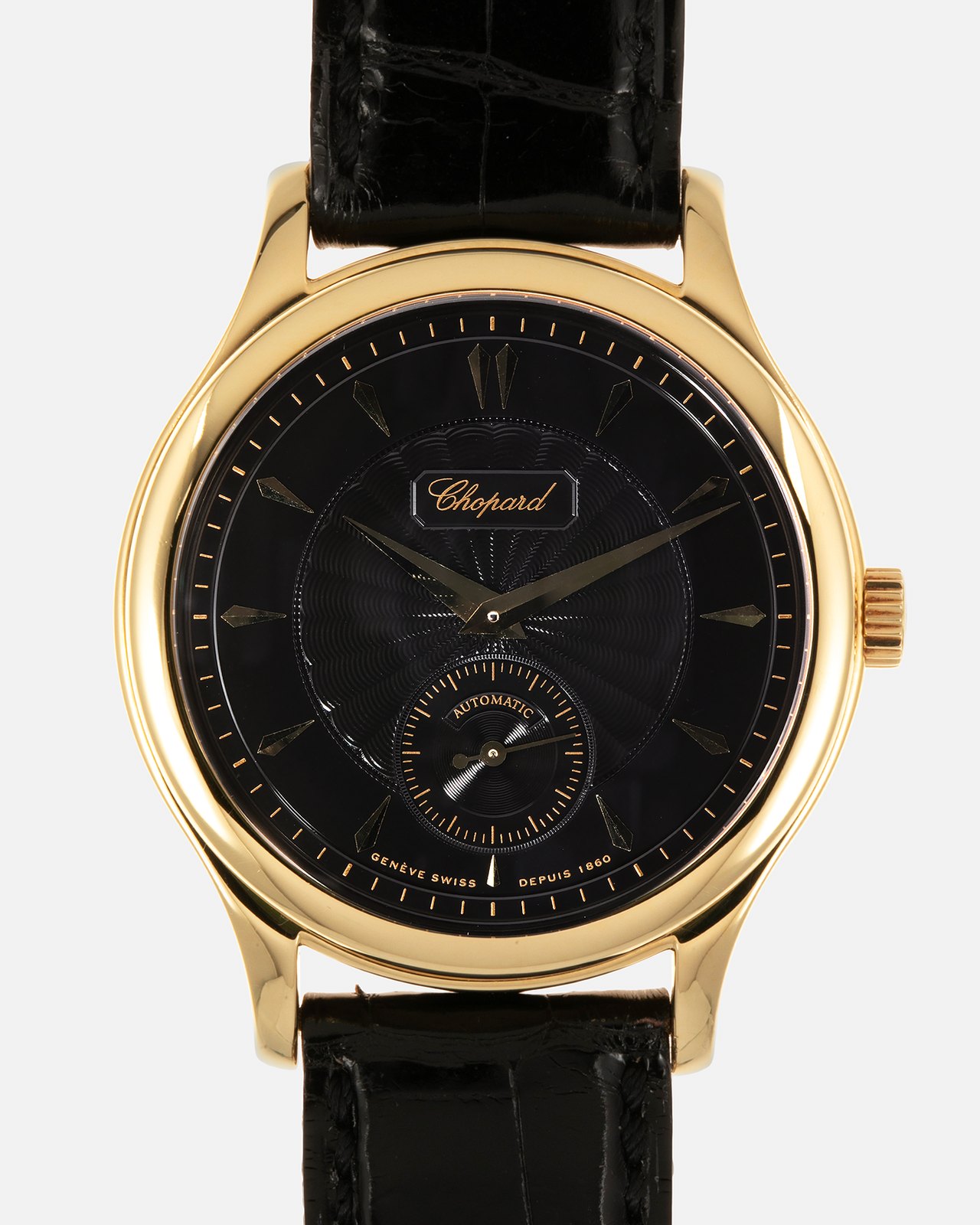
Chopard LUC 16/1860/2 Prototype No Date Dial, 1990s
- Maker / attribution
- Chopard (maker)
- Date
- 1990s
- Historical period
- Mechanical Renaissance (1990 – 2010)
- Country of origin
- Switzerland
- Object type
- Wristwatch
- Dimensions
- Case 37 mm
- Stock no.
- Product 7112956248151
- Credit line
- Dealer listing, S.Song Watches (product 7112956248151)
- Catalogue title (original)
- Chopard LUC 16/1860/2 Prototype No Date Dial (English)
View the source record (dealer listing) ↗ (opens another website in a new tab)Suggest a correction
Record summary
Catalogued by S.Song Watches (dealer), Seattle (stock number Product 7112956248151), this is a wristwatch by Chopard, made in Switzerland, dated 1990s. The Atlas places it in the Mechanical Renaissance period (1990 – 2010) of its Wristwatches collection. Recorded dimensions: Case 37 mm. The record is illustrated with 6 photographs.
Assembled from the source record's structured fields. Dates and attributions are given as the source states them; where a field is missing the Atlas leaves it blank rather than estimating.
Catalogue description
Dealer description — S.Song Watches
Let’s begin by saying that to many, Chopard is predominantly seen as a jewelry house and not really thought of as a serious horological manufacture. There are reasons for this of course, with questionable watch designs over the years, it was always going to be an uphill battle. That being said, after you’re done reading this, you will see why the Chopard 16/1860/2 is anything of the aforementioned and one of the most revered watches to those who are in the know. Beginning with some historical context, the ’90s was seen as a period of recovery, where watch companies were still wary of the devastating quartz crisis that decimated the industry in the ’80s and as a result, remained largely conservative. Most houses were content using movements that had existed for decades from suppliers such as Valjoux, Lemania, and ETA. Bar a few outliers, it was just not the time to go wild. Relative to this, Chopard was looking to launch itself as a serious watchmaking house and began in 1993 with the help of independent watchmaker, Michel Parmigiani. As a testament to how seriously they were taking this undertaking, it wasn’t until 1996 that they felt ready to launch their high-end watchmaking line- the manufacture L.U.C. The 16/1860/2 you see here today is the first watch released by Chopard L.U.C. and it was universally praised when it came out. With a brand new in-house movement, it was described by Walt Odets on Timezone as ‘probably the finest automatic movement being produced in Switzerland today’. There are several things that make this watch impressive, with the Cal. 1.96 being at the top of that list. Just taking a single look at it, even a layman would be able to see how beautiful it is. It is evident that Chopard made no shortcuts when it came to this movement as the Cal. 1.96 is one of the most beautifully finished movements of its era. With a stunningly engraved 22-carat gold micro-rotor, thick hand bevelling throughout, and deep Côtes de Genève (Geneva stripes) all over, even Philippe Dufour rated Chopard only second to A. Lange & Söhne in terms of finishing at the time. Not only was the Cal. 1.96 masterfully decorated, but it was also technically a marvel. With a 70-hour power reserve from two stacked mainspring barrels, it also featured a Breguet overcoil hairspring and a swan neck regulator, all contributing towards its precision and power dispersion. The most comparable movement to the Cal. 1.96 would have to be the ever-trusty Patek Philippe Cal. 240. While that movement is historically important and impressive nonetheless, when comparing the two side by side, I think there is no contest as to who comes out on top. As a cherry on top, not only is this Chopard COSC ( Contrôle Officiel Suisse des Chronomètres ) certified, but it also bears the hallowed Poincon de Genève (Geneva Seal). Flipping the watch over, there is a strong resemblance to a certain Dufour Simplicity and that is because the 16/1860/2 dial was produced by Metelem, the same Swiss dial manufacturer that produced dials for the Simplicity. The beautiful hand engine-turned dial is stepped, made of gold and features a beautiful central guilloché pattern that reflects light beautifully. While this is enough to make any collector excited, what makes this particular example perhaps the most special 16/1860 ever may not be immediately obvious to most. You see, all 16/1860s come with a date window, which many purists would find unnecessary. What you see here, does not have a date window and is believed to be the only 16/1860 without one. Originally fitted with a silver dial, when this watch went back to service with Chopard, under unknown circumstances, the manufacture allowed this example to be refitted with a new old stock black prototype dial. I do believe they were experimenting back when Chopard was developing the watch and toyed with the idea of having a no-date model. This prototype dial is historically important and an interesting insight into the experimentations of the LUC manufacture in the 1990’s. I really do think that the 16/1860/2 is one of the most underrated and forgotten dress watches out there, perhaps because from photos it just looks like any other ordinary dress watch. With an impeccable case size of 37mm, excellent overall proportions, as well as its rarity with only 1860 pieces ever made in yellow gold, and with this particular example featuring a unique prototype no-date black dial (again, the only one in the world), it really doesn’t get any better than this. It could very well make a compelling case for it to be considered one of the greatest dress watches ever created. Period.
Historical context
Mechanical Renaissance (1990 – 2010)
Mechanical watches return as cultural objects; independent watchmaking flourishes.
Mechanical watches returned as cultural and luxury objects. Complications, tourbillons and new materials proliferated; independent watchmakers such as George Daniels, F.P. Journe and Philippe Dufour revived artisanal watchmaking; collecting vintage watches became a major field.
Read the period in the timelineMore wristwatches from this periodEarlier: Quartz Revolution
Atlas type guide
Wristwatches
Bracelet watches were worn by women from the early nineteenth century — Breguet made one for Caroline Murat, Queen of Naples, in 1810–12 — but the wristwatch only became a man's instrument with military use and aviation in the early twentieth century. Between the World Wars it overtook the pocket watch; the 1920s and 1930s brought rectangular Art Deco cases, water-resistant cases and the first automatic winding systems.
After 1945 the wristwatch became a carrier of identity — dress watches, sports and dive watches, chronographs, calendars — produced by Swiss, American, Japanese, German, Soviet and Chinese industries. The quartz revolution after 1969 and the mechanical renaissance since the 1990s, including the rise of independent watchmakers, complete the story.
What to look for
- The reference number (between the lugs or inside the case back) and serial number, the starting point for dating.
- The calibre: its maker and number are often stamped under the dial or on the bridge.
- Originality of dial, hands and crown — refinished ('redial') dials are common.
- Case material marks: 18K/750, 14K/585, stainless steel, gold-filled, plated.
Dating clues
- Wire-lug cases: before c. 1925.
- Water-resistant screw-down cases: from 1926.
- Quartz movements: from 1969; sapphire crystals widespread after c. 1980.
General guidance written by the Atlas editors about this kind of object. It is not a statement about this particular piece; for that, rely on the source record above and on physical examination.
Related records
Wristwatches · Sold on 23 Jun 1998
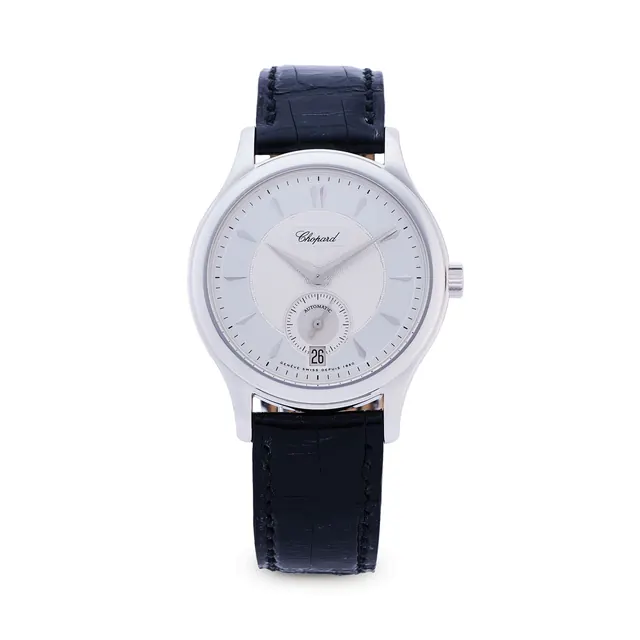
Chopard wristwatch, ref. 16/91860/2, L.U.c. 1860 Guilloche Dial, Sold on 23 Jun 1998
Antiquorum auction archive, Geneva
Wristwatches · c. 2000s
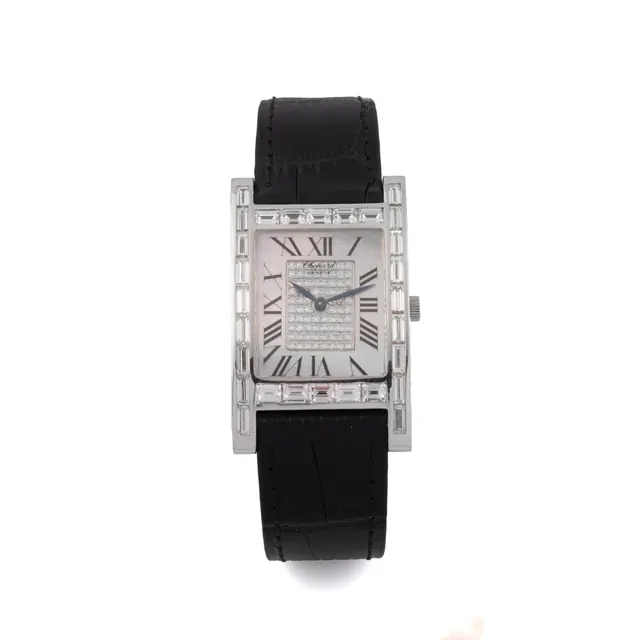
Chopard wristwatch, ref. 471, Your Hour Mop Dial, circa 2000's
Antiquorum auction archive, Geneva
Wristwatches · 2017
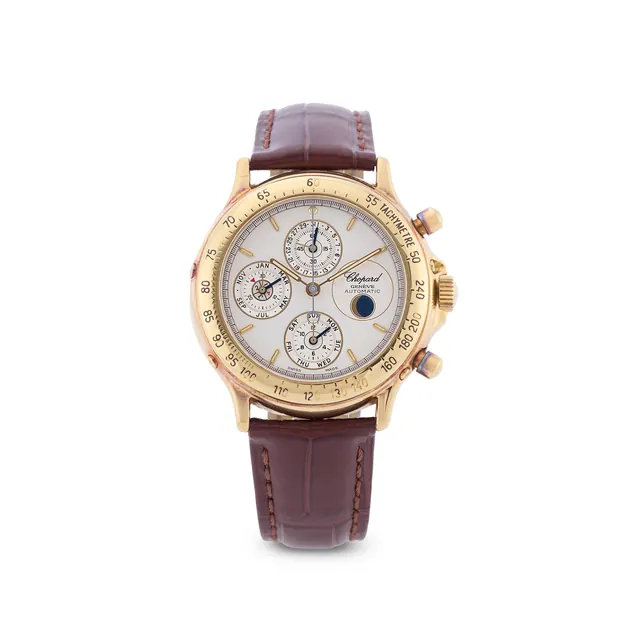
Chopard wristwatch, ref. 36/1208, Classic Perpetual Calendar Limited 12/50, Sold in June, 2017
Antiquorum auction archive, Geneva
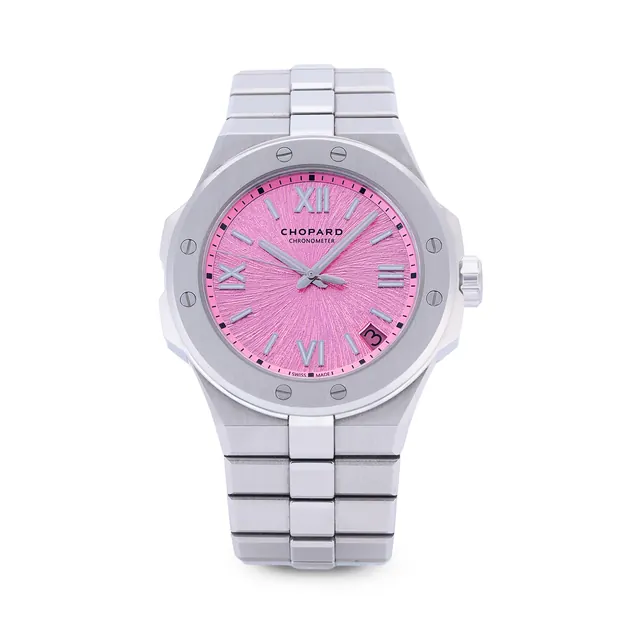
Wristwatches · c. 2024
Chopard wristwatch, ref. 298600-3022, Alpine Eagle, circa 2024
Antiquorum auction archive, Geneva

Wristwatches · 2008
Wristwatch by Breitling?, 2008
Museum Rotterdam

Wristwatches · c. 1990s
Audemars Piguet Bamboo, c. 1990s
Antiquorum auction archive, Geneva

Wristwatches · c. 1990
Audemars Piguet Huitieme Perpetual Calendar, ref. 25696PT, c. 1990
Antiquorum auction archive, Geneva

Wristwatches · c. 1990
Breitling Chronomat, ref. b13050.1, c. 1990
Antiquorum auction archive, Geneva