
Wristwatches · Wristwatch
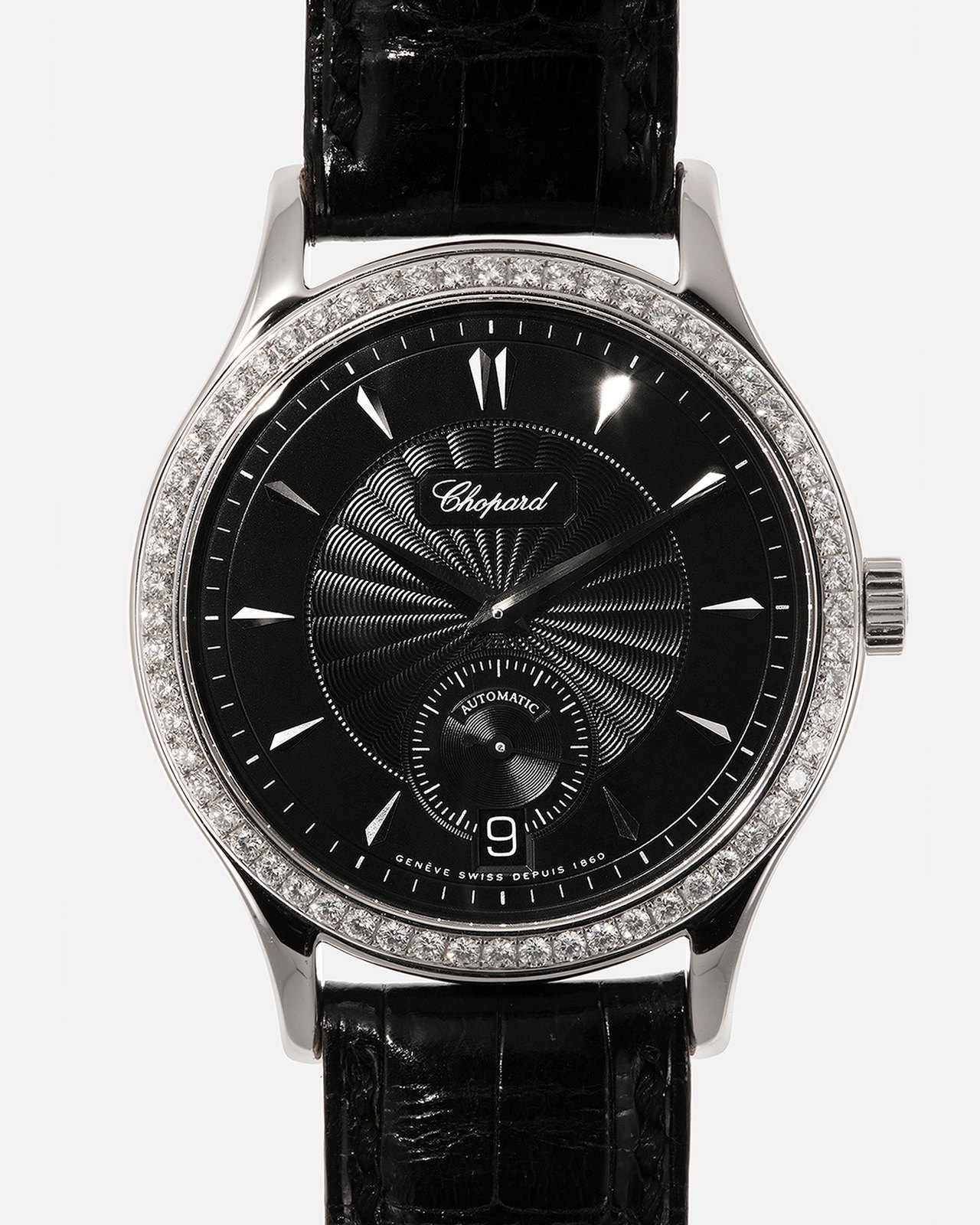
Chopard L.U.C. 17/1860/2 White Gold Black Dial Diamonds, 1990s
- Maker / attribution
- Chopard (maker)
- Date
- 1990s
- Historical period
- Mechanical Renaissance (1990 – 2010)
- Country of origin
- Switzerland
- Object type
- Wristwatch
- Materials / technique
- white gold
- Dimensions
- Case 37 mm
- Stock no.
- Product 7652930846807
- Credit line
- Dealer listing, S.Song Watches (product 7652930846807)
- Catalogue title (original)
- Chopard L.U.C. 17/1860/2 White Gold Black Dial Diamonds (English)
View the source record (dealer listing) ↗ (opens another website in a new tab)Suggest a correction
Record summary
Catalogued by S.Song Watches (dealer), Seattle (stock number Product 7652930846807), this is a wristwatch by Chopard, made in Switzerland, dated 1990s. The Atlas places it in the Mechanical Renaissance period (1990 – 2010) of its Wristwatches collection. Materials and techniques recorded by the source: white gold. Recorded dimensions: Case 37 mm. The record is illustrated with 6 photographs.
Assembled from the source record's structured fields. Dates and attributions are given as the source states them; where a field is missing the Atlas leaves it blank rather than estimating.
Catalogue description
Dealer description — S.Song Watches
Let’s begin by saying that, to many, Chopard is predominantly seen as a jewellery house and not really thought of as a credible horological manufacture. There are reasons for this, of course, as questionable watch designs over the years made it an uphill battle from the outset. That being said, after you’re done reading this, you will see why the early L.U.C 1860 series is anything but the aforementioned, and is now considered by many as one of the most acclaimed and beautifully executed dress watch lines of its era. Beginning with some historical context, the 1990s marked a period of cautious recovery for Swiss watchmaking. The industry was still reeling from the quartz crisis that nearly decimated it in the ‘80s, and most manufacturers relied on proven calibres from suppliers like Valjoux, Lemania, and ETA. Few dared to invest heavily in in-house development. Against this backdrop, Chopard set out to prove its horological credibility. With guidance from renowned independent watchmaker Michel Parmigiani, the brand began developing a new movement in 1993. Three years later, in 1996, it launched the L.U.C Manufacture and, with it, the debut 1860 series. The L.U.C 1860 made an immediate impression and garnered widespread praise. Its in-house Cal. 1.96 was a revelation, described by respected watchmaker and renowned movement critic Walt Odets on TimeZone as “the finest automatic movement being produced in Switzerland today”. That praise was well earned. Even by modern standards, the Cal. 1.96 remains one of the most beautifully finished movements of its period. Its execution reflects the level of care invested in its development. The movement features a stunning 22-carat engraved gold micro-rotor, mirror-polished bevels, and deep Côtes de Genève (Geneva Stripes) finishing throughout. Even Philippe Dufour once ranked Chopard second only to A. Lange & Söhne for finishing quality during those years. Not only was the Cal. 1.96 masterfully decorated, but it was also a technical marvel. With a 70-hour power reserve from two stacked mainspring barrels, it also featured a Breguet overcoil hairspring and a swan neck regulator, all contributing to its refinement and chronometric performance. The natural point of comparison is the venerable Patek Philippe Cal. 240 micro-rotor. While that calibre is historically important and impressive in its own right, comparing the two side by side leaves little room for debate. As a cherry on top, not only is this Chopard COSC ( Contrôle Officiel Suisse des Chronomètres ) certified, but it also bears the hallowed Poinçon de Genève (Geneva Seal). The reference offered here, the 17/1860/2, is effectively the diamond-set counterpart to the standard 16/1860/2. Aside from its factory-set diamond bezel, it retains the same Cal. 1.96 movement and case architecture, though examples fitted with both the black dial and diamond bezel appear to be exceptionally uncommon. Turning to its mysterious black dial, the 17/1860/2 recalls the quiet elegance of a Dufour Simplicity, albeit with a slightly more expressive character. Produced by Metalem, the same dial maker behind the famous Simplicity, it features an intricate hand-turned guilloché center framed by a clean stepped design, faceted applied hour markers, and a color-matching date wheel. The factory diamond-set bezel, however, fundamentally alters the character of the watch. Rather than overwhelming it, the diamonds frame the black dial remarkably well, adding just enough brilliance and contrast without disrupting the watch’s underlying restraint. It feels less like jewellery masquerading as horology and more like a genuinely cohesive expression of both disciplines, which is perhaps fitting for a brand like Chopard. It’s also worth noting that while Chopard officially limited the 1860 series to 1,860 pieces per metal, it’s widely believed that far fewer were actually produced, likely only a few hundred of each variant. While diamond-set dress watches from this period can often feel excessive or dated, this particular configuration avoids that entirely. The monochromatic palette keeps everything cohesive, while the brilliance of the bezel contrasts strikingly against the textured black guilloché dial. The result is a watch that feels simultaneously elegant, slightly theatrical, and unmistakably neo-vintage in the best possible way. That said, I truly believe the early L.U.C 1860 remains one of the most overlooked Chopard references. Its near-perfect 37mm x 8.5mm proportions make for an incredibly refined timepiece, while the Cal. 1.96 stands among the finest automatic movements of its generation. In the case of this 17/1860/2, that exceptional foundation is paired with Chopard’s jewellery heritage, creating a far more expressive interpretation of the standard model without sacrificing any of the watchmaking integrity that made the 1860 so compelling in the first place.
Historical context
Mechanical Renaissance (1990 – 2010)
Mechanical watches return as cultural objects; independent watchmaking flourishes.
Mechanical watches returned as cultural and luxury objects. Complications, tourbillons and new materials proliferated; independent watchmakers such as George Daniels, F.P. Journe and Philippe Dufour revived artisanal watchmaking; collecting vintage watches became a major field.
Read the period in the timelineMore wristwatches from this periodEarlier: Quartz Revolution
Atlas type guide
Wristwatches
Bracelet watches were worn by women from the early nineteenth century — Breguet made one for Caroline Murat, Queen of Naples, in 1810–12 — but the wristwatch only became a man's instrument with military use and aviation in the early twentieth century. Between the World Wars it overtook the pocket watch; the 1920s and 1930s brought rectangular Art Deco cases, water-resistant cases and the first automatic winding systems.
After 1945 the wristwatch became a carrier of identity — dress watches, sports and dive watches, chronographs, calendars — produced by Swiss, American, Japanese, German, Soviet and Chinese industries. The quartz revolution after 1969 and the mechanical renaissance since the 1990s, including the rise of independent watchmakers, complete the story.
What to look for
- The reference number (between the lugs or inside the case back) and serial number, the starting point for dating.
- The calibre: its maker and number are often stamped under the dial or on the bridge.
- Originality of dial, hands and crown — refinished ('redial') dials are common.
- Case material marks: 18K/750, 14K/585, stainless steel, gold-filled, plated.
Dating clues
- Wire-lug cases: before c. 1925.
- Water-resistant screw-down cases: from 1926.
- Quartz movements: from 1969; sapphire crystals widespread after c. 1980.
General guidance written by the Atlas editors about this kind of object. It is not a statement about this particular piece; for that, rely on the source record above and on physical examination.
Related records
Wristwatches · Sold on 23 Jun 1998
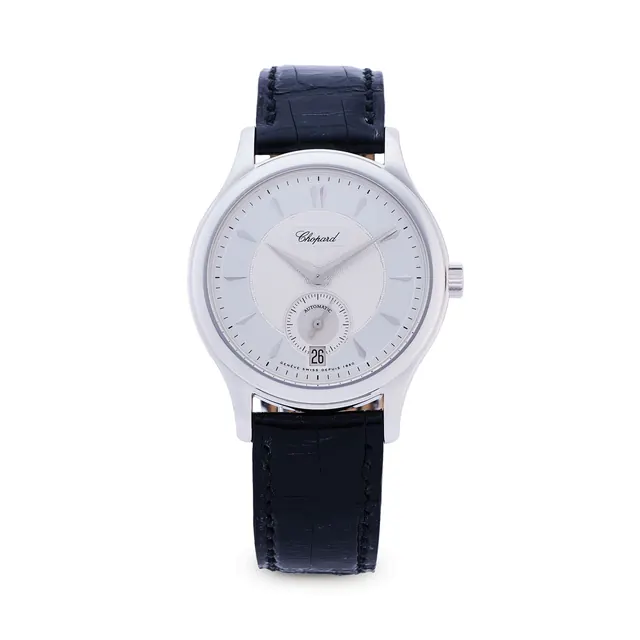
Chopard wristwatch, ref. 16/91860/2, L.U.c. 1860 Guilloche Dial, Sold on 23 Jun 1998
Antiquorum auction archive, Geneva
Wristwatches · c. 2000s
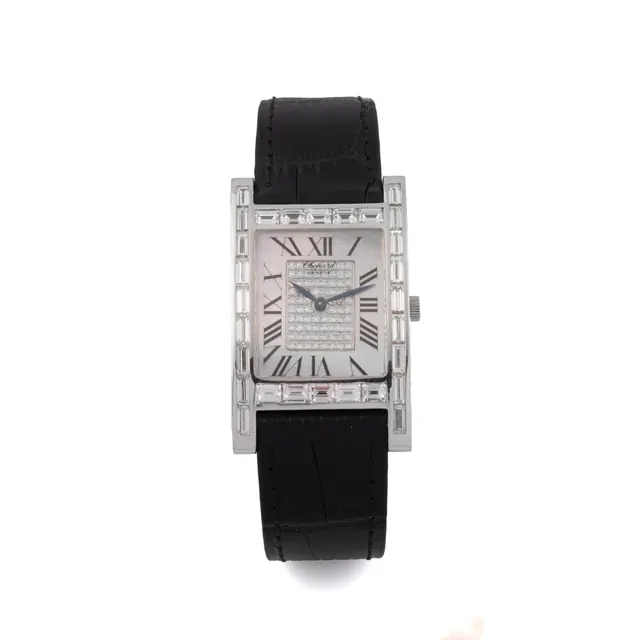
Chopard wristwatch, ref. 471, Your Hour Mop Dial, circa 2000's
Antiquorum auction archive, Geneva
Wristwatches · 2017
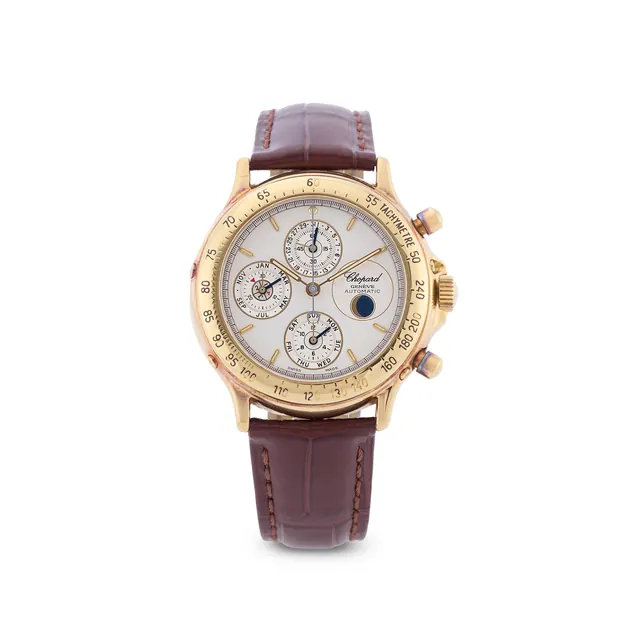
Chopard wristwatch, ref. 36/1208, Classic Perpetual Calendar Limited 12/50, Sold in June, 2017
Antiquorum auction archive, Geneva
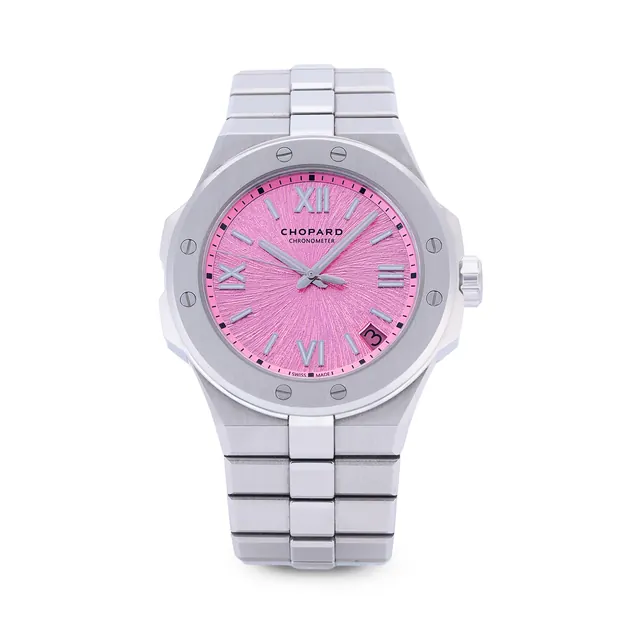
Wristwatches · c. 2024
Chopard wristwatch, ref. 298600-3022, Alpine Eagle, circa 2024
Antiquorum auction archive, Geneva

Wristwatches · 2008
Wristwatch by Breitling?, 2008
Museum Rotterdam

Wristwatches · c. 1990s
Audemars Piguet Bamboo, c. 1990s
Antiquorum auction archive, Geneva

Wristwatches · c. 1990
Audemars Piguet Huitieme Perpetual Calendar, ref. 25696PT, c. 1990
Antiquorum auction archive, Geneva

Wristwatches · c. 1990
Breitling Chronomat, ref. b13050.1, c. 1990
Antiquorum auction archive, Geneva