
Wristwatches · Diver's wristwatch
BWC self-winding wristwatch
- Maker / attribution
- BWC (source attribution)
- Date
- around 1970
- Historical period
- Quartz Revolution (1969 – 1990)
- Country of origin
- Switzerland
- Object type
- Diver's wristwatch
- Materials / technique
- Stainless steel
- Auction house
- Henry's Auktionshaus
- Lot
- 3017
- Credit line
- Henry's Auktionshaus
- Catalogue title (original)
- Sold at Auction: BWC self winding wristwatch (English)
View the source record (auction lot) ↗ (opens another website in a new tab)Suggest a correction
Record summary
Catalogued by Henry's Auktionshaus (lot 3017), this is a diver's wristwatch attributed to BWC, made in Switzerland, dated around 1970. The Atlas places it in the Quartz Revolution period (1969 – 1990) of its Wristwatches collection. Materials and techniques recorded by the source: Stainless steel. The record is illustrated with 1 photograph.
Assembled from the source record's structured fields. Dates and attributions are given as the source states them; where a field is missing the Atlas leaves it blank rather than estimating.
Catalogue description
Original object description
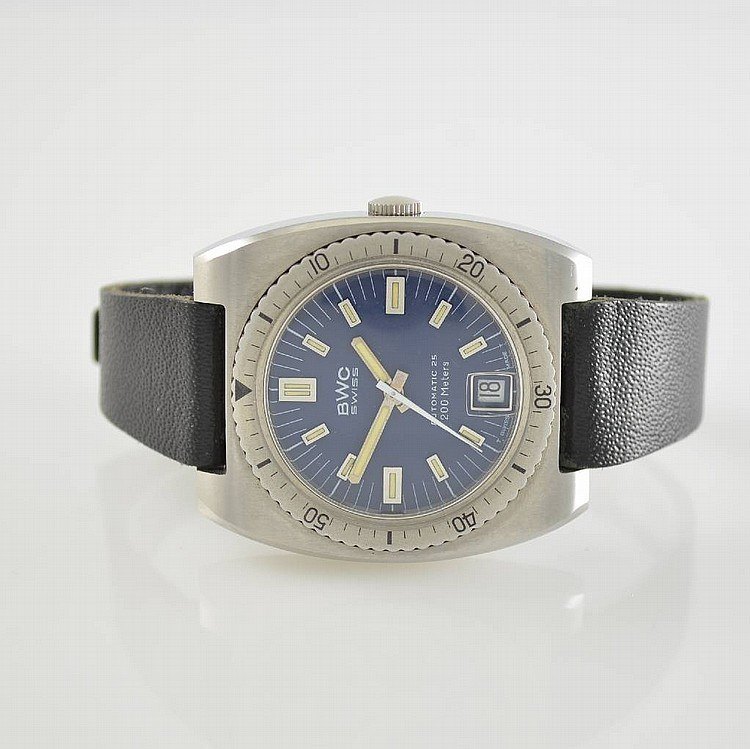
Dating to circa 1970 and manufactured in Switzerland, this automatic wristwatch by BWC is designed with a cushion-shaped stainless steel case of approximately 42 by 37 mm, featuring a satin-brushed top, hooded lugs, and a screw-down caseback. A rotating external 60-minute bezel frames the face, detailed with minute graduations, Arabic numerals every ten minutes, and a top triangle marker. Set against a blue dial are a central sweep seconds hand, rectangular luminous markers, and a bordered date display at the 3 o'clock position; text on the dial reads 'BWC SWISS' beneath 12 o'clock and 'AUTOMATIC 25' over '200 METERS' above 6 o'clock, referencing its historical factory water resistance. While unphotographed in the catalog, the movement is stated to be an ETA calibre 2782 featuring an Incabloc shock system, a flat balance wheel, and a flat balance spring. It is mounted on an unsigned black leather strap.
Historical context
Quartz Revolution (1969 – 1990)
Seiko's Astron begins mass quartz timekeeping; traditional industries contract sharply.
Quartz and digital watches transformed the market after 1969. Swiss employment collapsed, Japanese and Hong Kong production soared, and the Swatch (1983) helped the Swiss industry recover; mechanical watches survived as luxury goods.
Read the period in the timelineMore wristwatches from this periodEarlier: Modern Mechanical Horology
Atlas type guide
Dive and water-resistant watches
Keeping water and dust out of a wristwatch was a long-standing challenge. Rolex's screw-down Oyster case (1926) and Omega's Marine (1932) were landmarks; in the early 1950s Blancpain's Fifty Fathoms and Rolex's Submariner defined the professional dive watch with rotating bezels for timing dives, luminous dials and high water resistance. The ISO 6425 standard (1982) later codified what a 'diver's watch' must do.
Dive watches became icons of post-war design and exploration, and their evolution — helium escape valves, ceramic bezels, saturation-diving depth ratings — records the history of underwater work.
What to look for
- Unidirectional or bidirectional rotating bezel with minute markings.
- Screw-down crown and case back; depth rating printed on the dial.
- Luminous hands and markers (radium before c. 1960, tritium c. 1960–1998, then Super-LumiNova).
- Reference numbers on the case between the lugs or inside the back.
Dating clues
- Screw-down Oyster cases: from 1926.
- Professional dive watches: from 1953.
- Tritium 'T' marks on dials: c. 1960–1998.
General guidance written by the Atlas editors about this kind of object. It is not a statement about this particular piece; for that, rely on the source record above and on physical examination.
Related records
Wristwatches · c. 1970
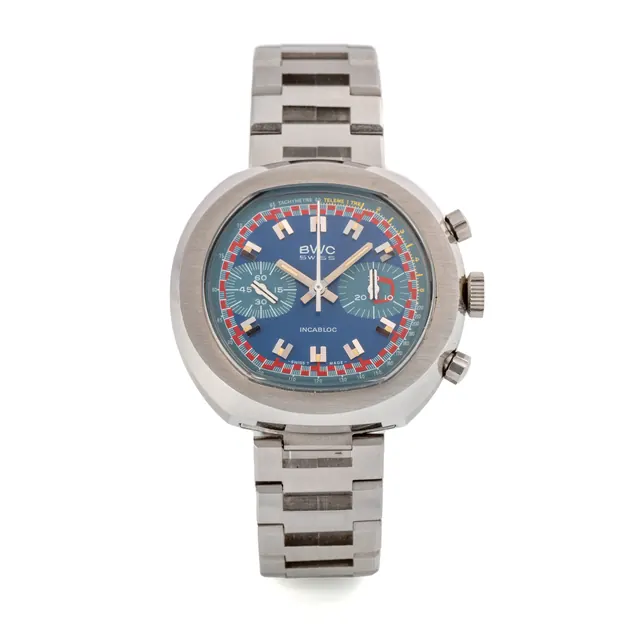
Bwc wristwatch, Chronograph, circa 1970
Antiquorum auction archive, Geneva
Wristwatches · c. 1980
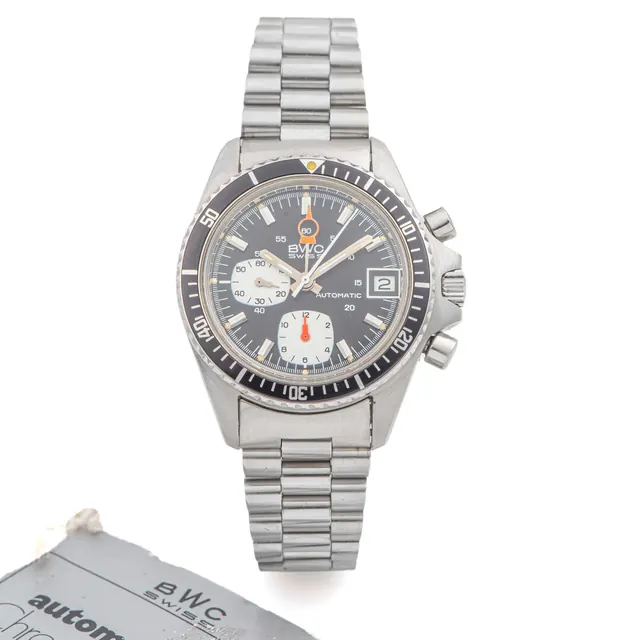
Bwc wristwatch, Chronograph, circa 1980
Antiquorum auction archive, Geneva
Wristwatches · 1970s
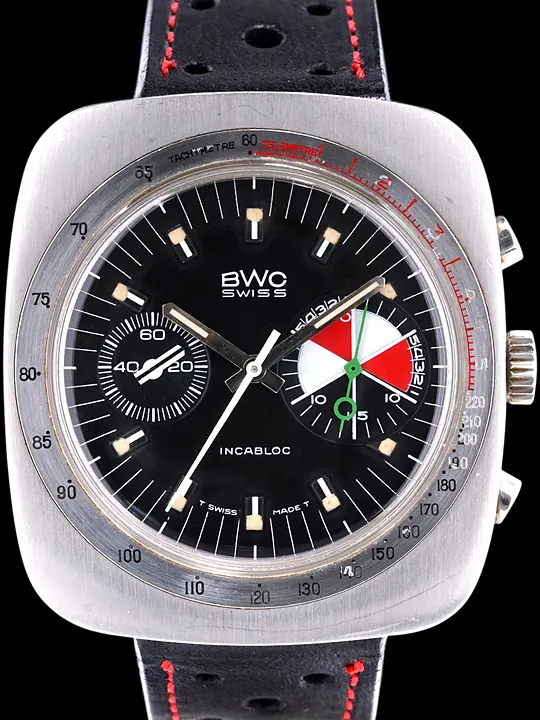
BWC Chronograph (Ref. 953013) "Valjox Cal. 7733", 1970s
Craft & Tailored (dealer), Los Angeles

Wristwatches · 1970
Wristwatch by Heno, Switzerland, 1970
Museum Rotterdam
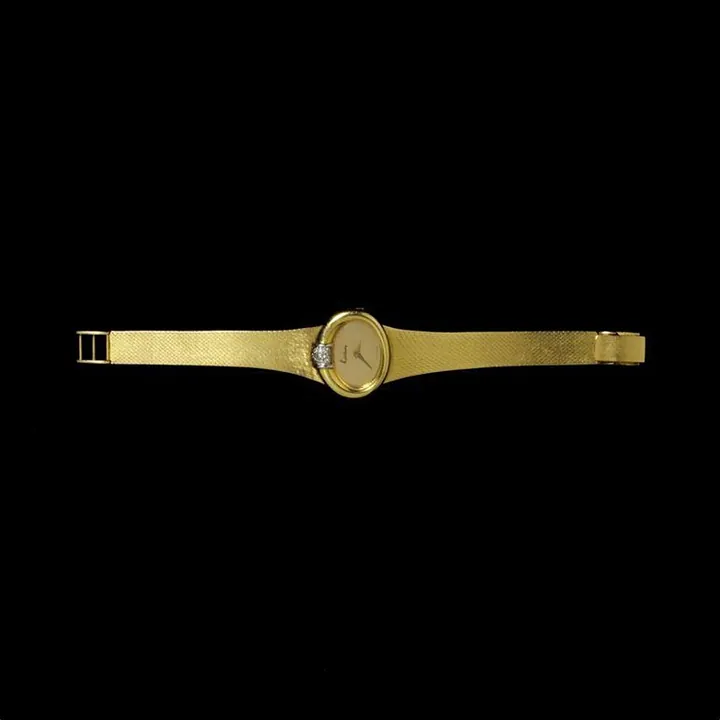
Wristwatches · 1973
Woman's watch, gold with diamonds set in platinum. Made for Kutchinsky, London by Chopard et Cie. Switzerland, 1973
Victoria and Albert Museum, London
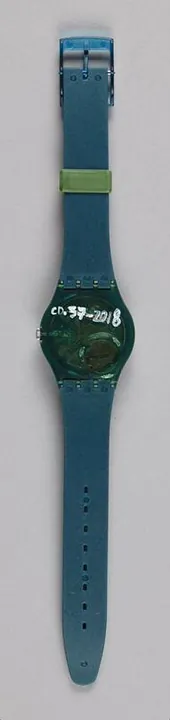
Wristwatches · 1985–1991
Swatch dummy watch: Blue Leaves GN104 design
Victoria and Albert Museum, London
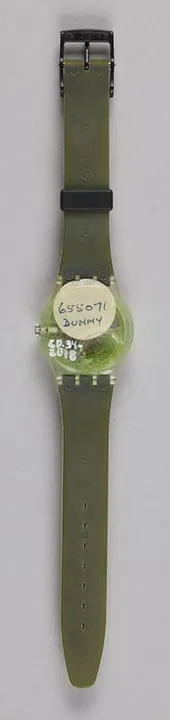
Wristwatches · 1985–1991
Swatch dummy watch: Technosphere GK101 design
Victoria and Albert Museum, London

Wristwatches · 1960–1986
'Tri-Compax' calendar chronograph wristwatch in gold case, by Universal, Geneva, Switzerland, 1960–1986.
Science Museum Group, London