
Pocket Watches · Pocket watch
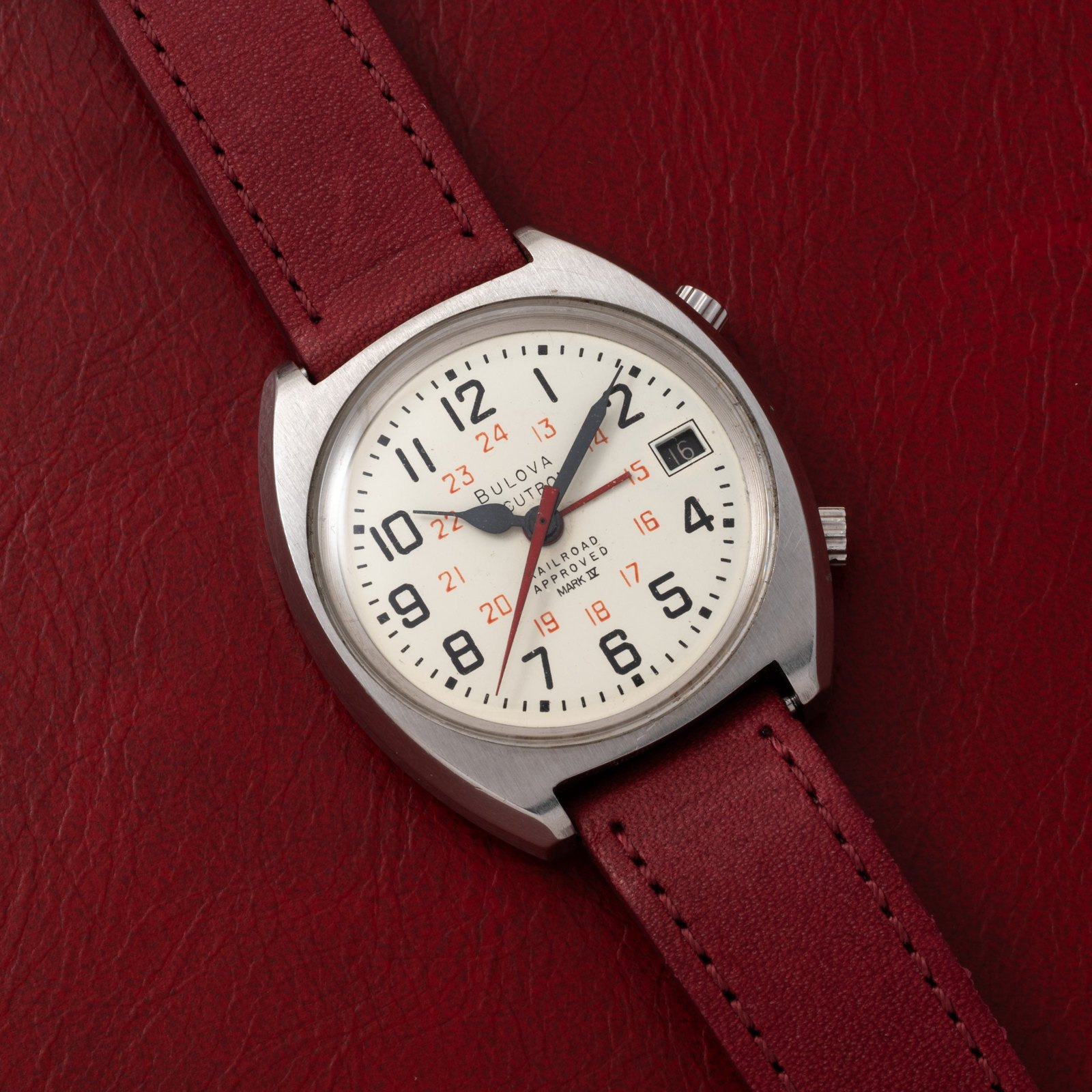
Bulova Accutron Railroad GMT, 1974
- Maker / attribution
- Bulova (maker)
- Date
- 1974
- Historical period
- Quartz Revolution (1969 – 1990)
- Country of origin
- United States
- Object type
- Pocket watch
- Dimensions
- Case 35 mm
- Stock no.
- 40992746
- Credit line
- Dealer listing, Analog/Shift (40992746)
- Catalogue title (original)
- Bulova Accutron Railroad GMT (English)
View the source record (dealer listing) ↗ (opens another website in a new tab)Suggest a correction
Record summary
Catalogued by Analog/Shift (dealer), New York (stock number 40992746), this is a pocket watch by Bulova, made in United States, dated 1974. The Atlas places it in the Quartz Revolution period (1969 – 1990) of its Pocket Watches collection. Recorded dimensions: Case 35 mm. The record is illustrated with 6 photographs.
Assembled from the source record's structured fields. Dates and attributions are given as the source states them; where a field is missing the Atlas leaves it blank rather than estimating.
Catalogue description
Dealer description — Analog/Shift
In 1960, Bulova had a vision of the future — and in that future, there was humming. About a decade before the infamous Quartz Crisis, Bulova put into production a timepiece that did away with the traditional balance wheel, favoring instead a steel tuning fork powered by electromagnets attached to a battery-powered transistor oscillator circuit. Designed by Max Hetzel, the Accutron made waves, becoming the first wristwatch precise enough to be qualified for U.S. Railroad certification, and guaranteed to be accurate to roughly one minute per month, or about 2 seconds per day. While Bulova had grand plans for their watch of the future, they never anticipated the success that the uniquely appointed Spaceview would generate. Designed to be a salesman's tool and display watch only, the transparent Spaceview 214 was never intended for retail purchase. But when demands for the watch spiked, Bulova responded, producing versions with the same unique characteristics of their display models. With its visible circuitry and tuning fork, the Accutron Spaceview was unlike anything before — and really, anything since. Though it remained in production for roughly 17 years, the tuning fork technology was eventually beaten out by quartz crystal movements, making this unbelievable piece of history a short-lived but totally revolutionary wristwatch. This specific watch, although not a Spaceview, uses the same tuning fork technology. It dates to 1974, given its N4 caseback engraving. "N" representing production in the 1970s, and "4" being the specific year within that decade. Housed in a 35mm cushion stainless steel case, it features a white dial with an outer black open minute track, black Arabic numerals, and a 'spade' handset with a red seconds hand. This piece also includes a GMT hand and date window for added functionality. With the ability jump the hour hand both forwards and backward via the two o'clock crown, this piece is an ideal travel companion! No matter your mechanical-movement inclinations, there is no denying that tuning fork movement is a one-of-a-kind piece of horological history. Oh, and the humming? Hold this baby up to your ear and you'll hear that tuning fork, humming away! Accutron Factory Certified Pre-Owned Analog:Shift is proud to be partnered with Accutron as the exclusive retailer for Factory Certified Pre-Owned timepieces. Our longstanding relationship and shared passion for horological history and design have culminated in this unique offering. Each Accutron timepiece undergoes rigorous inspection and certification by expert watchmakers and is backed by the manufacture, ensuring unparalleled authenticity and quality.
Historical context
Quartz Revolution (1969 – 1990)
Seiko's Astron begins mass quartz timekeeping; traditional industries contract sharply.
Quartz pocket watches and inexpensive novelty watches appeared, while traditional mechanical pocket watches survived mainly as collectibles and gifts.
Read the period in the timelineMore pocket watches from this periodEarlier: Modern Mechanical Horology
Atlas type guide
Railroad and railway watches
Timetables made accurate timekeeping a matter of safety. After a fatal collision at Kipton, Ohio, in 1891, American railroads adopted strict standards: open-face watches, lever setting, at least 17 jewels, adjustment to temperature and five positions, and a performance within 30 seconds a week, inspected regularly by approved watch inspectors. Waltham, Elgin, Hamilton, Illinois and Ball made railroad-grade watches in large numbers.
European railways issued service watches to guards, drivers and station staff, often engraved with the railway's initials and a staff number. Such watches link industrial timekeeping with the standardisation of time zones (Greenwich Mean Time adopted by British railways in 1847; North American standard time in 1883).
What to look for
- Open-face cases with the crown at 12 and lever setting under the bezel.
- Montgomery dials with every minute numbered, or bold Arabic numerals.
- 'Railroad grade', '21 Jewels', 'Adjusted 5 positions' on the movement.
- Railway initials and issue numbers engraved on the case back.
Dating clues
- American railroad standards: from 1891–93, revised c. 1908.
- Serial numbers of American makers allow dating to within a year.
General guidance written by the Atlas editors about this kind of object. It is not a statement about this particular piece; for that, rely on the source record above and on physical examination.
Read next:Detached lever escapement
Related records
Wristwatches · c. 1969
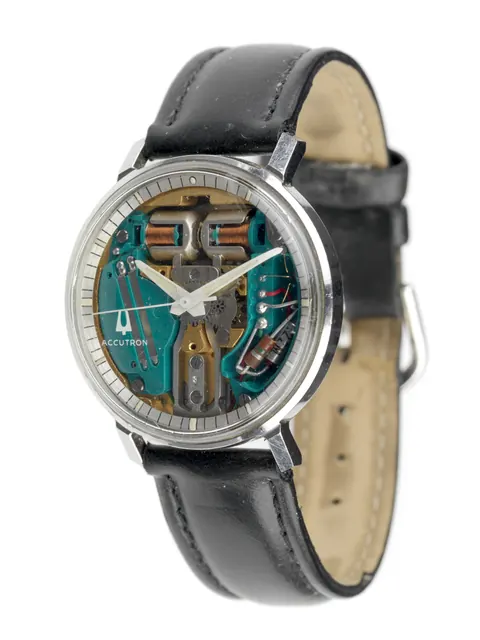
Bulova 'Accutron' tuning-fork wristwatch by Bulova
Royal Museums Greenwich
Wristwatches · c. 1965
Wristwatch Accutron by Knud Geelmuyden Bull
Royal Museums Greenwich
Clocks · c. 1960s
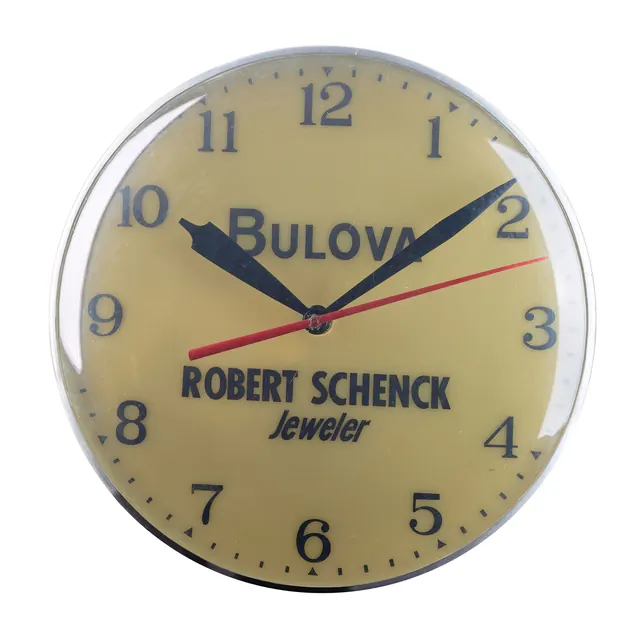
Bulova wall clock, Lighted Advertising Wall Clock for Robert Schenck Jeweler, circa 1960s
Antiquorum auction archive, Geneva
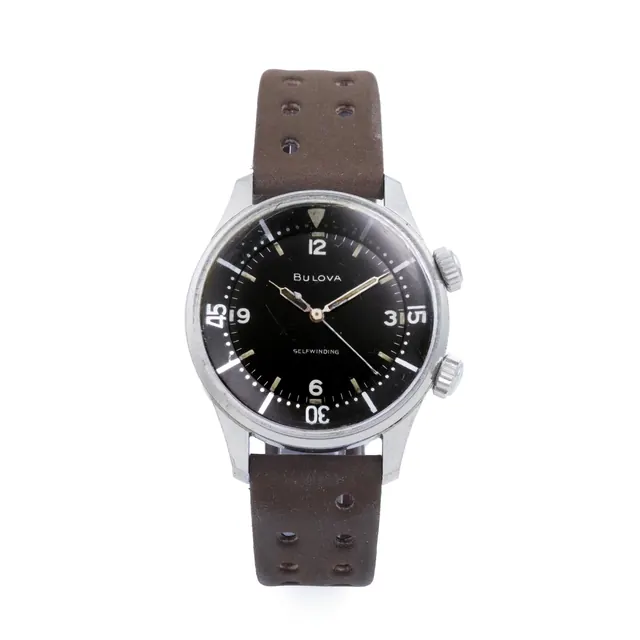
Wristwatches · 1963
Bulova wristwatch, ref. 314, Diver Super Compressor, 1963
Antiquorum auction archive, Geneva
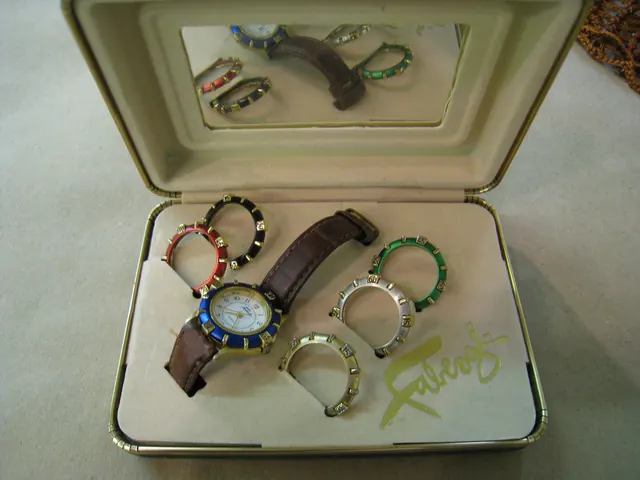
Pocket Watches · c. 1970
Watch by M.Z. Berger and Co., Inc
Yale University Art Gallery, New Haven
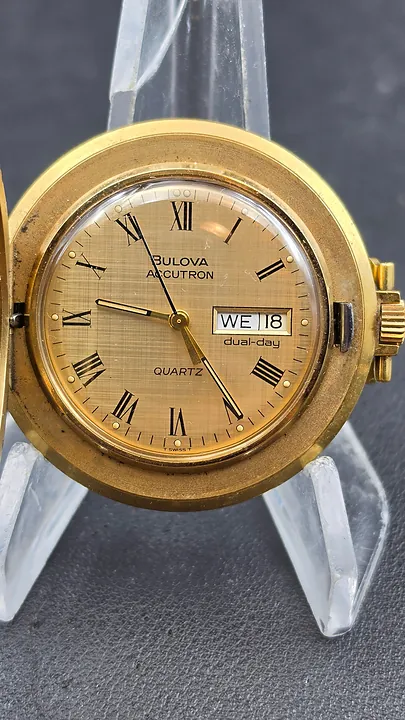
Pocket Watches · c. 1978
Bulova Accutron Dual-Day Quartz Pendant Pocket Watch, Gold-Tone, circa 1978
LiveAuctioneers auction archive
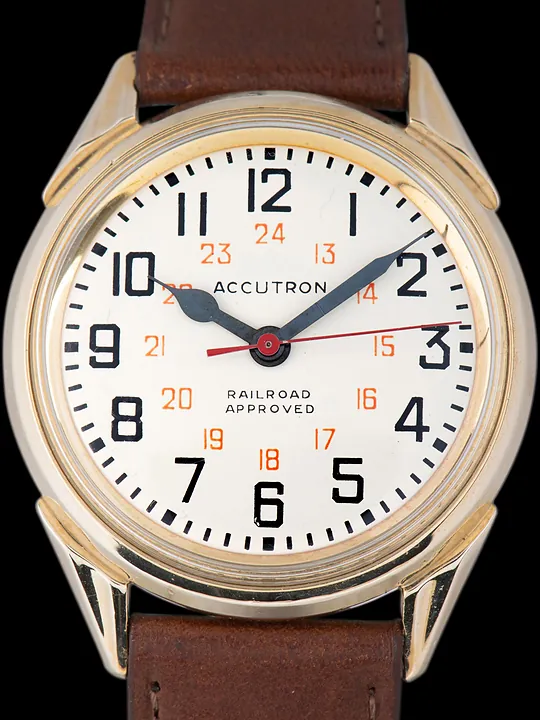
Pocket Watches · 1971
Bulova Accutron Railroad Approved (Ref. 2875) Gold Capped, 1971
Craft & Tailored (dealer), Los Angeles
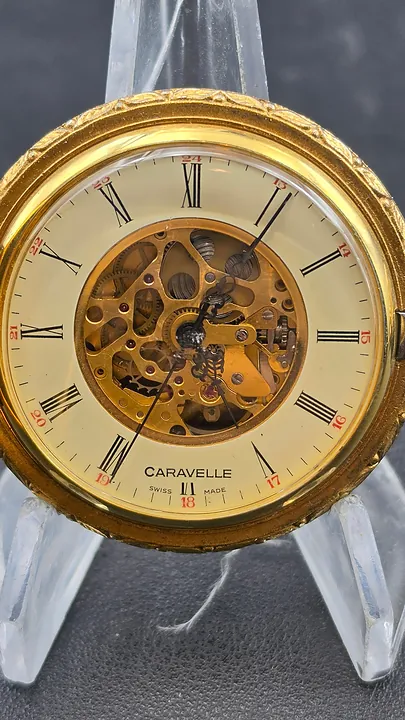
Pocket Watches · c. 1980
Caravelle (Bulova) Full Hunter Skeleton Pocket Watch, 17 Jewels, circa 1980
LiveAuctioneers auction archive