
Pocket Watches · Pocket watch
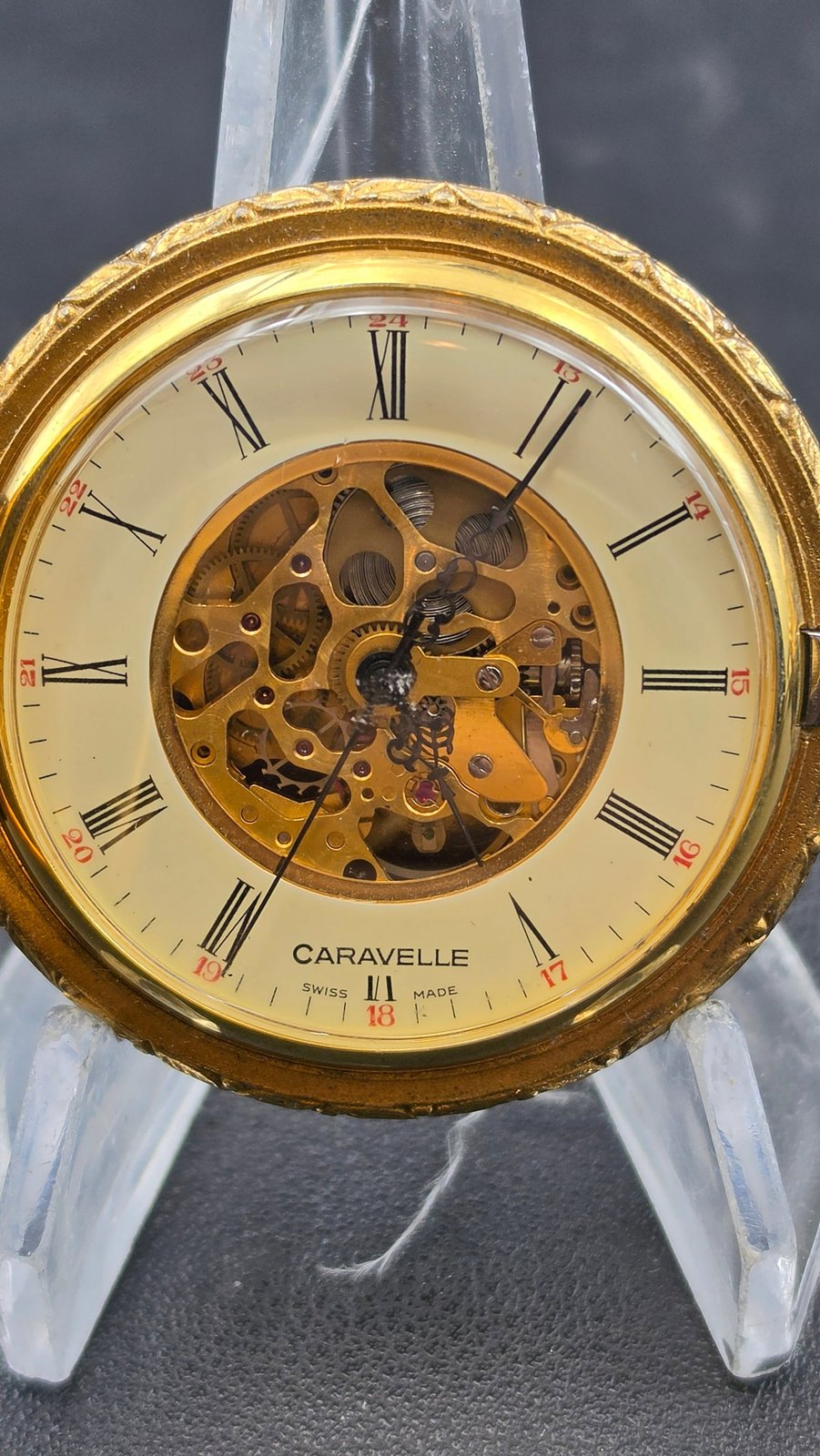
Caravelle (Bulova) Full Hunter Skeleton Pocket Watch, 17 Jewels, circa 1980
- Maker / attribution
- Bulova (maker)
- Date
- c. 1980
- Historical period
- Quartz Revolution (1969 – 1990)
- Country of origin
- United States
- Object type
- Pocket watch
- Auction house
- LiveAuctioneers auction archive
- Lot
- Item 237139720
- Credit line
- Auction lot record: lot 172, EXCLUSIVE WATCHES AND POCKET WATCHES 13, Sphere Auctions LLC (2026), via LiveAuctioneers
- Catalogue title (original)
- Caravelle (Bulova) Full Hunter Skeleton Pocket Watch, 17 Jewels, Circa 1980 (English)
View the source record (auction lot) ↗ (opens another website in a new tab)Suggest a correction
Record summary
Catalogued by LiveAuctioneers auction archive (lot Item 237139720), this is a pocket watch by Bulova, made in United States, dated c. 1980. The Atlas places it in the Quartz Revolution period (1969 – 1990) of its Pocket Watches collection. The record is illustrated with 4 photographs.
Assembled from the source record's structured fields. Dates and attributions are given as the source states them; where a field is missing the Atlas leaves it blank rather than estimating.
Catalogue description
Lot description — Sphere Auctions LLC
This is a Caravelle-branded pocket watch (Caravelle is Bulova's secondary brand), housed in a gold-tone full hunter case with relief-engraved hunting scenes on both covers — one depicting a hunter with hounds in a landscape, the other a running stag pursued by a mounted hunter and hound. Case diameter measures 48.05mm. The dial is a skeleton design signed "Caravelle, Swiss Made," with an exposed mechanical movement visible through a cutout, black and red Roman/24-hour markings, and blued steel hands. The movement is signed "Caravelle Watch, Seventeen 17 Jewels, Unadjusted," caliber 1241.50, Swiss. The interior front cover bears a personal engraved inscription dated 11-17-80: "To Jimmy, with love, Mitzi" — a period gift inscription rather than a maker's mark.This watch runs well.This is a vintage mechanical pocket watch and is sold as a collectible. The case is gold-tone base metal, not solid gold. It bears a prior owner's engraved inscription.
Historical context
Quartz Revolution (1969 – 1990)
Seiko's Astron begins mass quartz timekeeping; traditional industries contract sharply.
Quartz pocket watches and inexpensive novelty watches appeared, while traditional mechanical pocket watches survived mainly as collectibles and gifts.
Read the period in the timelineMore pocket watches from this periodEarlier: Modern Mechanical Horology
Atlas type guide
Hunter, half-hunter and open-face watches
In the nineteenth century the pocket watch case settled into a few standard forms. The hunter (French savonnette) has a hinged front lid protecting the crystal — reputedly for riders who could not risk broken glass — and is opened by pressing the crown or a push-piece. The half-hunter has a small window in the lid so the hands can be read when closed. The open-face (lépine) watch has no front cover, with the crown at 12; hunters normally carry the crown at 3.
Case types also changed with winding: key-wound watches gave way to keyless (stem-wound) mechanisms after Adrien Philippe's and others' designs of the 1840s, with pendant setting or lever setting.
What to look for
- Crown position relative to the seconds dial: at 3 for hunters, at 12 for open-face watches.
- Spring-loaded front cover with a push-piece in the pendant.
- Half-hunter chapter ring enamelled on the lid.
- Key holes in the inner dome (cuvette) versus keyless winding.
Dating clues
- Keyless winding spread after c. 1850 and became standard by c. 1890.
- English hallmarks inside gold and silver cases give the year of assay.
General guidance written by the Atlas editors about this kind of object. It is not a statement about this particular piece; for that, rely on the source record above and on physical examination.
Read next:Detached lever escapement
Related records
Wristwatches · c. 1969
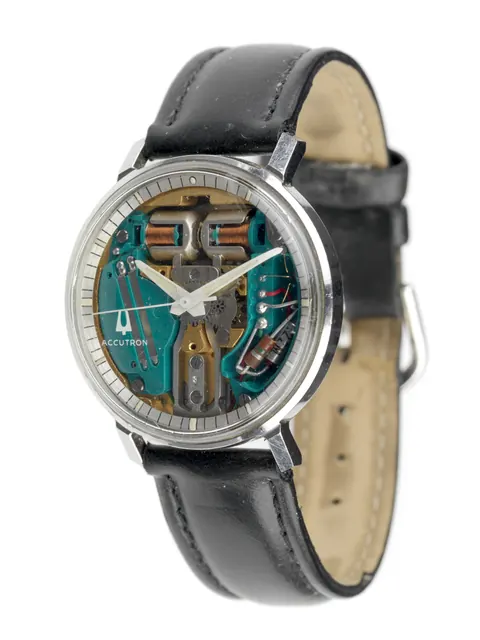
Bulova 'Accutron' tuning-fork wristwatch by Bulova
Royal Museums Greenwich
Wristwatches · c. 1965
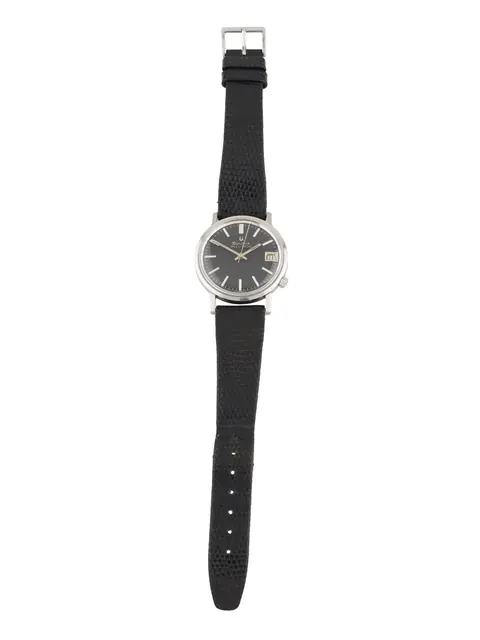
Wristwatch Accutron by Knud Geelmuyden Bull
Royal Museums Greenwich
Clocks · c. 1960s
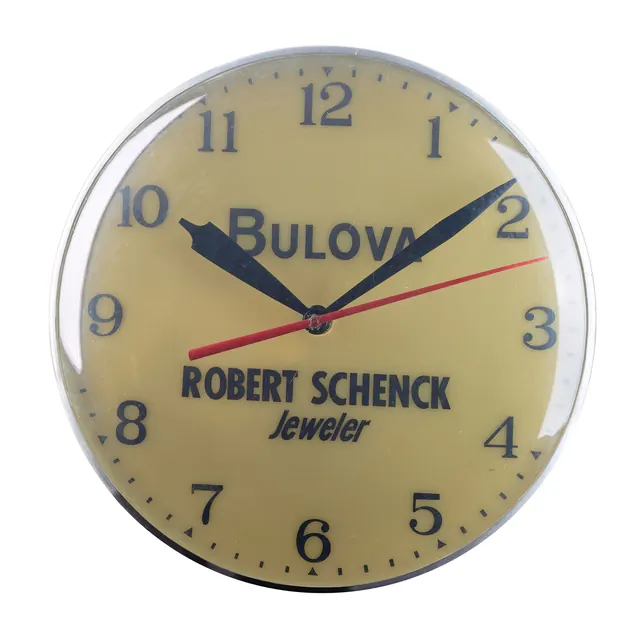
Bulova wall clock, Lighted Advertising Wall Clock for Robert Schenck Jeweler, circa 1960s
Antiquorum auction archive, Geneva
Wristwatches · 1963
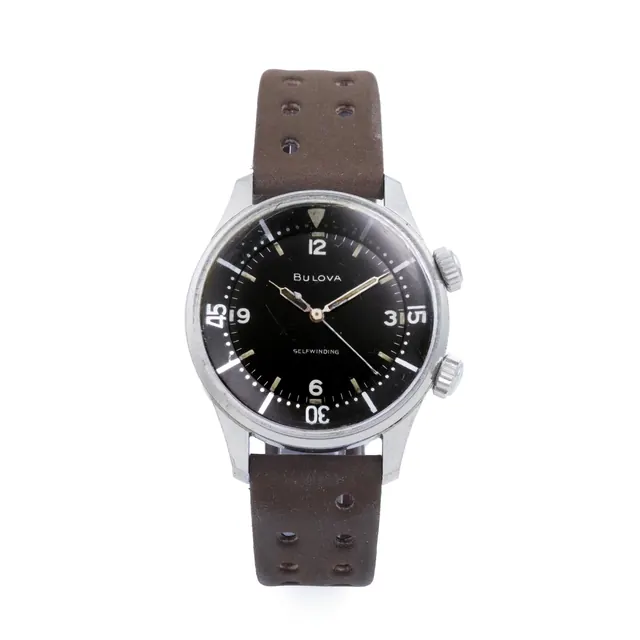
Bulova wristwatch, ref. 314, Diver Super Compressor, 1963
Antiquorum auction archive, Geneva
Pocket Watches · c. 1970
Watch by M.Z. Berger and Co., Inc
Yale University Art Gallery, New Haven
Pocket Watches · c. 1978
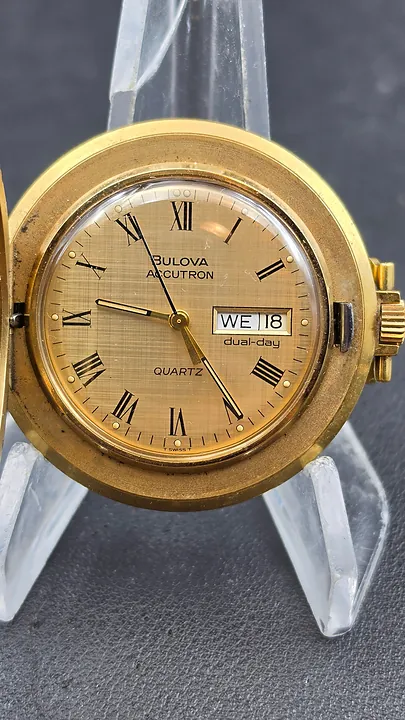
Bulova Accutron Dual-Day Quartz Pendant Pocket Watch, Gold-Tone, circa 1978
LiveAuctioneers auction archive
Pocket Watches · 1971
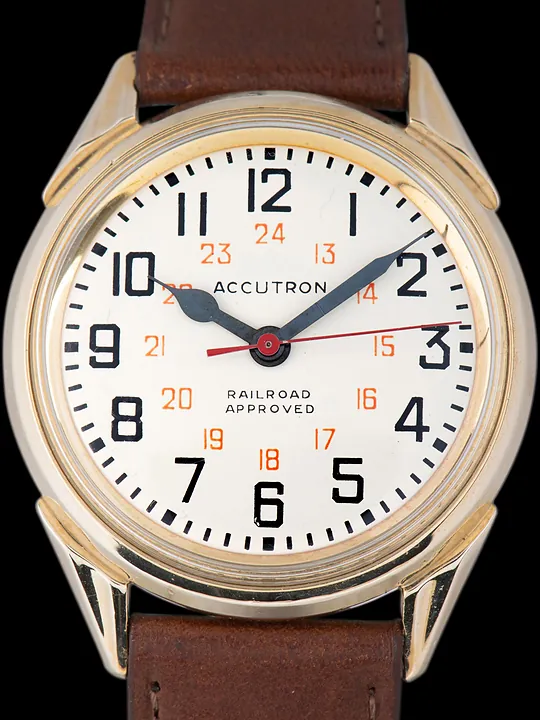
Bulova Accutron Railroad Approved (Ref. 2875) Gold Capped, 1971
Craft & Tailored (dealer), Los Angeles
Pocket Watches · 1974
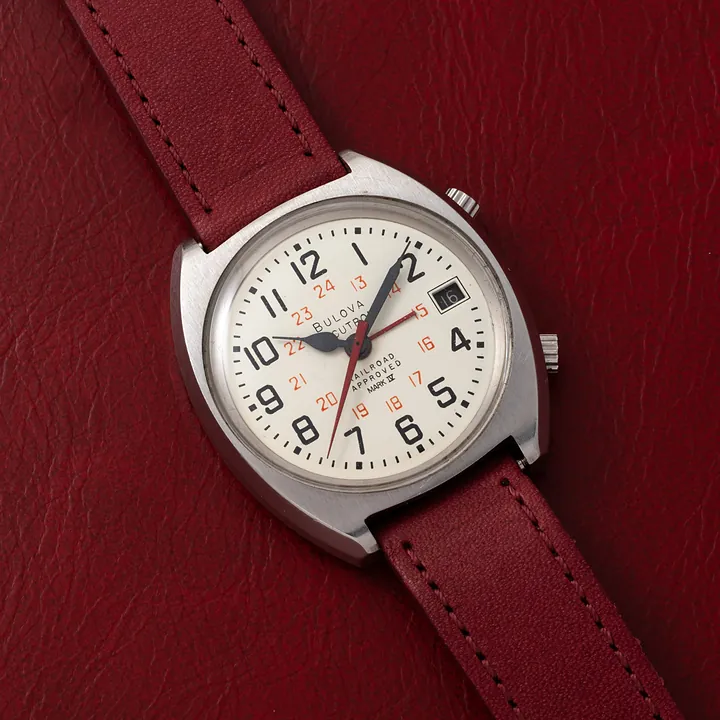
Bulova Accutron Railroad GMT, 1974
Analog/Shift (dealer), New York