
Wristwatches · Wristwatch
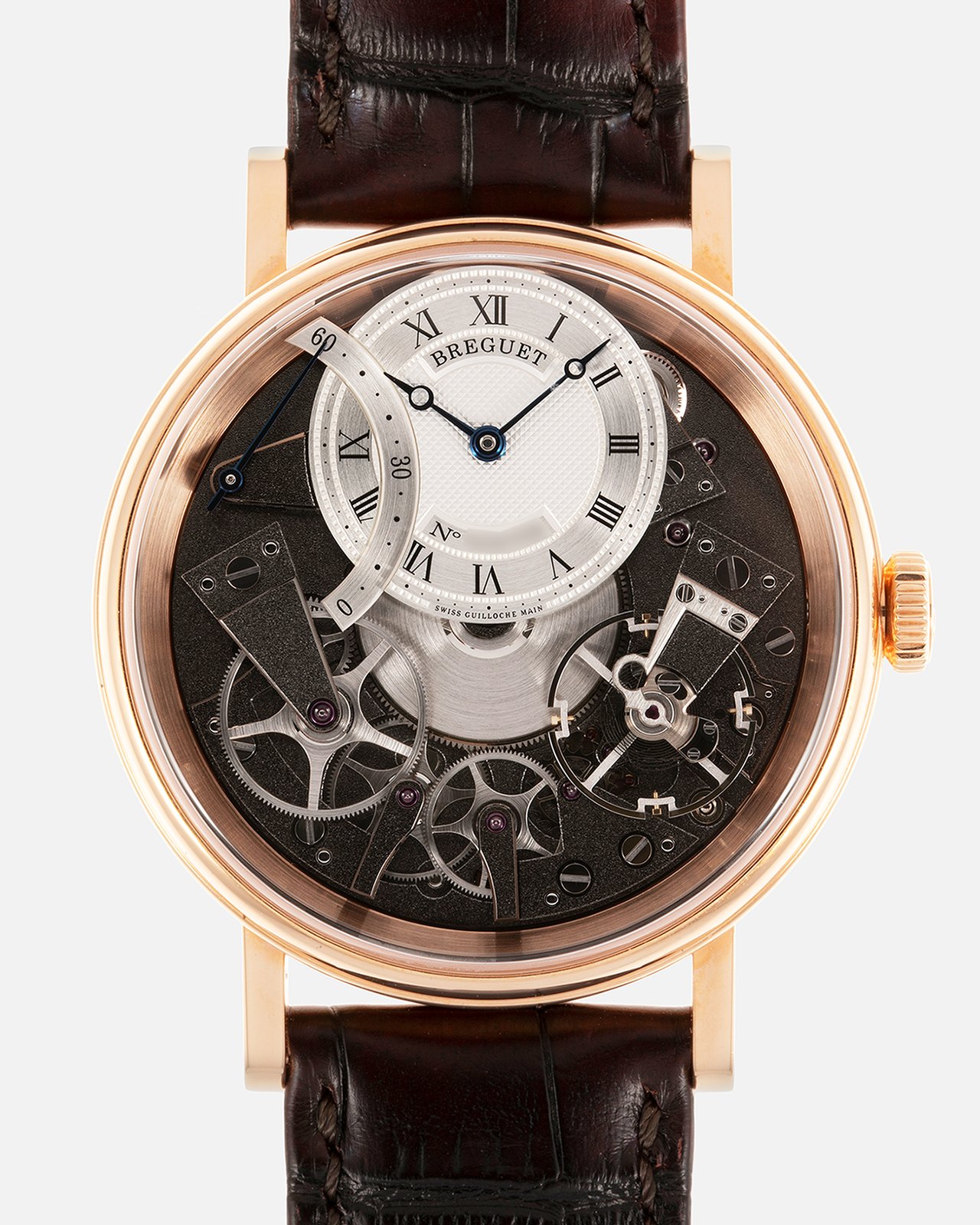
Breguet Tradition Automatique Seconde Retrograde Ref. 7097, 2022
- Maker / attribution
- Breguet (maker)
- Date
- 2022
- Historical period
- Contemporary Horology (2010 – Present)
- Country of origin
- Switzerland
- Object type
- Wristwatch
- Dimensions
- Case 40 mm
- Stock no.
- Product 6880057360471
- Credit line
- Dealer listing, S.Song Watches (product 6880057360471)
- Catalogue title (original)
- Breguet Tradition Automatique Seconde Retrograde Ref. 7097 (English)
View the source record (dealer listing) ↗ (opens another website in a new tab)Suggest a correction
Record summary
Catalogued by S.Song Watches (dealer), Seattle (stock number Product 6880057360471), this is a wristwatch by Breguet, made in Switzerland, dated 2022. The Atlas places it in the Contemporary Horology period (2010 – Present) of its Wristwatches collection. Recorded dimensions: Case 40 mm. The record is illustrated with 6 photographs.
Assembled from the source record's structured fields. Dates and attributions are given as the source states them; where a field is missing the Atlas leaves it blank rather than estimating.
Catalogue description
Dealer description — S.Song Watches
Perhaps one of watchmaking's most overlooked industry titans, few brands can claim as many mechanical innovations and iconic pieces of design as Breguet can. Be it their Breguet hands, Breguet numerals, the tourbillon, the Breguet overcoil, or others; the industry has benefited tremendously from Breguet's continuous technical evolution. For context, Breguet initially launched its Tradition collection in 2005 with the goal of showcasing the technical innovations of the movement underneath the dial. Instead of displaying these components on the caseback, Breguet decided to place them on top of the base plate, making them highly visible from the dial. The Breguet Tradition Automatique Seconde Retrograde Ref. 7097, which is what we have on offer today, was introduced to the collection in 2015. It included a retrograde seconds function that added some degree of animation to the dial alongside the rotations of the balance wheel. A real treat to wear and look at. Beginning with the Ref. 7097’s beautiful and attractive dial, the visible plates and bridges here possess a unique grey-colored surface with a gritty appearance which is actually achieved via a technique involving meticulous hammering to create tiny little craters (called peening). Apart from that, you will also find a mainspring barrel located right in the center of the dial, flanked by two fan-shaped structures on either side. If you look closely, you will notice that the right structure extends over the balance wheel with Breguet’s pare-chute shock protection system at 3 o ’clock, while the other is positioned at 9 o 'clock for the center wheel of the going train. The time is located on the upper half of the dial and indicated via a galvanized disc which features Breguet’s world-renowned guilloche, as indicated by the Swiss Guilloché Main signature right at the bottom of the disc. This disc is further intersected by an arc-like structure on its left which is the retrograde seconds. In addition, both indications also utilize thermal-blued Breguet hands which adds a nice accent to the overall aesthetic of the dial. Moving on to its 18-carat rose gold case, the Ref. 7097 measures 40mm × 11.8mm in dimensions and features an elegant fluted case band as well as welded screw-bar lugs. Encased within its handcrafted case is Breguet’s in-house, 38-jeweled Cal. 505 SR1, a self-winding movement that features an inverted in-lever escapement with silicon pallets and a silicon Breguet overcoil for its balance spring. While the dial of the watch gloriously displays many of the brand’s historic technical innovations, the underside of the watch is actually just as captivating. At its center, you will find an unusual yet beautiful 22-carat gold rotor, specially shaped to resemble the platinum oscillating weight on Breguet's perpétuelle self-winding à tact watches (a watch made especially for the blind). It is meticulously hand-polished to a mirror finish and pivots in a ceramic bearing, completing 360 ⁰ rotations. As far as power reserve goes, the Cal. 505 SR1 holds an impressive capacity of 50 hours. In my opinion, Breguet’s Tradition collection is some of the most visually and mechanically intriguing modern pieces I’ve seen and handled. The interesting thing about these contemporary designs is the fact that they faithfully utilize and pay homage to some of Breguet’s historical technical innovations over the decades, whilst maintaining a strong spiritual connection to the Maison’s DNA through its aesthetics and mechanical ingenuity.
Historical context
Contemporary Horology (2010 – Present)
Silicon components, connected watches, optical-lattice research clocks and a thriving independent scene.
Smartwatches became the world's best-selling watches, while mechanical watchmaking focuses on craft, innovation (silicon components, new escapements) and independent makers.
Read the period in the timelineMore wristwatches from this periodEarlier: Mechanical Renaissance
Atlas type guide
Automatic (self-winding) watches
Self-winding watches use the wearer's motion to wind the mainspring. Abraham-Louis Perrelet and Breguet made 'perpétuelle' pocket watches with oscillating weights in the late eighteenth century, but the principle only became practical in the wristwatch. John Harwood patented a bumper automatic in 1923; Rolex's Perpetual rotor (1931) winding in one direction, and later bidirectional rotors (Eterna, Felsa Bidynator), established the modern form. Micro-rotors (Universal Genève, Buren) and peripheral rotors made automatic watches thinner.
What to look for
- A semicircular rotor turning 360° over the movement, or a 'bumper' weight that rebounds between springs.
- 'Automatic', 'Perpetual' or 'Self-winding' on the dial.
- A sealed screw-back case, since automatic watches are wound less often by the crown.
Dating clues
- Bumper automatics: 1923–c. 1955.
- Full rotors: from 1931 (Rolex); widespread after c. 1950.
- Micro-rotors: from 1954–1958.
General guidance written by the Atlas editors about this kind of object. It is not a statement about this particular piece; for that, rely on the source record above and on physical examination.
Related records
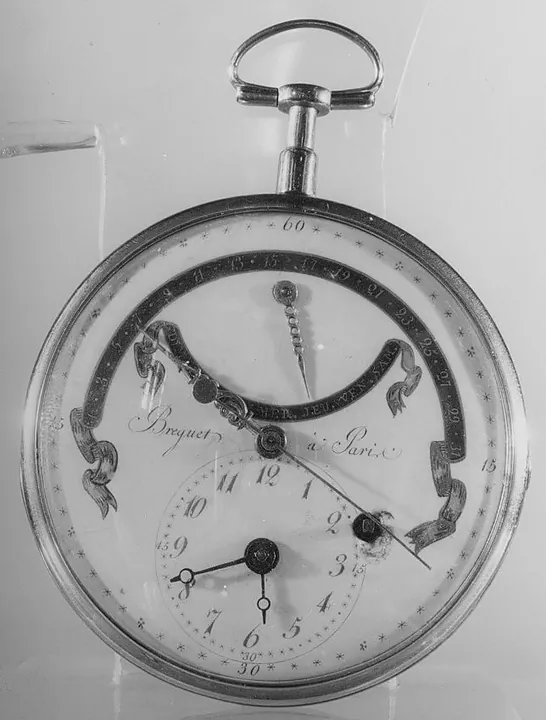
Pocket Watches · 1700–1799
Pocket watch by Breguet, Belgium, 1700–1799
Royal Institute for Cultural Heritage
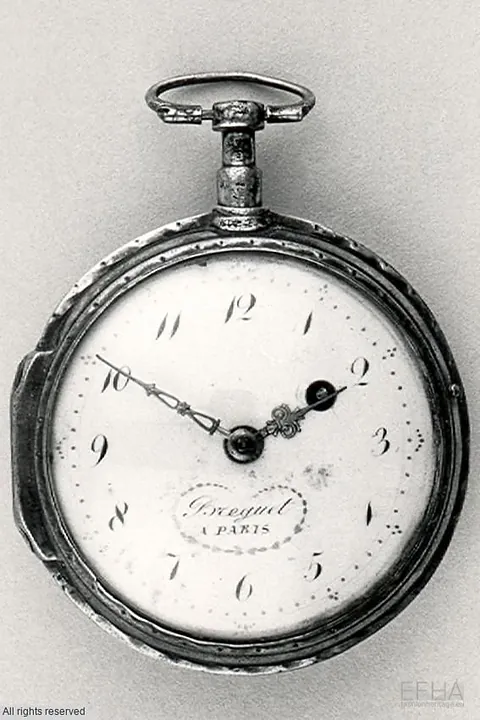
Pocket Watches · 1700–1799
Pocket watch by Breguet, France, 1700–1799
Fashion Museum of Antwerp
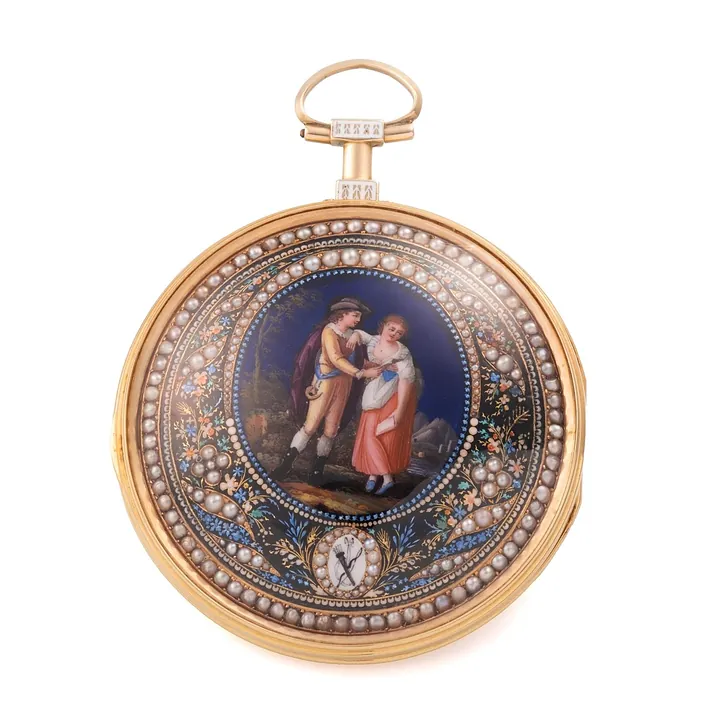
Pocket Watches · c. 1790
Breguet Love Letter, c. 1790
Antiquorum auction archive, Geneva
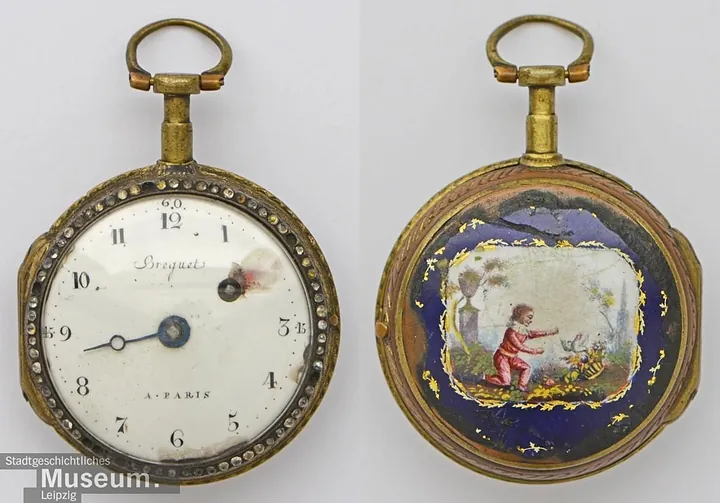
Pocket Watches · 1790
Pocket watch possibly by Breguet, France, 1790
Museum of City History Leipzig

Wristwatches · c. 2010s
Breguet Type XXI, ref. 3810, c. 2010s (Antiquorum Lot 381-24)
Antiquorum auction archive, Geneva

Wristwatches · c. 2010s
Breguet Type XXI, ref. 3810, c. 2010s (Antiquorum Lot 386-229)
Antiquorum auction archive, Geneva

Wristwatches · Sold in September 2010
Breitling Cosmonaute, ref. A 22322, Sold in September 2010
Antiquorum auction archive, Geneva

Wristwatches · c. 2010
Corum Bubble Chrono, ref. 396.150.20, c. 2010
Antiquorum auction archive, Geneva