
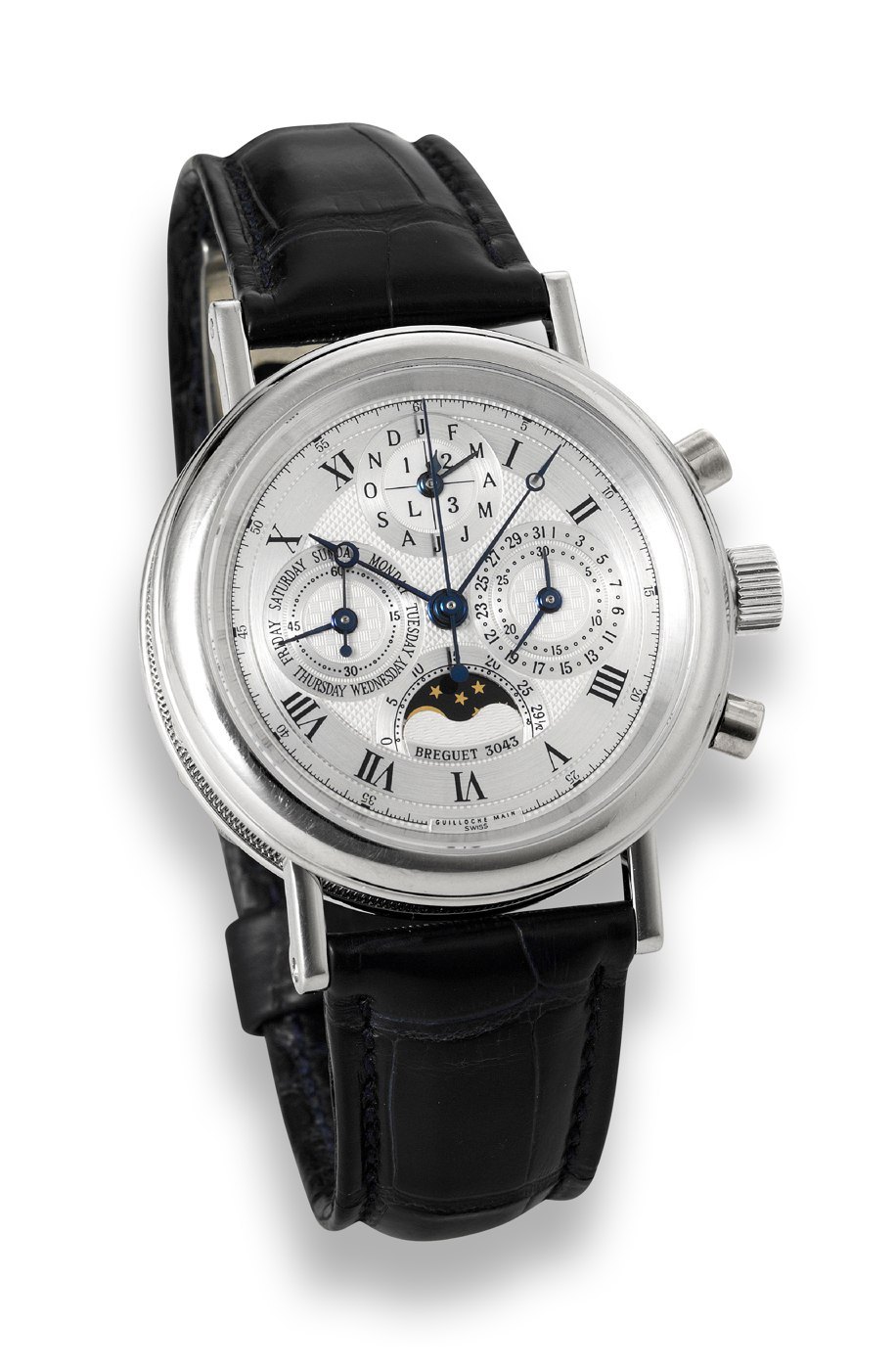
Wristwatches · Perpetual calendar chronograph wristwatch
Breguet Quantieme Perpetuel Chronograph Ref. 3617
- Maker / attribution
- Breguet (source attribution)
- Date
- 1990s
- Historical period
- Mechanical Renaissance (1990 – 2010)
- Country of origin
- Switzerland
- Object type
- Perpetual calendar chronograph wristwatch
- Materials / technique
- Platinum
- Dimensions
- 38 mm
- Holding institution
- Antiquorum
- Accession / object no.
- 158
- Credit line
- Antiquorum
- Catalogue title (original)
- Breguet Quantieme Perpetuel\nchronograph\nBreguet, 'Chronograph, Quantieme Perpetuel', No. 3043 G,\nmovement No. 1363, Ref. 3617. Made in the 1990's.\nVery fine and rare, platinum wristwatch with roun (English)
View the source record ↗ (opens another website in a new tab)Suggest a correction
Record summary
Held and catalogued by Antiquorum (object number 158), this is a perpetual calendar chronograph wristwatch attributed to Breguet, made in Switzerland, dated 1990s. The Atlas places it in the Mechanical Renaissance period (1990 – 2010) of its Wristwatches collection. Materials and techniques recorded by the source: Platinum. Recorded dimensions: 38 mm. The record is illustrated with 1 photograph.
Assembled from the source record's structured fields. Dates and attributions are given as the source states them; where a field is missing the Atlas leaves it blank rather than estimating.
Catalogue description
Original object description
Dating from the 1990s, Breguet reference 3617 is a platinum chronograph equipped with a perpetual calendar, moon phase, and lunar age indications. The watch is driven by the 21-jewel, 13-ligne Calibre 533 QP, which incorporates a swan-neck regulator. The two-piece platinum case features straight lugs, a reeded band, and a domed polished bezel, housing a two-tone guilloché silver dial completed with blued steel Breguet hands, Roman hour numerals, and dedicated sub-registers for calendar and timing complications. Signed across the case, movement, and dial, it is secured by a platinum Breguet deployant clasp and is retained with its original display case and servicing documents.
Case and Dial Design
Measuring 38 mm in diameter, the two-part platinum case is distinguished by straight lugs secured with screw-pins, a smooth polished bezel, inset calendar correctors, and signature fluting along the case flank. The two-tone silver dial displays engine-turned decoration, an outer 1/5th-of-a-second timing scale, radial Roman numerals on a brushed track, and blued steel Breguet hands. Dedicated registers display the day, date, month, leap year cycle, subsidiary seconds, and a 30-minute chronograph counter, alongside an aperture at 6 o'clock charting the lunar phase and age.
Movement and Complications
Powering the timepiece is the 13-ligne Calibre 533 QP, a rhodium-plated movement enriched with Côtes de Genève (fausses côtes) striping. Its regulating organ includes an in-line lever escapement, a shock-absorbing monometallic balance, a Breguet overcoil hairspring, and a swan-neck precision adjustment mechanism. Built to automatically reconcile variations in month lengths and leap-year intervals including February 29, the perpetual calendar mechanism operates alongside precise lunar tracking, ranking this watch among Breguet's foremost multi-complication designs of the 1990s.
Provenance and Condition
The dial, case, and movement all bear Breguet signatures; the dial is recorded in 'as new' state and retains its original hands. The watch holds an overall auction condition score of AAA and is accompanied by its genuine tailored presentation box and related maintenance records.
Inscriptions & marks
3043 G
Historical context
Mechanical Renaissance (1990 – 2010)
Mechanical watches return as cultural objects; independent watchmaking flourishes.
Mechanical watches returned as cultural and luxury objects. Complications, tourbillons and new materials proliferated; independent watchmakers such as George Daniels, F.P. Journe and Philippe Dufour revived artisanal watchmaking; collecting vintage watches became a major field.
Read the period in the timelineMore wristwatches from this periodEarlier: Quartz Revolution
Atlas type guide
Chronographs and split-seconds watches
A chronograph is a watch with an additional seconds hand that can be started, stopped and returned to zero independently of the timekeeping. Louis Moinet built an early example in 1816 and Nicolas Rieussec a recording 'chronographe' in 1821; Adolphe Nicole's heart-shaped reset cam (patented 1862) made the modern return-to-zero possible. Split-seconds (rattrapante) chronographs add a second hand that can be stopped for intermediate times; flyback chronographs restart instantly.
Chronographs were essential tools for doctors (pulsometer scales), artillery (telemeter), engineers and sport. In wristwatches, Valjoux, Venus, Lemania and later the automatic chronographs of 1969 (Zenith El Primero, the Chronomatic Calibre 11 group and Seiko 6139) are milestones.
What to look for
- Push-pieces on the case band or a single button in the crown (monopusher).
- Subsidiary registers for minutes and hours; tachymeter, telemeter or pulsometer scales.
- Column wheel versus cam control visible in the movement.
- Calibre markings of specialist makers (Valjoux, Lemania, Venus, Landeron).
Dating clues
- Pocket chronographs with heart cam reset: after 1862.
- Wrist chronographs: from c. 1910; two-button designs from the 1930s.
- Automatic chronographs: from 1969.
General guidance written by the Atlas editors about this kind of object. It is not a statement about this particular piece; for that, rely on the source record above and on physical examination.
Read next:Flyback chronographChronograph
Related records
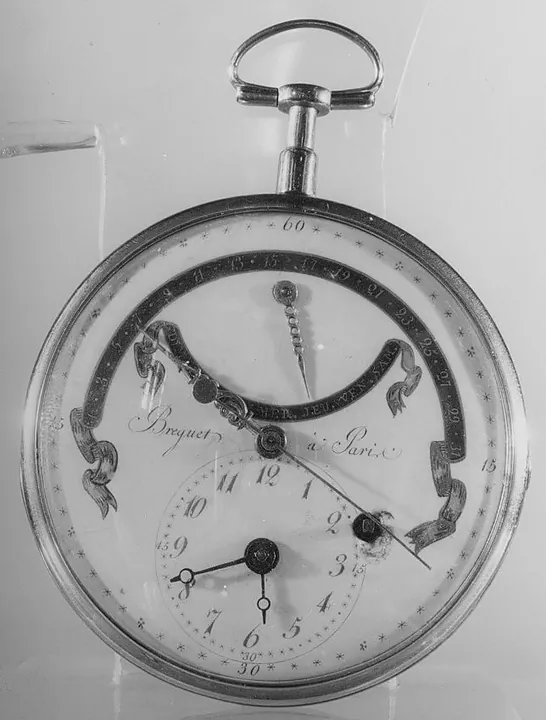
Pocket Watches · 1700–1799
Pocket watch by Breguet, Belgium, 1700–1799
Royal Institute for Cultural Heritage
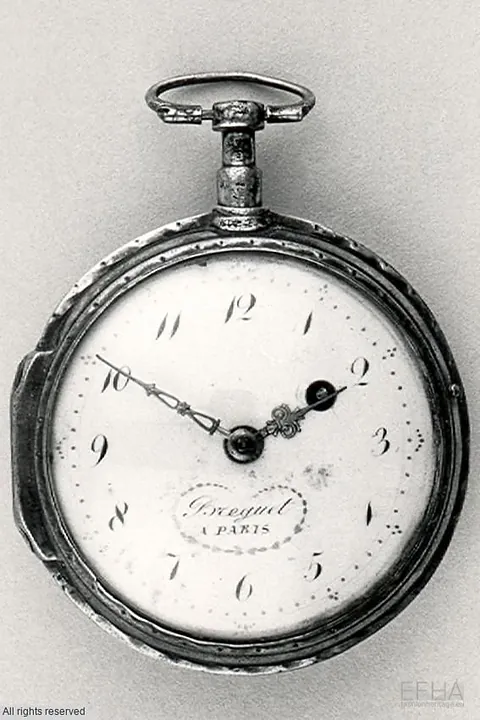
Pocket Watches · 1700–1799
Pocket watch by Breguet, France, 1700–1799
Fashion Museum of Antwerp
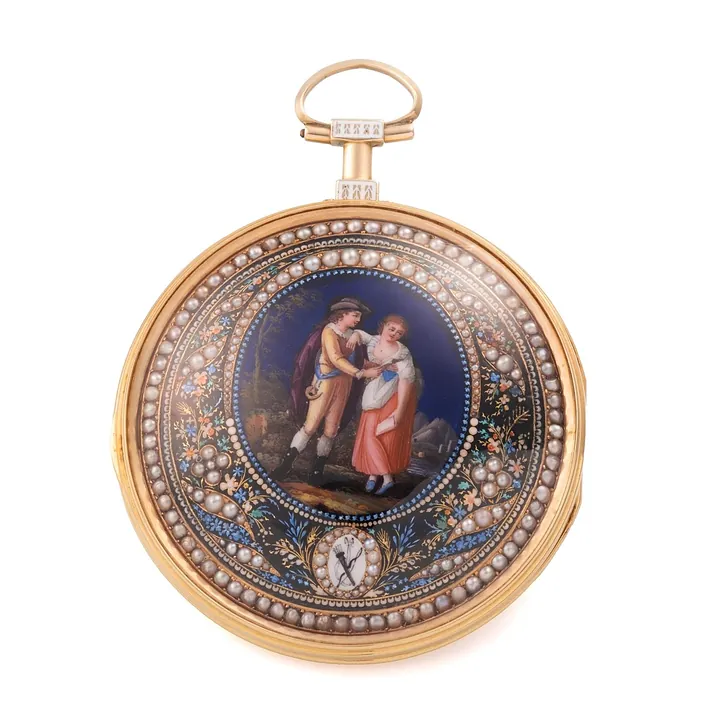
Pocket Watches · c. 1790
Breguet Love Letter, c. 1790
Antiquorum auction archive, Geneva
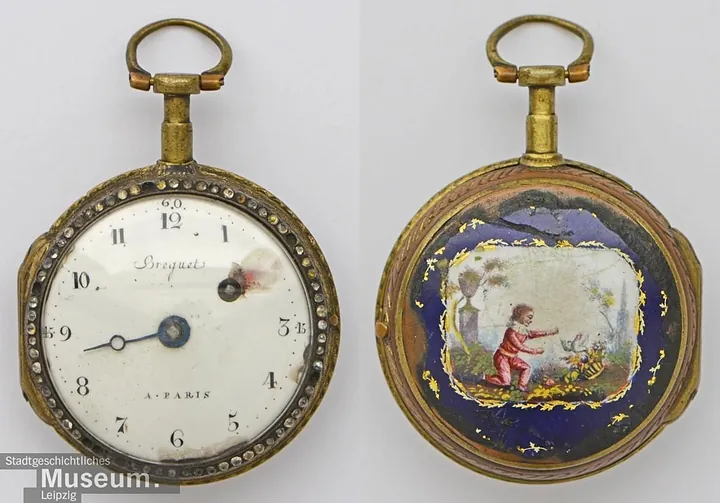
Pocket Watches · 1790
Pocket watch possibly by Breguet, France, 1790
Museum of City History Leipzig
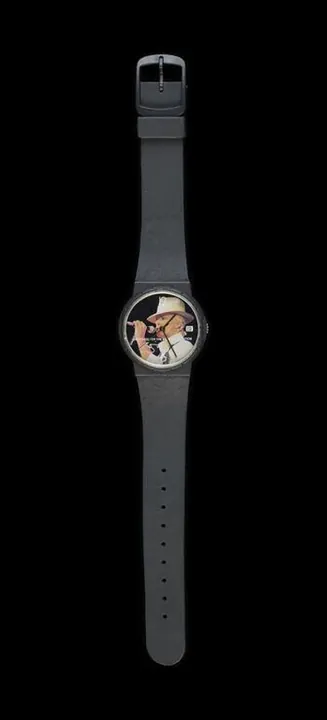
Wristwatches · 1991
Limited edition watch designed by Eta relating to David Bowie's Serious Moonlight live tour, 1991
Victoria and Albert Museum, London

Wristwatches · 2008
Wristwatch by Breitling?, 2008
Museum Rotterdam

Wristwatches · c. 1990s
Audemars Piguet Bamboo, c. 1990s
Antiquorum auction archive, Geneva

Wristwatches · c. 1990
Audemars Piguet Huitieme Perpetual Calendar, ref. 25696PT, c. 1990
Antiquorum auction archive, Geneva