
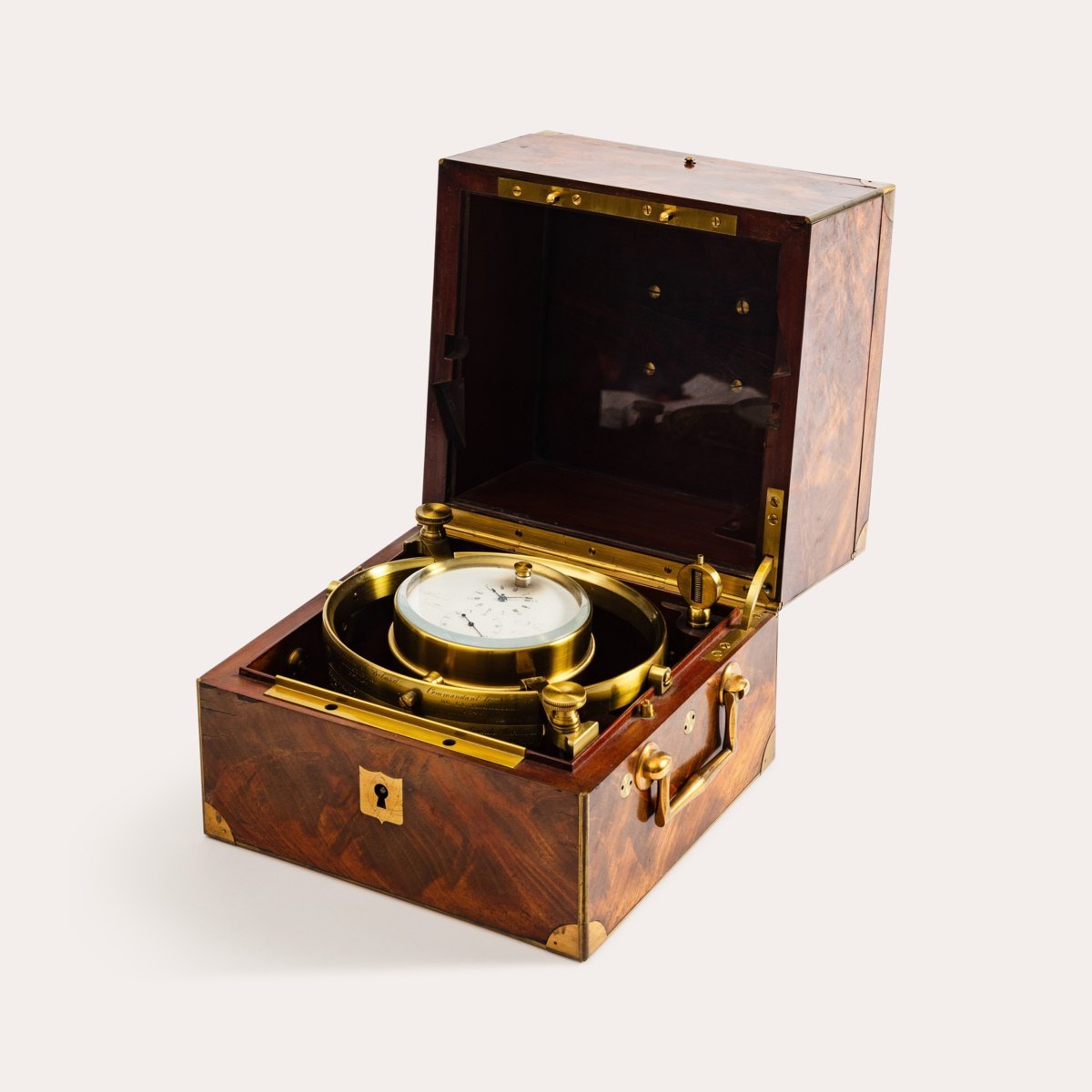
Instruments · Two-day marine chronometer
Breguet No. 4852 Two-Day Marine Chronometer
- Maker / attribution
- Breguet Neveu & Compagnie (source attribution)
- Date
- sold 31 July 1841
- Historical period
- Precision & Scientific Horology (1750 – 1850)
- Country of origin
- France
- Object type
- Two-day marine chronometer
- Auction house
- Sotheby's
- Lot
- 27
- Credit line
- Sotheby's
- Catalogue title (original)
- Horloge Marine à deux Barillets | A brass and mahogany boxed two-day (English)
View the source record (auction lot) ↗ (opens another website in a new tab)Suggest a correction
Record summary
Catalogued by Sotheby's (lot 27), this is a two-day marine chronometer attributed to Breguet Neveu & Compagnie, made in France, dated sold 31 July 1841. The Atlas places it in the Precision & Scientific Horology period (1750 – 1850) of its Instruments collection. The record is illustrated with 1 photograph.
Assembled from the source record's structured fields. Dates and attributions are given as the source states them; where a field is missing the Atlas leaves it blank rather than estimating.
Catalogue description
Original object description
Classified as a two-day marine chronometer manufactured in France, this precision instrument bears serial number 4852 by Breguet Neveu & Compagnie. Suspended inside an oval brass gimbal assembly, it is housed within a mahogany case trimmed in brass edging. The 35-ligne caliber dispenses with a fusee entirely, instead relying on tandem-wound twin going barrels to drive an Earnshaw-type spring detent escapement arranged upon a shuttle-shaped sub-plate. On its silvered dial, standard time and subsidiary running seconds are displayed across two non-concentric registers, situated beneath a protective brass covering over the winding square sited past 12 o'clock. Engraved inscriptions dedicated to Captain J. Bilard and bearing the date February 1841 are present on both the gimbal ring and a decorative plaque mounted on the outer lid. Movement Construction: Caliber number 4852 measures 35 lignes across and achieves its runtime using a pair of tandem-wound mainspring barrels rather than a fusee mechanism. Power is transmitted via intermediate gearing and winding wheels configured with wolf's-tooth ratchet profiles. Attached by three securing screws, an independent navette-form platform accommodates the Earnshaw-pattern spring detent escapement. Regulation is achieved through a free-sprung bimetallic balance featuring threaded timing screws for thermal compensation, working in conjunction with a steel helical balance spring treated to a blued or grey finish. Dial and Case Description: The timepiece is weighted within a cylindrical brass bowl that pivots inside a brass-bound, brass-hinged mahogany transit chest, which also incorporates a matching brass keyhole escutcheon. An integrated glazed port in the lid permits inspection of the silvered dial without opening the casing. Two eccentric sub-registers delineate the primary time and continuous seconds, placed beneath a hinged or fitted brass cap shielding the winding arbor positioned directly above the twelve-hour mark. Provenance and Records: Archival records indicate that Breguet completed the sale of the chronometer on 31 July 1841 to Monsieur G. Lafond, acting for Les Compagnies d'Assurance in Paris. Commemorative inscriptions etched onto the gimbal ring as well as the outer casing plaque document its conferral in February 1841 upon Captain J. Bilard, master of the ship L'ALEXANDRE. Firm ledgers maintained by Breguet document that the instrument returned for workshop maintenance on three distinct occasions, with the final documented servicing entered on 7 December 1859.
Inscriptions & marks
4852
Historical context
Precision & Scientific Horology (1750 – 1850)
Harrison solves longitude; Mudge invents the lever; Breguet's Paris workshop defines the modern watch.
The longitude problem was solved by the marine chronometer and lunar distance methods; dividing engines made precision scales possible, and observatories set time by transit instruments.
Read the period in the timelineMore instruments from this periodEarlier: Early Modern Horology
Atlas type guide
Marine chronometers
A marine chronometer is a precision timekeeper carried at sea to find longitude: the navigator compares local noon, observed with a sextant, with the time at a reference meridian kept by the chronometer. Each hour of difference corresponds to fifteen degrees of longitude. John Harrison proved the method in the 1760s; Pierre Le Roy, Ferdinand Berthoud, John Arnold and Thomas Earnshaw then developed the detent escapement and the compensation balance that made chronometers practical to manufacture.
By the nineteenth century London, Liverpool, Le Locle and Glashütte supplied navies and merchant fleets. A typical box chronometer has a spring-detent escapement, a fusee to equalise mainspring torque, a bimetallic compensation balance with a helical balance spring, and is mounted in gimbals inside a wooden box so that it stays level.
What to look for
- Gimbals and a three-tier wooden box with a glazed inner lid.
- A power-reserve ('up and down') indicator on the dial, usually showing 56 hours on two-day instruments.
- Spring-detent escapement and a cylindrical (helical) balance spring visible through the movement.
- Admiralty or navy marks (broad arrow), and rating certificates from observatories.
- The maker's number on the dial and movement; many makers' registers survive, allowing dating.
Dating clues
- Earnshaw-type spring-detent chronometers became standard after about 1800.
- Auxiliary compensation devices on the balance appear from the mid-nineteenth century.
- Quartz and radio time signals ended routine use of mechanical chronometers in the 1970s and 1980s.
General guidance written by the Atlas editors about this kind of object. It is not a statement about this particular piece; for that, rely on the source record above and on physical examination.
Related records
Instruments · 1751–1850
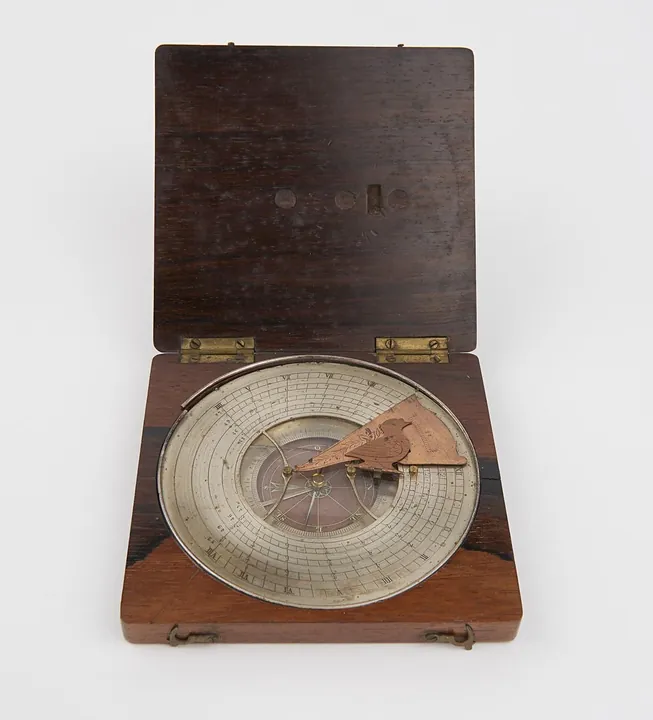
Horizontal compass sundial for latitudes 43 degrees, 46 degrees, 49 degrees, 52 degrees, in rosewood case French, c.1800 Cover glass cracked.
Science Museum Group, London
Instruments · 1751–1850
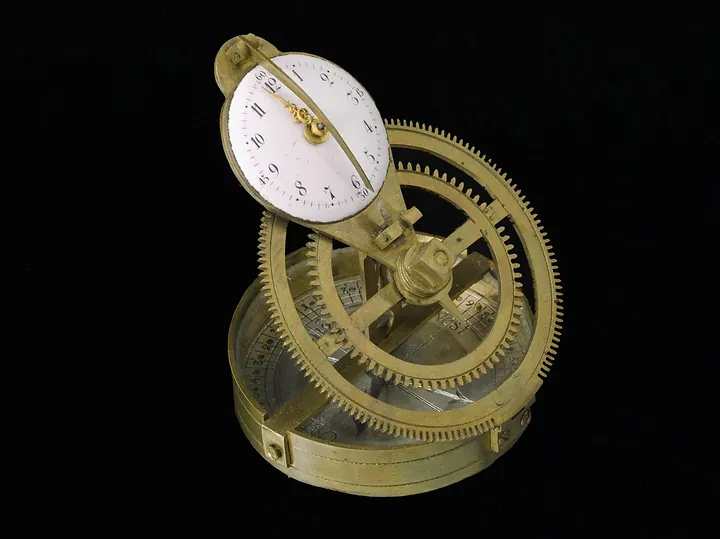
Mechanical equinoctial sundial for latitude 52 degrees, in original card case, one sight missing. French, c.1800
Science Museum Group, London
Instruments · last quarter 18th century
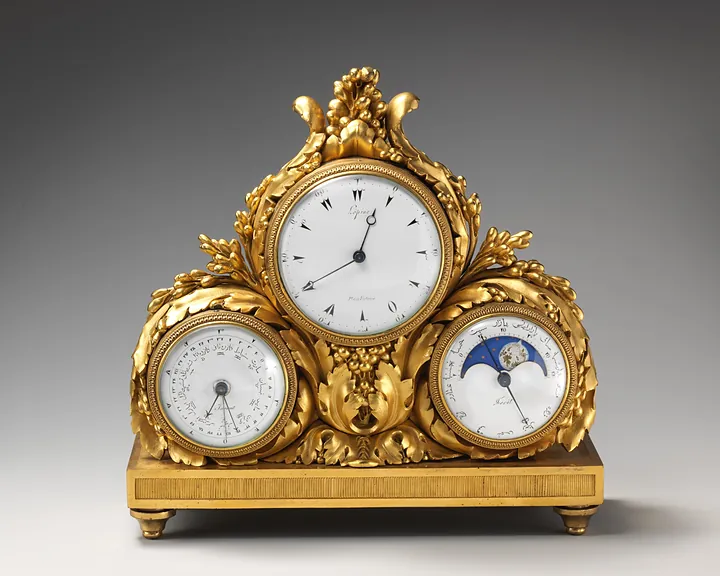
Clock by Jean Antoine Lépine, France, last quarter 18th century
The Metropolitan Museum of Art, New York
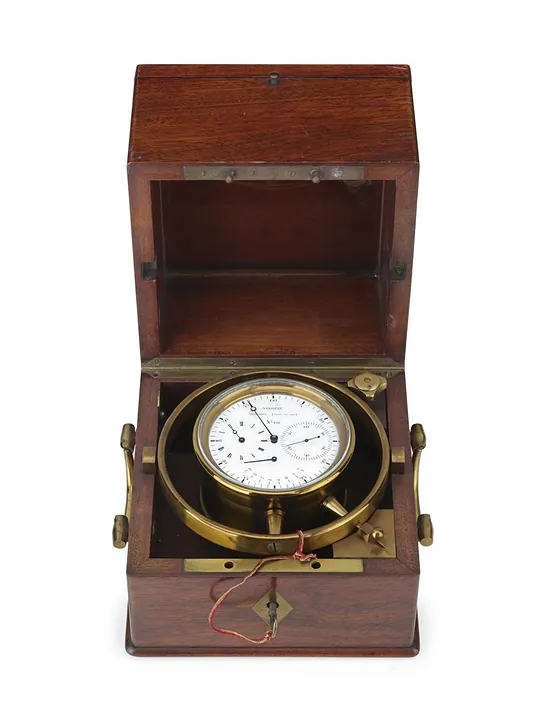
Instruments · 1780–1799
Marine chronometer by Vissière, France, 1780–1799
Science Museum Group, London
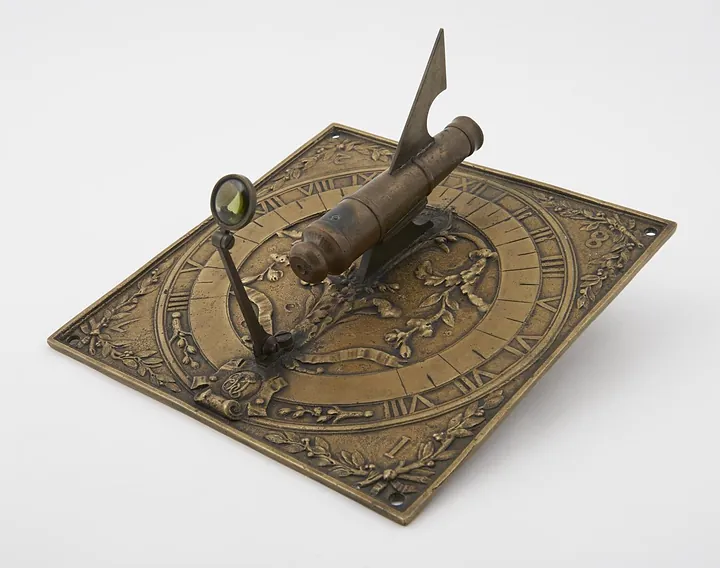
Instruments · 1782
Sundial, gnomon fixed on a cannon over touch hole of which a lens is fixed on a square base, unsigned, French, 1782
Science Museum Group, London
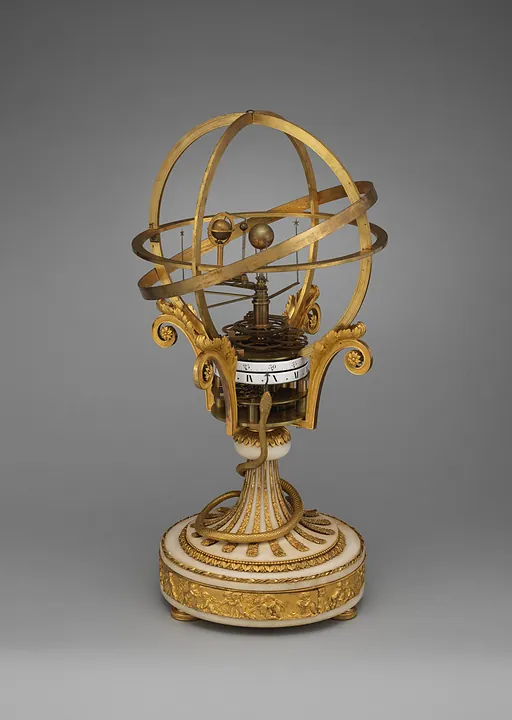
Instruments · 1790
Orrery clock by Louis Thouverez, France, 1790
The Metropolitan Museum of Art, New York
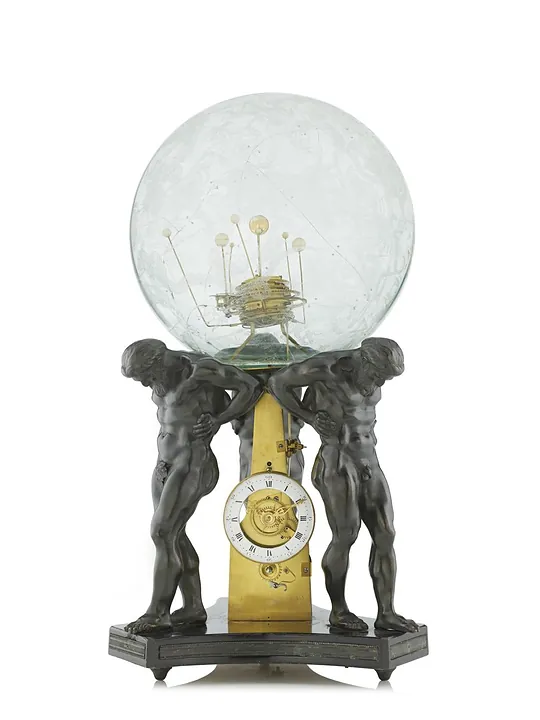
Instruments · 1795–1805
Armillary / astronomical instrument, France, 1795–1805
Science Museum Group, London
Instruments · 1800
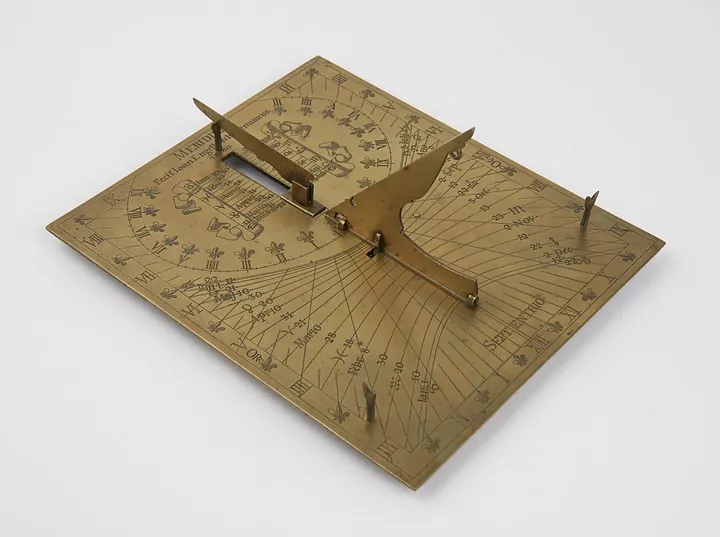
Horizontal and analemmatic sundial, "Engelbrecht, 1800" (plummet missing)
Science Museum Group, London