
Wristwatches · Wristwatch
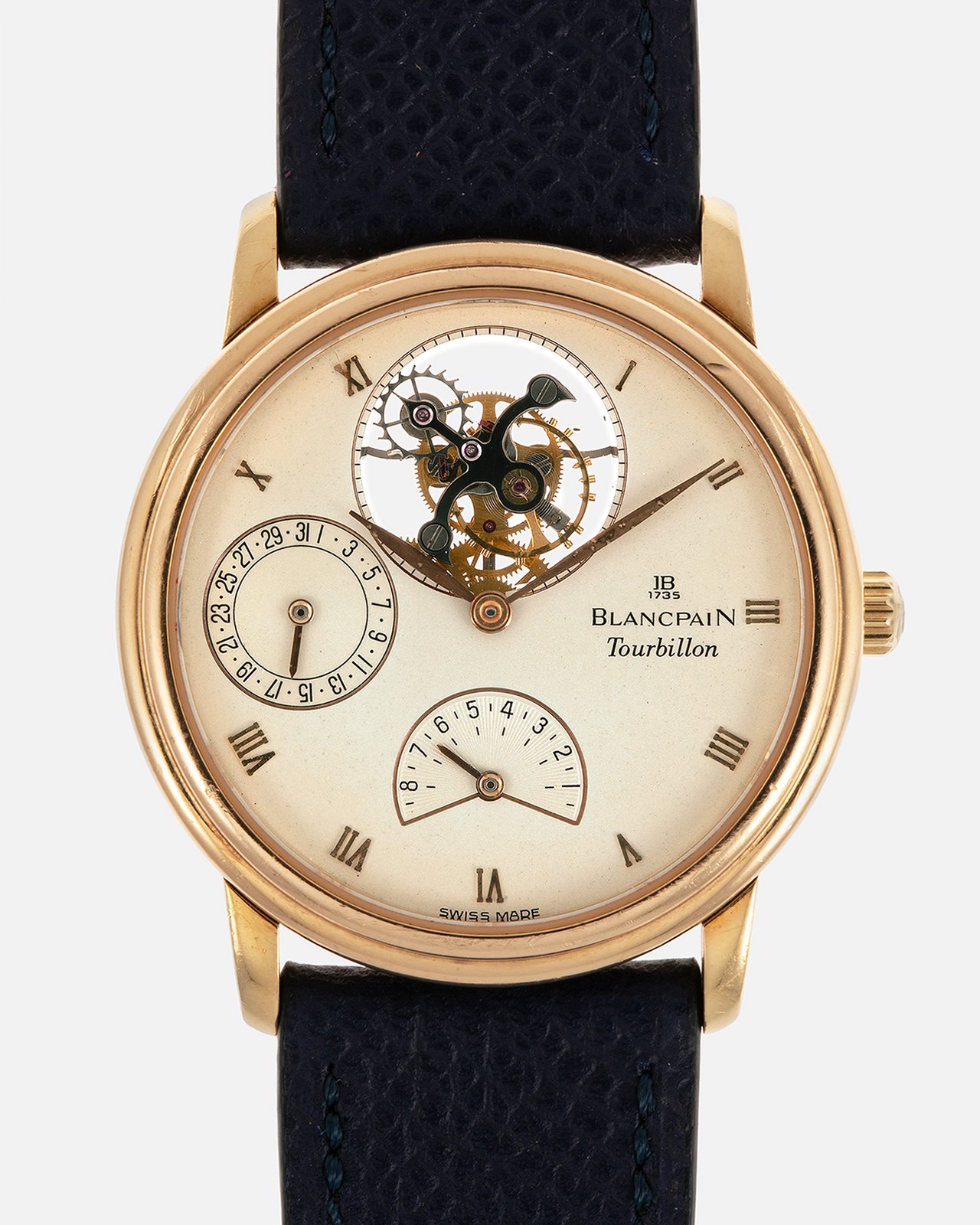
Blancpain Villeret Flying Tourbillon 8 Days 0023-1418-55 YG, 1996
- Maker / attribution
- Blancpain (maker)
- Date
- 1996
- Historical period
- Mechanical Renaissance (1990 – 2010)
- Country of origin
- Switzerland
- Object type
- Wristwatch
- Dimensions
- Case 34 mm
- Stock no.
- Product 7643651244119
- Credit line
- Dealer listing, S.Song Watches (product 7643651244119)
- Catalogue title (original)
- Blancpain Villeret Flying Tourbillon 8 Days 0023-1418-55 YG (English)
View the source record (dealer listing) ↗ (opens another website in a new tab)Suggest a correction
Record summary
Catalogued by S.Song Watches (dealer), Seattle (stock number Product 7643651244119), this is a wristwatch by Blancpain, made in Switzerland, dated 1996. The Atlas places it in the Mechanical Renaissance period (1990 – 2010) of its Wristwatches collection. Recorded dimensions: Case 34 mm. The record is illustrated with 6 photographs.
Assembled from the source record's structured fields. Dates and attributions are given as the source states them; where a field is missing the Atlas leaves it blank rather than estimating.
Catalogue description
Dealer description — S.Song Watches
If you’re in the know, the Blancpain brand we see today is far removed from what it was in the 1990s. During the closing years of the quartz crisis, the brand took a firm stance against quartz, leaned fully into mechanical watchmaking and built its entire identity around traditional complications. Under the stewardship of the legendary duo Jean-Claude Biver and Jacques Piguet, Blancpain produced a focused run of classically restrained, technically serious pieces through the late 80s and early 90s, later grouped as the ‘six masterpieces’: an ultra-thin, calendar moonphase, perpetual calendar, minute repeater, split seconds chronograph, and the flying tourbillon, here in the form of the reference 0023. Starting with its unassuming 34mm Villeret-style case, the 0023 features a double-stepped bezel, a svelte and gently curved caseband, and tapered lugs that sit elegantly on the wrist. The design follows one of Blancpain’s most consistent case codes, prioritising proportion over visual weight. The compact dimensions and controlled lines keep the profile thin and place all emphasis on the dial. Roman numerals here are clean and evenly spaced, with the open tourbillon aperture set at 12:00, while the date indication at 9:00 and power reserve at 6:00 are both spaciously arranged to avoid crowding the dial. Beneath that restrained exterior sits the manually wound Cal. 23, developed in collaboration with Vincent Calabrese, a celebrated watchmaker and co-founder of the AHCI (Académie Horlogère des Créateurs Indépendants). He is best known for creating the Corum Golden Bridge, which pioneered a minimalist, spatial approach to movement design. That approach is clearly reflected here in the Cal. 23, which was, at launch, among the earliest flying tourbillons adapted for a wristwatch and one of the thinnest, with the case measuring just 7.4mm. From a technical standpoint, the tourbillon here is executed in a true flying configuration, with the cage supported only from the rear and left unobstructed on the dial side, exposing only the balance wheel and escapement. The concept traces back to Abraham-Louis Breguet, who invented the tourbillon in 1795 as a means to average out positional errors through constant rotation of the escapement. Here, that principle is adapted and applied with minimal visual interruption, using a compact rear bridge with a single ball bearing to support the tourbillon carriage from underneath. Despite its ultra-thin architecture, the Cal. 23 delivers a whopping eight-day power reserve on a full wind. Produced in a total run of 99 pieces across yellow gold, white gold, and platinum, the 0023 is a reference that reflects Blancpain’s post-quartz revival, when the focus was purely on advancing traditional watchmaking without spectacle. On the wrist, it does not present as an eye-catching showpiece, but rather a quiet demonstration of the brand’s technical capability to produce something of this calibre, and that is precisely the point. If you know, you know. Through the caseback, the tourbillon remains the only visible component, with engravings beneath the aperture window indicating its serial number, here numbered “1”, which I think is a particularly desirable detail for a reference of this rarity and importance. It is also marked “three precious metals”, a detail which indicates that this piece was sold as a set with its white gold and platinum counterpart. The case shows honest wear, while the hallmarks remain sharp and fully legible, indicating how well it has been preserved. In my mind, the 0023 is a strong representation of the spirit of 1990s watchmaking, a period that felt modern and progressive at the time as brands pushed to reestablish themselves after the quartz crisis, and one that continues to stand as a defining era for watchmaking in hindsight.
Historical context
Mechanical Renaissance (1990 – 2010)
Mechanical watches return as cultural objects; independent watchmaking flourishes.
Mechanical watches returned as cultural and luxury objects. Complications, tourbillons and new materials proliferated; independent watchmakers such as George Daniels, F.P. Journe and Philippe Dufour revived artisanal watchmaking; collecting vintage watches became a major field.
Read the period in the timelineMore wristwatches from this periodEarlier: Quartz Revolution
Atlas type guide
Wristwatches
Bracelet watches were worn by women from the early nineteenth century — Breguet made one for Caroline Murat, Queen of Naples, in 1810–12 — but the wristwatch only became a man's instrument with military use and aviation in the early twentieth century. Between the World Wars it overtook the pocket watch; the 1920s and 1930s brought rectangular Art Deco cases, water-resistant cases and the first automatic winding systems.
After 1945 the wristwatch became a carrier of identity — dress watches, sports and dive watches, chronographs, calendars — produced by Swiss, American, Japanese, German, Soviet and Chinese industries. The quartz revolution after 1969 and the mechanical renaissance since the 1990s, including the rise of independent watchmakers, complete the story.
What to look for
- The reference number (between the lugs or inside the case back) and serial number, the starting point for dating.
- The calibre: its maker and number are often stamped under the dial or on the bridge.
- Originality of dial, hands and crown — refinished ('redial') dials are common.
- Case material marks: 18K/750, 14K/585, stainless steel, gold-filled, plated.
Dating clues
- Wire-lug cases: before c. 1925.
- Water-resistant screw-down cases: from 1926.
- Quartz movements: from 1969; sapphire crystals widespread after c. 1980.
General guidance written by the Atlas editors about this kind of object. It is not a statement about this particular piece; for that, rely on the source record above and on physical examination.
Related records
Clocks · c. 2010
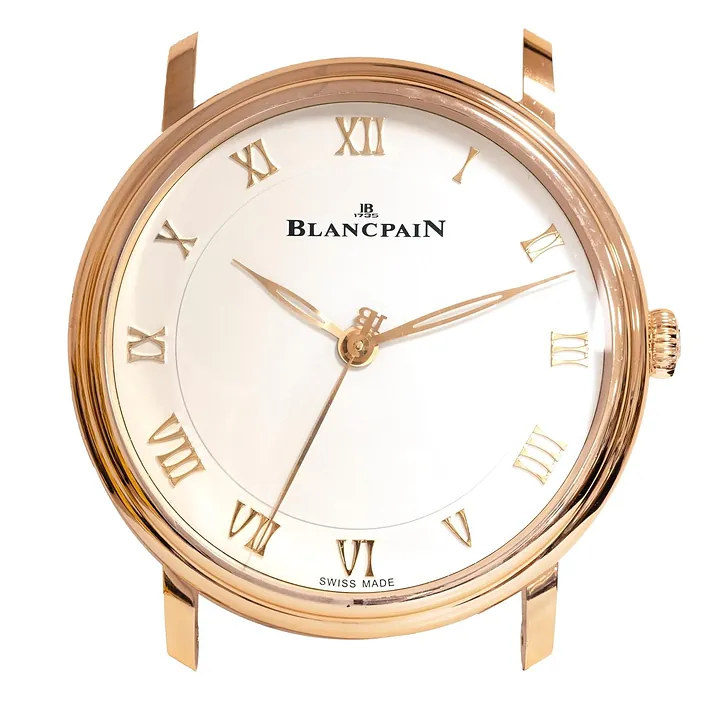
Blancpain clock, c. 2010
Antiquorum auction archive, Geneva
Wristwatches · c. 1930
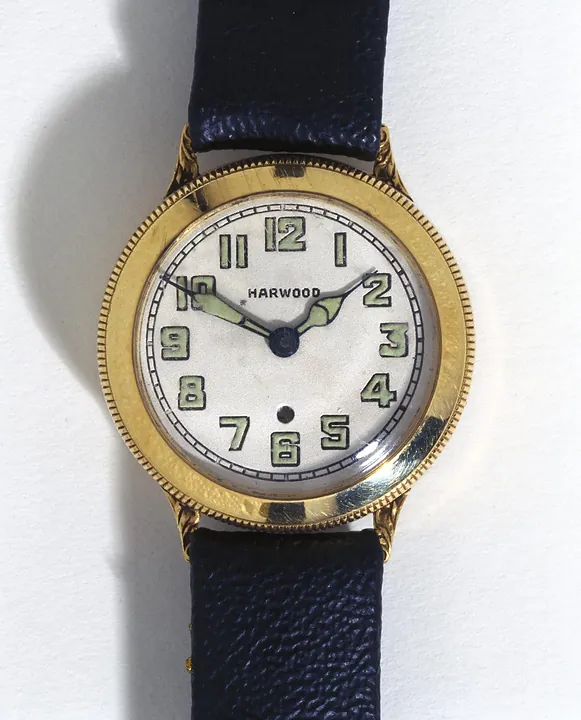
Wristwatch by J. Harwood and Son and Blancpain, Switzerland, c. 1930
Science Museum Group, London
Wristwatches · c. 1930
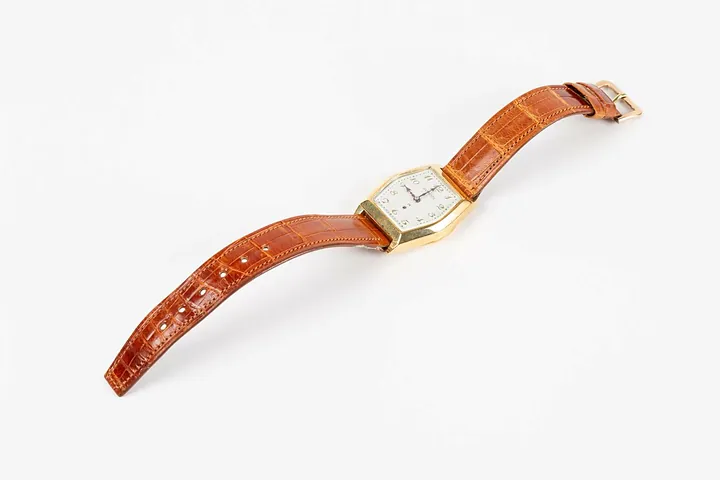
Wristwatch by Harwood (Société Centrale de la Montre Sans Remontoir), Switzerland, c. 1930 (no. 58042)
German Clock Museum
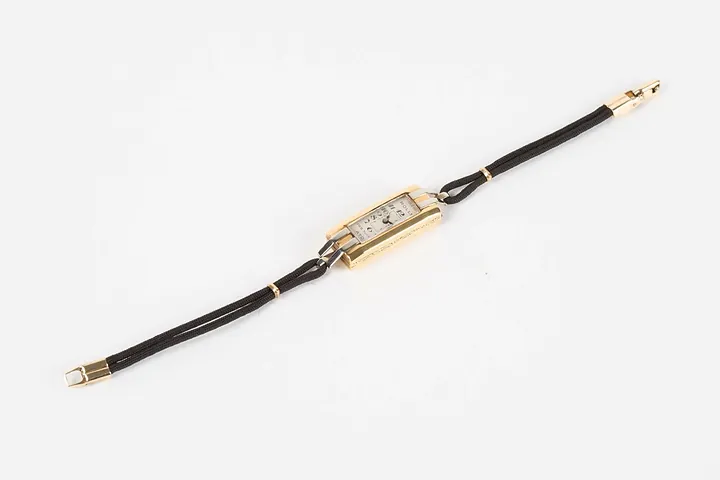
Wristwatches · c. 1932
Wristwatch by Blancpain, Switzerland, c. 1932
German Clock Museum

Wristwatches · 2008
Wristwatch by Breitling?, 2008
Museum Rotterdam

Wristwatches · c. 1990s
Audemars Piguet Bamboo, c. 1990s
Antiquorum auction archive, Geneva

Wristwatches · c. 1990
Audemars Piguet Huitieme Perpetual Calendar, ref. 25696PT, c. 1990
Antiquorum auction archive, Geneva

Wristwatches · c. 1990
Breitling Chronomat, ref. b13050.1, c. 1990
Antiquorum auction archive, Geneva