
Clocks · Astronomical regulator
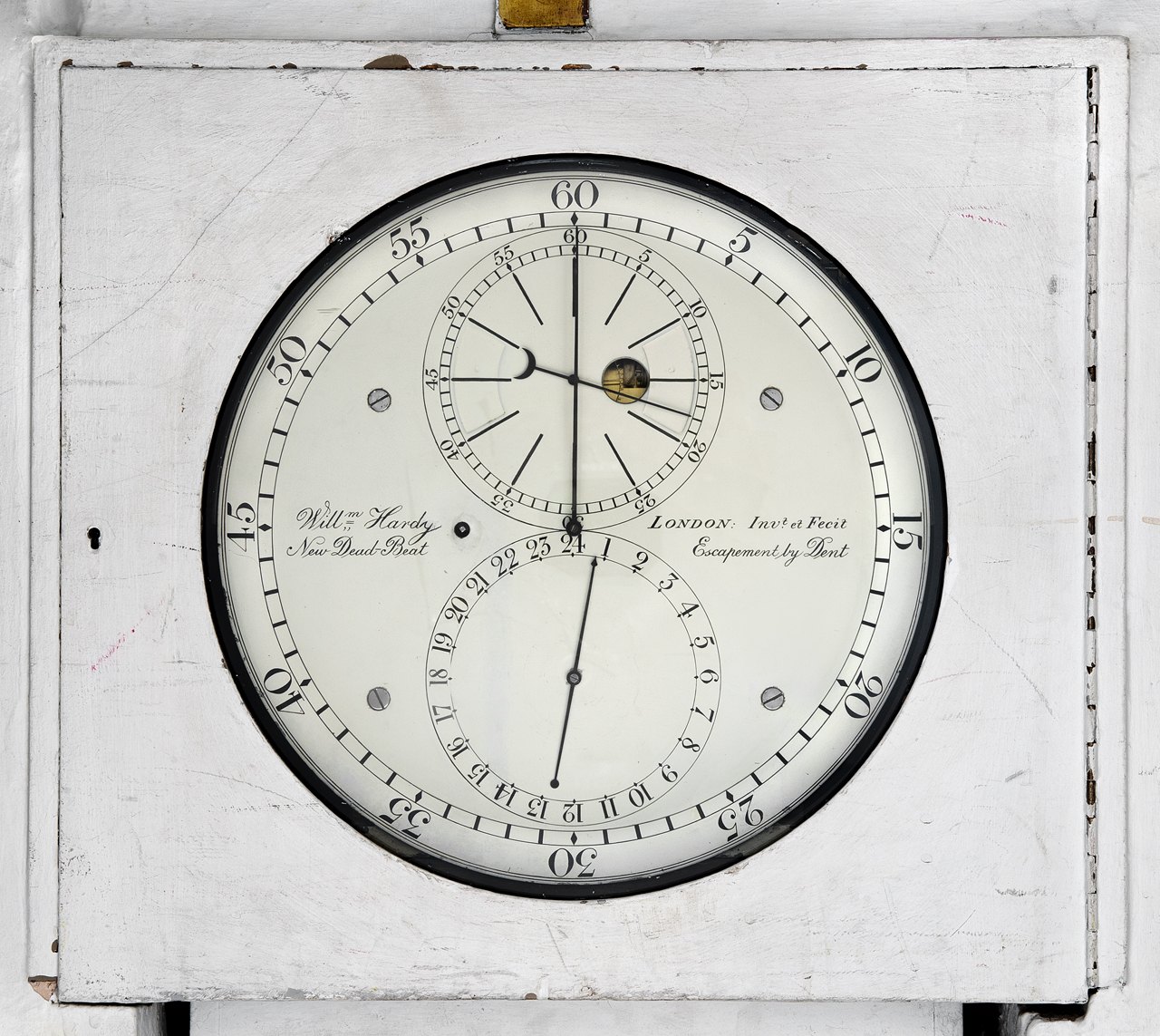
An eight-day sidereal regulator, mounted within a stone block at the southern end of the Airy transit circle by William Hardy, London, circa 1811
- Maker / attribution
- William Hardy (maker)
- Date
- c. 1811
- Historical period
- Precision & Scientific Horology (1750 – 1850)
- Country of origin
- England
- Place
- London
- Object type
- Astronomical regulator
- Dimensions
- Overall: 1000 x 300 x 200 mm
- Holding institution
- Royal Museums Greenwich
- Accession / object no.
- ZAA0591
- Credit line
- National Maritime Museum, Greenwich, London
- Catalogue title (original)
- An eight-day sidereal regulator, mounted within a stone block at the southern end of the Airy transit circle by William Hardy, London, circa 1811 (English)
View the source record ↗ (opens another website in a new tab)Suggest a correction
Record summary
Held and catalogued by Royal Museums Greenwich (object number ZAA0591), this is an astronomical regulator by William Hardy, made in London, England, dated c. 1811. The Atlas places it in the Precision & Scientific Horology period (1750 – 1850) of its Clocks collection. Recorded dimensions: Overall: 1000 x 300 x 200 mm. The record is illustrated with 6 photographs.
Assembled from the source record's structured fields. Dates and attributions are given as the source states them; where a field is missing the Atlas leaves it blank rather than estimating.
Catalogue description
Catalogue description — Royal Museums Greenwich
An eight-day sidereal regulator, mounted within a stone block at the southern end of the Airy transit circle by William Hardy, London, circa 1811. This regulator is significant as it was the first of Hardy’s regulators with spring pallet escapement to be built. Prior to its commission in 1809 William Hardy submitted a longcase regulator fitted with his own spring pallet escapement for testing at the Royal Observatory. Pleased with its performance the then Astronomer Royal, Dr Nevil Maskelyne (1732-1811), recommended that the board of ordnance commission Hardy to manufacture an exceptional astronomical regulator to accompany Troughton’s ten-foot transit instrument (the mural circle) which was already being constructed. Hardy set to making the regulator with great enthusiasm sparing no expense or effort. It appears that he ordered the unfinished movement from Leyland of Prescot to whom he supplied the cutters to provide truly epi-cycloidal teeth. Hardy’s method of producing the cutters is described in Gill’s 'Machinery Improved' which was published in 1839. Today the gearing still runs very smoothly when the escapement is removed; in a fitting testament to its quality Charles Frodsham remarked in volume XXVIII of the 'Horological journal' ‘wheelwork in Hardy’s regulators is among the best in England, and the shape of the wheels and pinions makes the most perfect gearing I ever witnessed’. Dr Maskelyne died before the clock was delivered to the Royal Observatory and his successor, John Pond (1767-1836), questioned the £325 bill referring it to the Royal Society for scrutiny. Various clockmakers were consulted including the eminent retired clockmaker, Alexander Cumming, who interviewed Hardy. In the end Hardy accepted payment of £200 but as Cumming had suggested in his letter to W.H. Wollaston, dated 19 January 1812, the prestige in making such an important timekeeper led to further commissions. Two regulators of the same design were purchased in 1812 by F.R. Hassler for use in the American coastal survey. The regulator was initially used in the circle room until 1823 when it was moved to the transit room. Hardy’s escapement performed extraordinarily well in the short term. However, for the escapement to function properly good lubrication is critical and if allowed to run dry the escapement will not function consistently and the rate will become erratic. About 1830 the Astronomer Royal sent for Hardy to attend to the clock but for reasons unknown Hardy did not respond quickly and the clock was entrusted to E.J. Dent who replaced the spring pallet escapement with a deadbeat escapement and also added his own name to the clock dial. Hardy was mortified that Dent should be allowed to alter the clock in this way and complained to the Royal Society. In 1850 the regulator was removed from its case and housed within the stone block at the southern end of Airy’s transit pit; four years on Dent installed the electrical contacts connecting the movement to his galvanic chronograph. The jewelled dead beat escapement has deliberately large drops; the electrical impulses are given during the moment of drop so as to reduce any chance of the contacts interfering with the rate of the pendulum. The movement is now in the same form as it was when it was used by the Sir George Biddell Airy. The Hardy transit clock continued to be used for observations until the observatory was relocated in Herstmonceux in 1957. The movement has exceptionally thick (7mm) arched brass plates are united by five heavy pillars riveted to the backplate and secured by domed blued steel screws with shouldered brass washers. The finely constructed six-wheel train is driven by brass cased weight with integral pulley and triple pulley system to compensate for the short drop of the pendulum chamber. The double line runs on a turned barrel with a sprung C-shaped stop iron mounted to the front flange with a chamfered push piece lying across the nineteenth turn. The barrel is also fitted with Harrison’s maintaining power, a great wheel and a second wheel driving the large hour wheel. All wheels have six straight crossings and are of light construction. The dead-beat escapement with jewelled brass pallets is mounted on the backplate; a sixty-tooth contact wheel with one blank division is mounted to escape wheel arbor between the frontplate and the dial with corresponding view aperture cut into the dial plate. The half-second and minute galvanic impulses were recorded on a drum chronograph to meter the astronomer’s observations recorded by a hand-held push button. The seconds beating zinc tube type temperature compensated pendulum has a knurled and graduated rating nut and is suspended from a Troughton frame mounted to the cast iron seatboard. The twelve inch circular painted dial is signed “Willm. Hardy Inv. et Fecit, New Dead-Beat escapement by Dent”. The outer minute track having arabic five-minute markers enclosing a seconds subsidiary dial with observatory marks and shuttered viewing aperture for the electrical contacts over a twenty four-hour subsidiary. Both subsidiary dials have painted steel counterpoised hands alongside a tapering minute hand.
Historical context
Precision & Scientific Horology (1750 – 1850)
Harrison solves longitude; Mudge invents the lever; Breguet's Paris workshop defines the modern watch.
The age of the deadbeat escapement, compensated pendulums and observatory regulators. Domestic clocks spread through the middle classes: English longcase and bracket clocks, French gilt-bronze mantel clocks, Viennese Biedermeier wall clocks, Black Forest painted-shield clocks, and the first American shelf clocks.
Read the period in the timelineMore clocks from this periodEarlier: Early Modern Horology
Atlas type guide
Regulators, wall and Vienna clocks
A regulator is a precision pendulum clock used as a time standard in observatories, workshops and railway offices. Typical features are a deadbeat or Graham escapement, a temperature-compensated pendulum (mercury jar, gridiron or later invar), maintaining power and a regulator dial that separates hours, minutes and seconds. George Graham's deadbeat escapement (c. 1715) and his mercury pendulum, together with Harrison's gridiron, set the pattern for two centuries.
Wall clocks span a much wider range: the elegant Viennese Laterndluhr and Dachluhr of the Biedermeier period, the Dutch stoelklok and staartklok, English 'dial' clocks used in schools, offices and railway stations, and mass-produced spring and weight wall clocks from Germany (Gustav Becker, Junghans, Kienzle) and America.
What to look for
- Deadbeat escapement and compensated pendulum (gridiron rods, mercury jar or wood rod).
- A regulator dial with a large central minute hand and separate hour and seconds dials.
- Vienna regulators: glazed cases, slender pendulum, small weights, enamel two-piece dials.
- German factory trademarks stamped on the backplate (e.g. Gustav Becker anchor and crown, Junghans star).
Dating clues
- Graham-type deadbeat regulators: from c. 1720.
- Viennese Laterndluhr: c. 1800–1850.
- German factory 'Vienna-style' regulators: c. 1870–1930; Gustav Becker serial numbers allow close dating.
General guidance written by the Atlas editors about this kind of object. It is not a statement about this particular piece; for that, rely on the source record above and on physical examination.
Related records
Clocks · c. 1825
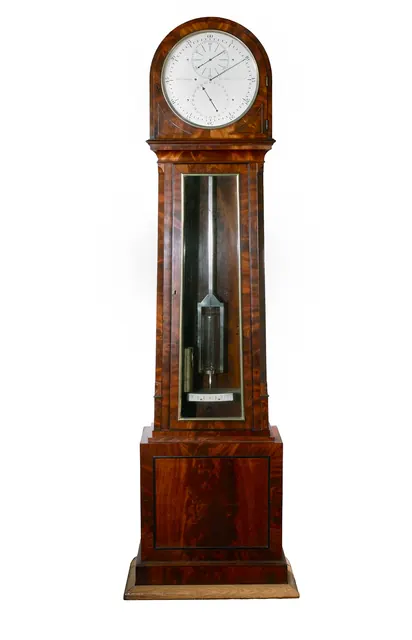
An eight-day duration mahogany longcase sidereal regulator, by William Hardy, London, circa 1825
Royal Museums Greenwich
Instruments · 1800–1810
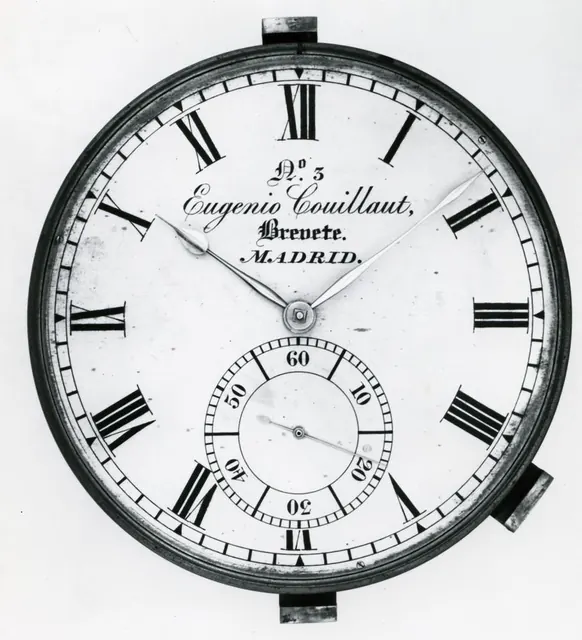
Marine chronometer by William Hardy
British Museum
Clocks · 1740–1760
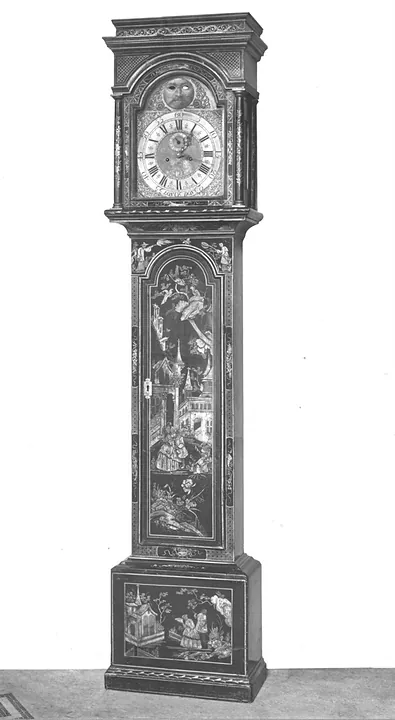
Longcase clock, English, 1740–1760, japanned wood, John Ellicott
Victoria and Albert Museum, London
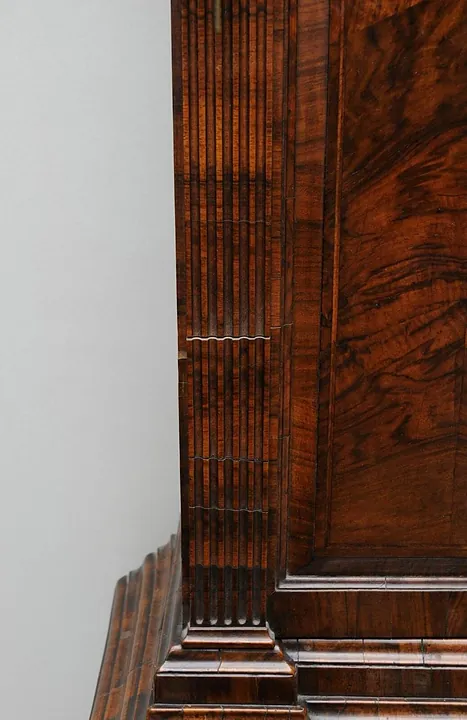
Clocks · c.1750
Long-case clock, English, ca. 1750, by Richard Peyton of Gloucester
Victoria and Albert Museum, London
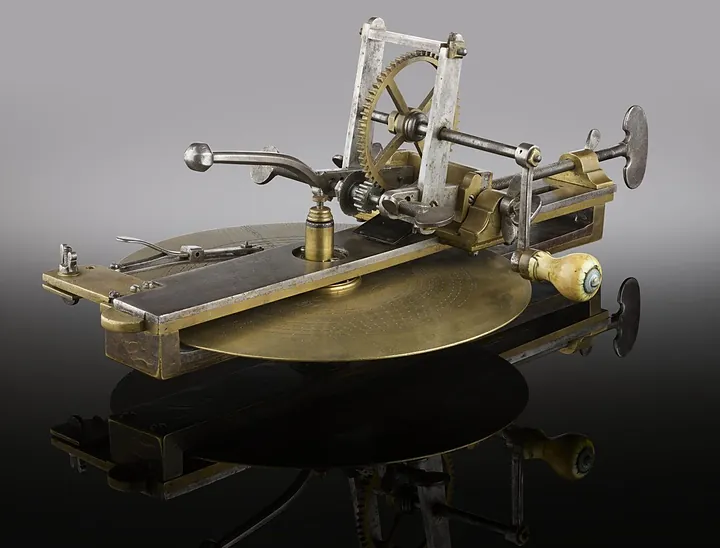
Clocks · 1751
Large wheel engine, signed and dated "John Tipping, Whildon Green, 1751".
Science Museum Group, London
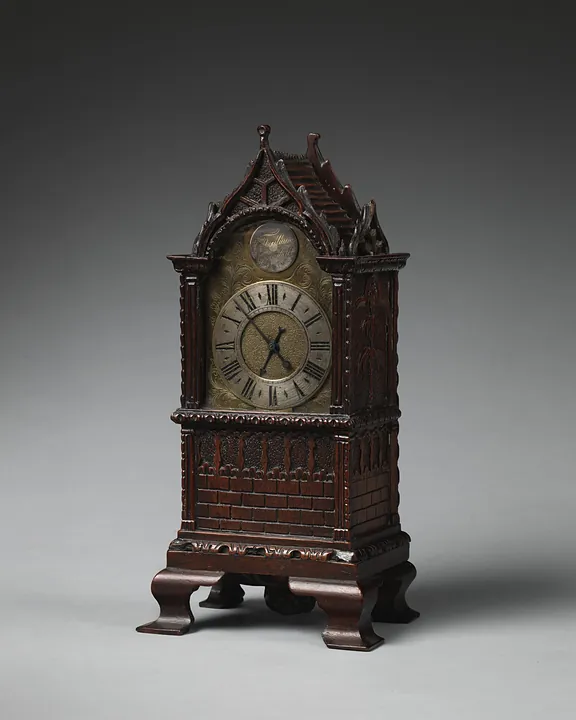
Clocks · 1755
Bracket clock by John Fordham, England, 1755
The Metropolitan Museum of Art, New York
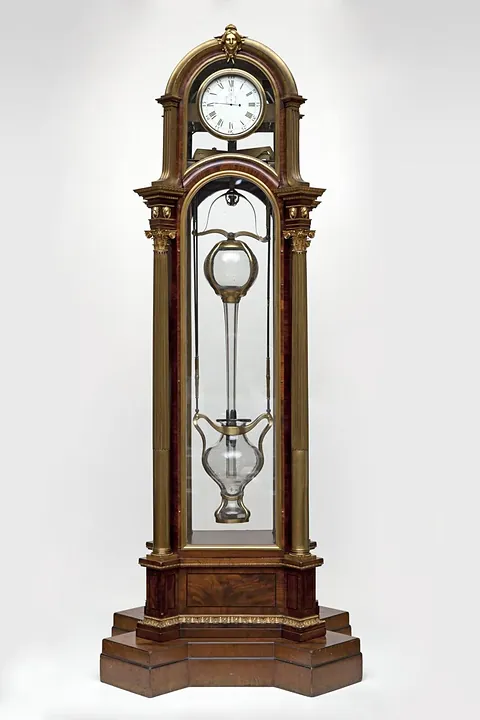
Clocks · c. 1760
Longcase clock by James Cox, England, c. 1760
Victoria and Albert Museum, London
Clocks · 1766
Clock by Alexander Cumming, England, 1766
Science Museum Group, London