
Horological History · Historical feature
The Wrist Chronograph, 1913–1975: Monopushers, Compax and the Race to the Automatic
How a stopwatch was moved to the wrist, given a second pusher, calendars and slide rules, and finally an automatic winding rotor in 1969 — told through nineteen chronographs in the catalogue, from an Omega sold in 1913 to a Lemania made for the British forces.
Atlas Editorial · · 11 min read
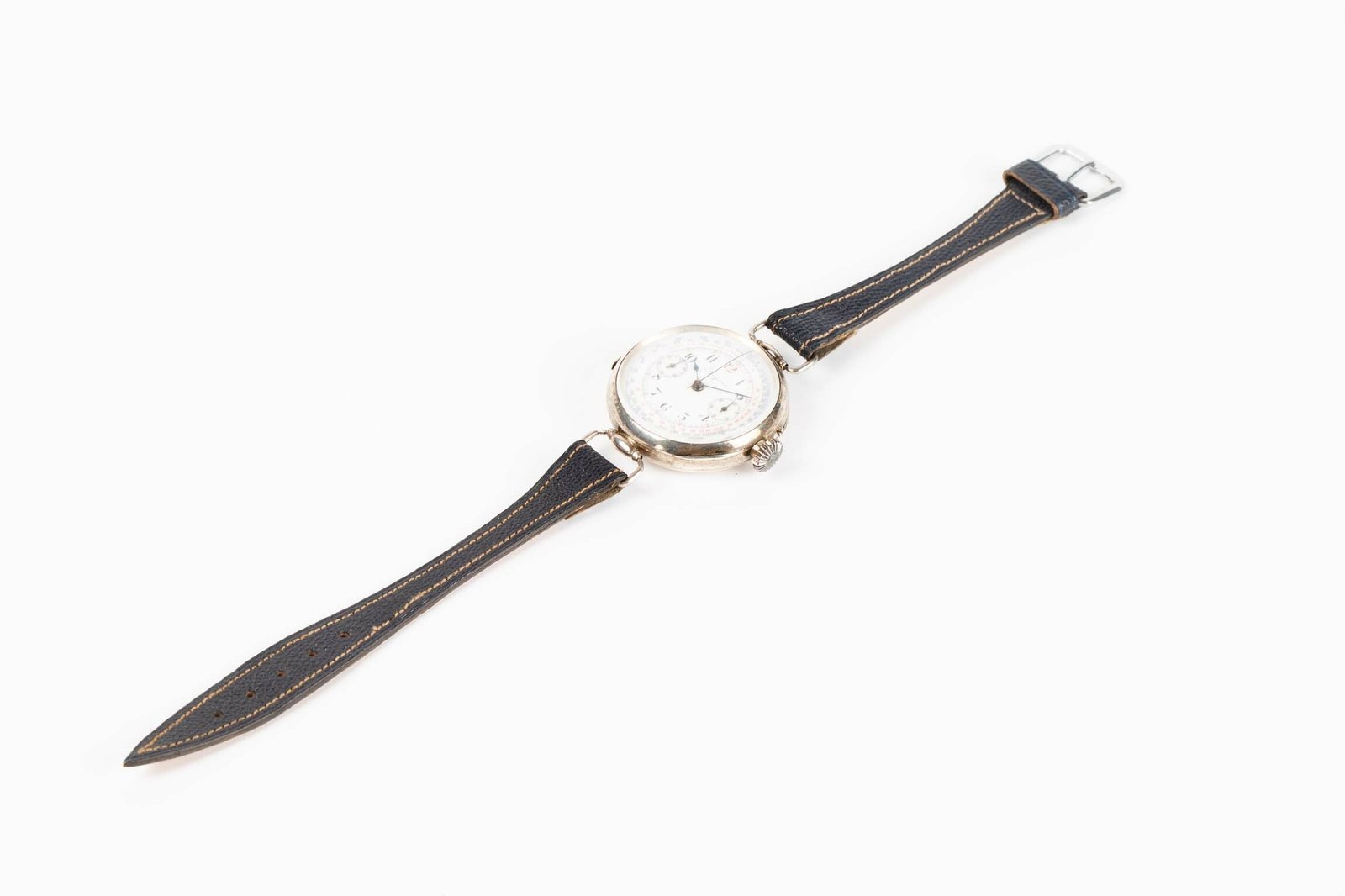
German Clock Museum · CC BY-SA — permission review · source (opens another website in a new tab)
A chronograph is a watch with a second, independent hand that can be started, stopped and returned to zero without stopping the watch itself. Chronograph pocket watches were made in the nineteenth century for doctors taking pulses, artillery officers timing shells, and racegoers timing horses. Moving that mechanism onto the wrist took almost the whole of the twentieth century to perfect: first a single pusher in the crown, then a second pusher, then counters for minutes and hours, calendars, slide rules and finally, in 1969, a self-winding rotor.
This feature follows that development through objects in the Atlas catalogue. Most are auction lots from the Antiquorum archive, whose records give the calibre, case and movement numbers and often an extract from the maker's archive; a few are museum objects. The dates and details below come from those records. Where a record says 'sold in' a year, that is the date the maker's archive gives for the original sale, which is the closest evidence for the date of manufacture.
How a chronograph works
The chronograph mechanism sits on top of an ordinary watch movement. A wheel on the fourth-wheel arbor of the watch, which turns once a minute, drives the chronograph through a coupling. When the user presses the start pusher, the coupling engages and the central chronograph seconds hand begins to turn; at each revolution a finger advances a minute counter by one division. Pressing stop disengages the coupling and brakes the chronograph wheel. Pressing reset drops hammers onto heart-shaped cams on the chronograph arbors, which spin the hands back to zero whatever their position.
The sequence of start, stop and reset is controlled in one of two ways. Traditional Swiss chronographs used a column wheel — a small castellated wheel that turns one step with each press and whose pillars lift or lower the levers. From the 1930s cheaper cam-operated designs, pioneered by Landeron, did the same job with a stamped cam; the Valjoux 7750 of the 1970s, still the most common mechanical chronograph, uses a cam. The coupling itself can be a lateral (horizontal) clutch, with a sliding wheel that meshes with the chronograph wheel, or a vertical clutch, a friction disc that avoids the hand jumping at start.
| Term | Meaning |
|---|---|
| Monopusher (single-button) | One pusher, usually in the crown, cycles start → stop → reset |
| Two-pusher | Separate start/stop and reset pushers, so the user can stop and restart without resetting |
| Flyback (retour en vol) | Pressing reset while running returns the hand to zero and restarts it at once |
| Split-seconds (rattrapante) | A second chronograph hand that can be stopped independently to time two events |
| Register / counter | Subsidiary dial counting minutes (15, 30 or 45) or hours (12) |
| Tachymeter scale | Converts elapsed time over a measured distance into speed |
| Telemeter scale | Converts time between seeing and hearing an event into distance (speed of sound) |
| Pulsometer scale | Converts time for a given number of heartbeats into beats per minute |
1913–1930: the stopwatch on the wrist
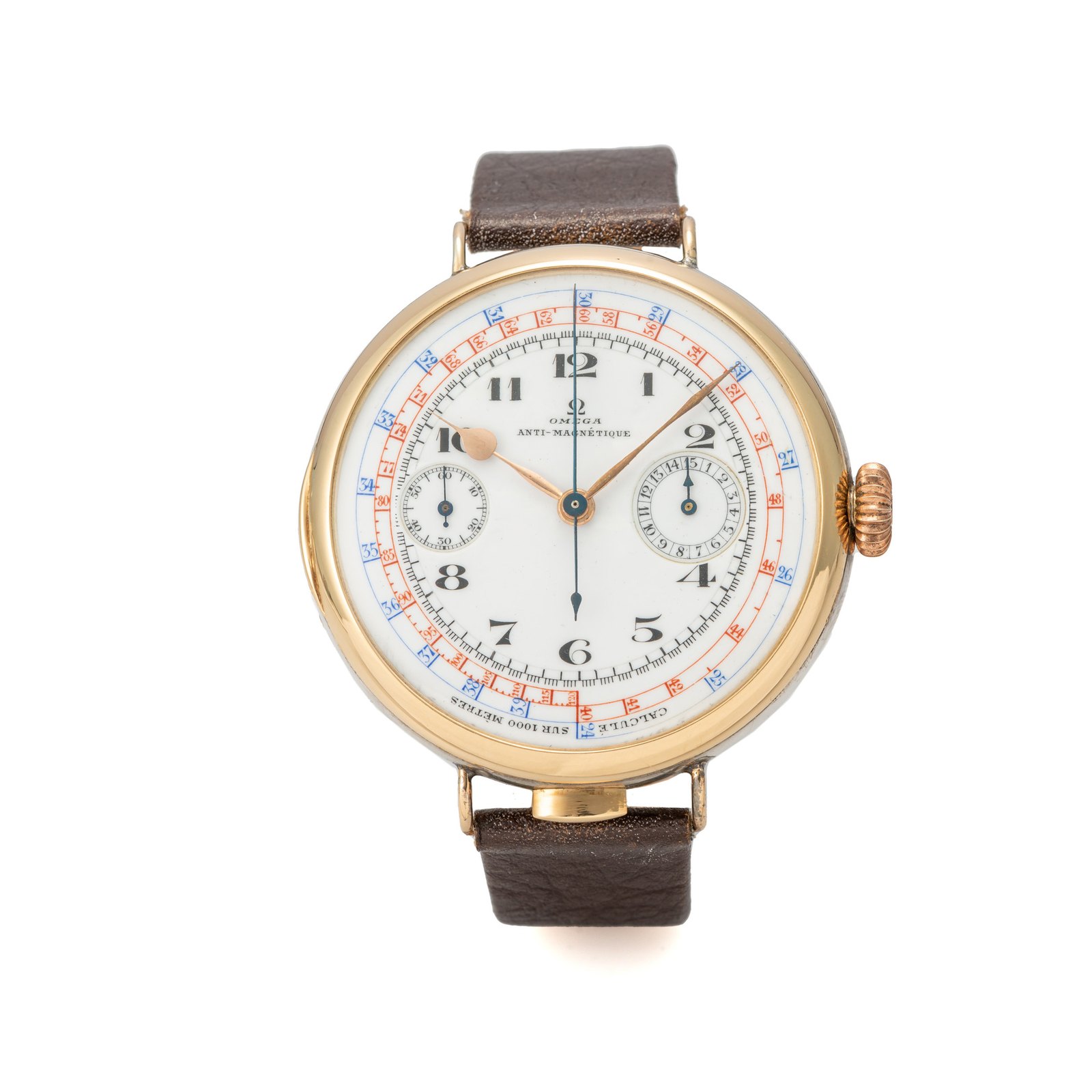
The first wrist chronographs were essentially small pocket chronographs in a case with wire lugs. Omega and Longines both produced wrist chronographs in 1913. The catalogue's earliest example is an Omega with an 18-ligne chronograph movement — 18''' CHRO — in a 46 mm silver and gold case with an enamel dial; the extract from Omega's archive accompanying the lot records that it was sold in France in December 1913. Like almost all early wrist chronographs it is a monopusher: the single button in the crown starts, stops and resets the hand in turn.
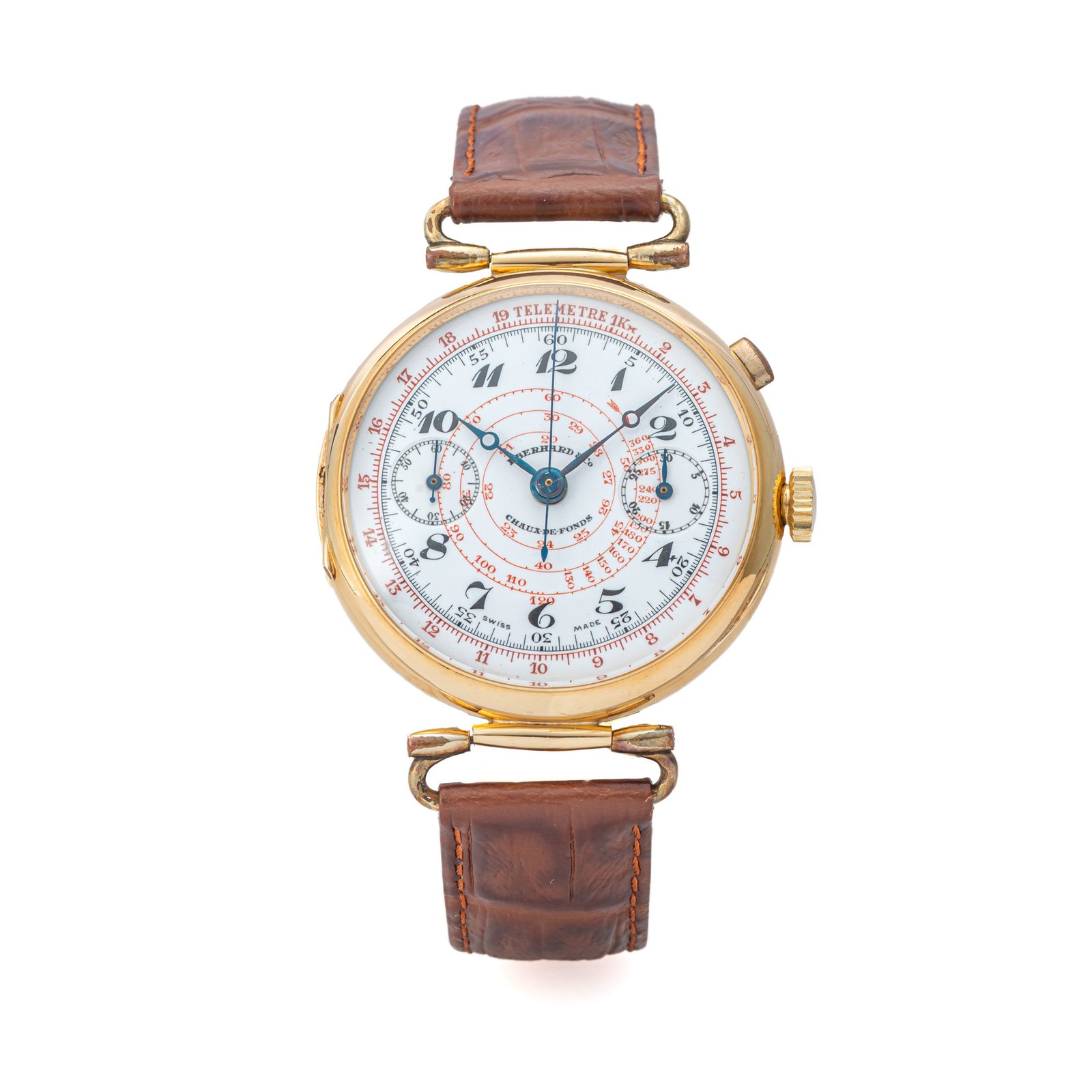
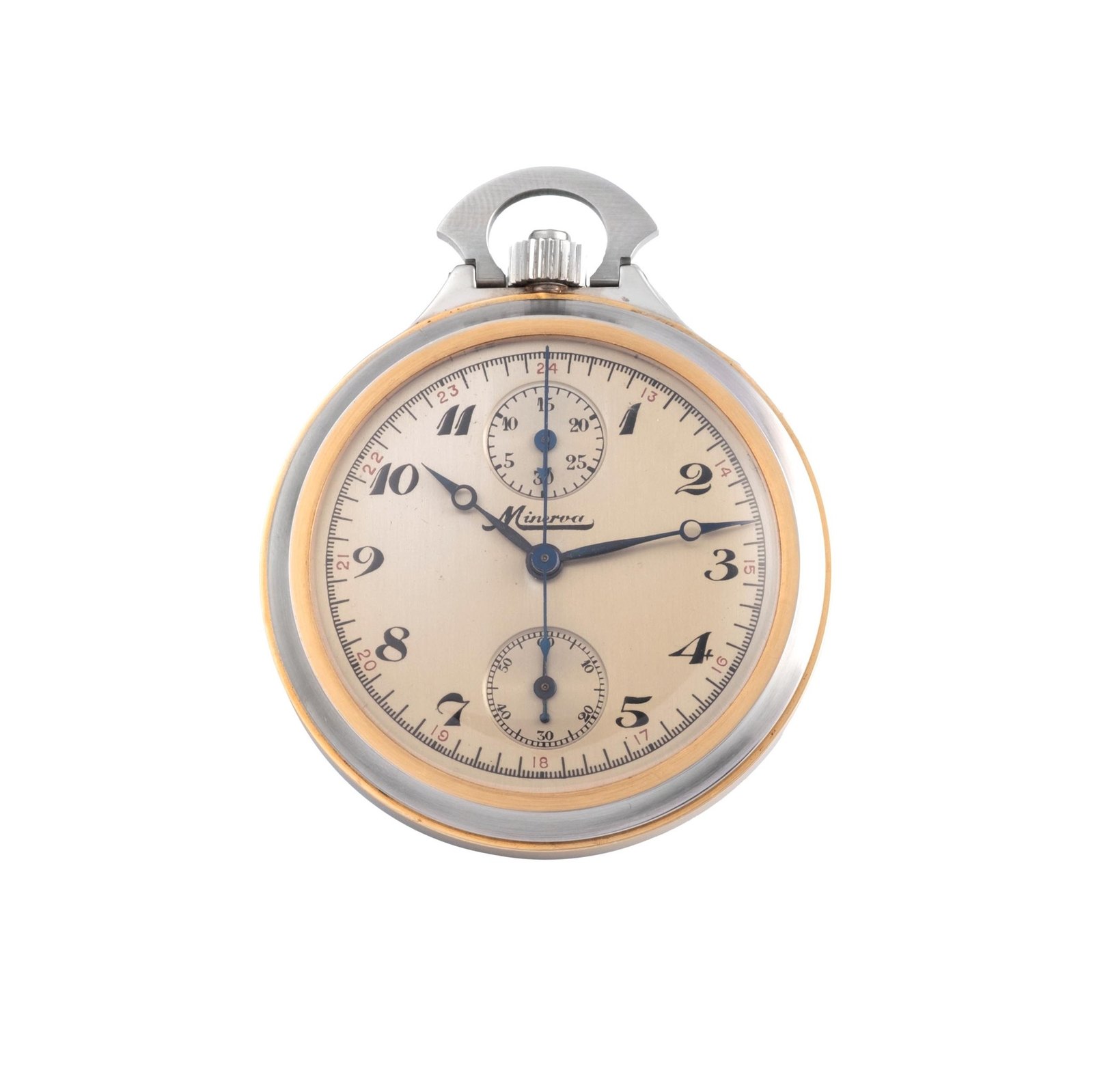
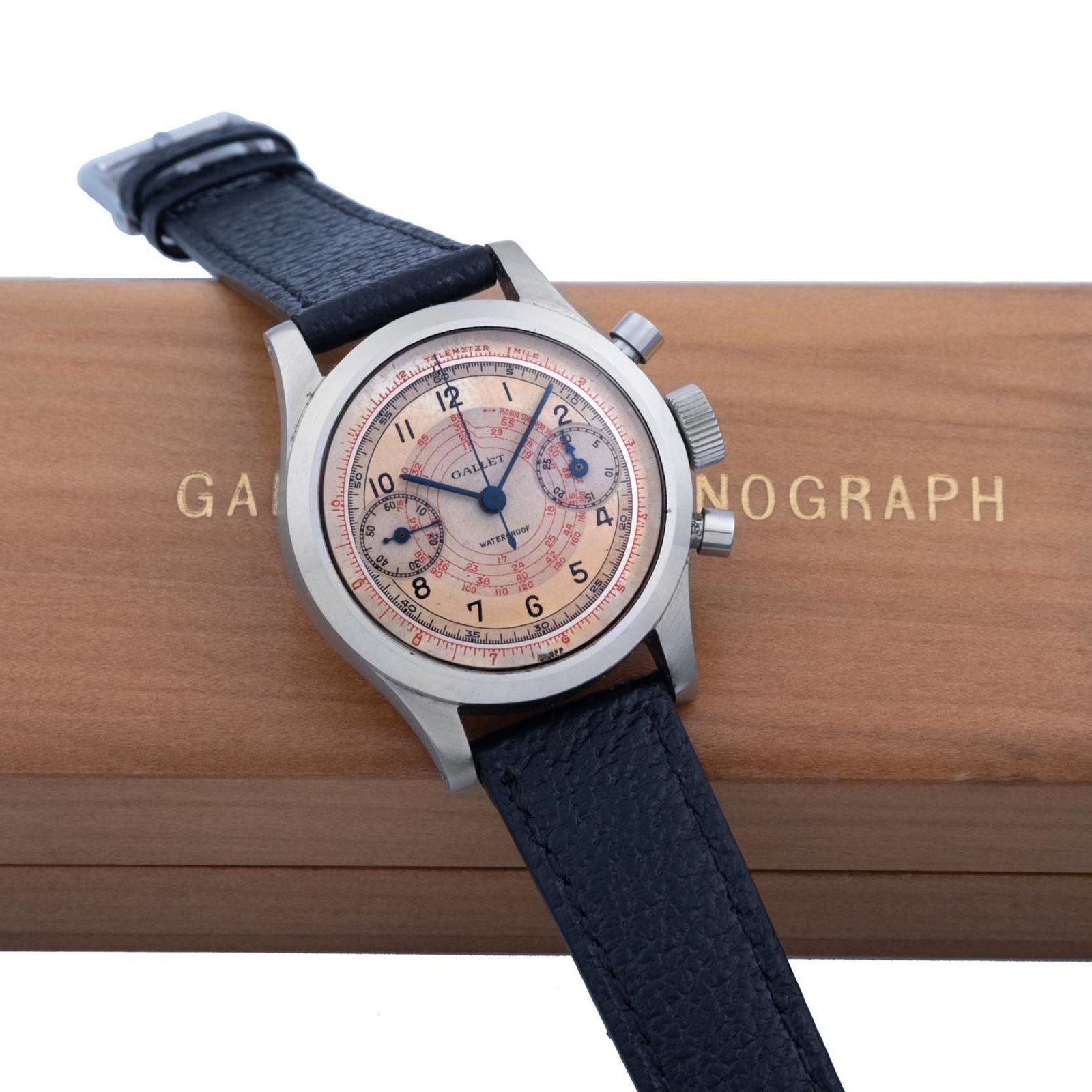
Longines's 13.33Z calibre of 1913 was one of the first chronograph movements designed for the wrist. The German Clock Museum in Furtwangen holds a Longines chronograph with a 13.33 calibre of around 1920, catalogued under the firm's formal name, Francillon. The 1920s also saw monopusher wristwatches from Gallet and Eberhard alongside chronograph pocket watches such as Minerva's; the enamel dials with red twelve and sixty markings, tachymeter or pulsometer scales and a thirty-minute register are typical of the period.
1915–1940: the second pusher and the registers
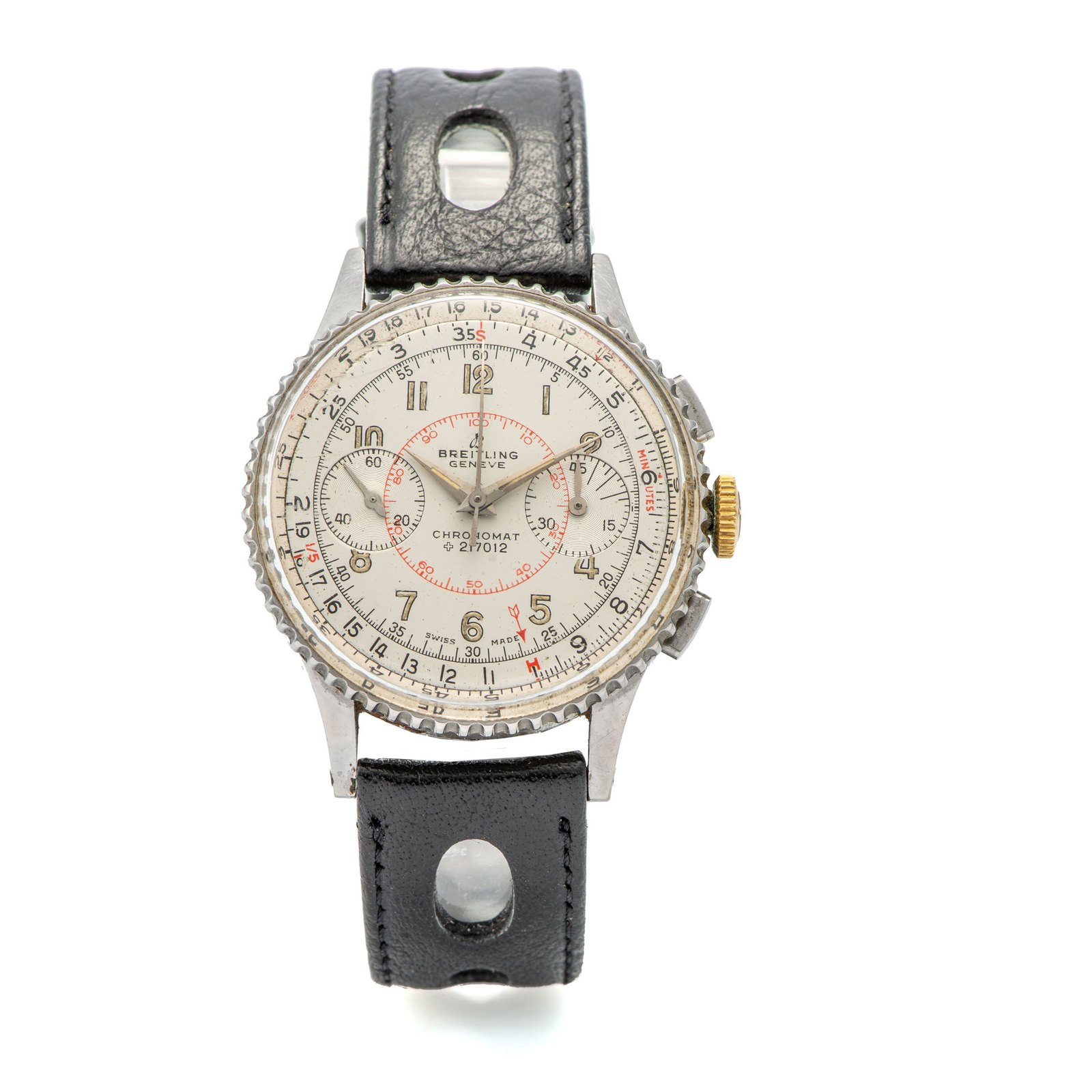
The decisive change was to separate the functions. Gaston Breitling introduced a chronograph wristwatch with an independent pusher at two o'clock in 1915, and in 1934 Willy Breitling added a second pusher for the reset, so that an interrupted timing could be resumed. Universal and others introduced two-pusher designs at about the same time, and by the late 1930s the two-pusher layout with a minute counter at three o'clock and running seconds at nine had become the standard chronograph face.
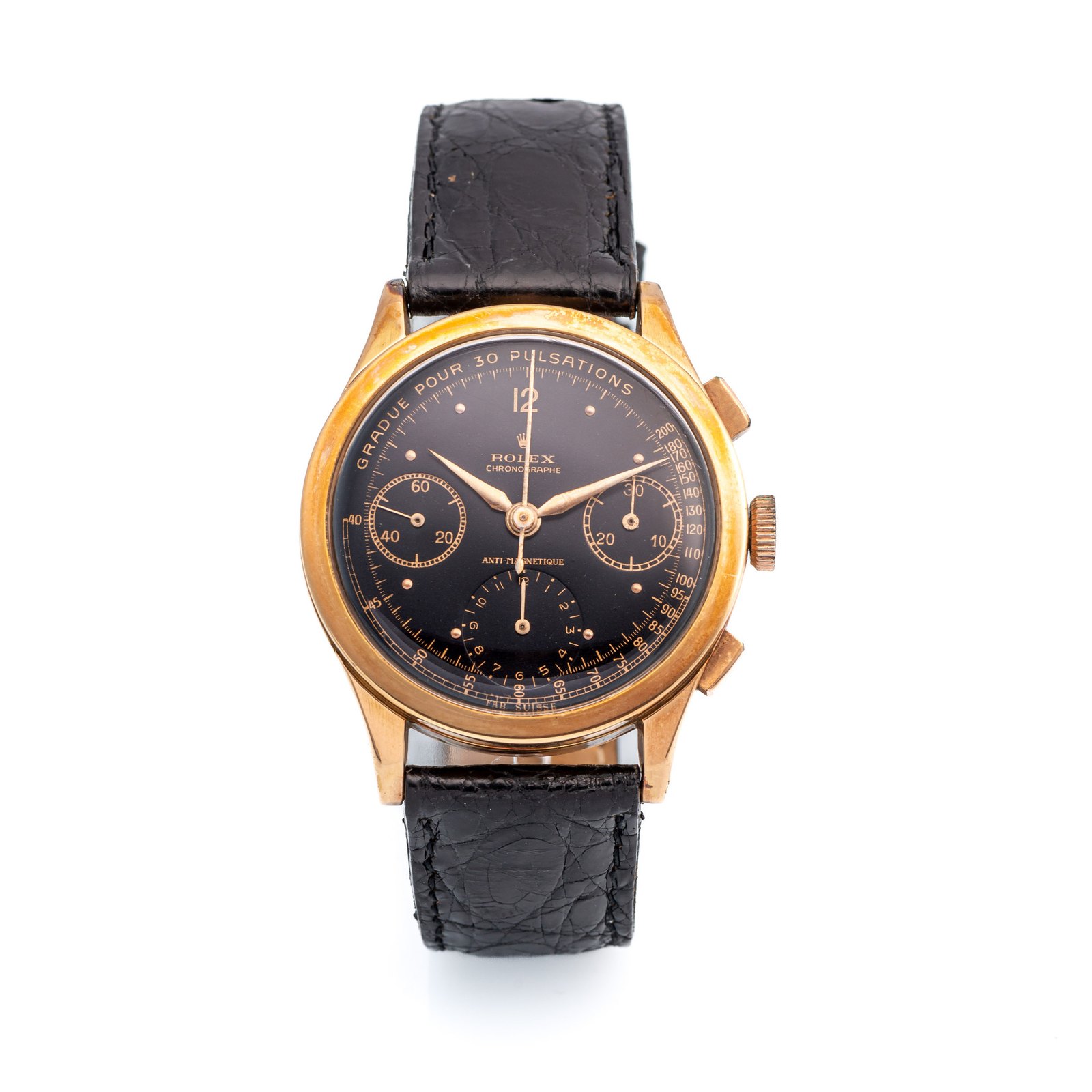
Rolex's reference 3330 of around 1934, catalogued as a 'Chronographe Anti-Magnétique', shows how quickly the face filled up: square pushers, three subsidiary dials for seconds, a thirty-minute and a twelve-hour register, and a pulsometer scale around the edge. Rolex did not then make its own chronograph movements; like most brands it bought them from the specialist movement makers of the Vallée de Joux and the Jura.
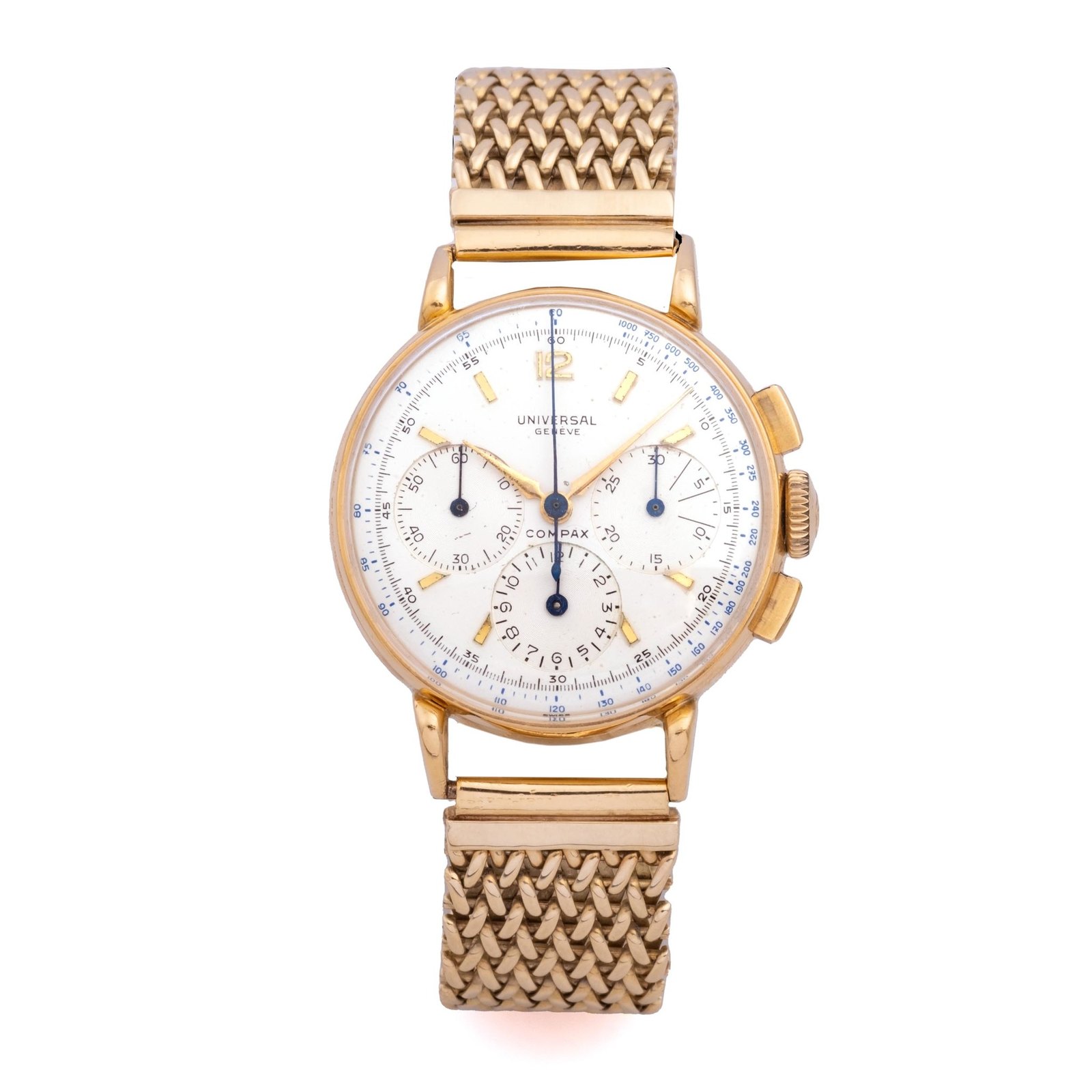
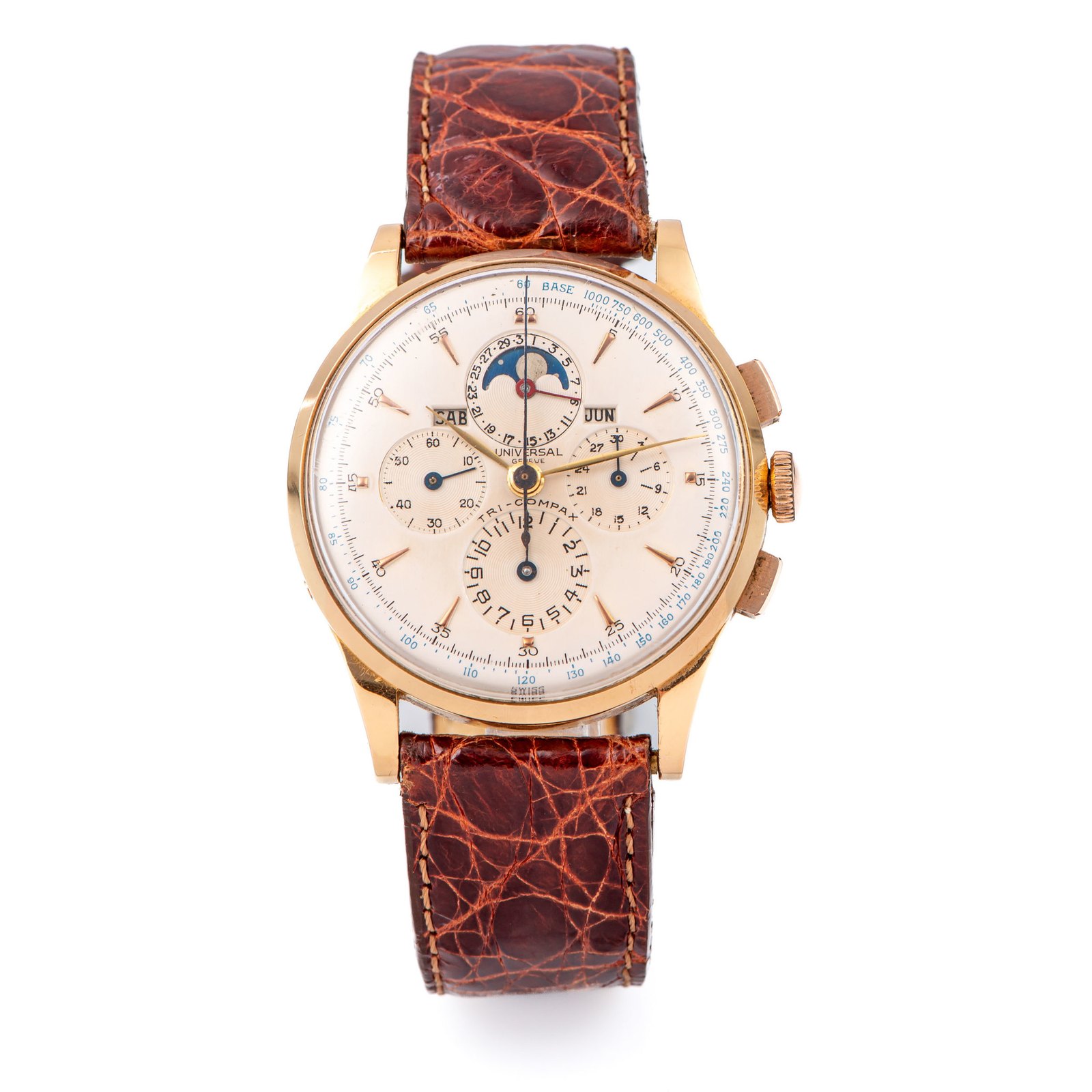
Universal named its chronographs by the number of counters: the Compax (two registers) and Uni-Compax, and from 1944 the Tri-Compax, which added a full calendar and moon phase. The catalogue includes a gold Compax of about 1940 with the calibre 283, an oversize steel Compax pilot's chronograph of about 1942 with the calibre 292, and a Tri-Compax of the late 1940s with the calibre 481, whose dial carries the date around the edge, the day and month in apertures and the moon phase.
The movement makers
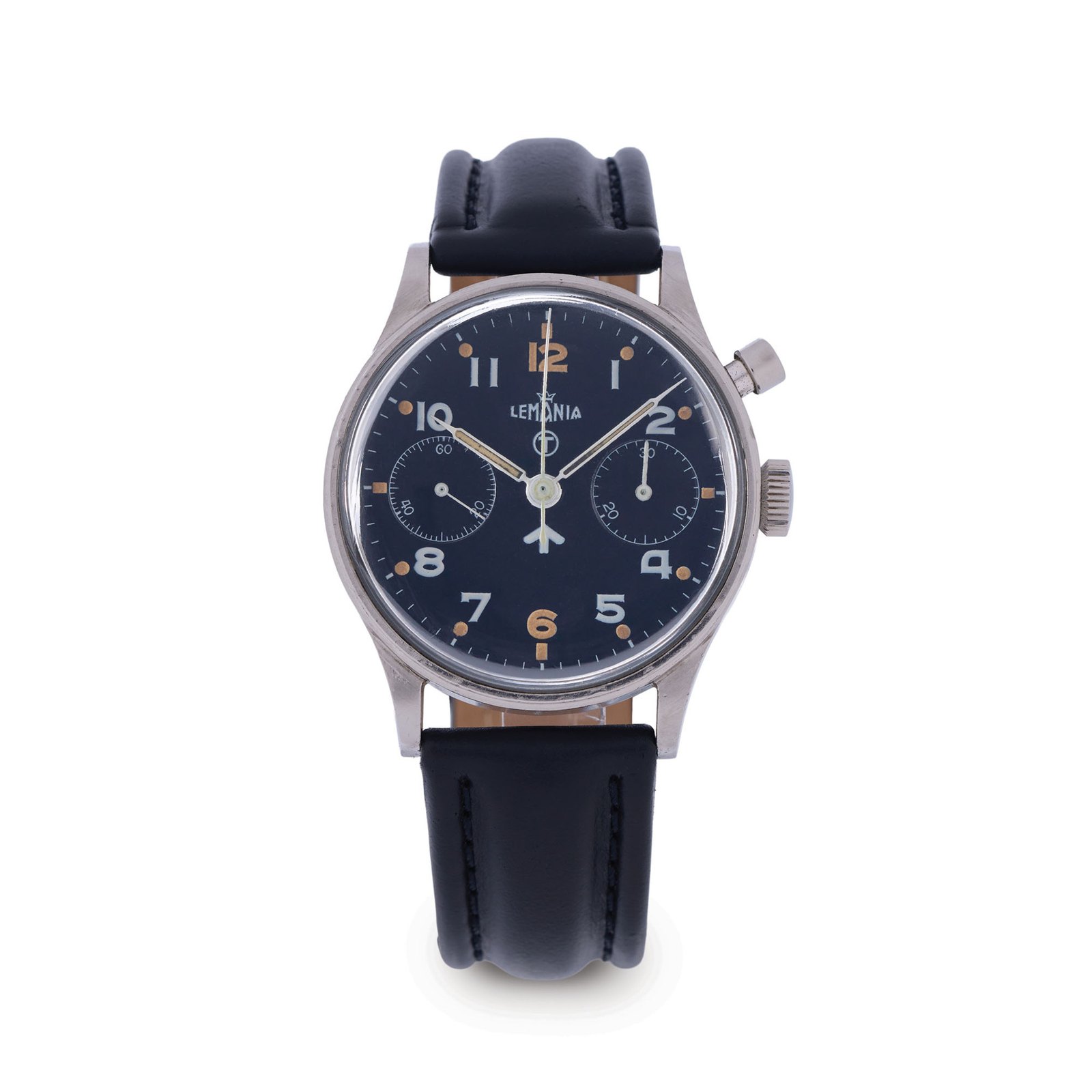
Behind the brand names stood a small number of specialist ébauche makers. Valjoux, in Les Bioux in the Vallée de Joux, supplied the calibres 22 and 23 and, from 1938, the 72 with a twelve-hour counter, which went into watches by Heuer, Rolex, Breitling, Gallet and many others. Venus, in Moutier, made the calibres 150, 175 and 178. Lemania supplied Omega within the SSIH group; Excelsior Park and Landeron served the middle and lower market. Only a few houses — Longines, Minerva and Angelus among them — made their own chronograph movements in this period. Universal and Zenith depended on Martel of Les Ponts-de-Martel, a specialist chronograph maker that worked with Universal from about 1918 and passed under Zenith's control around 1960; how much of Universal's Compax design was Martel's own work is still debated.
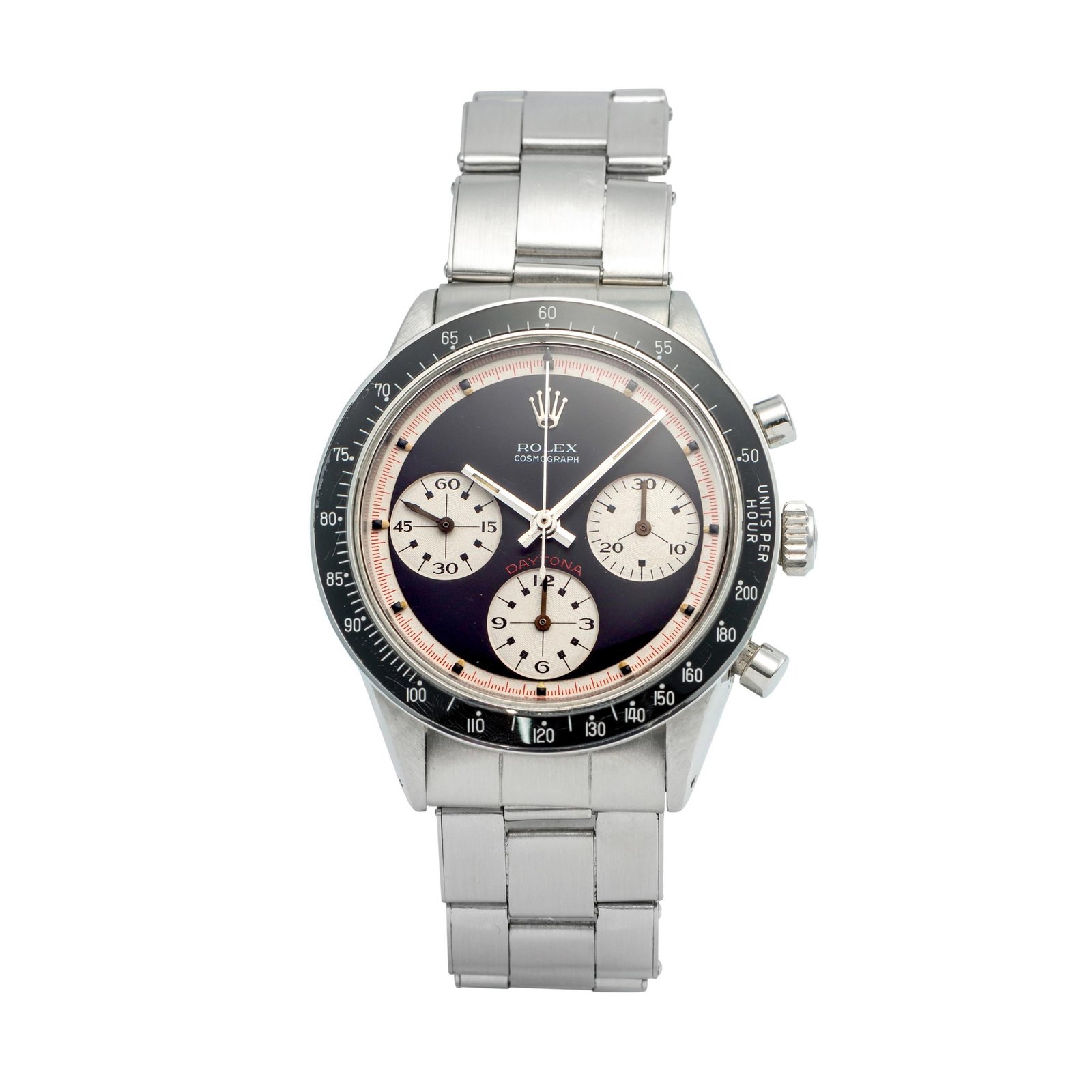
The records show these connections clearly. Gallet's 'clamshell' chronographs of the 1940s use the Venus 150. A Breitling Chronomat of about 1946, reference 769, with a slide-rule scale on a rotating bezel for calculations, has a Venus 175 — made, the auction entry notes, by Berret & Schmitz of Moutier — and comes with a copy of Breitling's patent for the slide rule. The Rolex Daytona reference 6241 of about 1967 has a movement of the Valjoux 72 family, listed in the sale as calibre 72B and finished by Rolex to its own standard (later designated calibre 722).
| Movement | Maker | Introduced | Notes |
|---|---|---|---|
| 13.33Z | Longines | 1913 | Early wrist chronograph calibre (monopusher) |
| 13ZN | Longines | mid-1930s | Among the first flyback wrist chronographs |
| Valjoux 72 | Valjoux | 1938 | Column wheel, 12-hour counter; Heuer, Rolex, Breitling, Gallet |
| Venus 175 / 178 | Venus, Moutier | 1940s | Column wheel; Breitling Chronomat and Navitimer |
| Lemania 27 CHRO / Omega 321 | Lemania for Omega | 1940s | Speedmaster until 1968 |
| Omega 861 | Omega / Lemania | 1968 | Cam-operated successor to the 321 |
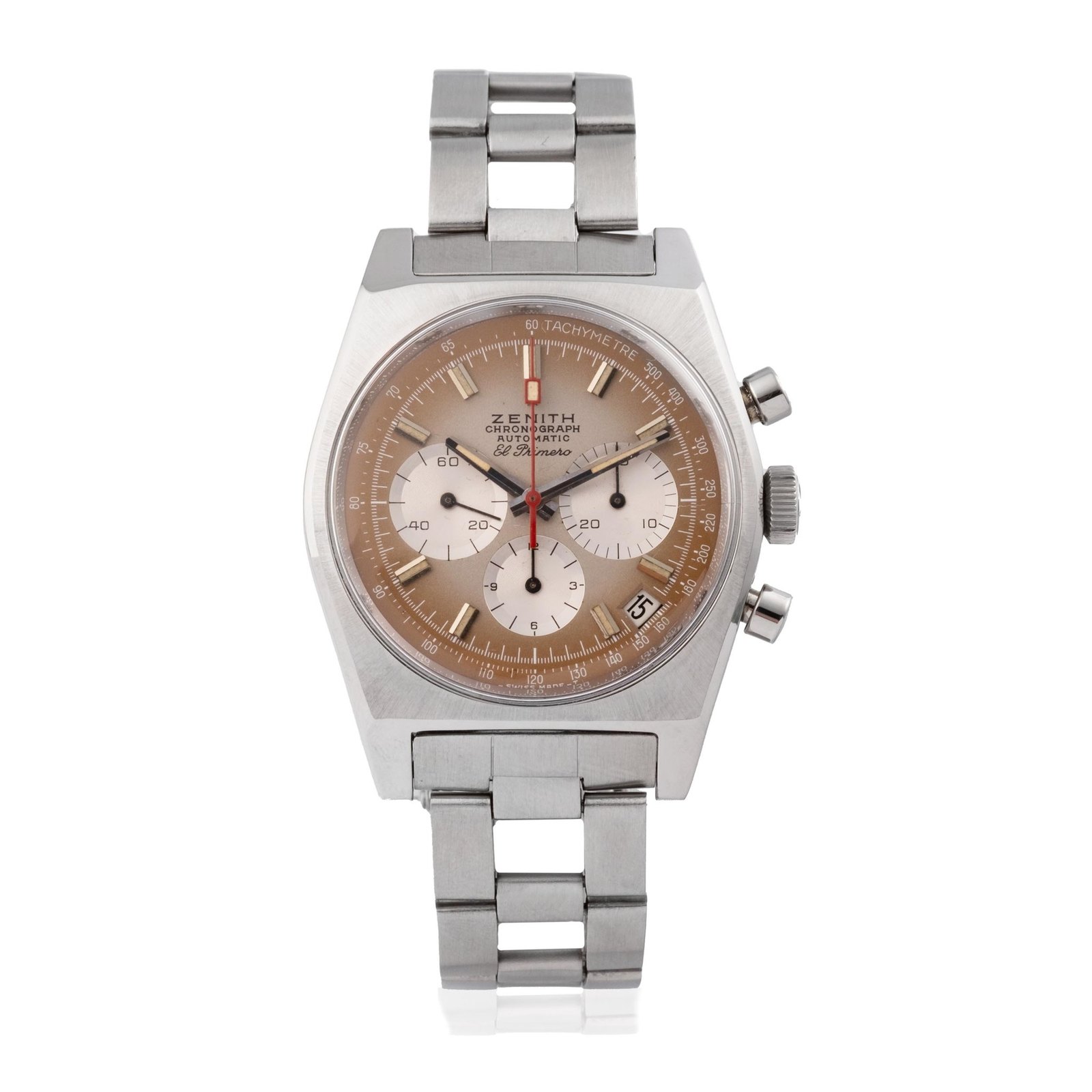
| Zenith El Primero (3019 PHC) | Zenith | 1969 | Integrated automatic, 36,000 vibrations per hour |
| Calibre 11 Chronomatic | Heuer, Breitling, Hamilton-Büren, Dubois Dépraz | 1969 | Modular automatic with micro-rotor |
| Seiko 6139 | Seiko | 1969 | Japanese automatic chronograph |
| Valjoux 7750 | Valjoux | 1970s | Cam-operated automatic; still in production |
1930s–1950s: flyback, calendars and the specialist chronograph
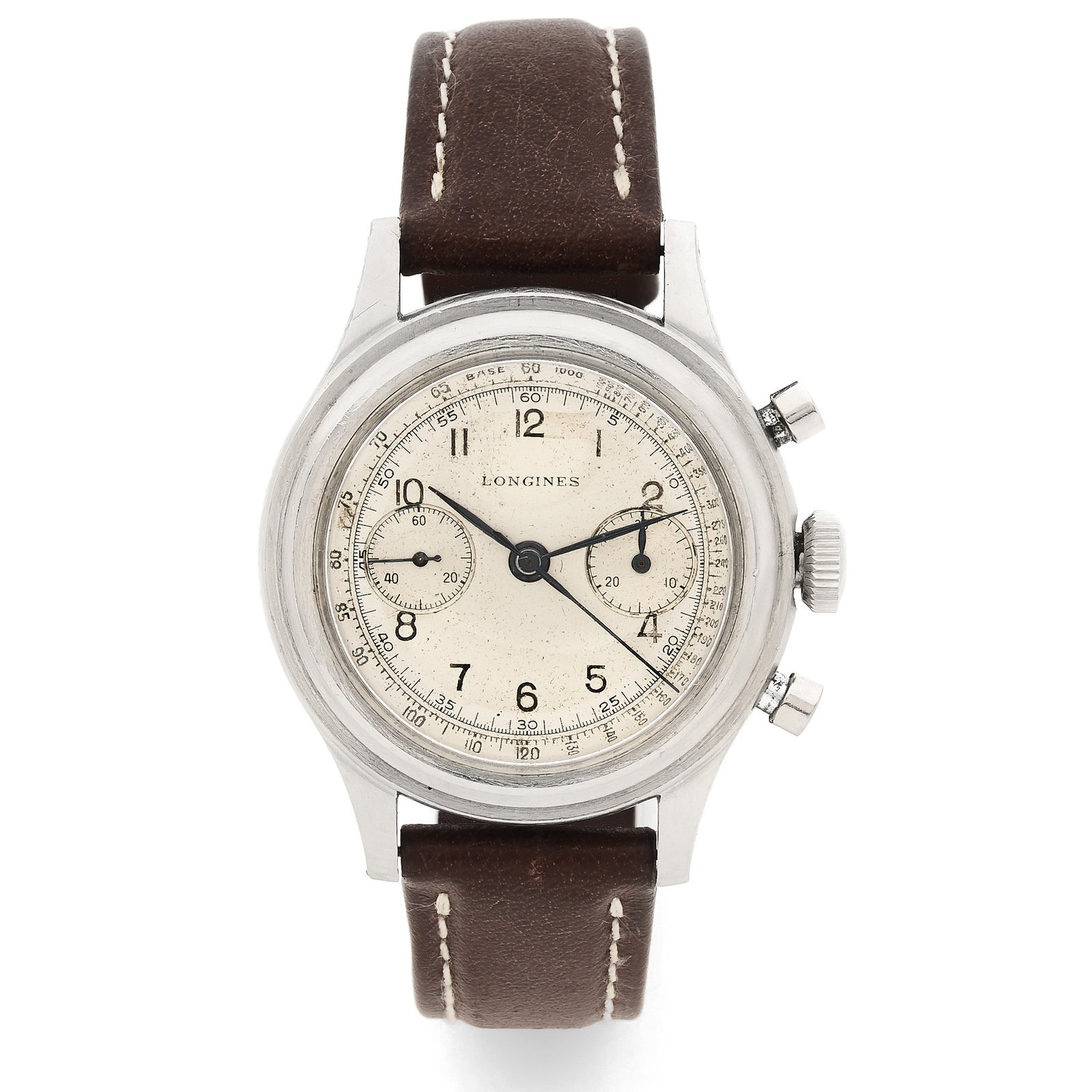
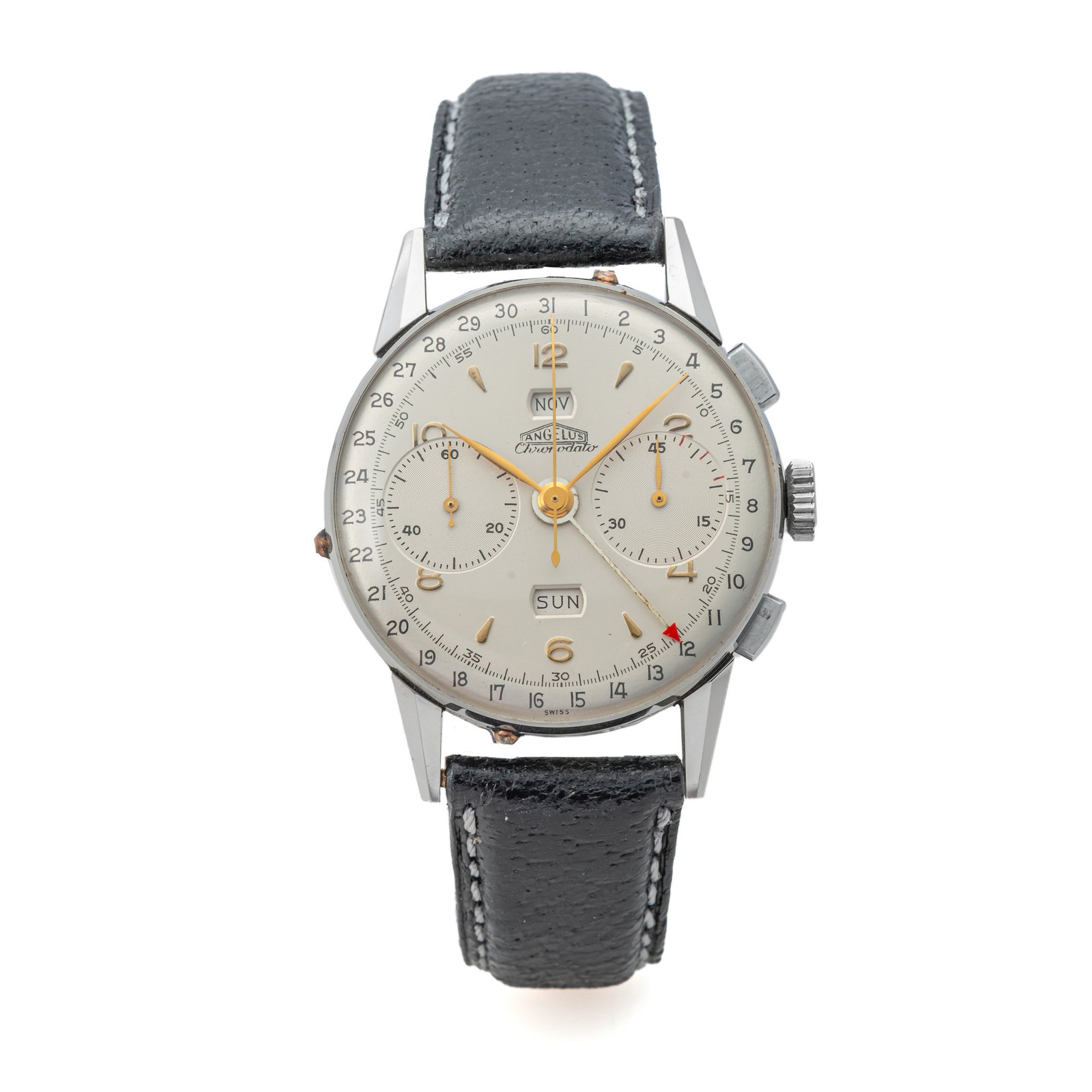
Longines's 13ZN calibre, introduced in the mid-1930s, was among the first wrist chronographs with a flyback function: pressing the reset pusher while the chronograph runs returns the hand to zero and starts it again instantly, useful for pilots timing successive legs of a flight. A waterproof steel Longines chronograph of the 1940s with the 13ZN is in the catalogue. The same decades produced the calendar chronograph: Angelus's Chronodato of 1942, one of the first series-produced chronograph wristwatches with a full calendar, appears in an oversize steel example of about 1945.
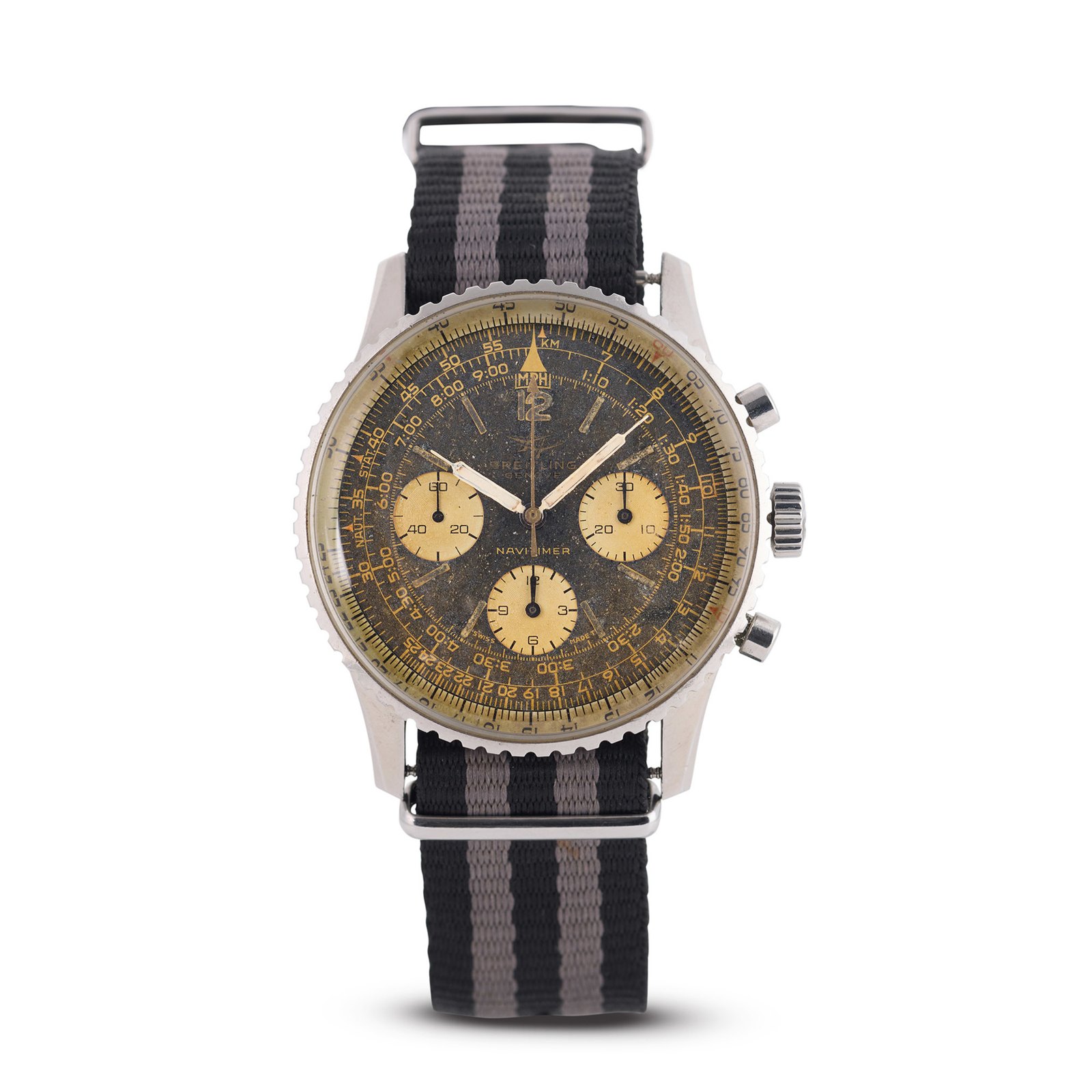
Chronographs were also specialised for professions. Pilots' models had large pushers and luminous dials; doctors' chronographs had pulsometer scales; slide-rule bezels such as Breitling's turned the watch into a navigational calculator, a development that led to the Navitimer of 1952. The catalogue's Navitimer reference 806 of about 1967 has the Venus 178 movement.
The 1960s: racing, diving and the Moon
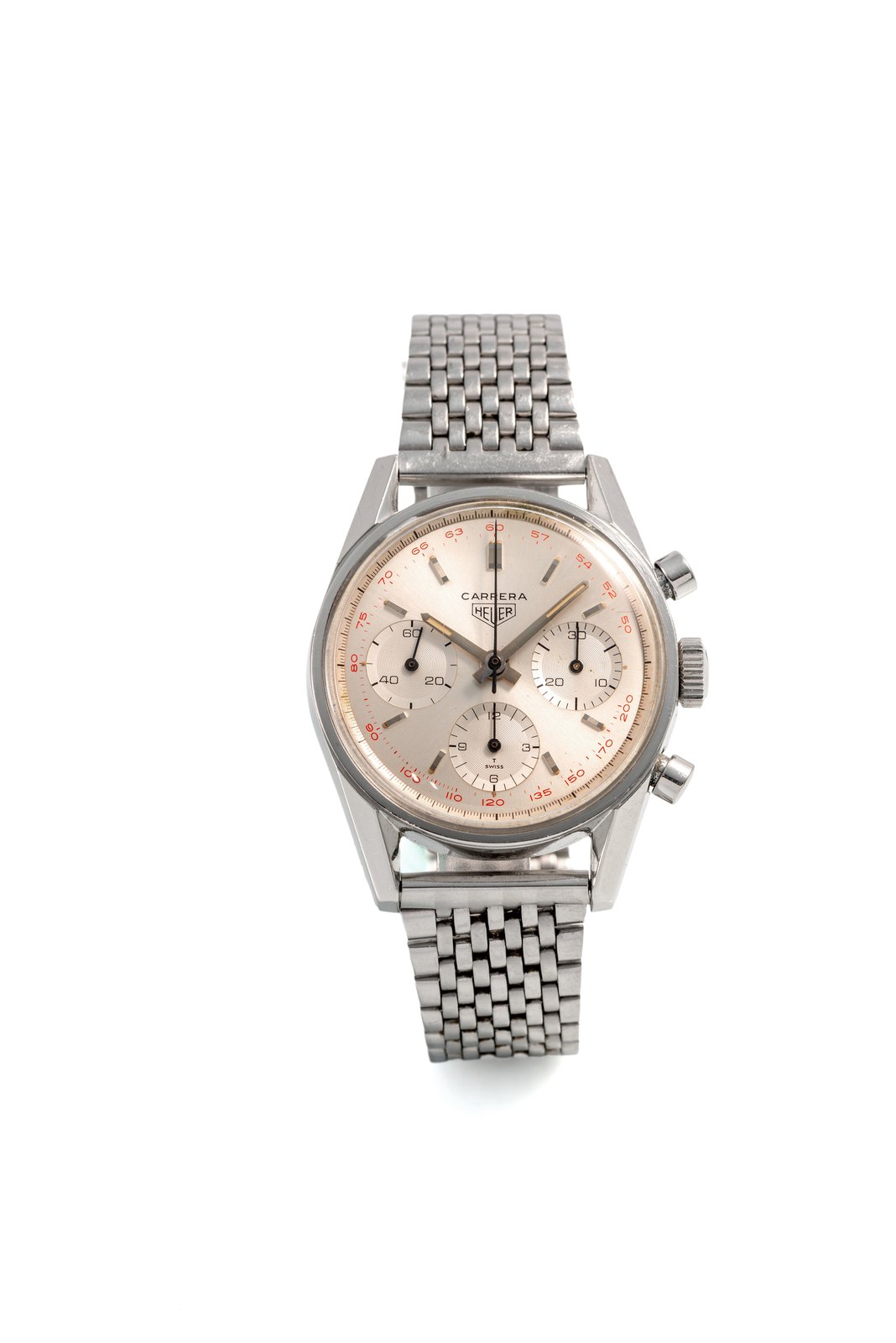
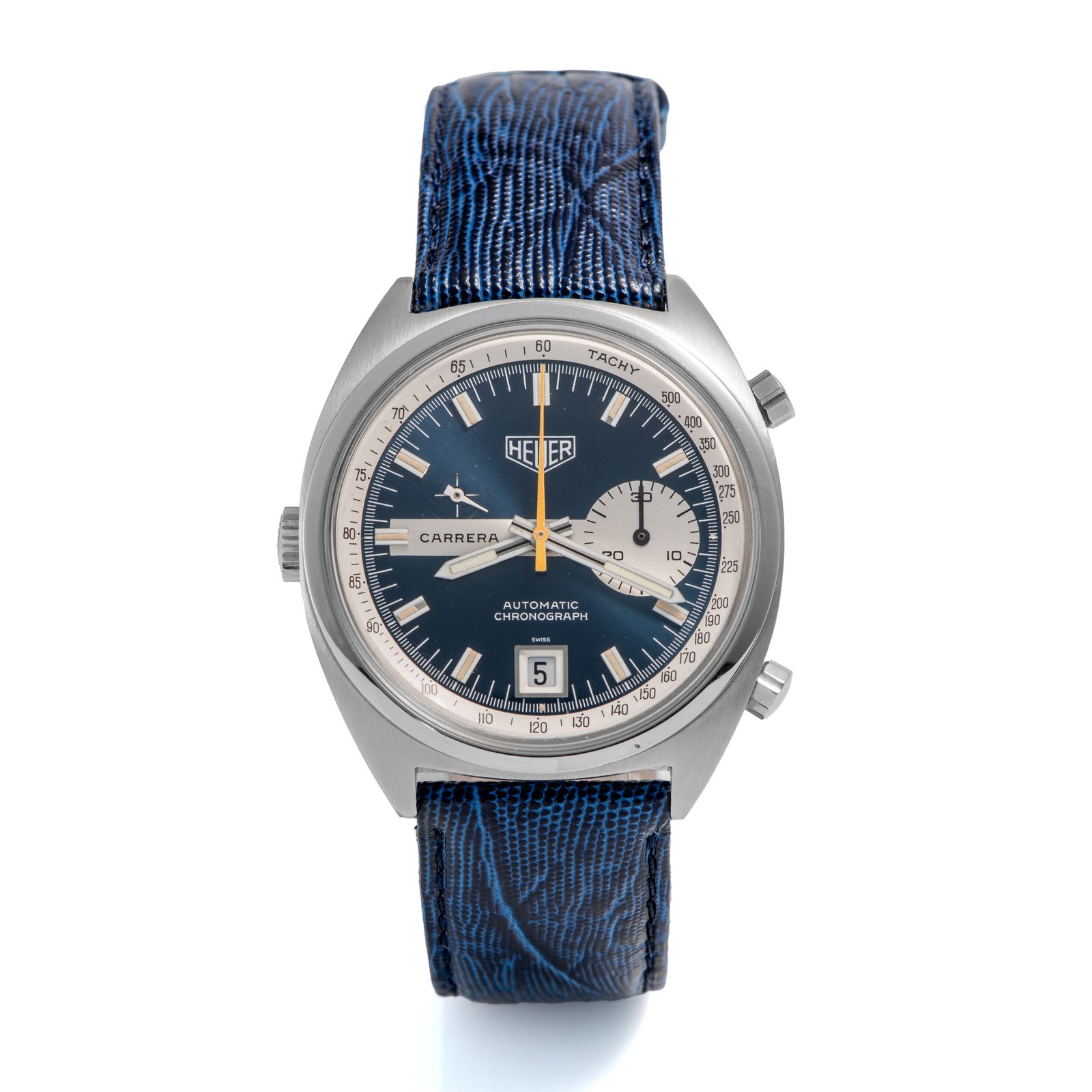
In the 1960s the chronograph became a sports watch. Heuer's Carrera of 1963, named after the Carrera Panamericana road race, had a clean dial designed for legibility; the catalogue's Carrera reference 2447T is dated 1967. Rolex introduced the Cosmograph in 1963, soon named Daytona after the Florida race track. Omega's Speedmaster, introduced in 1957 as a sports and racing chronograph with a tachymeter on the bezel, became the most famous chronograph of all after NASA qualified it for its astronauts.
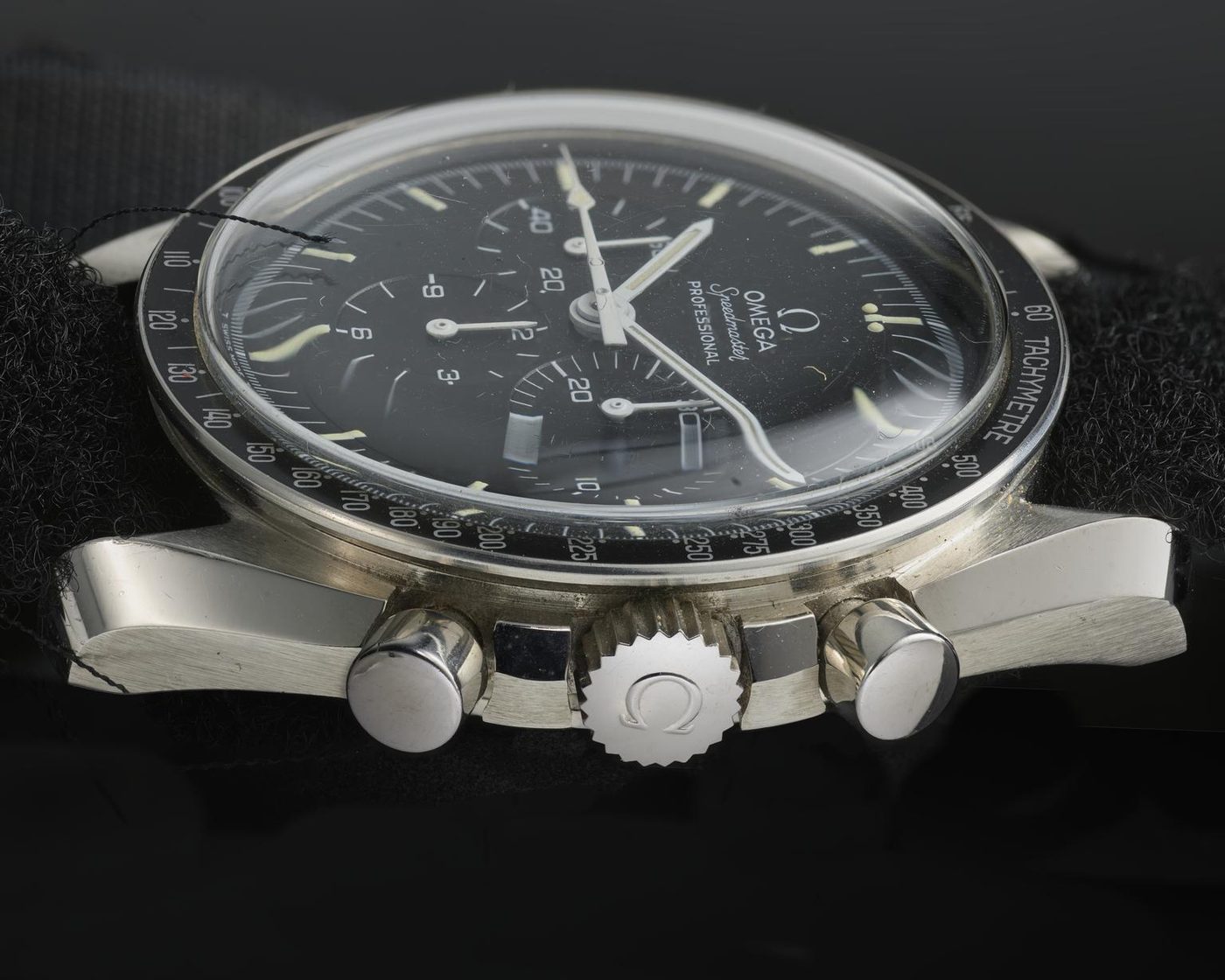
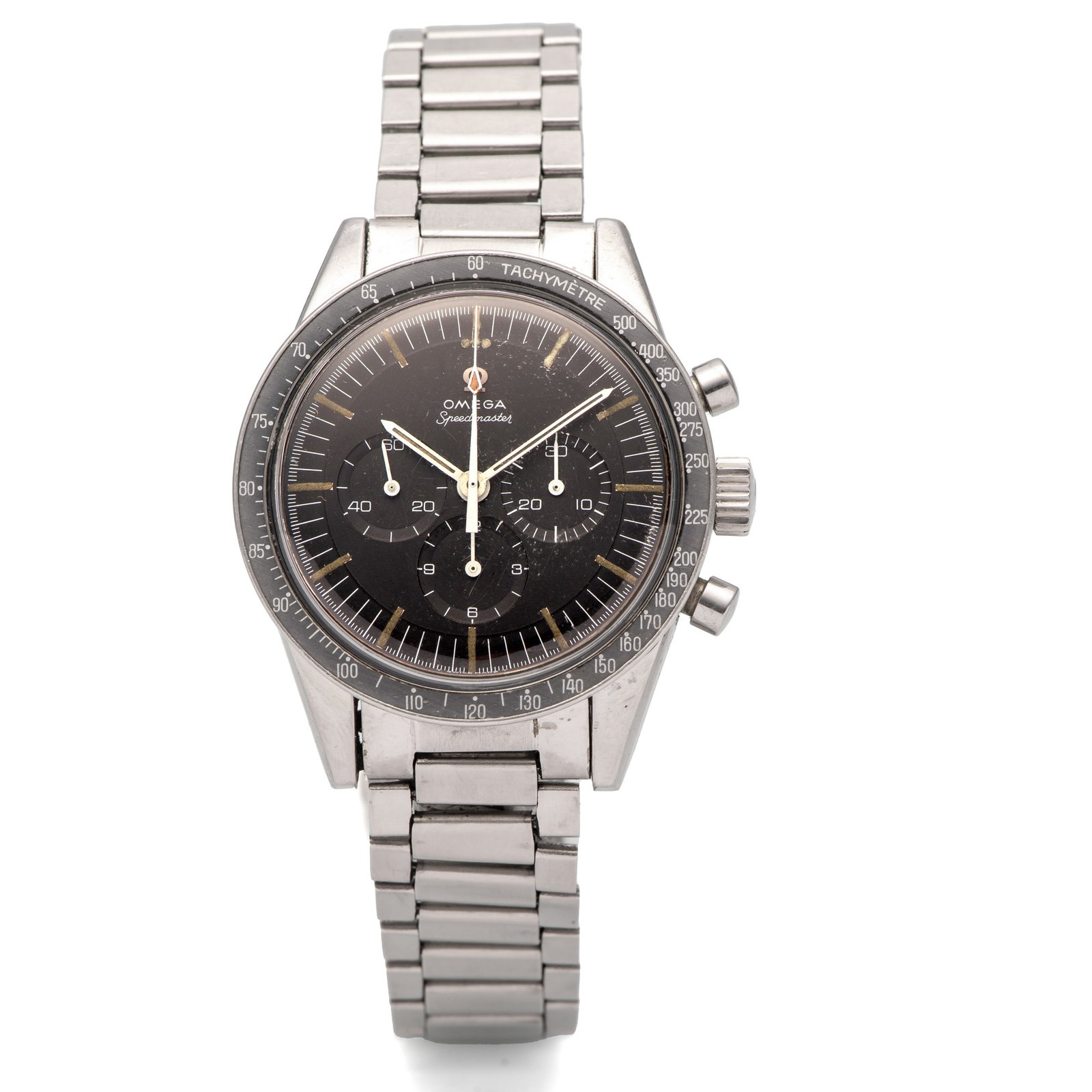
The Science Museum Group holds a complete Omega Speedmaster Professional of the 1960s on the long Velcro strap used on NASA's Apollo programme, so that the watch could be worn over a spacesuit. The museum's text notes that Wally Schirra wore a Speedmaster on the Mercury-Atlas 8 mission in 1962, that NASA certified the Speedmaster for its missions from 1965, and that Buzz Aldrin wore one on the Moon in 1969. A Speedmaster reference 105.003 of about 1965 in the catalogue has the calibre 321, the Lemania-derived column-wheel movement used until Omega replaced it with the cam-operated calibre 861 in 1968.
1969: the automatic chronograph
An automatic chronograph — one wound by a rotor like an ordinary self-winding watch — had been the industry's unsolved problem, because the chronograph mechanism and the rotor both need space. In 1969 three solutions appeared. Zenith's El Primero, announced in January, was an integrated automatic chronograph with a high beat of 36,000 vibrations per hour, allowing tenths of a second to be read. In March a consortium of Heuer-Leonidas, Breitling, Hamilton-Büren and the module maker Dubois Dépraz presented the Calibre 11 'Chronomatic', a chronograph module on a thin micro-rotor movement, with the crown on the left. In Japan, Seiko launched its 6139 automatic chronograph the same year.
The triumph was short-lived. Within a few years quartz watches had undercut the Swiss industry, and many of the houses in this story — Universal, Gallet, Angelus, Minerva in its old form — declined or disappeared. The mechanical chronograph survived through a few movements, above all the Valjoux 7750, and through the revival of mechanical watchmaking from the late 1980s, when the old names began to be bought and relaunched: Minerva by Richemont in 2006, Universal by Breitling in 2023 and Gallet by Breitling in 2025.
Checklist: examining a vintage chronograph
- Identify the movement maker and calibre: signatures on the movement, the layout of bridges and the shape of the column wheel or cam help when the movement is unsigned.
- Check that pushers and functions match the calibre: a monopusher movement should not sit in a two-pusher case.
- Look for redials: enamel and lacquer dials were often repainted. Compare the scales and printing with known examples and check that the subsidiary dials sit exactly over the hand arbors.
- Confirm the case and movement numbers against the maker's archive where one exists; many records in the catalogue cite an archive extract.
- Test the chronograph: start, stop, reset and, where fitted, flyback or split-seconds, watching that the hands return exactly to zero.
- Note replaced parts — pushers, crowns, hands and crystals are often later — and record them rather than assuming a watch is original.
- Ligne ('''): the Swiss unit for movement diameter, about 2.256 mm.
- Ébauche: an unfinished movement supplied by a specialist maker to a watch brand.
- Column wheel: the castellated wheel that sequences start, stop and reset in traditional chronographs.
- Calibre: a movement design, usually identified by its maker's number.
Every watch in this feature links to its catalogue record, with the calibre, reference and source. The Atlas reproduces the auction houses' and museums' descriptions; where a description seems to contradict a calibre's known features, the record is flagged for review rather than corrected silently.
Sources & further reading
- Manufacturing Time: Global Competition in the Watch Industry, 1795–2000 — Amy K. Glasmeier, Guilford Press (New York), 2000.
- Revolution in Time: Clocks and the Making of the Modern World — David S. Landes, Harvard University Press, 1983.
- Practical Watch Repairing — Donald de Carle, N.A.G. Press (London), 1946.
- Technique and History of the Swiss Watch — Eugène Jaquet and Alfred Chapuis, Urs Graf (Olten), 1945 (French); English editions from 1953.
- Antiquarian Horology — Antiquarian Horological Society, AHS (London), 1953 – present.
- Horological Journal — British Horological Institute, BHI (Upton Hall), 1858 – present.
- A Business History of the Swatch Group — Pierre-Yves Donzé, Palgrave Macmillan, 2014.