Wristwatches · Wrist watch
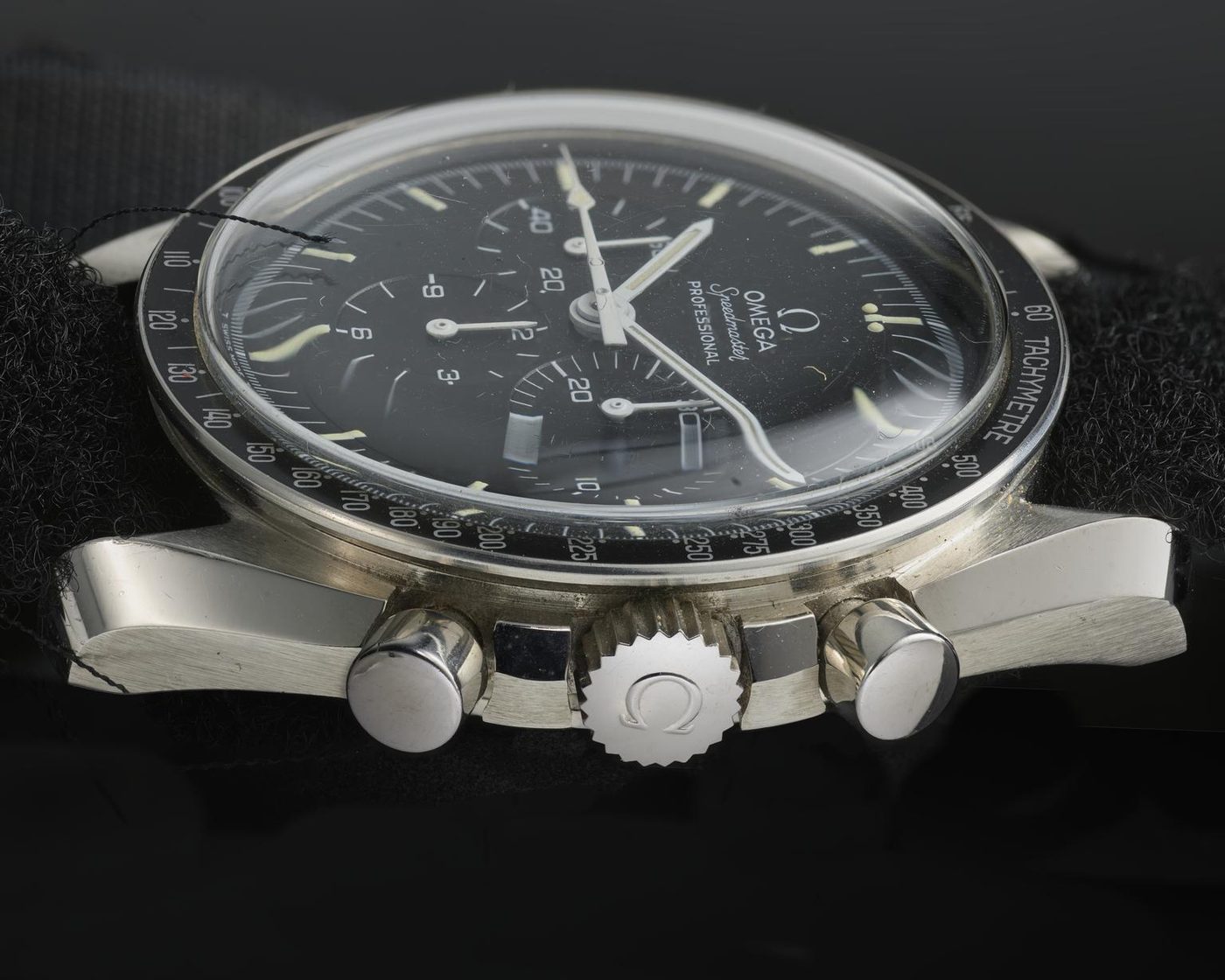
Complete Omega Speedmaster Professional Chronograph watch with velcro straps as used on NASA's Apollo programme.
- Maker / attribution
- Omega (maker)
- Date
- 1960s
- Historical period
- Modern Mechanical Horology (1945 – 1969)
- Country of origin
- Switzerland
- Place
- Switzerland, Switzerland
- Object type
- Wrist watch
- Dimensions
- overall: 35 mm x 50 mm x 150 mm, , .065kg
- Holding institution
- Science Museum Group, London
- Accession / object no.
- 1977-817/1
- Catalogue title (original)
- Omega Speedmaster watch
Record summary
Held and catalogued by Science Museum Group, London (object number 1977-817/1), this is a wrist watch by Omega, made in Switzerland, Switzerland, dated 1960s. The Atlas places it in the Modern Mechanical Horology period (1945 – 1969) of its Wristwatches collection. Recorded dimensions: overall: 35 mm x 50 mm x 150 mm, , .065kg. The record is illustrated with 4 photographs.
Assembled from the source record's structured fields. Dates and attributions are given as the source states them; where a field is missing the Atlas leaves it blank rather than estimating.
Catalogue description
Science Museum Group description
The Speedmaster (also known subsequently as the Moon watch) was first worn by Astronaut Wally Schirra in 1962 on the Mercury-Atlas 8 mission. Since 1965 these watches have been chosen by NASA to be the only type of chronograph certified for use on all their missions. At the time NASA was unsure how other mechanical watches would work in zero gravity. The three additional dials and the fact that the Omega watch can be hand wound made this watch exceptionally good at keeping accurate time. Despite being certified by NASA, astronauts now use a variety of different watches while in space. Most of the Apollo astronauts wore watches like this. They could be worn both on the wrist while inside a spacecraft, and over their bulky spacesuits during walks in space and on the Moon. In 1969, the Speedmaster became the first ever watch to be worn on the Moon when Buzz Aldrin stepped onto the lunar surface. Neil Armstrong also had a Speedmaster, but he decided to leave it inside the Lunar Module. The module had suffered a malfunction with its electronic timers, so an alternative way to track time was needed - the Speedmaster - and Armstrong didn't want to risk it duriing his walking on the Moon. Apollo 13 Command Module pilot, Jack Swigert, used his watch to time crucial engine firings after a near-fatal explosion in an oxygen tank had cut all electrical power to the on-board computer. The engine firings, or ‘burns’, had to be carried out manually. Normally these could have been timed by the Lunar Module Guidance Computer, but it had had to be powered down after the explosion to save on power. It was vital the burn was timed to the exact second. A mistake would have led to their spacecraft being unable to return to Earth safely. Swigert calibrated hs watch with mission control and the burn was carried out successfully. Omega now has both a ‘Moonwatch’ range and a ‘Silver Snoopy’ range, inspired by the Silver Snoopy award. This award is given by NASA astronauts for outstanding achievements in flight safety and mission success. Omega received the ‘Silver Snoopy Award’ in 1970 after the safe return of the Apollo 13 astronauts.
Inscriptions & marks
; ;
Historical context
Modern Mechanical Horology (1945 – 1969)
Tool watches for divers, pilots and astronauts; electric watches anticipate the electronic age.
The classic era of the mechanical wristwatch: dive watches, chronographs for motor racing and space flight, GMT watches for jet travel, slim dress watches, automatic calendars, and the rise of Japanese manufacturers alongside Swiss, American, German and Soviet industries.
Read the period in the timelineMore wristwatches from this periodEarlier: Golden Age of Mechanical Watchmaking
Atlas type guide
Chronographs and split-seconds watches
A chronograph is a watch with an additional seconds hand that can be started, stopped and returned to zero independently of the timekeeping. Louis Moinet built an early example in 1816 and Nicolas Rieussec a recording 'chronographe' in 1821; Adolphe Nicole's heart-shaped reset cam (patented 1862) made the modern return-to-zero possible. Split-seconds (rattrapante) chronographs add a second hand that can be stopped for intermediate times; flyback chronographs restart instantly.
Chronographs were essential tools for doctors (pulsometer scales), artillery (telemeter), engineers and sport. In wristwatches, Valjoux, Venus, Lemania and later the automatic chronographs of 1969 (Zenith El Primero, the Chronomatic Calibre 11 group and Seiko 6139) are milestones.
What to look for
- Push-pieces on the case band or a single button in the crown (monopusher).
- Subsidiary registers for minutes and hours; tachymeter, telemeter or pulsometer scales.
- Column wheel versus cam control visible in the movement.
- Calibre markings of specialist makers (Valjoux, Lemania, Venus, Landeron).
Dating clues
- Pocket chronographs with heart cam reset: after 1862.
- Wrist chronographs: from c. 1910; two-button designs from the 1930s.
- Automatic chronographs: from 1969.
General guidance written by the Atlas editors about this kind of object. It is not a statement about this particular piece; for that, rely on the source record above and on physical examination.
Read next:Flyback chronographChronograph
Related records
Instruments · 1950-1976
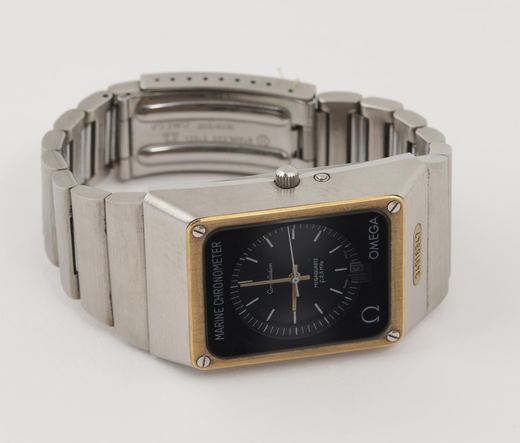
Omega Megaquartz 2400 marine chronometer, 1950-1976
Science Museum Group, London
Instruments · 1960-1979
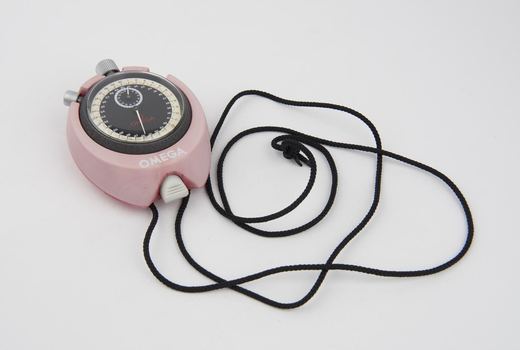
Stopwatch / timer by Omega, 1960-1979
Science Museum Group, London
Instruments · 1960-1979
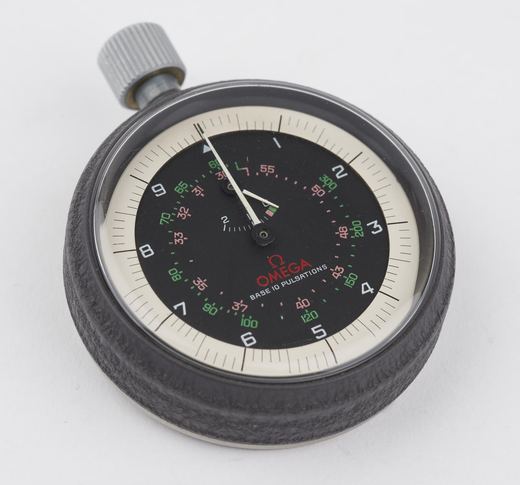
Stopwatch / timer by Omega, Switzerland, 1960-1979
Science Museum Group, London
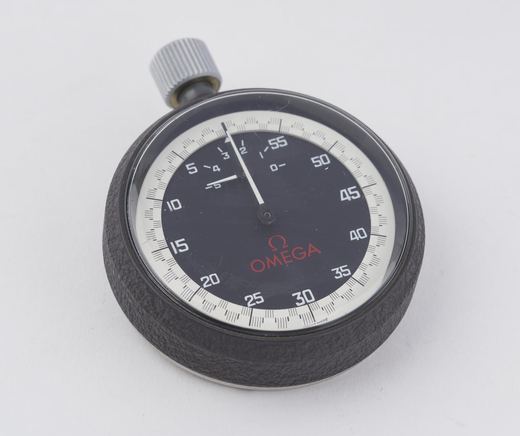
Instruments · 1960-1979
Stopwatch by Omega, Swiss made, single-button type reading 0 - 60 seconds in fifths and 0 - 5 minutes in minutes on subsidiary dial, 1960-79.
Science Museum Group, London
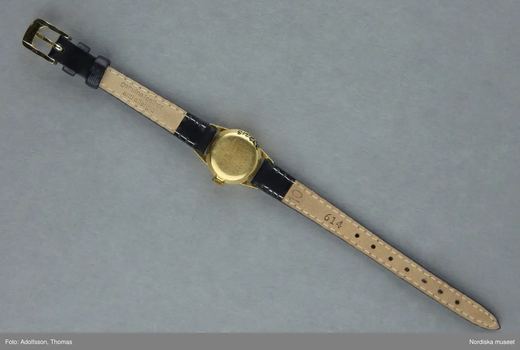
Wristwatches · 1900–1999
Wristwatch by Certina, Switzerland, 1900–1999
Nordic Museum Foundation
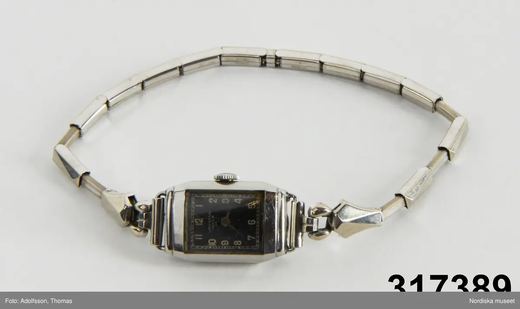
Wristwatches · 1900–1999
Wristwatch by Universal, Switzerland, 1900–1999
Nordic Museum Foundation
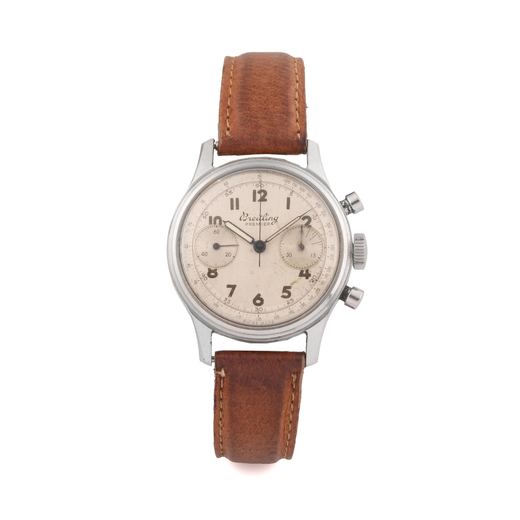
Wristwatches · circa 1945
Breitling Premier, ref. 790, circa 1945
Antiquorum auction archive, Geneva
Wristwatches · circa 1945
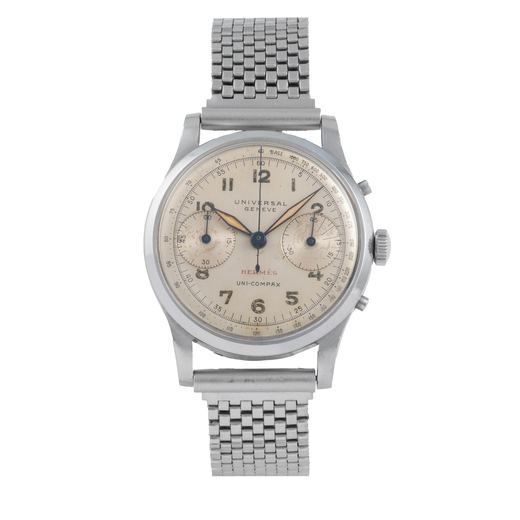
Universal Genève Uni-Compax, ref. 22492, circa 1945
Antiquorum auction archive, Geneva