
Advanced · Lesson 1 of 7 · 16 min read
Longitude and the marine chronometer
How the problem of finding longitude at sea led to the Longitude Act of 1714, John Harrison's sea clocks and watches, and the mass-produced chronometers of Arnold, Earnshaw and their successors.
By the end of this lesson you will be able to:
- Explain why accurate time gives longitude
- Outline Harrison's work from H1 to H4
- Describe how chronometers became standard naval equipment
Latitude can be found from the height of the Sun or the Pole Star. Longitude is harder: it is a difference in time. The Earth turns 15 degrees an hour, so a navigator who knows the time at a reference meridian, and can find local time from the Sun, can calculate longitude — four minutes of time for every degree. The whole problem reduces to carrying the reference time accurately for weeks at sea.
The Longitude Act of 1714
After a series of naval disasters, the British Parliament offered rewards of up to £20,000 for a method of finding longitude to within half a degree on a voyage to the West Indies. Two methods competed: astronomical 'lunar distances', and a timekeeper accurate enough to survive a ship's motion and changes of temperature.
John Harrison
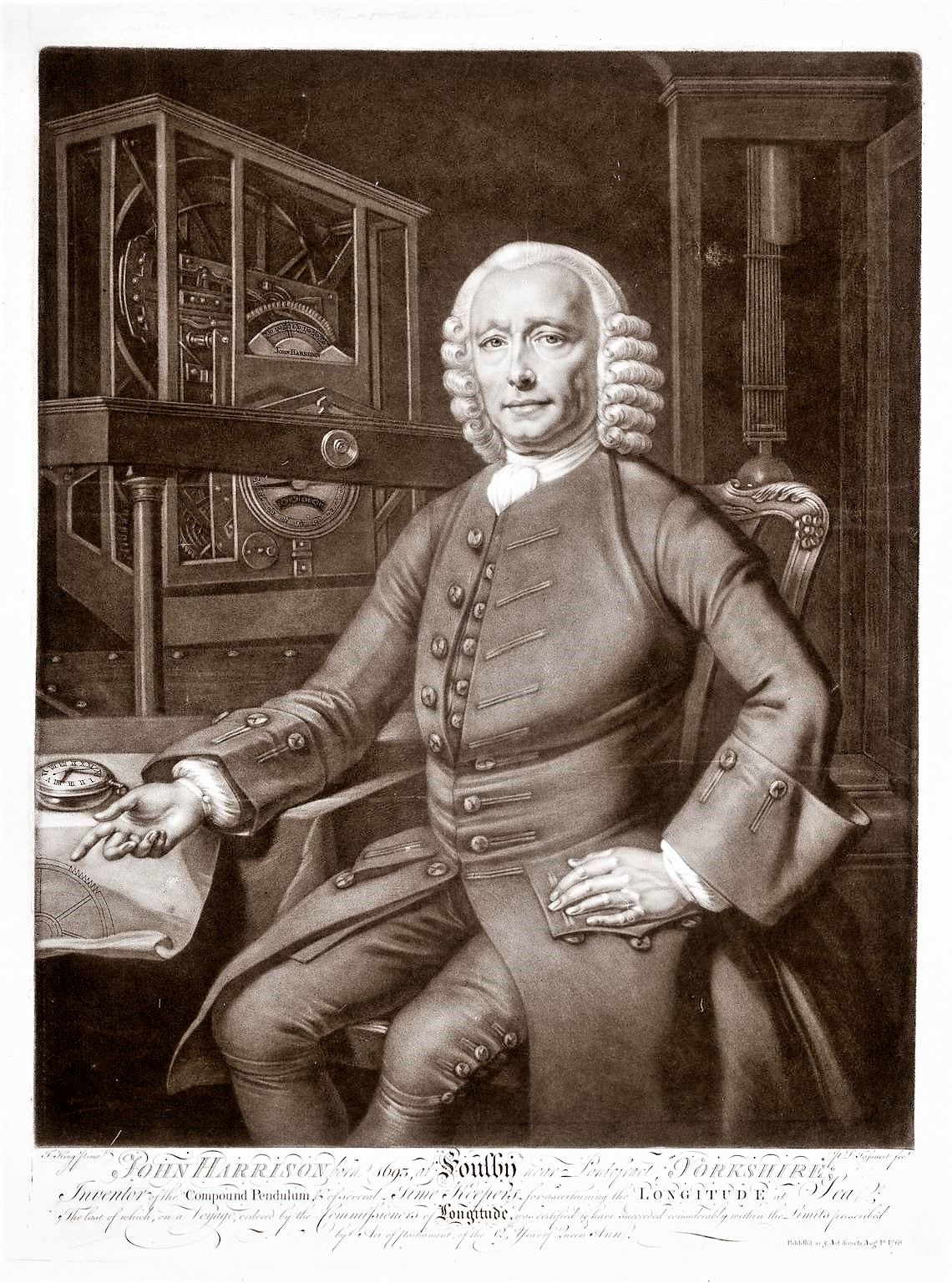
John Harrison (1693–1776), a Lincolnshire carpenter and clockmaker, spent most of his life on the problem. His first three marine timekeepers, H1 to H3 (1730s–1750s), were large clocks with linked balances and many innovations, including the bimetallic strip and the caged roller bearing. His fourth, H4 (completed 1759), was a large watch about 13 cm across. On its trial voyage to Jamaica in 1761–62 it performed within the Act's limits, and after long disputes Harrison received substantial payments from the Board of Longitude and Parliament.
Larcum Kendall's copy of H4, known as K1, went with James Cook on his second voyage (1772–75) and kept excellent time, convincing many sceptics.
From invention to standard equipment
Harrison's watch was too complex to make in numbers. In the following decades John Arnold and Thomas Earnshaw in London, and Pierre Le Roy and Ferdinand Berthoud in France, developed the simpler detent escapement, compensation balances and the familiar gimballed box chronometer. By the early nineteenth century chronometers were being made in quantity, and over the century they became standard equipment on naval and merchant ships.
| Date | Event |
|---|---|
| 1714 | Longitude Act offers rewards |
| 1730s | Harrison's H1 completed and tested |
| 1759 | H4 completed |
| 1761–62 | H4 trial voyage to Jamaica |
| 1772–75 | K1 used on Cook's second voyage |
| 1780s | Spring detent escapement developed by Arnold and Earnshaw |
| 19th century | Box chronometers become standard on ships |
Using a chronometer at sea
A marine chronometer was never reset at sea. It sat in a gimballed box, was wound every day at the same time, and its error on Greenwich time and its daily rate were recorded before departure and checked whenever possible. The navigator added the accumulated error to each reading. Ships on long voyages carried two or three chronometers to detect a failure: HMS Beagle sailed in 1831 with 22. Time balls, such as the one dropped at Greenwich from 1833, and later telegraph and radio signals, let crews check their chronometers in port and eventually at sea.
Recognising a marine chronometer
- A brass bowl in gimbals inside a wooden box, often with a glazed inner lid.
- A dial with a subsidiary seconds hand and an up-and-down (power-reserve) indicator.
- Inside, a fusee and a detent escapement with a compensation balance; two-day and eight-day versions exist.
- A maker's name, address and serial number on the dial and movement, and sometimes an Admiralty or naval mark.
| Method | Strengths | Weaknesses |
|---|---|---|
| Lunar distances | Needs only a sextant, tables and a reasonable watch | Long calculations; the Nautical Almanac was first published for 1767 |
| Marine chronometer | Quick and simple once rated | Expensive; needs careful handling and regular checks |
| Jupiter's moons | Accurate on land | Impractical from a moving deck |
| Radio time signals | Exact Greenwich time anywhere | Only from the early 20th century |
Practise
Use the longitude-from-time calculator →
See it in the collection
See marine chronometers in the catalogue →
Check your understanding
Lesson quiz
0 of 4 answered