
Wristwatches · Wristwatch
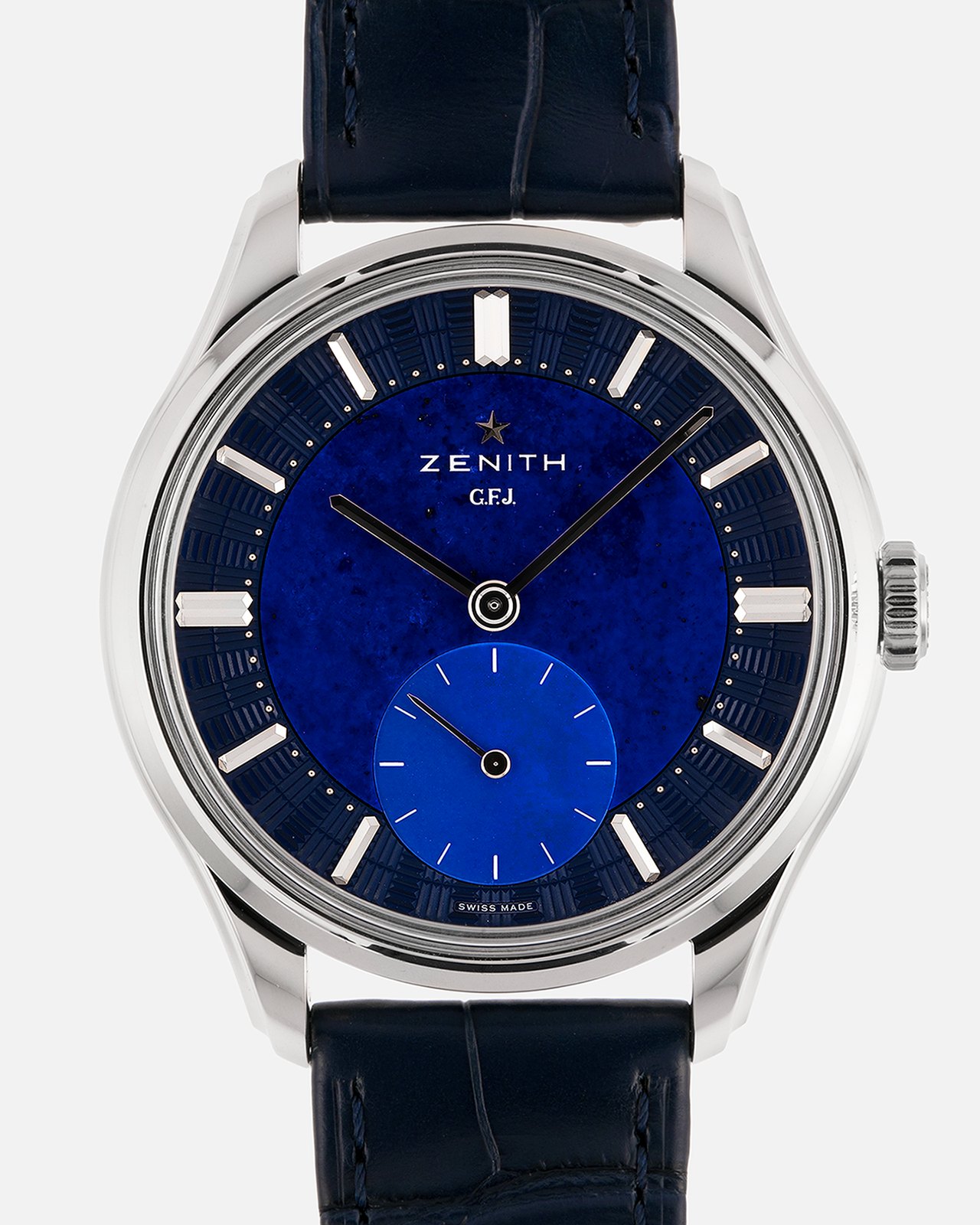
Zenith G.F.J. Caliber 135 Platinum Lapis Lazuli Mother Of Pearl, 2026
- Maker / attribution
- Zenith (maker)
- Date
- 2026
- Historical period
- Contemporary Horology (2010 – Present)
- Country of origin
- Switzerland
- Object type
- Wristwatch
- Materials / technique
- platinum
- Dimensions
- Case 14 mm
- Stock no.
- Product 7773318250583
- Credit line
- Dealer listing, S.Song Watches (product 7773318250583)
- Catalogue title (original)
- Zenith G.F.J. Caliber 135 Platinum Lapis Lazuli Mother Of Pearl (English)
View the source record (dealer listing) ↗ (opens another website in a new tab)Suggest a correction
Record summary
Catalogued by S.Song Watches (dealer), Seattle (stock number Product 7773318250583), this is a wristwatch by Zenith, made in Switzerland, dated 2026. The Atlas places it in the Contemporary Horology period (2010 – Present) of its Wristwatches collection. Materials and techniques recorded by the source: platinum. Recorded dimensions: Case 14 mm. The record is illustrated with 6 photographs.
Assembled from the source record's structured fields. Dates and attributions are given as the source states them; where a field is missing the Atlas leaves it blank rather than estimating.
Catalogue description
Dealer description — S.Song Watches
For much of its modern history, Zenith has been almost inseparable from the El Primero. Yet long before the arrival of its famous automatic chronograph in 1969, the manufacture had established an equally important reputation for precision timekeeping. At the centre of this was the Calibre 135, a movement developed specifically for the observatory chronometer competitions of the mid-20th century and one that would become among the most celebrated movements in Zenith's history. Introduced in 1948 and designed by Ephrem Jobin, the Calibre 135 was built around the pursuit of chronometric performance. Its unusual architecture positioned the gear train off-centre, creating enough space for an enormous 14mm balance wheel within a movement measuring just 30mm across. Beating at a relatively slow 18,000 vibrations per hour and paired with a Breguet overcoil, this oversized balance provided the stability required for the demanding observatory trials. The results were remarkable. Between 1950 and 1954, Zenith achieved five consecutive first prizes in the wristwatch category at the Neuchâtel Observatory, while the competition-specification 135-O would ultimately receive more than 230 chronometry prizes. Around 11,000 examples of the Calibre 135 were produced between 1949 and 1962, though only a small proportion were the specially prepared movements intended for observatory competition. In 2022, Zenith revisited this history with a series of just ten watches using original vintage 135-O movements that had never previously been cased. These were restored and finished in collaboration with Kari Voutilainen, introducing the Calibre 135 to an entirely new generation of collectors. Three years later, for its 160th anniversary in 2025, Zenith went considerably further with the G.F.J., named after the manufacture's founder, Georges Favre-Jacot. Rather than simply restoring another group of vintage movements, Zenith placed the Calibre 135 back into production for the first time in more than six decades. The new Calibre 135 remains remarkably faithful to the architecture of the original. The distinctive bridge layout, oversized balance wheel, Breguet overcoil and slow 18,000 vibrations per hour frequency have all been retained, while the movement itself has been extensively re-engineered for modern use. Power reserve has almost doubled to 72 hours, shock protection has been added and a stop-seconds mechanism allows for precise setting. More importantly, each movement is COSC certified and individually adjusted by Zenith to an accuracy of +/- 2 seconds per day, preserving the chronometric purpose for which the 135 was originally created. The movement is also finished to a level rarely associated with modern Zenith. Its bridges feature a distinctive brick guilloché pattern inspired by the red and white brick facade of the manufacture in Le Locle, complemented by hand-finished bevels and inward angles. It is an interesting balance between the industrial character of the original 135 and the considerably more elevated finishing expected from a modern watch at this level. The same brick motif continues onto the dial, which is perhaps the most visually distinctive aspect of the G.F.J. A dark blue guilloché chapter ring surrounds a central disc of natural lapis lazuli, its deep blue surface punctuated by naturally occurring pyrite inclusions. At 6 o'clock, the oversized subsidiary seconds is formed from blue mother-of-pearl, introducing yet another texture and shade of blue. Faceted white gold hour markers and hands sit above the dial, while a small pearl-style minute track provides a subtle reference to vintage chronometer dials. Despite the amount of detail, the watch itself remains relatively restrained in proportion. The platinum case measures 39.15mm across and approximately 10.5mm thick, with a stepped bezel, box-shaped sapphire crystal and sharply defined lugs. These dimensions, together with the simple time-only layout, allow the G.F.J. to retain much of the character of the mid-century chronometers that inspired it rather than feeling like an oversized modern reinterpretation. Limited to 160 pieces for Zenith's 160th anniversary, the G.F.J. is significant for reasons that extend considerably beyond the anniversary itself. For decades, the El Primero has understandably dominated the way collectors view Zenith, while the manufacture's extraordinary history in observatory chronometry has remained comparatively overlooked. The G.F.J. changes this by returning one of Zenith's most important movements to serial production, while retaining the unusual architecture and slow-beating oversized balance that made the original so successful. For me, this is what makes the G.F.J. particularly interesting. It is not simply a modern watch inspired by something from Zenith's archives, but the genuine revival of a movement architecture that helped establish the manufacture's reputation for precision more than 75 years ago. Combined here with the platinum case, lapis lazuli and mother-of-pearl dial, it also feels appropriately special for the first production watch to mark the return of the Calibre 135.
Historical context
Contemporary Horology (2010 – Present)
Silicon components, connected watches, optical-lattice research clocks and a thriving independent scene.
Smartwatches became the world's best-selling watches, while mechanical watchmaking focuses on craft, innovation (silicon components, new escapements) and independent makers.
Read the period in the timelineMore wristwatches from this periodEarlier: Mechanical Renaissance
Atlas type guide
Wristwatches
Bracelet watches were worn by women from the early nineteenth century — Breguet made one for Caroline Murat, Queen of Naples, in 1810–12 — but the wristwatch only became a man's instrument with military use and aviation in the early twentieth century. Between the World Wars it overtook the pocket watch; the 1920s and 1930s brought rectangular Art Deco cases, water-resistant cases and the first automatic winding systems.
After 1945 the wristwatch became a carrier of identity — dress watches, sports and dive watches, chronographs, calendars — produced by Swiss, American, Japanese, German, Soviet and Chinese industries. The quartz revolution after 1969 and the mechanical renaissance since the 1990s, including the rise of independent watchmakers, complete the story.
What to look for
- The reference number (between the lugs or inside the case back) and serial number, the starting point for dating.
- The calibre: its maker and number are often stamped under the dial or on the bridge.
- Originality of dial, hands and crown — refinished ('redial') dials are common.
- Case material marks: 18K/750, 14K/585, stainless steel, gold-filled, plated.
Dating clues
- Wire-lug cases: before c. 1925.
- Water-resistant screw-down cases: from 1926.
- Quartz movements: from 1969; sapphire crystals widespread after c. 1980.
General guidance written by the Atlas editors about this kind of object. It is not a statement about this particular piece; for that, rely on the source record above and on physical examination.
Related records
Pocket Watches · 1900
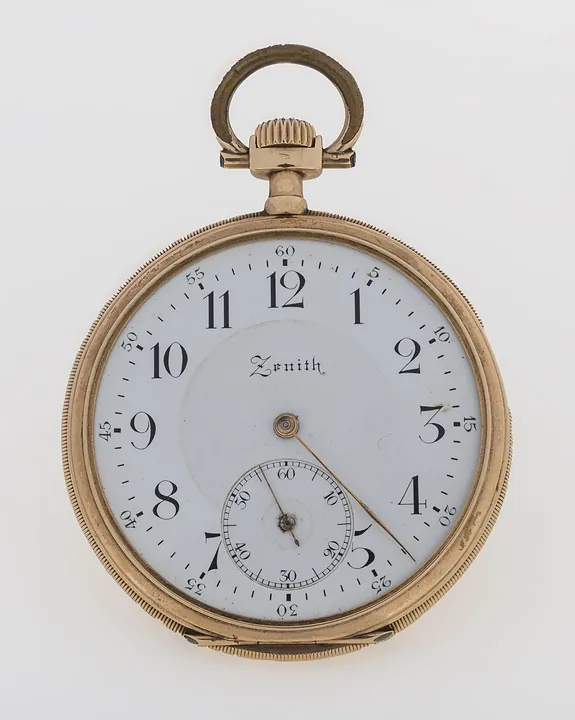
Pocket watch by Zenith, Switzerland, 1900
Museum Rotterdam
Pocket Watches · c. 1900s
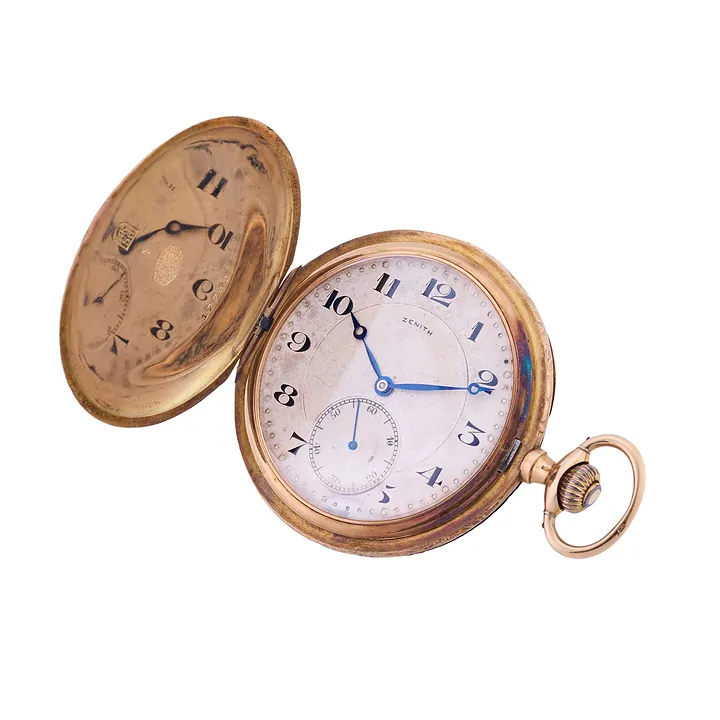
Zenith pocket watch, c. 1900s
Antiquorum auction archive, Geneva
Wristwatches · c. 1980s
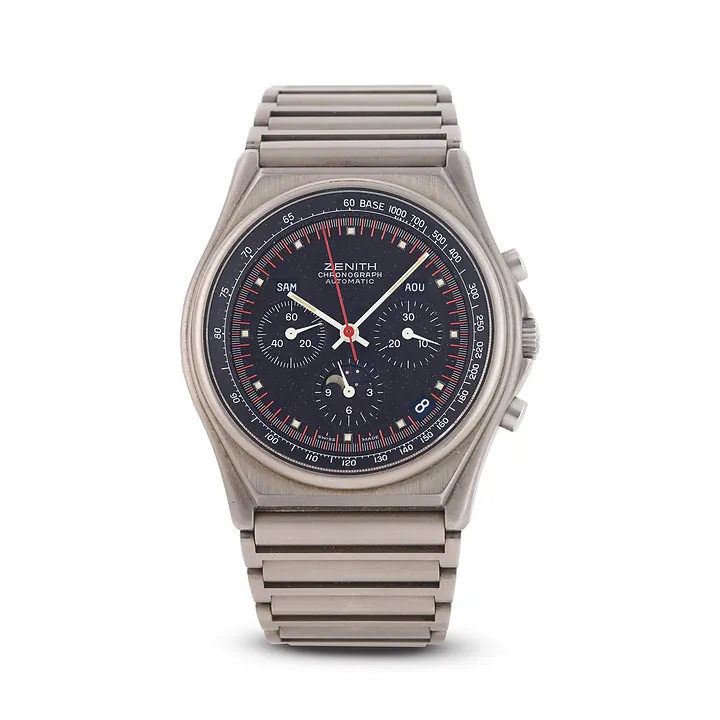
Zenith El Primero Triple Calendar Chronograph, ref. 95.0100.418, c. 1980s
Antiquorum auction archive, Geneva
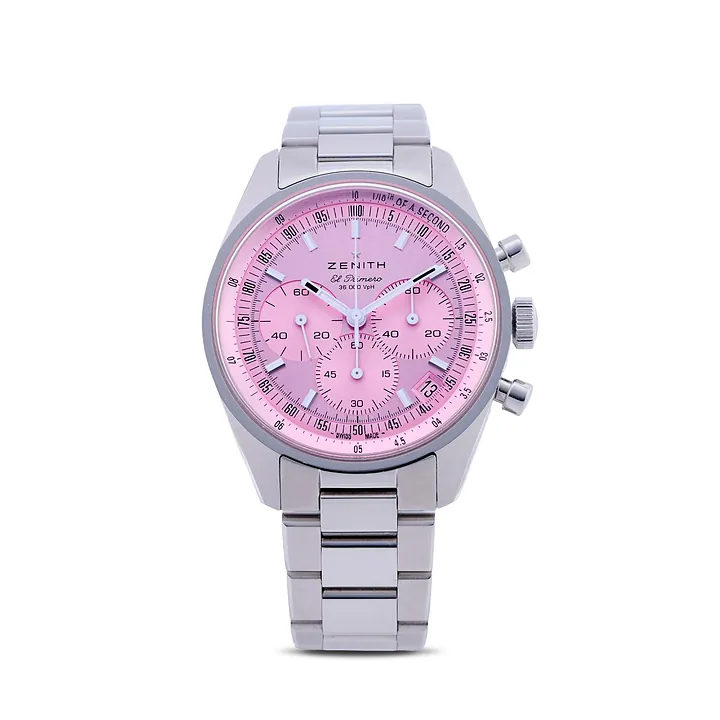
Wristwatches · originally sold in 2022 (per the lot record)
Zenith Chronomaster Original, ref. 03.3202.3600/33.M3200, originally sold in 2022
Antiquorum auction archive, Geneva

Wristwatches · c. 2010s
Breguet Type XXI, ref. 3810, c. 2010s (Antiquorum Lot 381-24)
Antiquorum auction archive, Geneva

Wristwatches · c. 2010s
Breguet Type XXI, ref. 3810, c. 2010s (Antiquorum Lot 386-229)
Antiquorum auction archive, Geneva

Wristwatches · Sold in September 2010
Breitling Cosmonaute, ref. A 22322, Sold in September 2010
Antiquorum auction archive, Geneva

Wristwatches · c. 2010
Corum Bubble Chrono, ref. 396.150.20, c. 2010
Antiquorum auction archive, Geneva