
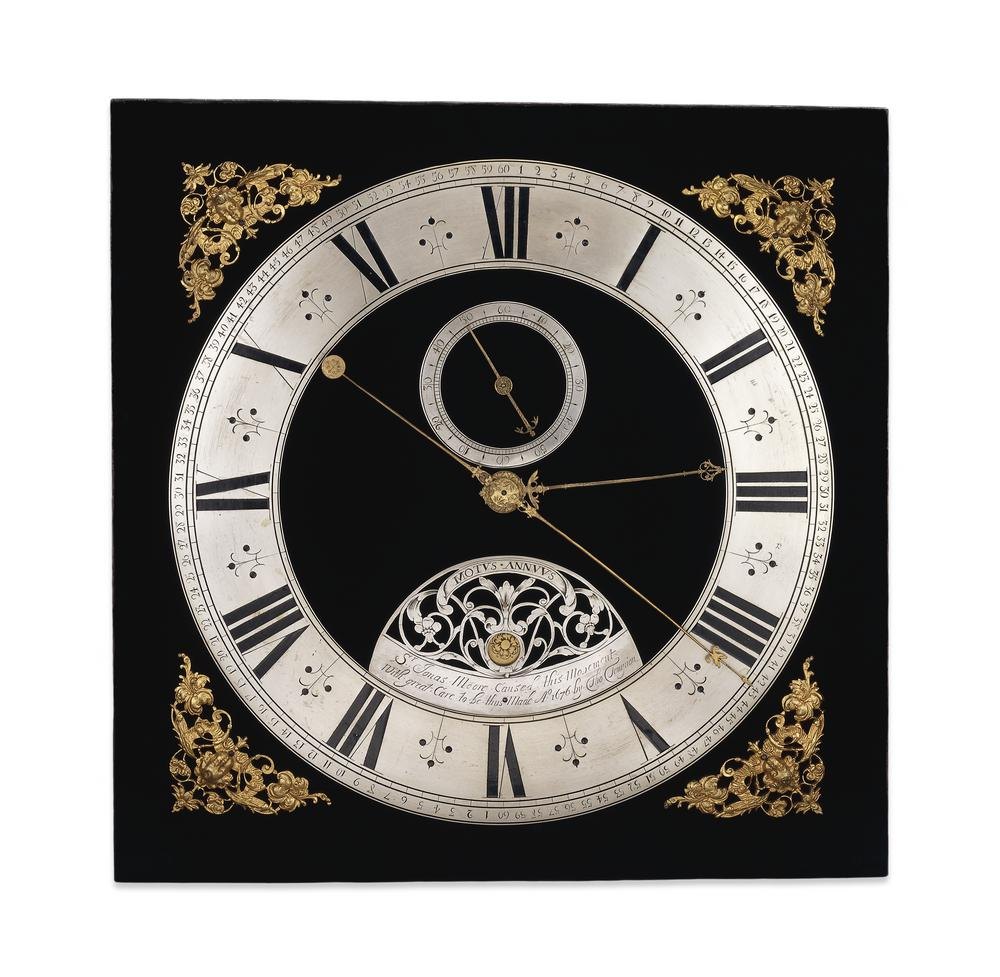
Clocks · Astronomer's clock
Year-going clock by Thomas Tompion
- Maker / attribution
- Thomas Tompion (Made by); Richard Towneley (original escapement) (Designed by)
- Date
- 1676; 1678 (escapement)
- Historical period
- Early Modern Horology (1600 – 1750)
- Country of origin
- England
- Place
- London (England)
- Object type
- Astronomer's clock
- Materials / technique
- brass
- Holding institution
- British Museum
- Accession / object no.
- 1928,0607.1
- Credit line
- British Museum, London
- Catalogue title (original)
- Year-going clock by Thomas Tompion (English)
View the source record ↗ (opens another website in a new tab)Suggest a correction
Record summary
Held and catalogued by British Museum (object number 1928,0607.1), this is an astronomer's clock by Thomas Tompion, made in London (England), dated 1676; 1678 (escapement). The Atlas places it in the Early Modern Horology period (1600 – 1750) of its Clocks collection. Materials and techniques recorded by the source: brass. The record is illustrated with 4 photographs.
Assembled from the source record's structured fields. Dates and attributions are given as the source states them; where a field is missing the Atlas leaves it blank rather than estimating.
Catalogue description
Description — British Museum
Year-going clock; frame of cast brass plates, hammer-hardened; fastened by five pillars riveted to back-plate and pinned to front-plate; train of five wheels, upper three supported in sub-frame with its three pillars riveted to back-plate; spring-operated maintaining power ('bolt-and-shutter') engaged by pulling small cord; when first set, driving weight and 13ft pendulum swinging once every two seconds, were suspended below the movement; later adapted for domestic use; escape-wheel with 60 teeth, made to drive conventional 39in pendulum, is modern replacement; original escapement based on dead-beat, later replaced. Train Count:- Greatwheel, 112 intermediate wheel, 96 centre wheel 80 fourth wheel 48 escape wheel 30 Motion Work: Cannon pinion 30 Hour wheel 60.
Curator's comments — British Museum
Text from 'Clocks', by David Thompson, London, 2004, pp. 80-83. Thomas Tompion In 1674, a committee which included Christopher Wren, Robert Hooke and the astronomer John Flamsteed, set up by Charles II to investigate claims that variations in magnetic dip could be used to determine the longitude of a particular place, was asked to look into claims by a Frenchman, the Sieur de St Pierre. Through the king's mistress, Louise de Kéroualle, the Sieur had proposed to Charles II that longitude could be found by observing the motions of the moon. In response, Charles charged the committee to investigate the practicality of the Sieur's claim. This led in 1675 to a Royal Warrant enabling an observatory, designed by Sir Christopher Wren, to be built at Greenwich, and for John Flamsteed to be the first Astronomer Royal. The Warrant began 'whereas we have appointed our trusty and well-beloved John Flamsteed, master of arts, our astronomical observer, forthwith to apply himself to the rectifying the tables of the motions of the heavens, and the places of the fixed stars, so as to find out the so-much desired longitude of places for the perfecting of the art of navigation'. Sir Jonas Moore supervised the construction of the building and commissioned two specially-designed regulators from the leading London clockmaker of the time, Thomas Tompion, and a third from a Lancashire clockmaker, Richard Townley, whose dead-beat escapement, subsequently modified by Tompion, was used in the clocks. Thomas Tompion was baptised on the 25th of July, 1639, in Northill, Bedfordshire and lived in the nearby hamlet of Ickwell Green. Nothing is known of his early career. In 1671, he can be traced in London where he established a business in Water Lane just off Fleet Street. In 1674, he supplied a turret clock for the Wardrobe Tower at the Tower of London and a quadrant for the Royal Society. The following year he made a watch for King Charles II. In 1675-6 he was commissioned to make the regulators for the new Greenwich Royal Observatory. Tompion became the most celebrated of all English clockmakers and established a business with a reputation second to none in Europe. He was admitted as a Free Brother in the Clockmakers' Company in 1671, was granted full freedom in 1647 and held the office of Master of the Company in 1703/4. He died in 1713 and was buried in Westminster Abbey. Both of the Tompion clocks survive, one in the National Maritime Museum, the other in The British Museum, but the whereabouts of the Townley clock remain unknown. Astronomers had always been great campaigners for accurate clocks, essential to their work, and the clocks installed in the Greenwich Royal Observatory in 1676 were at the time the best in the world, enabling Flamsteed to record the motions of the planets and the moon and establish the true positions of the fixed stars. The large square dials were velvet covered and while they seem at a glance to be of standard design, they are not so. The chapter ring is calibrated in hours I-XII, with an outer ring divided into minute divisions, all numbered and calibrated 1-60 twice, i.e. for a minute hand rotating once in two hours. The subsidiary dial above the centre is for seconds, divided to single seconds and also numbered 1-60 twice for a seconds hand revolving once every two minutes. Thus the time on the dial shown here is forty-four minutes past two o'clock and not twenty-two minutes past, as it first appears (see image no. AN32111). However, this clock was designed specifically for use by an astronomer who was not concerned with the time of day. Above the VI numeral a silver plate around the winding hole is inscribed, 'Sir Jonas Moore Caused this Movement With great Care to he thus made Ao 1676 by Tho Tompion'. At the top of the plate is the inscription 'Motus Annus' indicating that the clock will run for a whole year on a single wind. Even so, the massive movement is furnished with maintaining power to keep the clock running during winding. Clearly these clocks were never meant to stop from one year to the next. When the clock was set up in Greenwich it had a two-seconds beating pendulum measuring 13 feet (3.96 m) long. After initial adjustments made to the escapement, Flamsteed recorded that the clocks were keeping time to within two seconds per day. Following Flamsteed's death in 1719 his widow removed the clocks and instruments from the observatory on the grounds that they had been the property of her late husband. At some time after this, this clock was converted to domestic use by the replacement of the escape wheel so that it would function with a seconds pendulum. Recently, however, with funds provided by the Townley Group of The British Museum Friends, a new dead-beat pin-wheel escapement has been made by Jeremy Evans, curator at the Museum. The escapement is based on surviving sketches of Richard Townley's original concept and the clock now performs as it used to, with the pendulum beating two seconds and swinging at right angles to the dial. Purchased in 1928. View more about curator's comments Information supplied by Jeremy Evans, former curator of Horology at the British Museum (May 2011) Greenwich Year-Going Timepiece 1. 1676. Case: Originally installed into wainscoting of the Octagon Room, Greenwich. When this clock was offered at auction in 1923 it was housed in ‘an Empire mahogany tall case, 7ft 6in high’. Courtenay Ilbert is said to have described this case as ‘an ill proportioned red mahogany case [of the] so-called Regency period’, but no illustration is known to exist. It is possible that the case was retained by Webster – it is not believed to have accompanied the clock when it was acquired by The British Museum in 1928, and a new display case was provided. Dial: 17½” square, with four substantial feet, pinned, not latched, the front surface of the plate left roughly filed to enable a better bond for the glue which would have held the covering of material - possibly a.
Inscriptions & marks
inscription; dial; Motus Annus; Sir Jonas Moore Caused this Movement; With great Care to be thus Made Ao 1676 by Tho.Tompion
Provenance
Purchased from:, Percy Webster; Acquired 1928
Historical context
Early Modern Horology (1600 – 1750)
Huygens' pendulum and balance spring transform accuracy; English makers develop the anchor and deadbeat escapements.
Huygens's pendulum (1656–57) improved clock accuracy from about a quarter of an hour to under a minute a day. The anchor escapement (c. 1670) and the long seconds pendulum created the longcase clock; London makers such as Fromanteel, Knibb, Tompion and Quare led European clockmaking, and French makers created the Boulle pendule.
Read the period in the timelineMore clocks from this periodEarlier: Renaissance Horology
Atlas type guide
Domestic clocks
A clock combines four systems: a source of power (falling weight, coiled spring, or later electricity), a gear train that divides time, an escapement and oscillator that regulate it (foliot, pendulum or balance), and an indicating system of dial and hands or a bell. Its history runs from the large iron weight-driven clocks of the late thirteenth century to Renaissance spring-driven table clocks, the pendulum revolution of 1656, the factory clocks of the nineteenth century and electric and quartz clocks of the twentieth.
Domestic clocks also reflect regional furniture and decorative traditions — English longcase and bracket clocks, French pendules, Viennese regulators, Black Forest and American shelf clocks — and therefore record changing tastes as much as technical progress.
What to look for
- How the clock is powered: weights, spring barrel, fusee, electric coil.
- The oscillator: foliot, short pendulum, long seconds pendulum or balance.
- Whether it strikes: hour only (count wheel) or hours and quarters (rack striking).
- The maker or retailer's name on dial and movement, and any factory trademarks.
- Signs of alteration — replaced dials, converted escapements, 'married' cases.
Dating clues
- Before 1656 clocks used foliots or balances; after, most domestic clocks have pendulums.
- Anchor escapements spread after c. 1670; minute hands became common at the same time.
- Factory production in America and Germany transformed prices after c. 1840.
General guidance written by the Atlas editors about this kind of object. It is not a statement about this particular piece; for that, rely on the source record above and on physical examination.
Related records
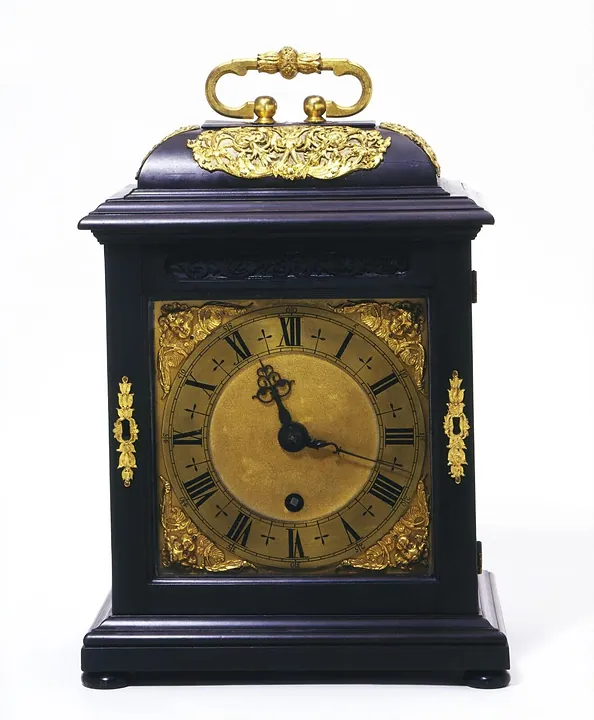
Clocks · c. 1690
Bracket clock by Thomas Tompion, England, c. 1690
Victoria and Albert Museum, London
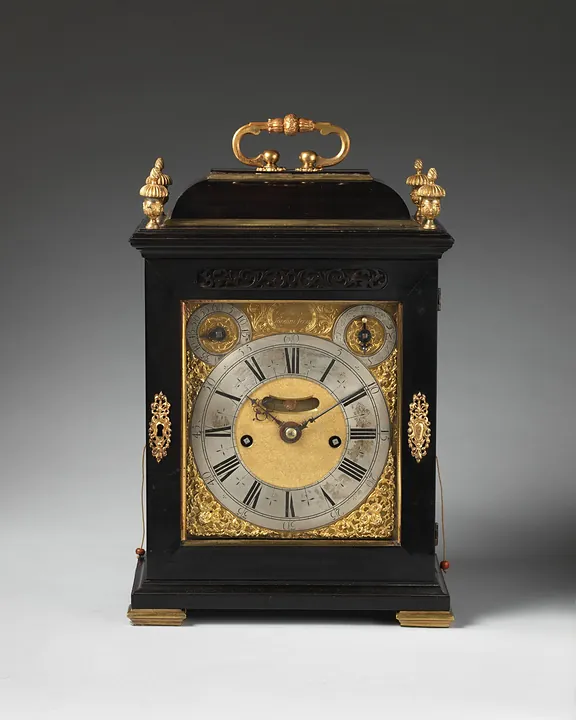
Clocks · c. 1696
Table or bracket clock by Thomas Tompion, England, c. 1696
The Metropolitan Museum of Art, New York
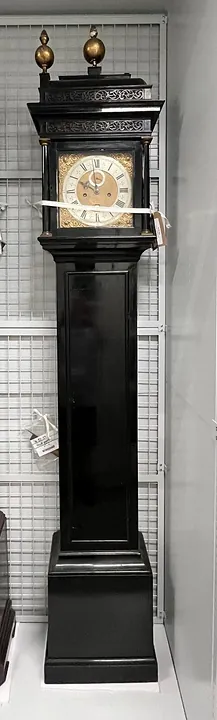
Clocks · c.1705
Eight day long case clock, ebonised pearwood veneer on oak carcase, inscribed 'Tho Tompion and Edw Banger London', made in about 1705
Victoria and Albert Museum, London
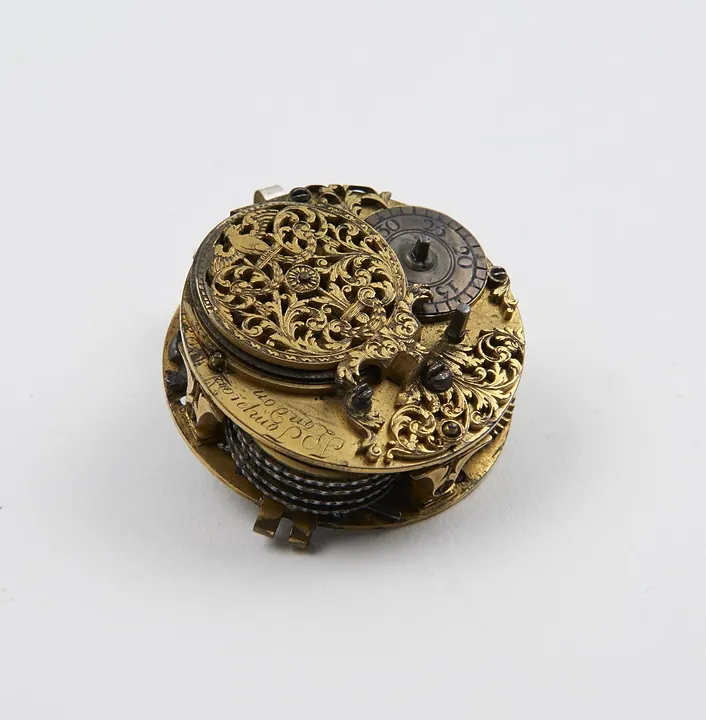
Movements & Components · 1690
Pocket watch verge escapement movement by Thomas. Tompion, London, England,1690
Science Museum Group, London
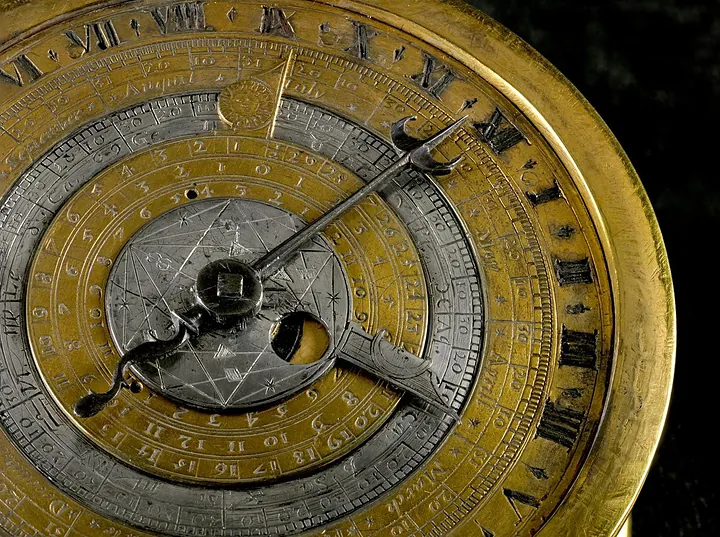
Clocks · 1598–1603
Circular table-clock with calendrical and lunar indications made by Nicholas Vallin in London between 1598 and 1603.
Science Museum Group, London
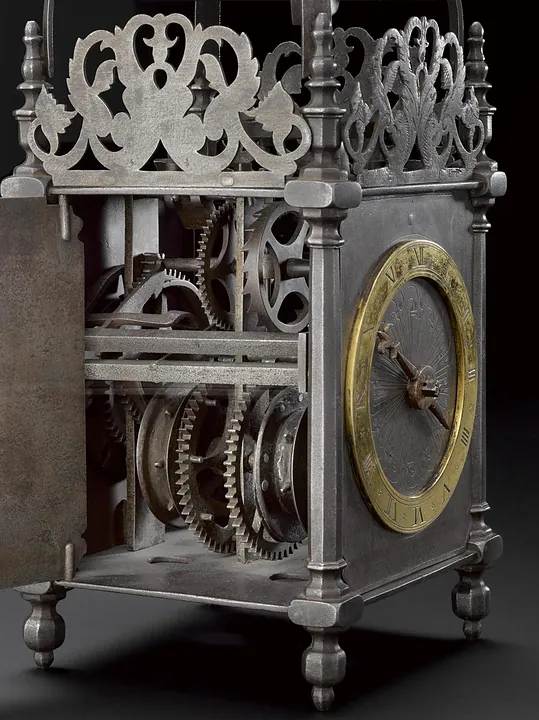
Clocks · 1611
English iron lantern clock, with wheel balance, by John Holloway, Market Lavington, Wiltshire, England, 1611.
Science Museum Group, London
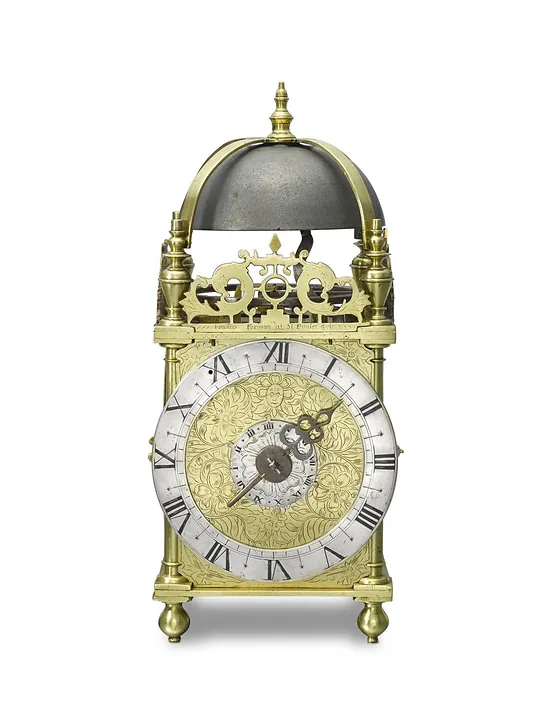
Clocks · 1630
Lantern clock by Francis Forman, England, 1630
Science Museum Group, London
Clocks · 1632–1640
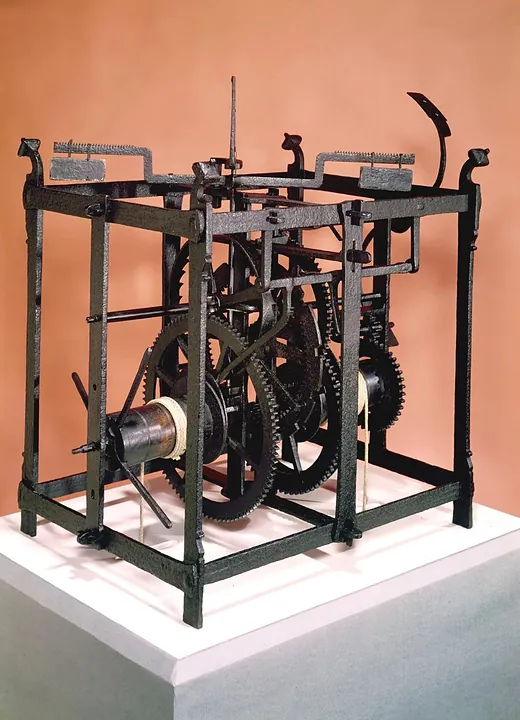
Turret clock, England, 1632–1640
Science Museum Group, London