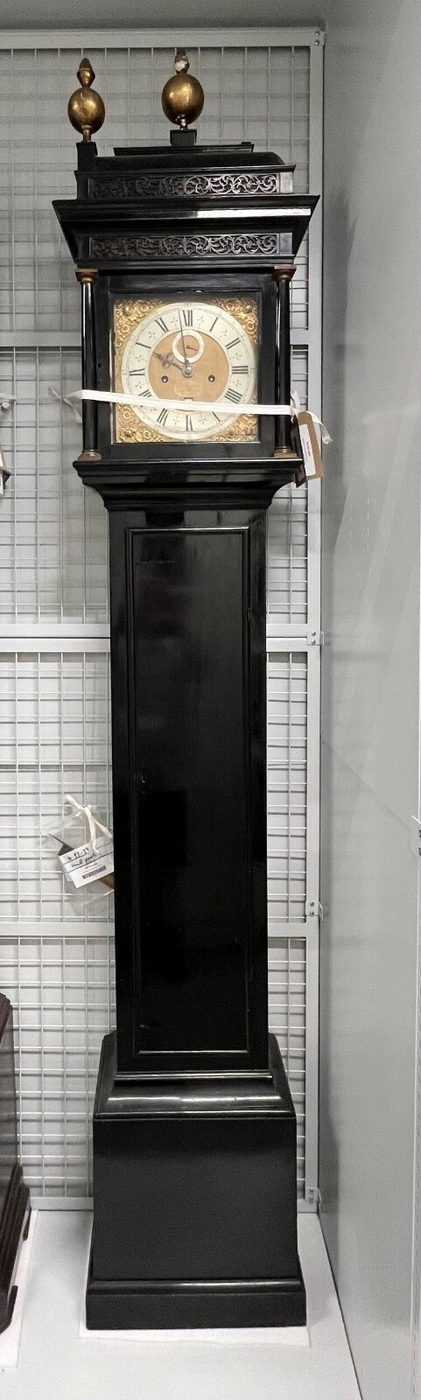
Clocks · Longcase clock
EIGHT DAY LONG CASE CLOCK Ebonised pearwood veneer on oak carcase Inscribed 'Tho Tompion and Edw Banger London', made in about 1705
- Maker / attribution
- Thomas Tompion (made); Edward Banger (made)
- Date
- c.1705
- Historical period
- Early Modern Horology (1600 – 1750)
- Country of origin
- England
- Place
- London
- Object type
- Longcase clock
- Materials / technique
- oak, pearwood, brass (alloy), steel
- Dimensions
- Height: 243.8 cm; Width: 47.6 cm; Depth: 25.4 cm; Weight: 6.25 kg (w.13:3 Lead weight 10/10/2025 NH); Weight: 5.85 kg (w.13:2 Lead weight 10/10/2025 NH)
- Holding institution
- Victoria and Albert Museum, London
- Accession / object no.
- W.13:1-1963
- Credit line
- Given by Brigadier W. E. Clark CMG, DSO through Art Fund
Record summary
Held and catalogued by Victoria and Albert Museum, London (object number W.13:1-1963), this is a longcase clock by Thomas Tompion, made in London, England, dated c.1705. The Atlas places it in the Early Modern Horology period (1600 – 1750) of its Clocks collection. Materials and techniques recorded by the source: oak, pearwood, brass (alloy), steel. Recorded dimensions: Height: 243.8 cm; Width: 47.6 cm; Depth: 25.4 cm; Weight: 6.25 kg (w.13:3 Lead weight 10/10/2025 NH); Weight: 5.85 kg (w.13:2 Lead weight 10/10/2025 NH). The record is illustrated with 4 photographs.
Assembled from the source record's structured fields. Dates and attributions are given as the source states them; where a field is missing the Atlas leaves it blank rather than estimating.
Catalogue description
V&A — Summary
Thomas Tompion (1639-1713) was the most famous of all English watch and clock makers, and made clocks for Charles II, William III, Queen Anne and her husband, Prince George of Denmark. Edward Banger, his apprentice, married his niece and became his journeyman. From 1701 to 1707/8 they jointly signed work. Tompion's shop was known as "The Dial and Three Crowns", at the corner of Water Lane and Fleet Street. This clock is numbered by Tompion 351 on the backplate, and the case is also stamped with the same number on the edge of the trunk door at the top.
V&A — Physical description
Case: Ebonised pearwood veneer on oak carcass. Rectangular trunk door with convex moulding to edge, the number 351 present on the edge of trunk door near top. Concave moulding beneath hood. Sliding hood with caddy top flanked by gilded wood ball finials mounted on short pedestals, a third finial similarly mounted top centre. Pierced wood, blind frets to front of frieze and superstructure. Hood sides with applied columns to front, quarter pillars at the back, all with brass caps. Rectangular glazed, side apertures. Rectangular base above deep plinth. A printed paper label is glued to the inside of the case bearing the Iden Collection Number. Dial: Brass, 11 inches square. Centre matted with plain winding holes, winding squares concealed by matted shutters. Square calendar aperture, with small semicircular cut-outs in the vertical bevelled edges, is located below oval reserve bearing the engraved signature: Tho Tompion / & / Edw Banger / London . Tompion cherub head spandrels each located by a pair of steel screws, with foliate design engraved on dial plate between each. Upper proper right dial plate and engraving partially cut away for maintaining power lever. Pinned to the dial plate is the silvered brass chapter ring with engraved minute and quarter hour bands Roman hour numerals and at intervals of five, Arabic minute numerals. Half-hour markers of opposed arrowheads connected to quarter hour band by single line; half-quarter marks of similar design. Pinned to the dial plate below "XII" is the subsidiary seconds ring of silvered brass with engraved seconds band and at intervals of five, Arabic seconds numerals; its diameter is less than the full space between the dial centre and inner edge of the chapter ring. A silvered brass ring with engraved Arabic numerals for the date (1-31) with pinhole adjustment runs behind the dial on brass pulleys. Four dial feet are latched to movement front plate. Hands: Steel. Pierced and partially chiselled, the minute hand with a straight portion. Plain seconds hand. Movement: Brass and steel, weight driven, hour striking of 8-day duration, with recoil escapement, pendulum regulated. The number 351 is stamped on outside backplate at the bottom centre. Going train planted on proper right. Six finned pillars each with central knop and semicircular ends riveted to the backplate, latched at front. Hour striking on bell controlled by internal countwheel; steel hammer head. Brass train wheels with four semicircular crossings. Where visible, scribed lines present on wheel faces, one at teeth roots, one above base of wheel band, except on third and escape wheels which appear plain. Three-spoked crossings on cannon pinion and minute wheel; each tooth root of these with a pair of short markings. Plain, domed wheel collets except those of hoop, warning, third and escape wheel which are domed with short cylindrical extensions. Steel arbors barrel-shaped, pinion heads not particularly short, especially hoop, fly, third and escape. Pinion leaf roots extend along fly arbor, warning pinion partially cut down to allow clearance for hoop wheel detent. Bolt and shutter maintaining power: actuating lever, located proper right, is linked to second arbor carrying bolt which drives centre wheel teeth. Actuating lever arbor directly operates one shutter, the other mounted on a post operated via central linkage. Centre wheel, third wheel and pinion head of the escape wheel all mounted some distance from inside back plate. Steel pallets embracing 9½ teeth mounted on pallet arbor with brass collet; the long crutch pinned to pallet arbor. Backplate with cut out corresponding to pallet frame shape. Detailing present on some steelwork: slight scrolling to barrel click tails, modified tear-drop shape to front-mounted bell standard foot and bevelling to front mounted hammer stop. Backcock details include: functional brass steady pins; additional steel pins finished flush on underside (corresponding with vacant holes in back plate); main locating screw holes oval in shape. Plugged holes visible around pallet arbor bearing on front plate; also around fly bearing. Unused threaded hole on backplate plate adjacent to backcock. Pendulum with brass rod, brass cased bob and brass regulating nut with engraved Arabic numerals. Description and notes by Francis Brodie, c. 2008
V&A — Object history
Gift of Brigadier W E Clark, 18 October 1963 (Registered File 63/2549). Gift form lists as "1 Clock - ebony case by Tompion and Banger". 2 October 1963 memo, Hayward to the Director refers to Clark's gift "this very fine long case clock by Tompion and Banger. Value is probably not much less than £1,000….considerably better than the Tompion we got last week". 24 October 1963 letter, Director to Clark thanks him for "this clock which combines a particularly well proportioned case with a movement by the most distinguished of English clockmakers". It is a "precious and most welcome acquisition". Handwritten notes, undated & unsigned gives the clock's dimensions and materials (ebonized pearwood veneered in oak) and describes it "Tompion - Banger. Eight day striking movement numbered 351 on back of movement and on case door circa 1705-10. Formerly W J Iden collection, bought by him 1903" Remarks : At least three clocks from the Tompion stable had very similar cases: this example (351), Tompion 534 and Graham 632, but the general style, albeit in different woods, was widely used by Tompion for his standard longcases; it evolved at the end of the seventeenth century, beginning of the eighteenth. The caddy top first seen towards the end of the seventeenth century began to enlarge at this date, leading to the sliding hood since, the superstructure of the caddy top rendered the rising hood impractical. Also characteristic of this period was the superseding of barley twist hood columns with plain columns, and the use of the deep plinth. The concave moulding under the hood was adopted around 1700. Interestingly the dial is eleven inches; at this date there was a trend for square dials to enlarge to twelve inches. The spandrels of the style used on this clock were introduced around 1700, whilst the floral engraving between them started to appear around 1690. Movement features typical of this date include the finned pillars and dome-shaped collets, although these did survive into the mid-eighteenth century. Features distinctive to Tompion are the retention of the maintaining power at this late date on an ordinary clock and therefore the absence of decoration to the winding holes and calendar aperture. Other features of quality work that are frequently (although not exclusively) associated with Tompion include: the latched fittings, the number of pillars on an ordinary clock, the backcock with its underslung pivot hole and, the long crutch and spandrels each located by a pair of screws. The hands are in a style and quality associated with the Tompion stable of this period. Dating the clock is not straightforward: the partnership between Tompion and Banger ran between 1701 to 1708/9. It is not known when Tompion started to number his clocks but is thought to have been from around 1680 (Symonds, R.W., Thomas Tompion, his life and work, London, 1969) going up to around 580 at his death in 1713; the number sequence was continued during the partnership with Banger and after Tompion’s death by his successor, George Graham (Loomes, B., Grandfather Clocks and Their Cases, Devon, 1985). Things are complicated further by the existence of longcase clock dials from the Tompion stable with the engraved reserve covered by an engraved plaque bearing the names (for example) Tompion (Thompson, D., The Watches of Ellicotts of London, Part 1, Antiquarian Horology, Vol.23, No.4, Summer 1997, pp306-321) and Tompion and Graham (Foulkes, R.K., The Ellicotts: A Family of Clockmakers, Antiquarian Horology, Vol.3, No.4, September 1960, pp102-110). It is possible to interpret this as evidence that Tompion stable longcase clock dials were made in advance of orders, forming stock. The layout of the movement is unusual in that this is a clock of eight-days duration but the Going train is located on the proper right, the opposite side to the norm. Such a layout would not be unusual for a Tompion month going clock. So far, only one other eight-day transposed train Tompion exists and the number (242) is only scratched on the back of the dial (Boney, G., Was Banger Really Fired? A tale of two nephews, Antiquarian Horology, Vol.27, No.4, June 1984, pp392-405). The possibility exists that 351 may have started out as a month-going movement, perhaps as stock, but for some reason was finished as an eight-day with transposed trains. Study of another month-going longcase 333 dated at 1699 and described as a fine example of Tompion’s standard month-going clock shows similarities with the layout of the Going train of 351 (Evans, J., Personal Communication). In both can be seen the additional arbor in the maintaining power mechanism to ensure the correct direction of drive in the transposed layout and in both, the centre wheels (and other mobiles above) are mounted a little distance from the back plate. This allows space in the month-going movement (333) for the intermediate wheel; the same space is present in 351 despite the absence of the intermediate wheel which was not required in the shorter duration clock. This reinforces the argument that 351 might have been intended as a month duration clock. The arrangement of the maintaining power with its linkage between actuating lever and bolt to reverse the motion is associated with Tompion month-going clocks, but it has to be of this type to drive the reversed eight-day movement in the correct direction, so this may not be significant. That the case and movement both share the same number 351 suggests that the two correspond. The pendulum is in a style associated with Tompion and is possibly original. It would appear that some modification has occurred to the movement most probably in those components with longer pinion heads and wheels devoid of scribed lines. Walter Iden, an engineer, collected mainly during the fourth decade of the twentieth century. Iden housed his collection in his ground floor flat in Keswick Road, Putney making photographs of the cases but not the movements, the photos…
V&A gallery label
LONG-CASE CLOCK ENGLISH; about 1705 Ebonised pearwood veneered on oak. The movement signed 'Tho. Tompion Edw. Banger London' Thomas Tompion (1639-1713) was the most famous of all English watch and clock-makers. Edward Banger, his apprentice, married his niece and became his journeyman. From 1701 to 1707/8, they signed their productions together. This clock is numbered by Tompion 351. Given by Brigadier W.E. Clark, C.M.G., D.S.O., through the National Art-Collections Fund.
Inscriptions & marks
351
Historical context
Early Modern Horology (1600 – 1750)
Huygens' pendulum and balance spring transform accuracy; English makers develop the anchor and deadbeat escapements.
Huygens's pendulum (1656–57) improved clock accuracy from about a quarter of an hour to under a minute a day. The anchor escapement (c. 1670) and the long seconds pendulum created the longcase clock; London makers such as Fromanteel, Knibb, Tompion and Quare led European clockmaking, and French makers created the Boulle pendule.
Read the period in the timelineMore clocks from this periodEarlier: Renaissance Horology
Atlas type guide
Longcase (tall-case or grandfather) clocks
The longcase clock was born from two seventeenth-century innovations: Christiaan Huygens's pendulum (1656–57) and the anchor escapement (c. 1670). A long seconds pendulum, nearly a metre long, swings with a small arc, and enclosing it together with the driving weights in a tall wooden case protected the mechanism and created a new piece of furniture. London makers such as Ahasuerus Fromanteel, Thomas Tompion and Joseph Knibb set the pattern.
By the eighteenth century longcase clocks were made throughout Britain, the Netherlands, Scandinavia (the Swedish Mora clock), France (the Comtoise from the Franche-Comté), Germany and colonial America. Eight-day movements with two weights became standard in better clocks; thirty-hour clocks with one weight and a rope or chain were cheaper alternatives.
What to look for
- Winding holes in the dial: two (eight-day, going and striking) or none (thirty-hour, pulled up by a chain).
- Brass dials with applied chapter rings (earlier) versus painted iron 'white' dials (after c. 1770 in Britain).
- Moon-phase arches, date apertures, seconds dials and maker's name on the dial.
- Case woods and style: ebonised, walnut marquetry, lacquer, oak or mahogany; regional styles from London, Lancashire, Scotland or America.
- Whether the movement and dial match the case — 'marriages' are common.
Dating clues
- Square brass dials suggest c. 1670–1720; arched brass dials c. 1715–1790.
- Painted (white) dials were made by Birmingham dial-makers from about 1772.
- Comtoise clocks with repoussé pendulums are mostly nineteenth century.
General guidance written by the Atlas editors about this kind of object. It is not a statement about this particular piece; for that, rely on the source record above and on physical examination.
Read next:Anchor escapement
Related records
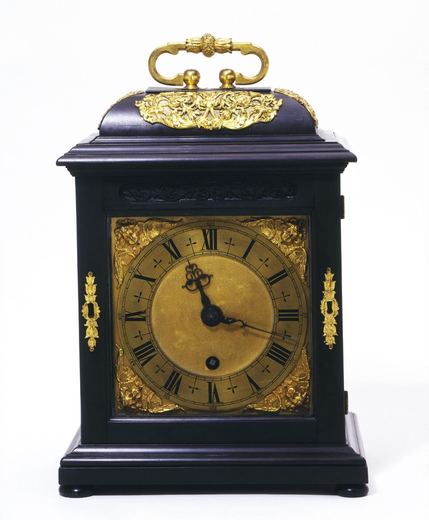
Clocks · ca. 1690
Bracket clock by Thomas Tompion, England, ca. 1690
Victoria and Albert Museum, London
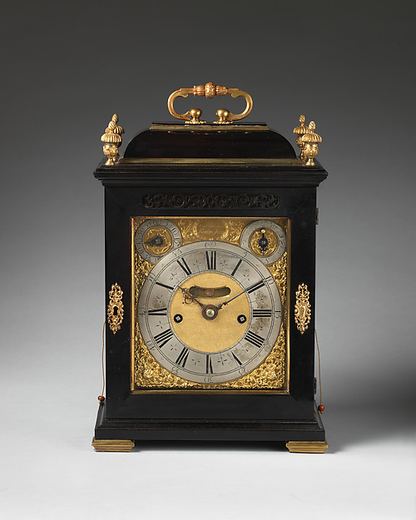
Clocks · ca. 1696
Table or bracket clock by Thomas Tompion, United Kingdom, ca. 1696
The Metropolitan Museum of Art, New York
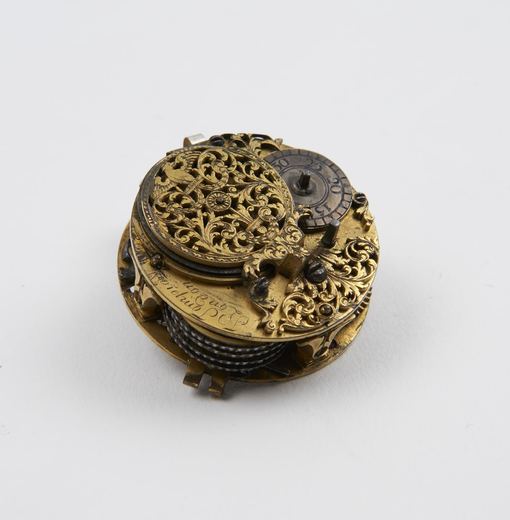
Movements & Components · 1690
Pocket watch verge escapement movement by Thomas. Tompion, London, England,1690
Science Museum Group, London
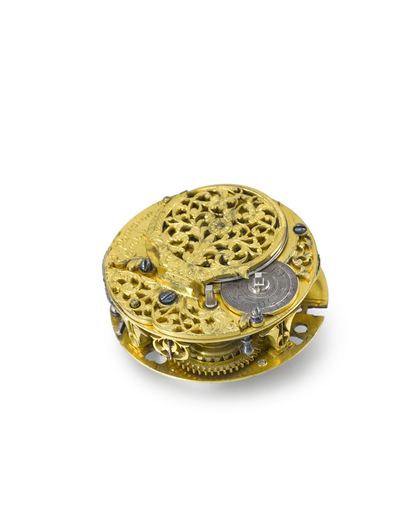
Movements & Components · 1692
Watch movement by Tompion, Thomas, England, 1692
Science Museum Group, London
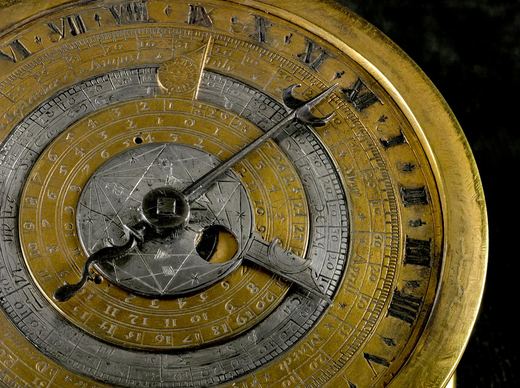
Clocks · 1598-1603
Circular table-clock with calendrical and lunar indications made by Nicholas Vallin in London between 1598 and 1603.
Science Museum Group, London
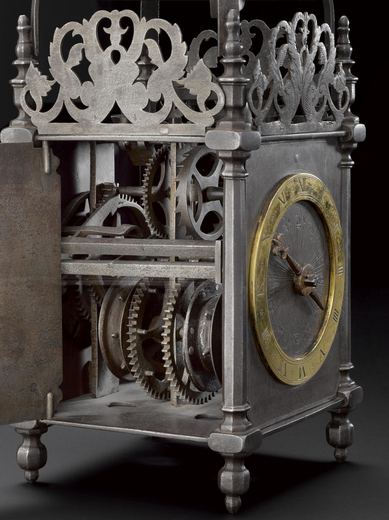
Clocks · 1611
English iron lantern clock, with wheel balance, by John Holloway, Market Lavington, Wiltshire, England, 1611.
Science Museum Group, London
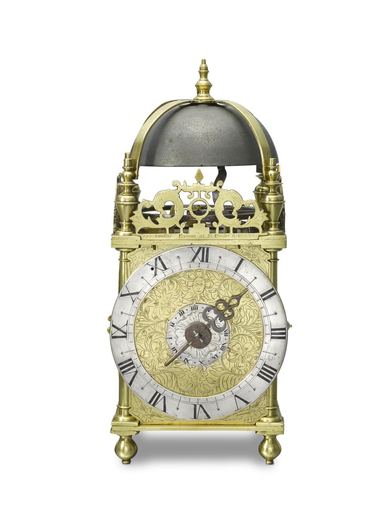
Clocks · 1630
Lantern clock by Forman, Francis, England, 1630
Science Museum Group, London
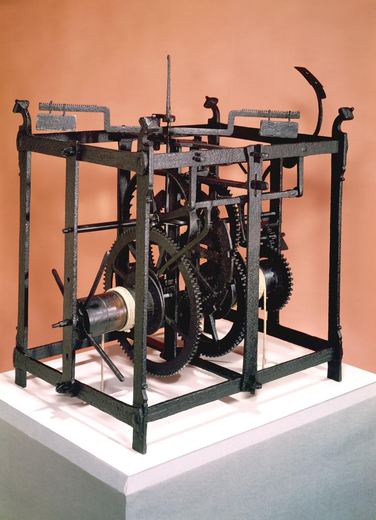
Clocks · 1632-1640
Turret clock, England, 1632-1640
Science Museum Group, London