
Clocks · Wall clock
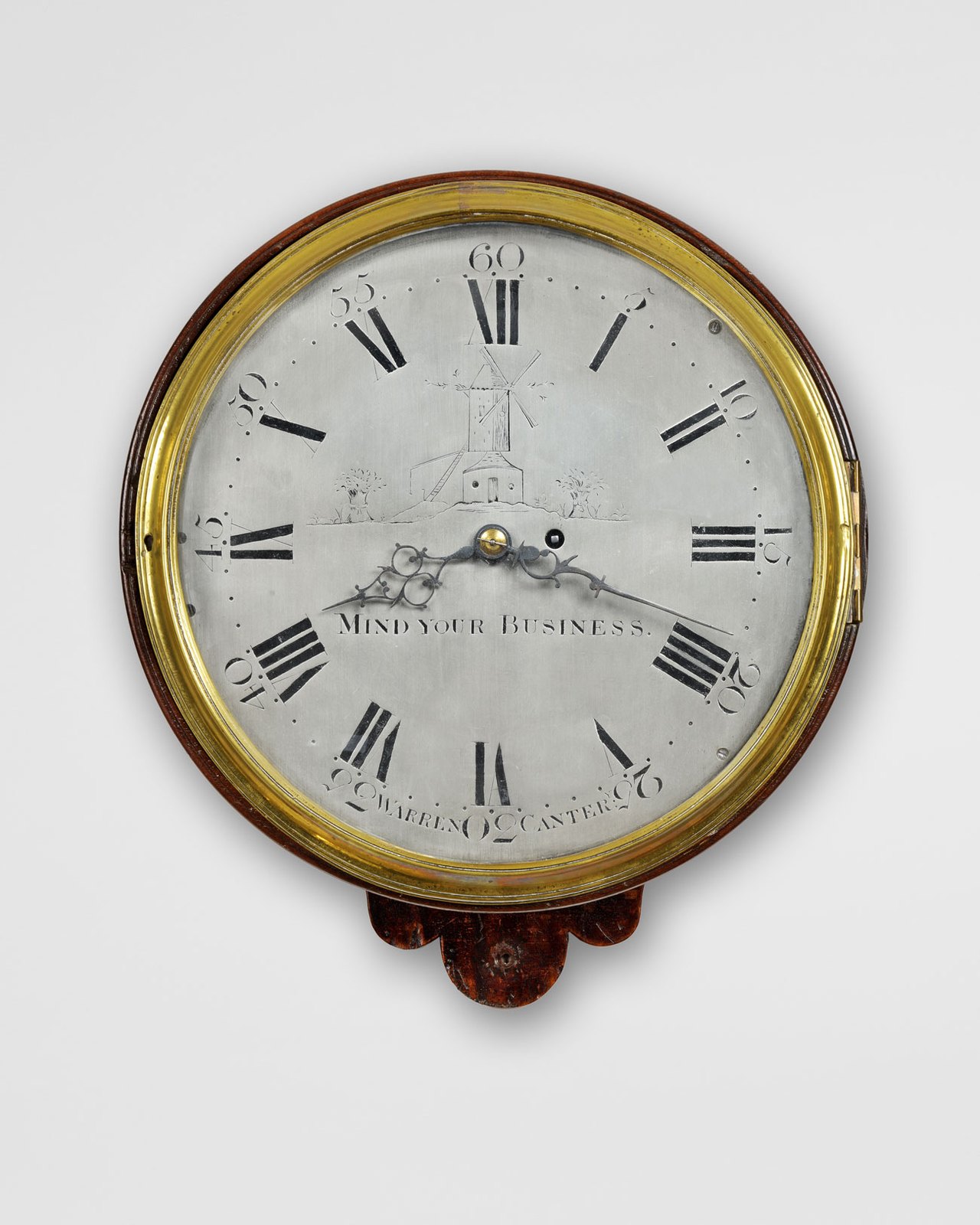
Wall clock by Warren, Canterbury, c. 1800
- Maker / attribution
- Warren (maker)
- Date
- c. 1800
- Historical period
- Precision & Scientific Horology (1750 – 1850)
- Country of origin
- United Kingdom
- Place
- Canterbury
- Object type
- Wall clock
- Materials / technique
- mahogany
- Dimensions
- Height 40 cm
- Stock no.
- Product 5290
- Credit line
- Dealer listing, Howard Walwyn (product 5290)
- Catalogue title (original)
- WARREN. A charming George III period mahogany dial wall timepiece by this well-known Kentish maker. (English)
View the source record (dealer listing) ↗ (opens another website in a new tab)Suggest a correction
Record summary
Catalogued by Howard Walwyn Fine Antique Clocks (dealer), London (stock number Product 5290), this is a wall clock by Warren, made in Canterbury, United Kingdom, dated c. 1800. The Atlas places it in the Precision & Scientific Horology period (1750 – 1850) of its Clocks collection. Materials and techniques recorded by the source: mahogany. Recorded dimensions: Height 40 cm. The record is illustrated with 2 photographs.
Assembled from the source record's structured fields. Dates and attributions are given as the source states them; where a field is missing the Atlas leaves it blank rather than estimating.
Catalogue description
Dealer description — Howard Walwyn
A charming George III period mahogany dial wall timepiece by this well-known Kentish maker. The circular mahogany case has a moulded outer surround enclosing a hinged brass bezel and glazed door. The lower part of the case is formed with a delicately shaped wooden earpiece, pierced with a fixing hole for securing the clock to the wall, while a further hook is fitted to the top of the case. Access to the movement is provided by two latched doors, one to the right-hand side and a second to the underside. The 12-inch engraved silvered brass dial dial has bold black Roman numerals for the hours and a double Arabic minute ring numbered 5 to 60 at five-minute intervals; the numerals at the lower part of the dial are engraved inverted, so as to read correctly when the clock is viewed from below or at a distance, a refinement typical of dials intended to hang high on a wall. At the centre is a finely engraved landscape vignette of a windmill flanked by trees, above the engraved motto MIND YOUR BUSINESS . The dial is signed at the base WARREN / CANTERBURY . The clock retains its original pierced and scrolled blued steel hands. The 8-day timepiece movement has an anchor escapement, wound from the front through the single aperture to the right of the centre. It is regulated by a pendulum with a lenticular brass bob. The engraving on this clock with its windmill and landscape vignette plus the ‘Mind Your Business ’ admonition is wonderfully eccentric and is something we have never seen before on a provincial dial clock. Date : circa 1800 Overall width : 14 in (35.5 cm) Height : 15 ¾ in (40 cm) Depth : 5 ⅞ in (15 cm) *Warren of Canterbury was from a Kentish clockmaking family working in the city through the late 18th and early 19th centuries, producing both longcase and bracket clocks alongside dial timepieces of this type. Signed examples include an eight-day mahogany longcase clock by James Warren of Canterbury and a mahogany verge bracket clock signed “J. A. Warren, Canterbury.” He is also listed numerous times in Michael Pearson’s Kent Clocks , with a biography on page 239. HW6493
Historical context
Precision & Scientific Horology (1750 – 1850)
Harrison solves longitude; Mudge invents the lever; Breguet's Paris workshop defines the modern watch.
The age of the deadbeat escapement, compensated pendulums and observatory regulators. Domestic clocks spread through the middle classes: English longcase and bracket clocks, French gilt-bronze mantel clocks, Viennese Biedermeier wall clocks, Black Forest painted-shield clocks, and the first American shelf clocks.
Read the period in the timelineMore clocks from this periodEarlier: Early Modern Horology
Atlas type guide
Regulators, wall and Vienna clocks
A regulator is a precision pendulum clock used as a time standard in observatories, workshops and railway offices. Typical features are a deadbeat or Graham escapement, a temperature-compensated pendulum (mercury jar, gridiron or later invar), maintaining power and a regulator dial that separates hours, minutes and seconds. George Graham's deadbeat escapement (c. 1715) and his mercury pendulum, together with Harrison's gridiron, set the pattern for two centuries.
Wall clocks span a much wider range: the elegant Viennese Laterndluhr and Dachluhr of the Biedermeier period, the Dutch stoelklok and staartklok, English 'dial' clocks used in schools, offices and railway stations, and mass-produced spring and weight wall clocks from Germany (Gustav Becker, Junghans, Kienzle) and America.
What to look for
- Deadbeat escapement and compensated pendulum (gridiron rods, mercury jar or wood rod).
- A regulator dial with a large central minute hand and separate hour and seconds dials.
- Vienna regulators: glazed cases, slender pendulum, small weights, enamel two-piece dials.
- German factory trademarks stamped on the backplate (e.g. Gustav Becker anchor and crown, Junghans star).
Dating clues
- Graham-type deadbeat regulators: from c. 1720.
- Viennese Laterndluhr: c. 1800–1850.
- German factory 'Vienna-style' regulators: c. 1870–1930; Gustav Becker serial numbers allow close dating.
General guidance written by the Atlas editors about this kind of object. It is not a statement about this particular piece; for that, rely on the source record above and on physical examination.
Related records
Clocks · 1798
Tall Case Clock
Yale University Art Gallery, New Haven
Clocks · c. 1800
Clock by Samuel Sly, Norwich, c. 1800
Howard Walwyn Fine Antique Clocks (dealer), London
Clocks · c. 1840–1845
Bracket clock by Whitehurst & Son, Derby, c. 1840–1845
Howard Walwyn Fine Antique Clocks (dealer), London
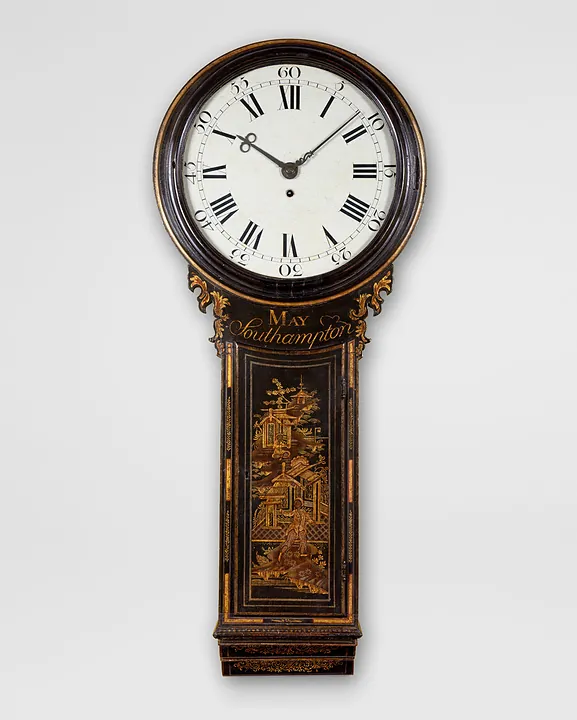
Clocks · 1775
Tavern clock by John May, Southampton, 1775
Howard Walwyn Fine Antique Clocks (dealer), London
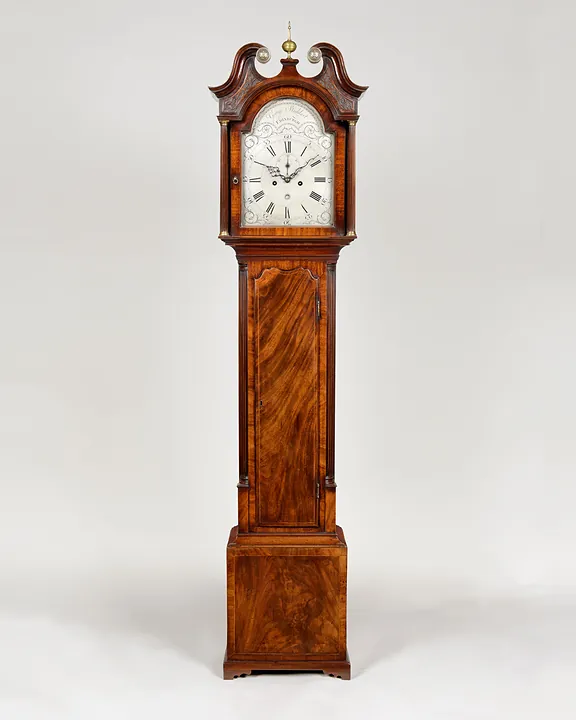
Clocks · c. 1795
Longcase clock by George Stoddart, c. 1795
Howard Walwyn Fine Antique Clocks (dealer), London
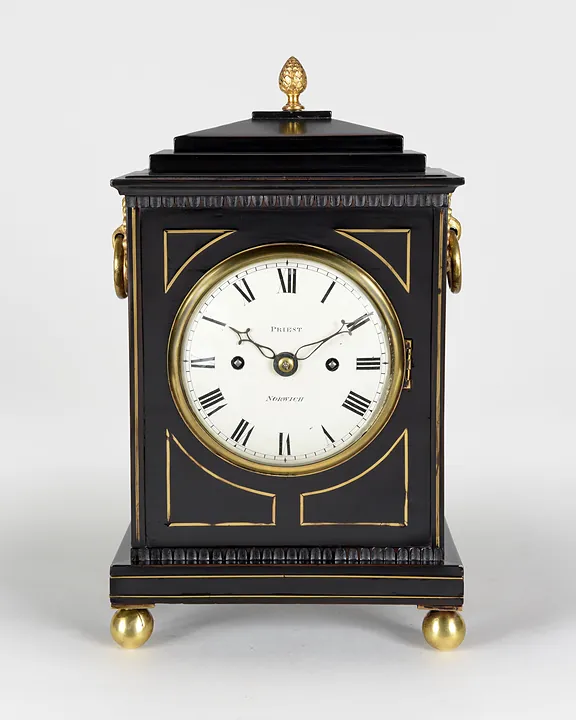
Clocks · c. 1830–1835
Bracket clock by Priest, Norwich, c. 1830–1835
Howard Walwyn Fine Antique Clocks (dealer), London
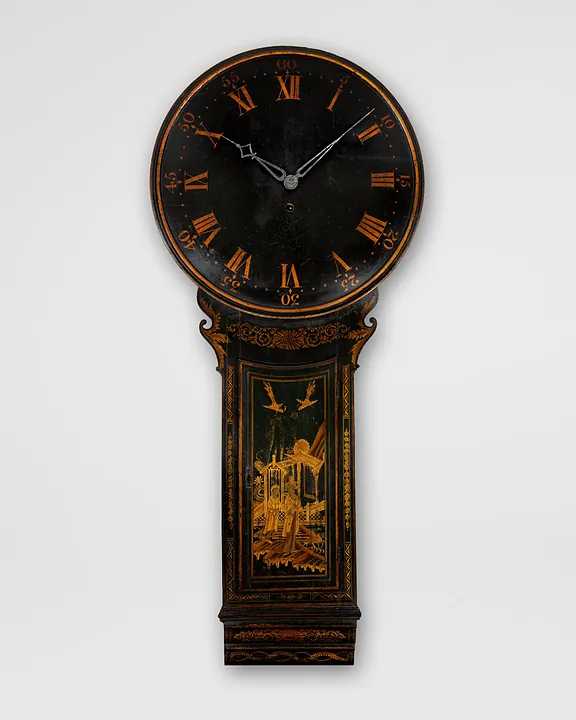
Clocks · c. 1785
Clock by Thomas Smoult, Newcastle, c. 1785
Howard Walwyn Fine Antique Clocks (dealer), London
Clocks · c. 1825–1830
Wall clock by J. Butler, Reading, c. 1825–1830
Howard Walwyn Fine Antique Clocks (dealer), London