
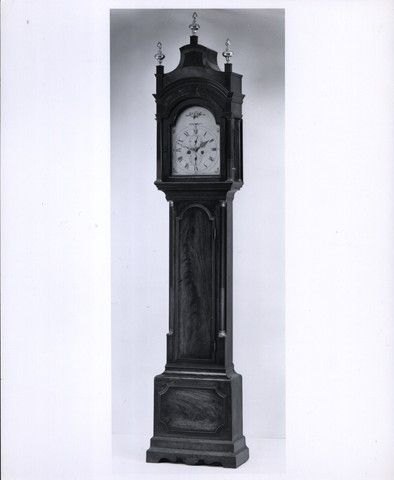
Clocks · Tall case clock
Tall Case Clock
- Maker / attribution
- Unrecorded in source
- Date
- 1798
- Historical period
- Precision & Scientific Horology (1750 – 1850)
- Country of origin
- United Kingdom
- Object type
- Tall case clock
- Materials / technique
- mahogany (sides of waist and hood); mahogany veneer (waist doors, base panel, front of hood); oak (back of waist door, back board of case, support blocks for movement); pine (backing for quarter columns, cove molding on case, back of hood, support for mahogany on front of hood, top of hood, dial mat)
- Dimensions
- H.: 105 × 21 5/8 × 10 1/2 in. (266.7 × 54.9 × 26.7 cm)
- Holding institution
- Yale University Art Gallery, New Haven
- Accession / object no.
- 1930.2338
- Credit line
- Mabel Brady Garvan Collection
- Catalogue title (original)
- Tall Case Clock (English)
View the source record ↗ (opens another website in a new tab)Suggest a correction
Record summary
Held and catalogued by Yale University Art Gallery, New Haven (object number 1930.2338), this is a tall case clock, made in United Kingdom, dated 1798. The Atlas places it in the Precision & Scientific Horology period (1750 – 1850) of its Clocks collection. Materials and techniques recorded by the source: mahogany (sides of waist and hood); mahogany veneer (waist doors, base panel, front of hood); oak (back of waist door, back board of case, support blocks for movement); pine (backing for quarter columns, cove molding on case, back of hood, support for mahogany on front of hood, top of hood, dial mat). Recorded dimensions: H.: 105 × 21 5/8 × 10 1/2 in. (266.7 × 54.9 × 26.7 cm). The record is illustrated with 2 photographs.
Assembled from the source record's structured fields. Dates and attributions are given as the source states them; where a field is missing the Atlas leaves it blank rather than estimating.
Catalogue description
The source record does not include a narrative description. The structured fields above are reproduced from it.
Inscriptions & marks
Pritnted paper label glued inside waist door reads: "DIRECTIONS, / ABSOLUTELY necessary to be known by every person owning a Clock: / In the first place, every Large or Parlour Clock, ought to be touched with a little/ pure sweet-oil every November (if it is not cleaned that month) on the hammer side of / the Clock, with a middle-sized knittingneedle--to wit: / Put a drop to each end of the arbour of the big wheel, where it enters the piller-plates, / in the same manner serve each end of the pin-wheel, or the next above it, in the same / manner serve the hammer arbour, and the point of the sprig that drives the hammer / to the Bell. Also to each end of the pinnion of the detent, or third wheel. / Also to the fly, or fourth wheel pinnion, / Also to each end of the fly pinnion. / If the Clock is cleaned in November or December, then administer the oil in the month / of February or March following, as the Clock appears to want it. Never set the Clock back / or forward by any other hand, but the minute hand, it is dangerous to touch one of the / other hands except the day of the month and this must always be moved forwards. Al / ways set the Moon to the date on the day after the Moon has changed [moon instructions crossed out] / To make a Clock go slower. Sink the brass bob that swings in the Clockcase, a li / tle at a time by unscrewing the nut at the bottom of the bob; and the contrary to make / the Clock go faster. / Mind never to turn the Minute-hand back other than the 12 o'
Provenance
Charles Woolsey Lyon (1872–1945), New York; sold to Francis P. Garvan (1875–2937), New York by 1930; given to theYale University Art Gallery, New Haven, Conn., 1930
Historical context
Precision & Scientific Horology (1750 – 1850)
Harrison solves longitude; Mudge invents the lever; Breguet's Paris workshop defines the modern watch.
The age of the deadbeat escapement, compensated pendulums and observatory regulators. Domestic clocks spread through the middle classes: English longcase and bracket clocks, French gilt-bronze mantel clocks, Viennese Biedermeier wall clocks, Black Forest painted-shield clocks, and the first American shelf clocks.
Read the period in the timelineMore clocks from this periodEarlier: Early Modern Horology
Atlas type guide
Longcase (tall-case or grandfather) clocks
The longcase clock was born from two seventeenth-century innovations: Christiaan Huygens's pendulum (1656–57) and the anchor escapement (c. 1670). A long seconds pendulum, nearly a metre long, swings with a small arc, and enclosing it together with the driving weights in a tall wooden case protected the mechanism and created a new piece of furniture. London makers such as Ahasuerus Fromanteel, Thomas Tompion and Joseph Knibb set the pattern.
By the eighteenth century longcase clocks were made throughout Britain, the Netherlands, Scandinavia (the Swedish Mora clock), France (the Comtoise from the Franche-Comté), Germany and colonial America. Eight-day movements with two weights became standard in better clocks; thirty-hour clocks with one weight and a rope or chain were cheaper alternatives.
What to look for
- Winding holes in the dial: two (eight-day, going and striking) or none (thirty-hour, pulled up by a chain).
- Brass dials with applied chapter rings (earlier) versus painted iron 'white' dials (after c. 1770 in Britain).
- Moon-phase arches, date apertures, seconds dials and maker's name on the dial.
- Case woods and style: ebonised, walnut marquetry, lacquer, oak or mahogany; regional styles from London, Lancashire, Scotland or America.
- Whether the movement and dial match the case — 'marriages' are common.
Dating clues
- Square brass dials suggest c. 1670–1720; arched brass dials c. 1715–1790.
- Painted (white) dials were made by Birmingham dial-makers from about 1772.
- Comtoise clocks with repoussé pendulums are mostly nineteenth century.
General guidance written by the Atlas editors about this kind of object. It is not a statement about this particular piece; for that, rely on the source record above and on physical examination.
Read next:Anchor (recoil) escapementDeadbeat escapementAnchor escapement
Related records
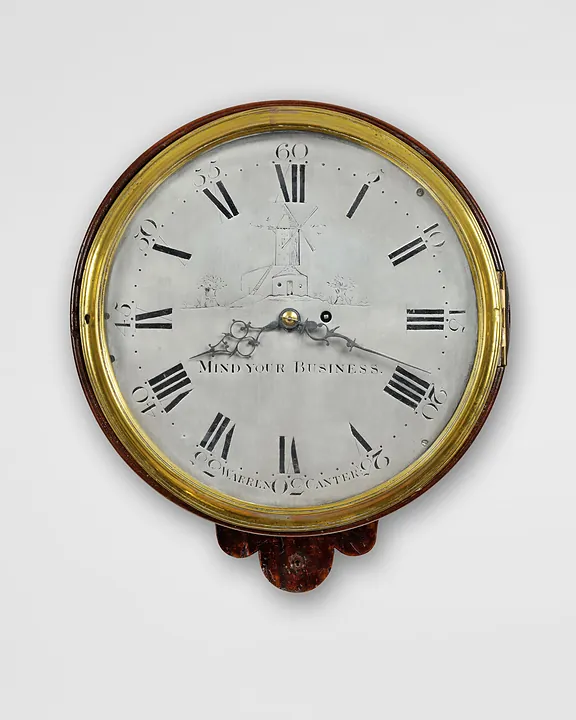
Clocks · c. 1800
Wall clock by Warren, Canterbury, c. 1800
Howard Walwyn Fine Antique Clocks (dealer), London
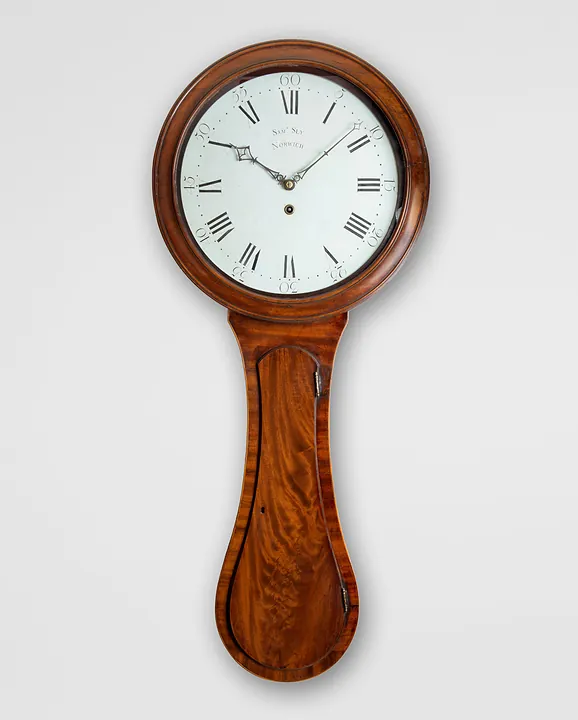
Clocks · c. 1800
Clock by Samuel Sly, Norwich, c. 1800
Howard Walwyn Fine Antique Clocks (dealer), London
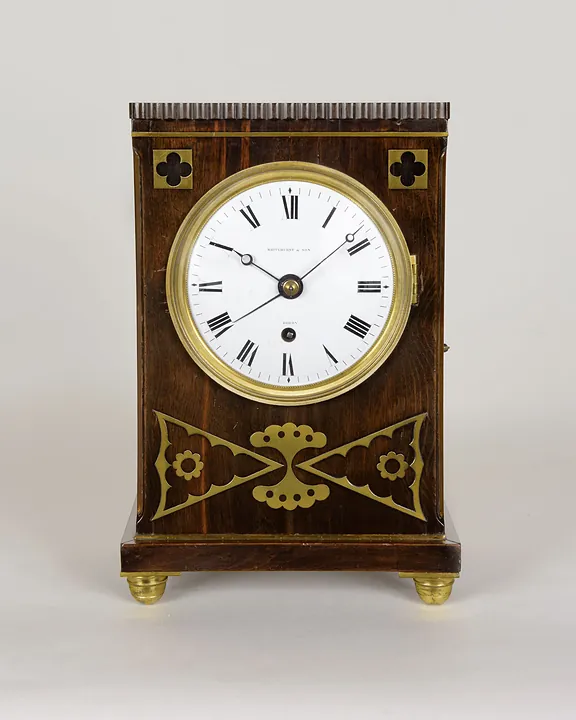
Clocks · c. 1840–1845
Bracket clock by Whitehurst & Son, Derby, c. 1840–1845
Howard Walwyn Fine Antique Clocks (dealer), London
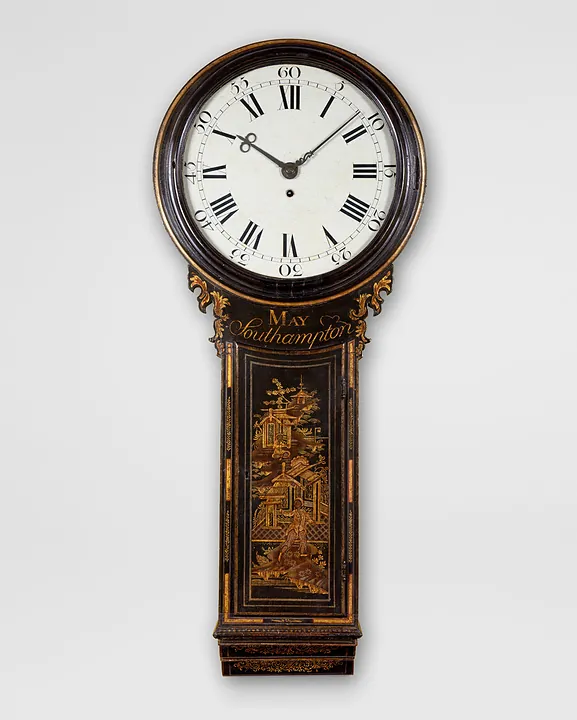
Clocks · 1775
Tavern clock by John May, Southampton, 1775
Howard Walwyn Fine Antique Clocks (dealer), London
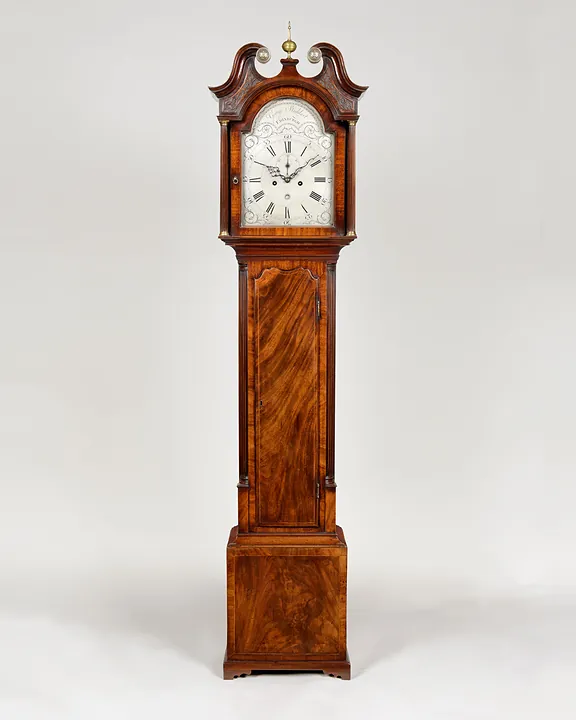
Clocks · c. 1795
Longcase clock by George Stoddart, c. 1795
Howard Walwyn Fine Antique Clocks (dealer), London
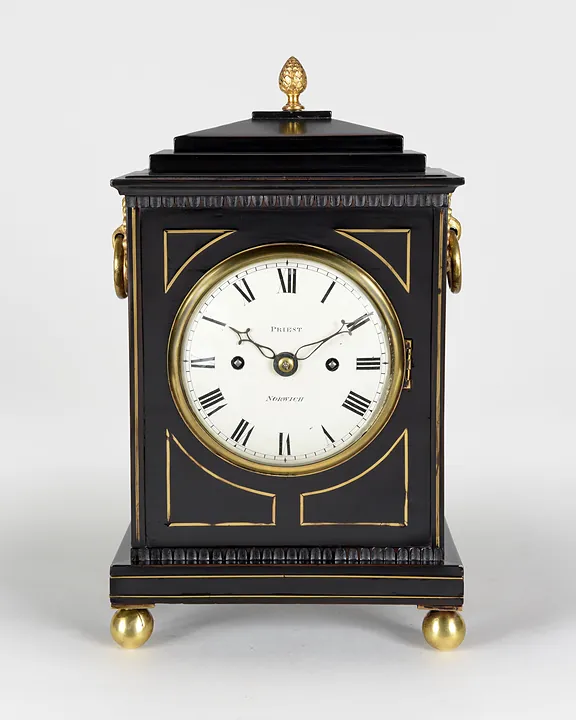
Clocks · c. 1830–1835
Bracket clock by Priest, Norwich, c. 1830–1835
Howard Walwyn Fine Antique Clocks (dealer), London
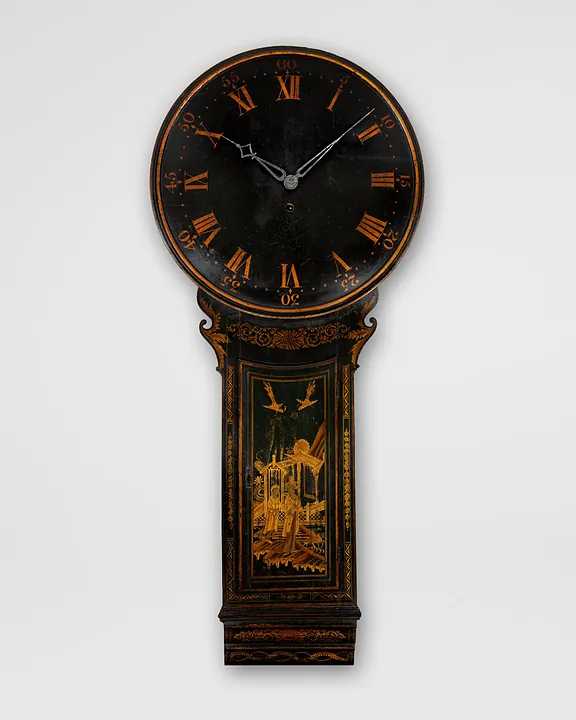
Clocks · c. 1785
Clock by Thomas Smoult, Newcastle, c. 1785
Howard Walwyn Fine Antique Clocks (dealer), London
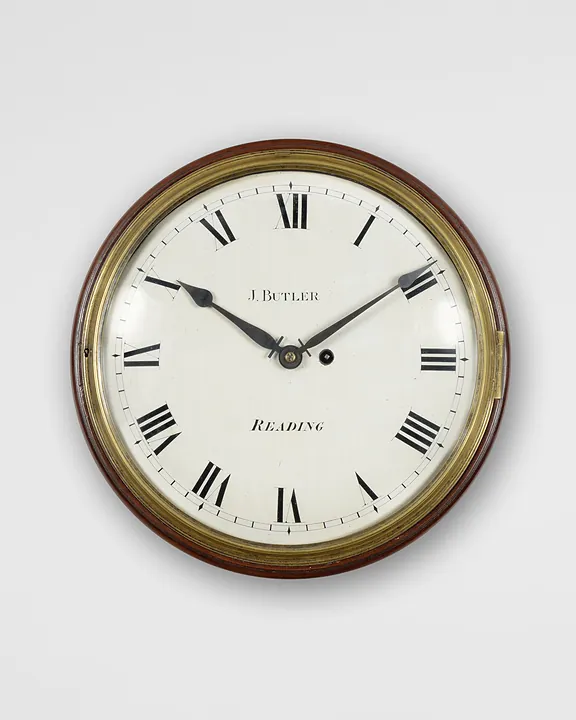
Clocks · c. 1825–1830
Wall clock by J. Butler, Reading, c. 1825–1830
Howard Walwyn Fine Antique Clocks (dealer), London